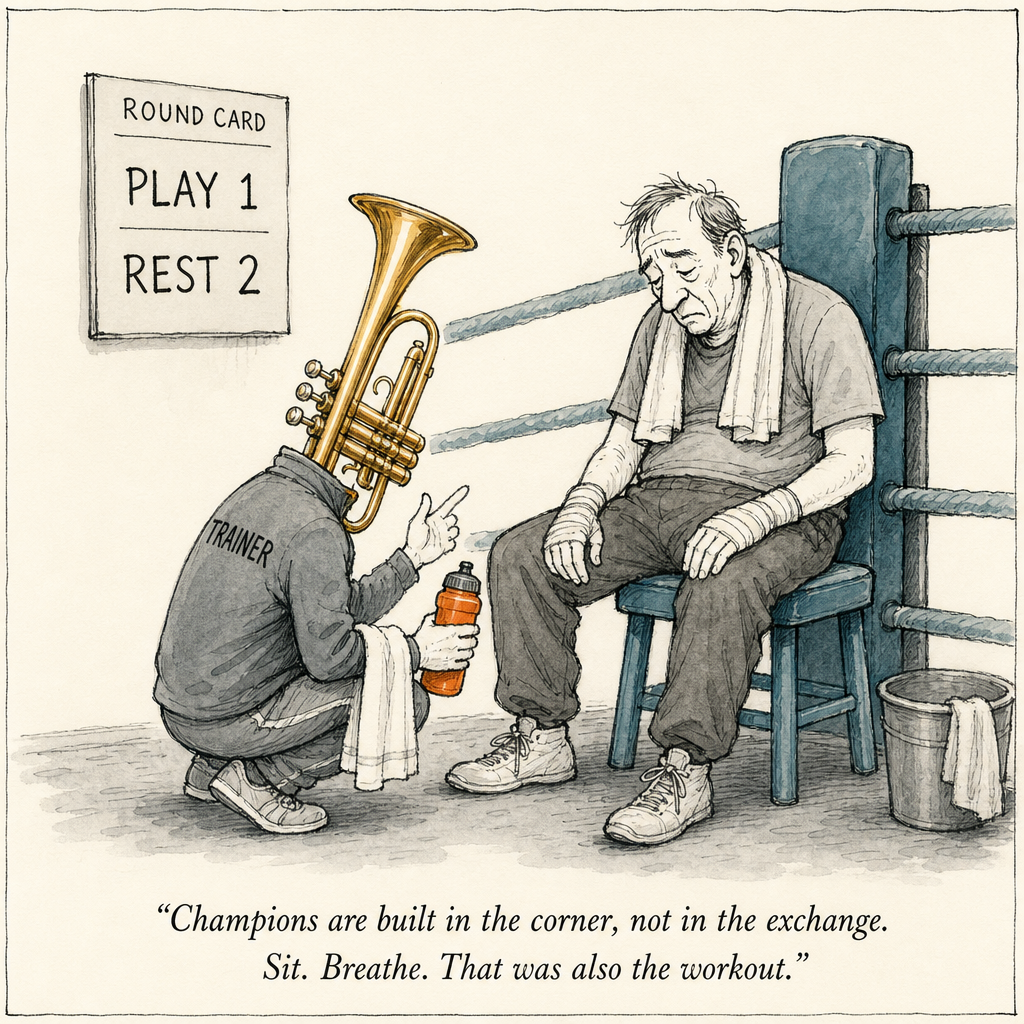
Here’s a truth about range that almost nobody says out loud: high notes are expensive, and stamina is the currency.
Every serious attempt at the top of your range costs energy. Every quality rep in your development zone costs energy. If you want to build trumpet stamina, it’s not so you can survive longer gigs, or not only for that. It’s because stamina is the fuel that makes range work possible at all. A player with weak stamina isn’t just tired. They’re locked out of the very practice that would grow their range.
And here’s the trap: the obvious way to build stamina, playing until your face falls off, is precisely the thing that destroys it. Grind to failure every day and you don’t build a bigger tank. You build worse habits with a smaller tank.
This article is about doing it the athletic way. It’s the stamina chapter of the complete guide to building trumpet range, and if your range work keeps stalling out, this is probably why.
Why range runs on stamina
Think about what a range breakthrough actually requires. You’re trying to reach a new level of energy and power. By definition, that takes everything you’ve got. And you cannot give everything you’ve got when there’s nothing in the tank.
It’s exactly like sprint training. If you want to get faster, are you going to sprint on exhausted legs? What sense would that make? Your sprint time would be garbage, you couldn’t hold form for more than a few seconds, and you’d be training yourself to run ugly. Sprinters do their speed work fresh, with full recovery between efforts. Trumpet is the same. Work near the max of your range only when you’re absolutely fresh, three to five attempts, two to three minutes of real rest in between.
Now run the math backward. If quality range work requires freshness, then your stamina determines how much quality range work you can even access in a week. A bigger tank doesn’t just mean longer gigs. It means more fresh minutes, which means more real range reps, which means faster progress. Stamina isn’t a separate goal from range. It’s range’s supply line.
I’ve missed high notes on stage not because I couldn’t play them, but because by the time they arrived I had nothing left to pay for them. If that story sounds familiar, the sibling article why your range disappears when you’re tired breaks down that exact failure.
The stamina bar: never let it hit red
Here’s the mental model I give every student. Think of your chops like a stamina bar in a video game.
In the game, what happens when the bar hits red? You lose. You get staggered, an enemy comes in, and you’re done. Trumpet works the same way. Drain the bar to red and your chops are cooked, your form collapses, and now you need way too long to recover. One reckless twenty minutes can cost you two good days.
So the first rule of building stamina: don’t redline. The moment you feel yourself getting close to the edge, take the horn off your face, back off the volume, or drop down the register. Better yet, spend most of your playing where the meter barely moves at all, cruising at 60 to 70 percent effort, playing efficiently, keeping headroom in reserve. That way, when the music actually demands a spike, you have the ability to deliver it.
And here’s the payoff that makes this a growth strategy and not just damage control: play at 60 to 70 percent consistently and the meter itself gets bigger over time. What used to feel like 80 percent effort becomes your new 70. The bar grows precisely because you never emptied it.
One more deposit into that bar, and it’s free: take the horn off your face. After every phrase, after every breath, release the pressure, even for a second. Blood flow comes back into the lips, and blood flow is recovery happening in real time. It’s not a secret. It’s just shockingly easy to forget, and players who glue the horn on and never take it off are quietly draining the bar between every note.
The Goldilocks Zone: where stamina is actually built
So if grinding to failure doesn’t build the tank, what does?
The Goldilocks Zone. It’s the magical middle where you’re playing enough to force progress but not so much that you can’t recover. Too little playing and there’s no stimulus, nothing for the body to adapt to. Too much and you’re tearing down faster than you rebuild. Ride the middle, day after day, week after week, and that’s where the gold shows up. You get better when you’re well balanced, and you get better permanently.
Here’s the classic trap that pulls players out of the zone, and I see it constantly with adult players: “I don’t even play that much.” Really? You skipped practice for three days and then sat through a three-hour rehearsal. That’s not “not much.” That’s a chop catastrophe. The same minutes spread across the week, an hour a day, would have been fine. You’d have walked into that rehearsal with a full bar and walked out tired instead of destroyed. Bunching it up is what breaks chops, not total minutes.
This is why consistency beats heroics for stamina, every time. The tank is built by regular, moderate deposits, not occasional massive ones. If you want to know whether you’re actually in the zone, track your playing time for two weeks. Most players who “don’t play that much” discover they play in exactly the feast-or-famine pattern that guarantees weak chops.
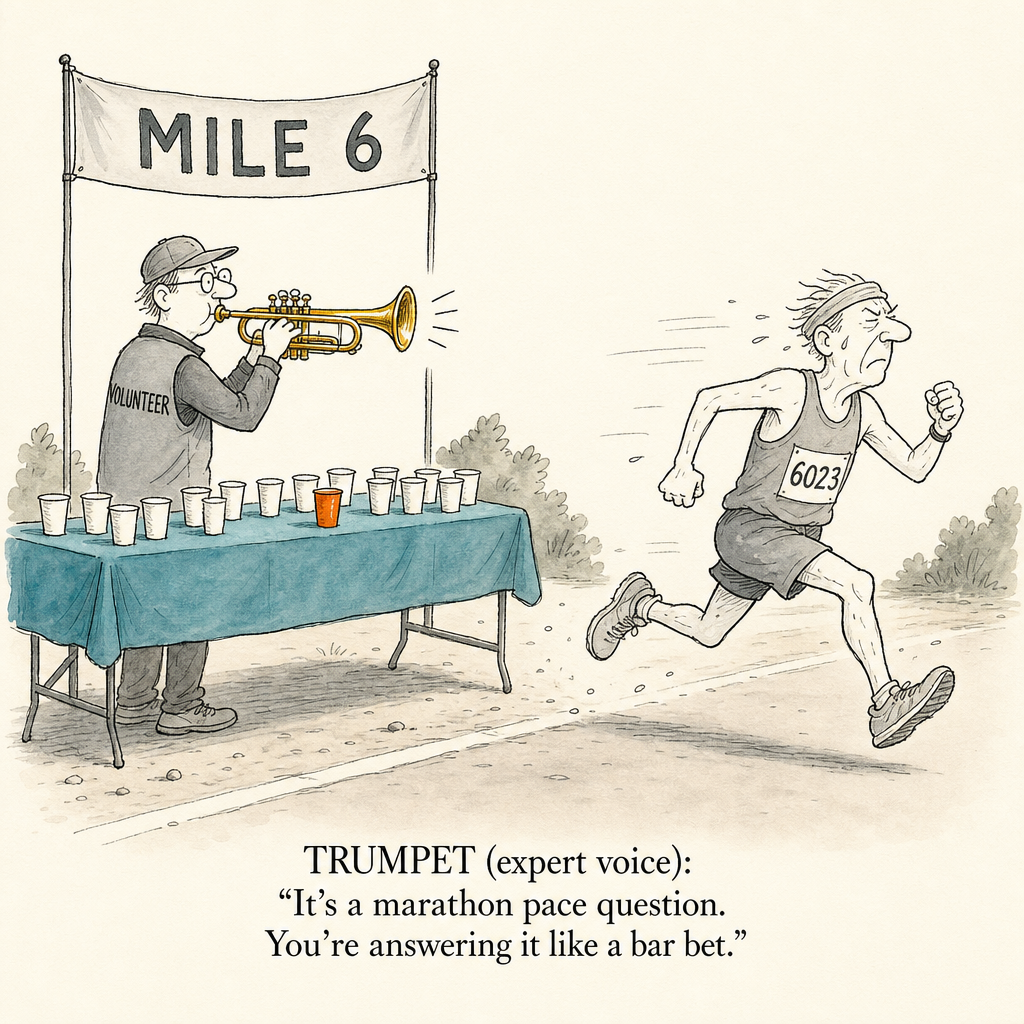
How to build trumpet stamina: the “little bit more” method
Inside the Goldilocks Zone, here’s my favorite way to actually expand the tank. I call it the “a little bit more” philosophy, and the whole trick is in how unimpressive it sounds.
You’re not trying to gain 5, 10, or 20 percent. No. One percent.
Take a piece of music you find kind of difficult. Play through it. The second you start getting tired, stop. Not “push through a bit,” not “finish the page.” Stop. Rest for a few minutes until you’re genuinely recovered. Then try again, and get just a little bit farther than last time. A phrase. A bar. Then rest and do it again.
That’s the entire method, and it works for one reason: you’re accumulating quality reps at the edge of fatigue without ever crossing into failure. Compare that to the player who destroys their chops going to absolute failure every session. Tomorrow, you’re not wrecked, so you can make another deposit. They’re toast, so they make a withdrawal. Run that ledger for three months and the results aren’t close.
Should you ever push hard? Sure. Challenging yourself is a tool. But it’s a tool, not a daily setting. This is exactly the Light, Medium, Heavy structure I use for periodizing practice: most days moderate, some days easy, and heavy days deployed deliberately, when you’re rested enough to actually benefit from them. Random maximum effort produces random results. Athletes figured this out decades ago. Trumpet players are still catching up.
Form before force
One warning before you go add minutes to anything: stamina training only works if your form deserves the reps.
Think about a gym. No decent coach watches you walk in on day one and prescribes a thousand squats to “build endurance.” They fix your squat first, because a thousand reps of a broken squat doesn’t build strength, it builds injury. The form comes before the physical loading. Always.
On trumpet, broken form looks like excess mouthpiece pressure, or more pressure on one lip than the other, or lips that aren’t contracting properly, or a sound that’s pinched and airy. If any of those are present, hear this clearly: more time on the horn is not yielding you the results you want. Reps on broken mechanics aren’t deposits. They’re withdrawals with interest, because you’re building endurance for your compensations. You end up with the stamina to play wrong for longer.
Fix your form, and you’ll fix a shocking amount of your endurance for free, because efficient playing simply costs less per note. Then the stamina work multiplies something worth multiplying. If you suspect this is you, start with why you can’t play high notes on trumpet, because the same broken mechanics that cap your range are the ones draining your tank.
Stamina and the range pyramid
Here’s how this all connects back to range, concretely.
I teach range through a pyramid: 60 to 70 percent of range practice in your foundation notes, 20 to 25 percent in development, 10 to 15 percent in challenge territory, 2 to 5 percent at your limit, zero beyond it. Look at that distribution through the stamina lens and you’ll see it’s not just a range plan. It’s a fuel budget.
Foundation work is played at low cost. It builds the tank while it builds your sound. Development work spends modestly. Challenge and limit work are expensive, which is exactly why they get the smallest slices and demand freshness. The pyramid works because it keeps you in the Goldilocks Zone automatically: enough load to grow, never enough to crater.
Players who invert the pyramid, spending their practice mashing at the ceiling, are violating the stamina budget and the range plan simultaneously. Their bar hits red daily, their form degrades, and their “range practice” becomes rehearsed failure. Meanwhile the player cruising at 60 to 70 percent, tapping the limit a few fresh times per week, quietly walks past them.
One last distinction that will save you: learn the difference between tired chops and done chops. Tired is normal, recoverable, part of training. Done means the quality is gone and every further rep is damage. I’ve written about telling those two apart, and it’s worth ten minutes of your time. And if you want the full endurance system, recovery protocols, efficiency work, the physiology underneath all of it, the deep dive is the complete trumpet endurance guide. This article is the range-facing version: build the tank so the tank can build your range.
Fill the tank, then come get the notes
Stamina work isn’t glamorous, and that’s exactly why the players who do it right pull away from the ones who don’t. Inside the 1% Trumpet Program, stamina, form, and range are trained as one system, because that’s what they are. I laid out the core of that system in a free 30-minute training.
Watch the free 30-minute training here. Build the bar. Guard the bar. Then go spend it on the notes you actually want.
— Jesse