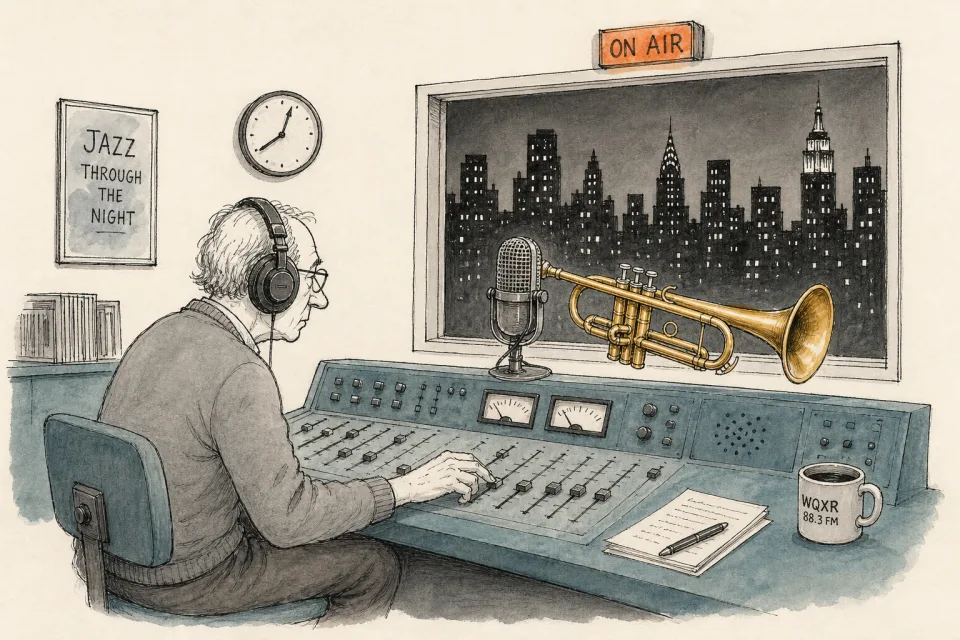
Late-night radio hosts learned something decades ago that trumpet players in apartments need: lowering your volume doesn’t mean lowering your standards. A great broadcaster at 2 a.m. speaks softly into the microphone and is more precise, more present, and more controlled than the guy shouting on the afternoon shift. The quiet is a constraint, and the constraint became the craft.
If you share walls, floors, a sleeping baby, or a spouse’s patience, this article is your night shift. And I want to reframe it from the start, because most “quiet practice” advice is written as apology, a list of sad compromises for players in unfortunate circumstances. Wrong frame. Practicing quietly, done correctly, is not a degraded version of practice. Some of it is training you should be doing anyway, and the players who master the soft end of the horn come out of the apartment years with skills the fortissimo-every-day crowd never built.
The Soft-Dynamic Goldmine
Here’s the secret hiding inside the constraint: soft playing is the most honest diagnostic dynamic on the trumpet.
At forte, momentum forgives you. Air volume covers small inefficiencies, attacks blur into the wall of sound, and a slightly mistimed tongue or leaky embouchure corner gets bulldozed by sheer flow. At piano and pianissimo, nothing forgives you. A note only speaks softly if the aperture, air, and tongue are genuinely coordinated; response, the first thing I check in any player’s warm-up, is exposed with nowhere to hide. Soft long tones, soft attacks, soft slurs: this is precision work, the kind that makes everything above it easier, and it’s naturally apartment-volume. A quiet room isn’t stopping you from doing this training. It’s assigning it.
So the core of a quiet session looks like this: soft long tones with real attention to instant response; delicate first attacks, the kind where the note blooms from nothing; lyrical playing at conversation volume, phrased like you mean it; finger technique and slurs at mezzo-piano. Run that with the 2:1 ratio enforcing quality and you have a completely legitimate training session, not a placeholder for one.
What Soft Practice Can and Can’t Carry
Honesty requires the other half. A practice diet of only soft playing will eventually show gaps, because some adaptations need load. Endurance needs accumulated work at real dynamics. Projection and the full-breath experience of forte playing need actual forte. Upper-register development needs air moving at quantities a bedroom at midnight won’t host.
The solution isn’t abandoning quiet practice; it’s zoning your week. Daily quiet sessions carry the precision work, which is most of what improvement is made of anyway. Then find two or three louder windows per week somewhere: the car in a parking lot remains the classic, a school or church or community band room borrowed off-hours, a rehearsal space rented cheap, even a generous friend’s garage. Those windows carry the load work: dynamics, endurance sets, range building. This split maps neatly onto Light, Medium, Heavy planning, with quiet days naturally serving as light and medium days and the louder windows hosting the heavies. Constraint becomes schedule, and the session structure stays fully intact either way.
Mutes: The Fine Print Nobody Reads
Practice mutes are the obvious tool and the most misused one, so here’s the fine print.
A good modern practice mute (sshhmute and Best Brass are the usual suspects; Yamaha’s Silent Brass adds headphone monitoring that lets you actually hear yourself, which matters more than it sounds) drops you to closed-door-conversation volume. Genuinely useful. But every practice mute changes the horn: added resistance, altered intonation, and a back-pressure that tempts you into working harder than the music requires. Players who live on a practice mute for months often develop a pressing, over-blown approach that they then carry back to the open horn.
So use mutes with rules. Prefer the open horn played softly whenever circumstances allow it at all, because soft open playing is real trumpet and muted playing is trumpet-adjacent. Reserve the mute for the hours when even soft is too much, keep muted sessions shorter, and if a mute is a daily necessity, spend part of every louder-window session deliberately recalibrating on the open horn: easy long tones, listening for the free, unforced blow the mute quietly talked you out of. The mute is a tool for the situation, never the new normal.
Logistics of the Night Shift
A few practical moves multiply everything above. Negotiate windows instead of apologizing daily: most neighbor friction isn’t about volume, it’s about unpredictability, and “I play 5:30 to 6:00 on weekdays” converts you from a nuisance into a schedule. Play into soft surfaces, a closet of hanging clothes swallows a surprising amount of sound, and a rug under you kills floor transmission downstairs. Split sessions help too: two fifteen-minute quiet sessions annoy nobody and, as covered in how long to practice daily, split doses work fine. And log everything in your practice log exactly as if it were “real” practice, because it is, and the log is where you’ll verify that.
What you never do is let the constraint shrink the standard. Quiet practice with drifting attention, no target, and no tally is exactly as useless as loud practice with the same flaws. Volume was never the variable that made practice work.
The Constraint Isn’t the Obstacle
Which brings me to the objection underneath this whole topic, the one I hear from apartment players in every cohort: “my situation makes real practice impossible, so I’m stuck until life changes.” I’ve now coached enough players through this, over a hundred trumpet players across every housing situation you can imagine, to say it plainly: the constraint is real, but it has never once been the actual reason a player stagnated. The stagnating apartment player and the stagnating house-with-a-basement player stall on the identical things: scattered focus, unfixed mistakes, no system. The apartment just provides a better story.
Meanwhile the constraint, embraced, keeps quietly producing specialists. The player who spent two years mostly at piano dynamics shows up with attacks and response control that shock the room. The night shift teaches precision that the day shift never demanded.
Building a full improvement system inside real-life constraints, quiet hours, thirty-minute windows, adult schedules, is exactly what my free 30-minute training covers: finding your actual bottleneck and structuring practice that moves it, whatever your living situation allows. It’s the same system the adults in the 1% Trumpet Program run, several of them from apartments smaller than yours. Watch the free 30-minute training here.
Lower the volume. Keep the standard. That’s the whole night shift.
— Jesse