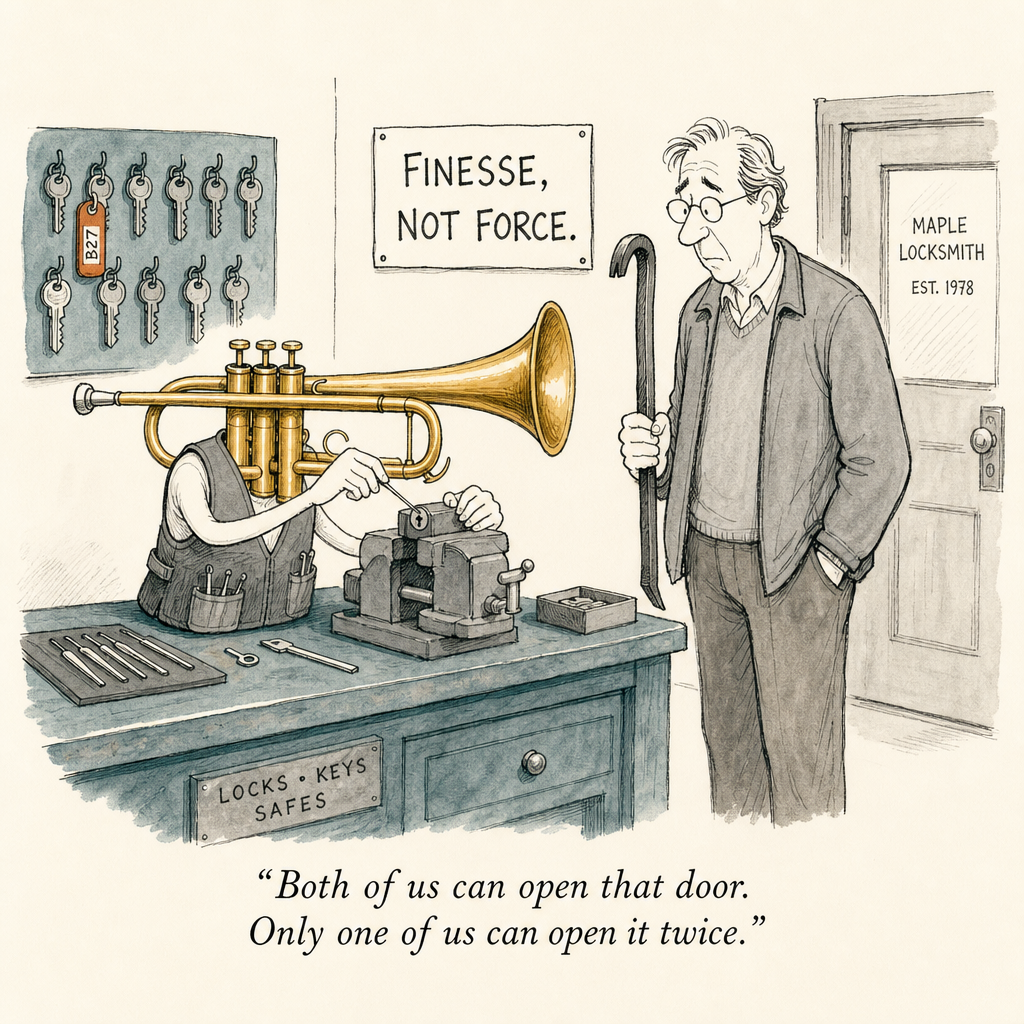
Let’s go. Solo’s coming up. You’re about to scream that high note, it’s going to be so sick, here it comes, and…
Nothing came out. You look dumb. Has this ever happened to you? It’s happened to me.
That silence at the top of your range has a specific cause, and it’s probably not the one you think. It isn’t weak chops. It isn’t small lungs. Nine times out of ten, it’s your own right hand jamming the mouthpiece into your face hard enough to stop your lips from working. Which is why building trumpet range without pressure isn’t a nice-to-have or a purist’s flex. It’s the difference between a range that grows for decades and one that dies on stage mid-scream.
This article is the escape plan. It sits inside my complete guide to building trumpet range, and it deals with the single most common way players sabotage everything else in that guide.
The One Rule of Sound: The Lips Must Vibrate
Everything on this instrument obeys one rule. To produce a sound, and to keep producing it, your lips have to be vibrating. The second the vibration stops, the sound stops. Period. No exceptions, no workarounds.
The vibrating surface is the middle of your chops, the small patch of lip tissue inside the mouthpiece that’s actually oscillating. When you add too much mouthpiece pressure, you push that tissue against the inside of the cup, and pinned tissue cannot vibrate. It’s game over, instantly. Not “the note gets harder.” The note ceases to exist.
So every missed high note comes down to one of exactly two failure modes. Either you didn’t create enough air speed and compression for the note to speak, or you created plenty and then stopped the vibrating surface from doing its job. Two causes. That’s the whole list. And before you attempt the note again, you owe yourself the diagnosis, because the fixes point in opposite directions. The first failure needs more energy in the air. The second needs less force on the face. Players who never make that distinction spend years alternating between the two mistakes and calling it inconsistency.
Why Pressure Works Down Low and Betrays You Up High
Here’s the sneaky part, the reason a pressure habit can hide in your playing for years.
Down low, pressure is nearly free. Low notes vibrate slowly, the oscillation is big and lazy, and there’s margin for error. You can mash a little extra mouthpiece into your chops and the lips will still flap away underneath it. Sound keeps coming out. Your body quietly logs the lesson: pressing is fine.
Then you climb. As the pitch rises, the vibration gets faster and the margin shrinks. Up in the stratosphere the lips are vibrating so fast that even a little extra pressure in the wrong spot kills the vibration completely. The same habit that cost you nothing on second-line G costs you everything above the staff. That’s why you can airball a high note with a full tank of air and perfect intentions: the air arrived, but the vibrating surface was already pinned shut.
If your range has a hard ceiling that no amount of effort moves, this is the first suspect. The ceiling isn’t where your potential ends. It’s where your pressure habit gets called in for collection. It’s also worth reading the deeper dive on why you can’t play high notes, because pressure rarely travels alone.
How to Tell If Pressure Is Your Problem
You don’t need a lab to diagnose this. The habit leaves fingerprints.
The airball is the loudest one. You reach for a high note with plenty of air and total commitment, and nothing comes out at all. Not a cracked note, not a thin note. Silence. Air doesn’t do that. Air failures produce weak, sagging, out-of-tune notes. Silence means the vibrating surface stopped, and the thing that stops it is pressure.
Notes that die when you crescendo up high are the second fingerprint. Playing louder in the upper register is exactly when players unconsciously lean the horn in harder, so if your high notes speak at mezzo forte and vanish at forte, you’re not running out of air. You’re pressing the note to death on the way up.
And then there’s the fatigue signature. Pressure players burn out fast and hurt afterward, because crushed lip tissue takes the beating that braced abs were supposed to take. If twenty minutes of upper register work leaves your chops feeling bruised rather than worked, that’s not effort. That’s damage, and it has a cause.
Any one of these is a strong hint. All three together is a diagnosis.
Why You Press in the First Place
Nobody chooses pressure. You reach for it because, in the moment, it works.
Pressing the horn harder against your face does real things: it firms up the seal, it stabilizes a shaky setup, it even adds a crude kind of compression. Under stress, at the top of a phrase, in front of an audience, your body grabs the tool with the fastest payoff. And pressure always pays fastest. It just pays with borrowed money. I’ve written a whole piece on this loan-shark arrangement called the mouthpiece pressure trap, and the trap in one sentence: every rep you press through today makes the note require more pressure tomorrow, until the vibration has no room left at all.
I once made a video where a quack trumpet doctor prescribes the standard self-treatment plan: use as much pressure as possible, play as loud as you can, take the biggest breath you can hold, close your throat. The joke is that the patient nearly dies hitting a high C. The reason the joke lands is that this is the actual regimen most struggling players are on. Every item on that prescription is the exact opposite of what works, and every item feels productive while it’s ruining you.
In my compression framework, mouthpiece pressure belongs with throat tension and lip pinching in the “bad sources” column. All three generate short-term results. All three collect their fee directly from the vibration your sound depends on.
Trumpet Range Without Pressure: What Replaces It
You can’t just remove pressure and leave a hole. Pressure was doing jobs. You have to rehire for those jobs with tools that scale.
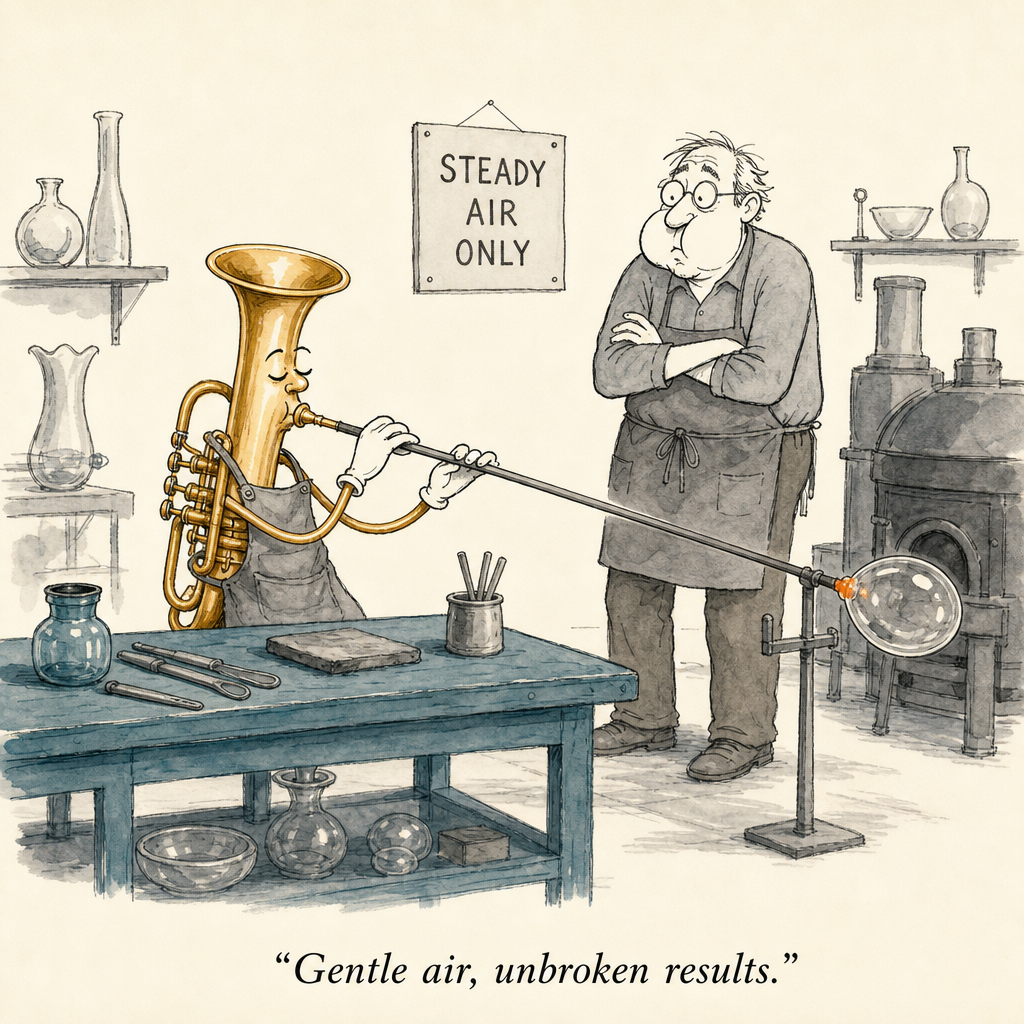
The headline replacements are abdominal strength and firm corners. The abs take over compression: brace them and support the air column from the bottom, so the air arrives at your lips already energized and the note gets pushed up by air instead of squeezed out by force. The corners take over stability: firm corners hold the embouchure’s architecture in place so the setup doesn’t need the mouthpiece pressed in as scaffolding. Air pushes the note up. Your right hand does not.
Behind those two sit the other good compression sources, the tongue arch that accelerates the air and the aperture control that focuses it. I’ve broken down the full speed-versus-force distinction in air speed vs. air volume, and it’s worth reading next, because a player who understands that distinction stops needing pressure. There’s nothing left for pressure to do.
Run every note through the North Star as you rebuild: feels good, sounds good, responds easily. Pressure-built notes flunk the first and third every time. They hurt, and they speak late or not at all. When a note passes all three, the replacement is complete for that note.
How to Wean Off Pressure Without Losing Everything Overnight
Fair warning: when you remove a compensation, you reveal the real issue it was covering. Take away the press and some notes at the top of your range will wobble or vanish at first. That’s not damage. That’s the truth about which notes you actually owned. Here’s how to rebuild them properly.
Play soft. Soft playing is pressure’s kryptonite, because the two can’t coexist. Mashing the mouthpiece while playing quietly is nearly impossible; the pinned lips just stop. Practicing your upper register at low volume forces the abs, tongue, and corners to carry the load, and it gives you ten times the repetitions, because you’re not burning your face off with every attempt.
Work fresh, and only fresh. Trying to extend range while tired is how pressure gets rehired, because a tired embouchure begs the right hand for help, and squeaking out high notes on exhausted chops just reinforces the exact pattern you’re escaping. Do your near-maximum work at the start of a session, three to five attempts, with two to three minutes of rest between each. A sprinter doesn’t run time trials at the end of a workout. If the tank is empty, that’s a foundation day, not a range day. Knowing the difference between tired and done is its own skill, and I’ve written about that line here.
Stay off the notes you can’t own yet. Do you know what really grinds my gears? Players who can barely hold a high C shooting for the G above it. Working a fifth above your reliable ceiling does not build range, it destroys chops, and there’s no result waiting up there. My range pyramid puts the bulk of your work, 60 to 70 percent, in completely comfortable territory, a small taxed dose near the top, and zero, actually zero, beyond your limit. Range built without pressure grows a half step at a time from underneath. Don’t go faster than nature allows.
Audit constantly. As you play louder and higher, pressure creeps back in by reflex; those are exactly the moments it offers to help. Be mindful of it the way you’d be mindful of your pitch. A quick mid-phrase check, “how hard is the horn against my face right now?”, costs nothing and catches the relapse early.
The Payoff
Here’s what you get on the other side. Notes that speak instead of notes you wrestle. A top register that’s still there at the end of the third set, because your lips spent the night vibrating instead of being crushed. And a range that keeps growing, because you’re no longer feeding it into the pressure loan every time you play.
The scream that died on stage? It dies because pressure kills vibration exactly when the stakes are highest. Take pressure out of the system and that moment stops being possible. That’s not a promise of perfection. It’s just how vibration works.
Go Deeper
Getting off pressure is one move inside a complete system, and the order you make the moves in matters. My free 30-minute training walks through that whole system, the same approach I use with players in the 1% Trumpet Program to rebuild range on air and architecture instead of force. If your high notes keep dying at the worst moment, watch the free 30-minute training here. Your chops will notice the difference before your ears do.
— Jesse