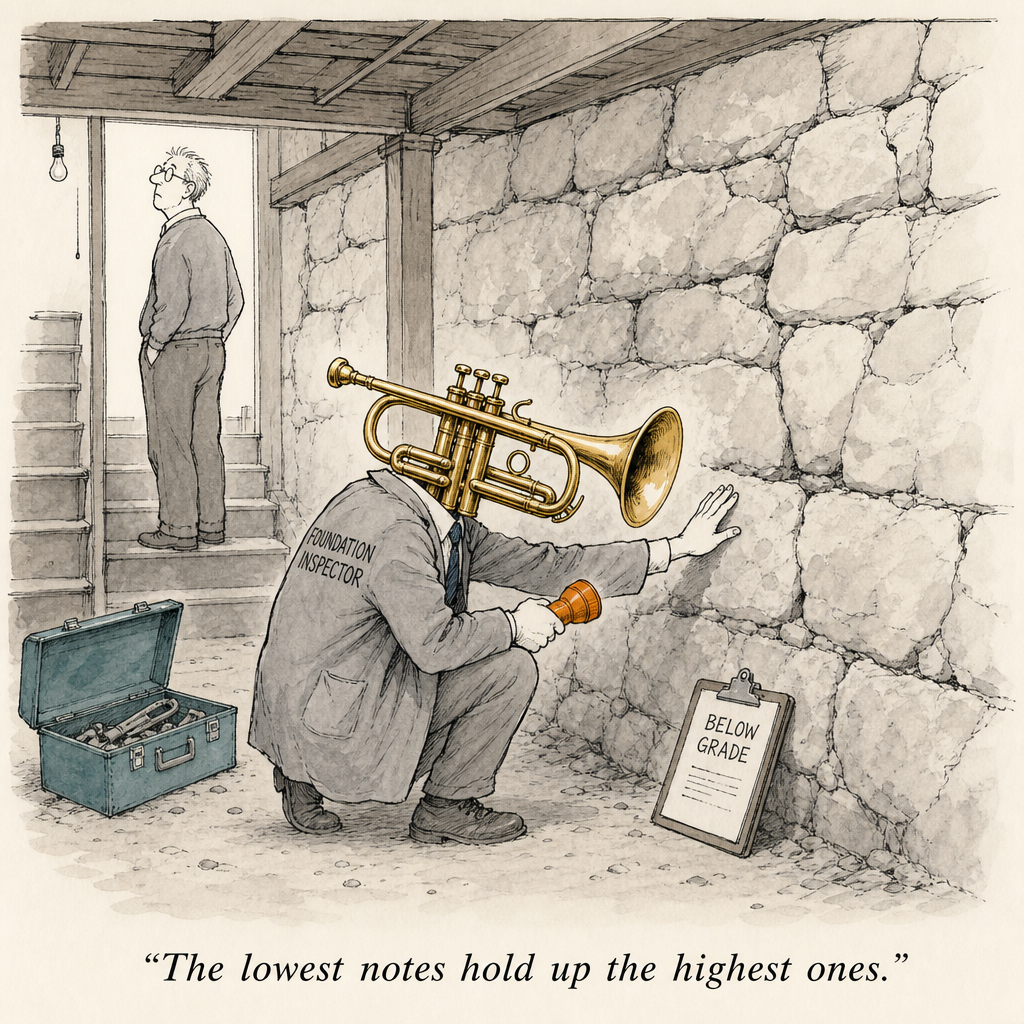
Everybody chasing trumpet range is staring at the top of the horn. The secret weapon lives at the bottom.
Pedal tones, the notes below the trumpet’s official basement, should be your best friend. That sounds backwards when what you want is a screaming upper register, and I get it. Playing lower to play higher sounds like training for a marathon by napping. But the connection between pedal tones and trumpet range is real, it’s mechanical, and the players who understand it protect their chops and build their top end faster than the players grinding away exclusively upstairs.
This piece sits inside my complete guide to building trumpet range, and it covers the least glamorous, most protective tool in the whole system.
What Pedal Tones Actually Are
Quick definitions so we’re talking about the same thing. The trumpet’s standard range bottoms out at low F sharp, the lowest note you can finger normally. Pedal tones are everything below that: pedal C sits an octave below low C, and the region between and below is territory the horn was never really designed to play.
That’s the point. Down there, the instrument gives you almost nothing for free. The resonance is weak, the slotting is vague, and the note only speaks if your lips, air, and aperture are genuinely cooperating. There is no note in the pedal register you can force out with mouthpiece pressure and stubbornness. The register simply doesn’t accept those currencies.
Remember that, because it’s the entire reason pedal tones work.
Why You Need Them: We Overdo It as a Species
Here’s the honest diagnosis of trumpet players as a group. We overdo it. We are hotheaded. We are terrible at pacing ourselves. We jam the horn into our face and we overblow, and we do it consistently enough that it burns into the nervous system. After enough years of that, the aggression isn’t a choice anymore. It’s the default setting. Some players even start getting genuinely nervous when they play, because their body has learned that playing means bracing for a fight.
I call the deepest layer of this the protective reflex: the body’s instinctive resistance to air being pushed through it. It closes the throat, tenses the face, and braces against the very airflow you’re trying to use. Every rep of overblowing and jamming reinforces it. And the protective reflex is a range killer, because the upper register demands the exact opposite of bracing. It demands fast air moving through an open, efficient system.
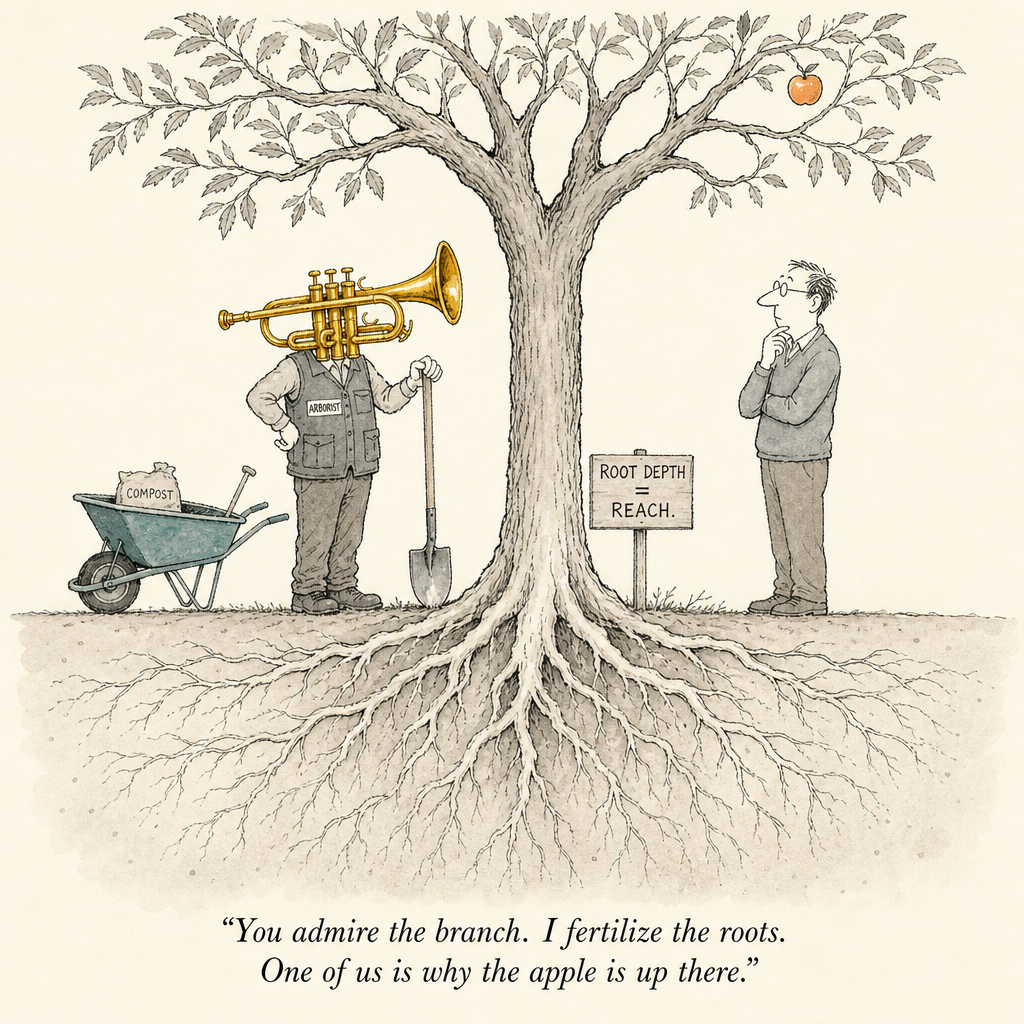
So you need something in your routine that trains the opposite instinct. Something that rewards relaxation and openness, and punishes force. That’s pedal tones. You physically cannot muscle your way through them, so every minute you spend down there is a minute your nervous system spends practicing the non-braced version of you. Pedal tones are how you counteract years of burned-in aggression, a few easy minutes at a time.
How Pedal Tones Help Trumpet Range
Now the mechanism, because “relax more” is not an explanation.
Think about what a high note actually requires: fast air from good compression sources, meaning the tongue, the abs, and the aperture, arriving at lips that are still free to vibrate. What destroys high notes is bad compression, meaning throat squeeze, lip pinch, and mouthpiece pressure, the stuff that feels strong and chokes the vibration. I’ve broken down that whole distinction in air compression versus pressure if you want the full picture.
Here’s the beautiful thing: the pedal register runs on the same good sources and rejects the same bad ones, just with the difficulty inverted. To get a clean pedal tone you need a relaxed, open air column, a big responsive lip mass, and an aperture you’re controlling with fine motor skill instead of clamping. Add pressure, and the note chokes. Pinch, and it disappears. Squeeze the throat, and you get nothing but rushing air.
In other words, pedal tones are a lie detector for your fundamentals. The register won’t let you pass with the compensations that the middle register politely tolerates and the upper register secretly hates. What you are doing down there is balancing things. And the balance you build at the bottom, open throat, working air, responsive aperture, is the identical balance the top of the horn is waiting for. That’s why this is a range article and not just a recovery article. If you’re trying to extend your range without pressure, the pedal register is where the no-pressure habit gets forged.
The Recovery Weapon Nobody Uses Enough
There’s a second job pedal tones do, and for working players it might be the more valuable one.
They are a recovery tool. After some brutal playing, a heavy rehearsal, a lead book gig, a big range day, or even after time completely off the horn, your chops don’t just need rest. They need recoordination. The fibers are recovering, the swelling is going down, and your embouchure’s fine calibration is slightly off. Jumping straight back into demanding playing on that setup is how one heavy day becomes a bad week.
An easy pedal session gets things to feel good and sound good again without costing you anything. It’s not a difficult exercise, and that’s precisely the design. You’re moving blood, restoring the feel of open air, and re-establishing balance while your chops rebuild. This is the practical application of a principle I’ve written about at length in building endurance through recovery: the improvement happens between the hard days, and what you do between them decides how much of it you keep.
In my light, medium, heavy training structure, pedals live on the light days. Day after a heavy session, chops feeling thick, life stress high, coming back from a break: pedal tones. They turn a throwaway day into a day that actively serves your range.
The Stamp Exercise: Your Starting Point
The classic entry point comes from the James Stamp book, and it’s the one I recommend because it connects the pedal register to your normal playing instead of treating it like a circus trick.
Start on middle C. Play a simple descending pattern and let it settle, then move the whole pattern down a half step and repeat. Keep walking it down chromatically, half step by half step, through low C, past low F sharp, and into the pedal register, until you arrive at pedal C. No heroics, no forcing, just a patient staircase into the basement.
The chromatic descent is the magic. You’re not leaping into the pedal register cold; you’re escorting your embouchure down there one half step at a time, letting it adjust gradually while everything stays connected to the setup you normally play with. The pedals you find this way are usable pedals, produced by your real embouchure in a relaxed state, not by some detached flapping arrangement you’ll never use again.
Keep it soft. Keep it patient. If a note doesn’t speak, don’t wrestle it. Back up a half step, re-establish ease, and try again tomorrow. The register rewards the player who refuses to fight.
And when you’re done at the bottom, don’t just put the horn down. Walk back up into your normal register and notice what came with you. The open throat, the moving air, the aperture doing its job without a clamp in sight. That transfer is the actual product of the exercise. The pedal C was never the point. The version of you that played it is, and your job is to smuggle that version back upstairs where the music lives.
1% TRUMPET · FREE PRACTICE RESOURCE
Try Pedal Tone Madness with the guided player
Want the notes in front of you while you practice? Pedal Tone Madness gives you a written score, an adjustable tempo, a piano guide and a timing click. You can use the play-along or print the PDF.
This is a separate practice resource, not enrollment in coaching. The 31 patterns are a menu, not a requirement to reach the lowest note or finish the whole ladder.
- Choose a comfortable starting pattern. Use the exercise picker if the opening notes do not suit your playing today. Skip anything that requires forcing.
- Set a comfortable tempo. Use the piano guide for the pitches and the timing click for the count-in. Keep the sound soft and responsive.
- Play a few comfortable patterns, with full rests. You can click Next exercise whenever you want. It loads the next score without starting the audio. Take more recovery time if you need it.
- Check the transfer. Play a familiar, easy middle-register phrase before and after. Notice whether it sounds clear and responds easily, rather than judging the session by your lowest note.
If your sound becomes harder to start, pressure increases, or you feel pain, stop rather than pushing farther down the ladder. The exercise is not a treatment for an injury.
The Standard You Have to Hold
One warning, because there’s a wrong way to do this.
Relaxation is not collapse. To do pedal tones correctly, you still have to have a good embouchure. You can’t just go completely limp and start accepting all kinds of fuzz and junk in the sound, because nobody wants that, and a fuzzy, disorganized pedal isn’t training balance. It’s training disorganization.
Hold the same standard down there that you hold everywhere else on the horn, my North Star test: feels good, sounds good, responds easily. All three. A proper pedal tone is relaxed and clear. Round, centered, honest tone at a soft dynamic, produced by an embouchure that’s still doing its job with the minimum necessary effort. If the sound is fuzzy, you’ve collapsed. If it feels like a fight, you’re forcing. The target is the narrow, glorious middle: full relaxation with full function.
That’s also exactly why the exercise is valuable. Finding that middle is the skill. The pedal register just happens to be the only place on the horn where you can’t fake it.
What Pedal Tones Won’t Do
Let me protect you from the other failure mode: pedal tone worship.
Pedal tones will not, by themselves, hand you a fifth of new range. They are not magic beans, and playing an hour of pedals a day does not build the tongue arch, the air speed, or the half-step-by-half-step progression that actually raises your ceiling. That work happens in the systematic climb I describe in the pillar guide, and no amount of basement time replaces it.
What pedals do is protect and balance the system that makes the climb possible. They unwind the aggression that sabotages your top end, rebuild coordination on the days your chops can’t handle more load, and keep your fundamentals honest. Think of them the way a sprinter thinks of mobility work. It never won anyone a race, and no one wins without it. They’re also one of the smartest responses on the days your top end has gone missing, which, as I explain in why your range disappears when you’re tired, is a day that punishes force and rewards exactly what the pedal register teaches.
Used that way, a few minutes a day, soft, clean, mostly on light days, pedal tones quietly become one of the highest-leverage habits in your entire routine.
Build the bottom, free the top
See how the pieces fit together
This article covers one piece of your playing. Jesse’s nine-minute training explains the wider approach. Paid coaching adds individual feedback, priorities and support.
The top of the horn is a privilege the bottom of the horn pays for. Go make a deposit.
— Jesse