Everyone who asks how long it takes to increase trumpet range wants a number. So let me give you one, and then earn it.
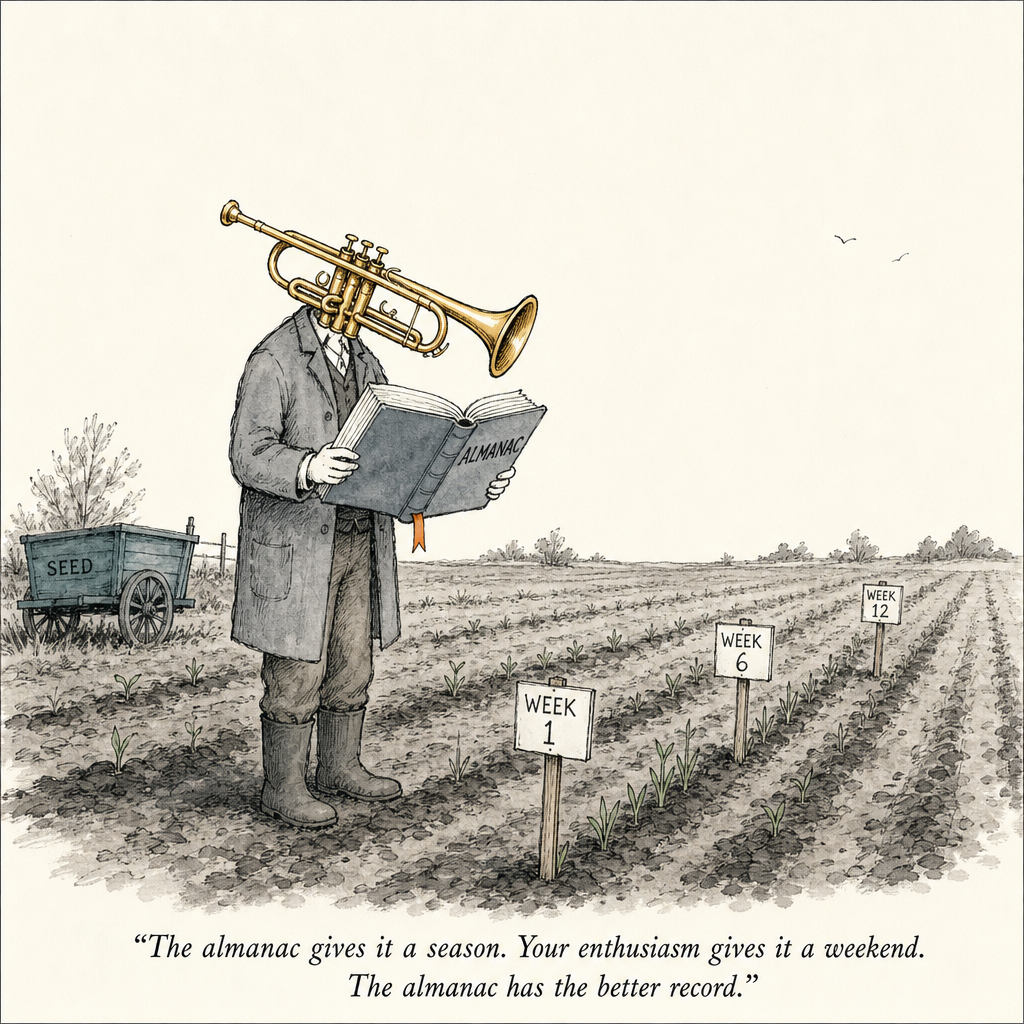
For most adult players training correctly, a genuinely owned half step takes somewhere between one and three months. Not one weekend. Not one magic exercise. Also not five years. One to three months of structured, honest work per half step, with the occasional glorious exception I’ll get to in a minute.
If that number disappoints you, stay with me, because the players who accept it end up with more range in a year than the players who reject it get in five. And if it surprises you that the number exists at all, good. Range development is not weather. It doesn’t just happen to you. It responds to inputs, which means it can be planned, and anything that can be planned has a timeline.
The full training system lives in my complete guide to building trumpet range. This article is about the calendar.
First, Fix Your Starting Line
Before any timeline means anything, you have to measure from the right place, and almost nobody does.
Ask a trumpet player their highest note and they’ll tell you their personal best, the note they nailed once, fresh, on a good day, planets aligned. That’s not their range. That’s their record. Your actual range is your highest reliable note: the one you can play at the end of a gig, at the end of the day, in front of people, nine times out of ten, from any starting point, at any dynamic the music demands.
The difference matters because a personal best is a peak, and a peak is not an average. The weightlifter who benches 315 once doesn’t walk in Monday and train as if 315 is his working weight. If he does, he gets hurt. Trumpet players make exactly this mistake with high notes, and then wonder why “their” range never feels secure and never seems to grow.
So the question isn’t “how long until I hit a note a half step above my best-ever squeak?” You might hit that tomorrow, and it will mean nothing. The real question is “how long until the note above my reliable base becomes reliable too?” That’s the half step worth timing, because that’s the one you keep.
The Machine That Adds Half Steps: The Range Pyramid
Here’s the system the timeline comes from. I train range as a pyramid built on your honest base note.
Foundation work, at and below your base, gets 60 to 70 percent of your range time. This is completely comfortable territory where you polish tone, dynamics, articulation, and endurance. Development, the next half step or two above base, gets 20 to 25 percent. Challenge, the notes above that, playable with good form when fresh, gets 10 to 15 percent. Your current limit gets 2 to 5 percent, touched briefly and only in perfect form. Anything beyond your limit gets zero percent of your practice time. Zero. Notes past your ceiling don’t get built by attempts; attempts up there only build fatigue and compensations.
Those proportions look conservative until you understand what they’re doing. They’re the trumpet version of progressive overload, the same principle that builds every athlete on earth: most of the work at capacities you own, a calculated slice just past the edge, and full recovery in between. I’ve written about progressive overload for trumpet in depth, but the short version is that adaptation comes from repeated, recoverable stress, not from maximal effort.
The half step gets added when the whole pyramid shifts up. Your development note passes the base test, so it becomes the new base. The old challenge note becomes development. Your old limit becomes a challenge. That shift is the unit of range progress. The timeline question is really: how long does one shift take?
How Long to Increase Trumpet Range: The Honest Math
Two of my training rules give you the skeleton of the answer.
First, real skill work happens in focused blocks of two to four weeks. Shorter than that and you’re topic-hopping, poking at ten things and fixing none. That’s the minimum time it takes for a physical coordination to move from “thing I can do when I concentrate” toward “thing my body does.”
Second, the promotion test. A note earns base status when it has met all the base criteria, response, dynamics, articulation, reliability, even when you’re not fresh, consistently for two or more weeks. Not two good days. Two weeks of evidence. A note that passes for two weeks is real; a note that passed on Tuesday is a rumor.
Stack those and you get the arithmetic: a focused block of two to four weeks to develop the note, then two-plus weeks of it proving itself under the criteria. Call it four to eight weeks when everything goes right, and everything doesn’t always go right. Life intervenes, some notes sit at awkward spots in the horn, and comeback players rebuilding old coordination may need longer on their first pyramid shift while their consistency catches up. Hence the honest range: one to three months per genuinely owned half step.
The compounding is the part nobody appreciates. Half steps sound pathetic to a player fantasizing about double C. But stack pyramid shifts back to back and the arithmetic gets loud: a few of them is a third, a year of consistent shifts can move your entire playing ceiling. Ask yourself where your range was one year ago. If it’s the same today, “slow” progress of a half step per quarter would have you well ahead of the pace you’re currently on, which is zero.

The Exception: Fast Unlocks vs. Slow Builds
Now the glorious exception, because you’ve seen the stories and I’ve personally watched it happen. In one of my live masterclasses, multiple players were hitting high Es and Fs, live in the stream, notes they had never hit before in their lives. Minutes, not months. So which is it, Jesse? Months per half step, or breakthroughs in an afternoon?
Both, because there are two different things being timed.
A fast unlock happens when the note was already physically available and something you were doing was blocking it. Usually it’s a technique error: mashing mouthpiece pressure, squeezing the throat, blowing slow air and compensating with force. Fix the error, teach the tongue to speed the air the way it already does when you whistle, and a note you “didn’t have” speaks the same day. Nothing was built. Something was unblocked. If your range problem is an unlock problem, the answer to “how long” can genuinely be “today,” and my article on why you can’t play high notes is where to hunt for your blocker.
A slow build is different. That’s when the efficiency, coordination, and conditioning for the note don’t exist yet at all. No trick releases a note your system can’t yet produce. That one goes through the pyramid, block by block, and takes its one to three months like everything else.
Here’s the catch that keeps players stuck for decades: an unlocked note is not an owned note. The guys hitting high F in my masterclass didn’t leave with a reliable high F; they left with proof of concept and a roadmap. The unlock shows you what’s possible. The pyramid makes it yours. Confuse the two and you become the player who “has a high F” that shows up one gig in ten.
What Speeds the Timeline Up
Within the honest range, you control which end you land on.
Daily consistency is the biggest lever. Thirty minutes minimum, every day. Everyone has thirty minutes; this is a priority issue, not a time issue. Range coordination is fine motor learning, and fine motor learning rewards frequency over heroics. Six thirty-minute days beat one three-hour Saturday by a mile, because the three-hour binge wrecks the chops it’s trying to train.
Intensity management is next. Structure your week as light, medium, and heavy days, the way I lay out in Light, Medium, Heavy training, so hard range work lands on rested chops and recovery days actually recover. The adaptation you’re waiting for happens between sessions, not during them. Skip recovery and you’re not saving time, you’re canceling the gains you already paid for.
And track everything. Write down your base note, your success rates, what you worked and how it responded. Progress per half step is slow enough that memory will lie to you in both directions. The log is how you catch a stalled month early and how you notice the quiet week-over-week wins that keep you in the game.
What Stalls It, and What “Stalled” Means
The killers are predictable. Chasing notes beyond your limit, which trades your practice time for fatigue and bad habits. Lying about your base, which makes you train the wrong pyramid entirely. Topic-hopping every few days so no adaptation ever completes. Bunching practice into binges. And grinding range work on exhausted chops, which, as I covered in why your range disappears when you’re tired, mostly rehearses your compensations.
One more flag: if a half step has resisted you for well past a month of genuinely consistent, structured work, the answer usually isn’t more weeks. It’s a missing piece you can’t see yourself, and it’s slightly too difficult to find alone. That’s not a character flaw. That’s the point at which every serious athlete uses a coach.
The question behind the question
“How long does it take to increase trumpet range” is really “can I actually do this, or is range just for other people?” And the answer is: it’s a system with a timeline, not a lottery. One to three months per owned half step, compounding for as long as you keep feeding it.
The whole system, the honest assessment, the pyramid ratios, the fast unlocks and how to convert them into owned notes, is exactly what I teach in my free 30-minute training. It’s the same framework I use with the players in the 1% Trumpet Program, and it’s built for adults who want progress they can predict. Watch the free 30-minute training here.
A half step a quarter feels slow for exactly one year. Then it looks like a miracle.
— Jesse