Charles Darwin filled field notebook after field notebook with observations he had no immediate use for: beak shapes, soil colors, which finch ate what on which island. He wasn’t journaling for wellness. He was collecting data whose meaning he couldn’t see yet, trusting that patterns invisible in any single day would become undeniable across hundreds of entries. The notebooks, not the voyage, are where the discovery actually happened.
Your practice deserves the same treatment, and almost nobody gives it. The average adult player runs an experiment every single day, thirty minutes of inputs producing real outputs, and then throws away the lab notes. Ask what they worked on two Tuesdays ago and you get a shrug. Ask whether their response is better than last month and you get a feeling. Practice without records isn’t a study; it’s an anecdote, repeated daily for years. Tracking is one of the three non-negotiables in my complete practice guide, and this article is the field manual.
Why Memory Is a Fraudulent Lab Assistant
The case for writing things down is really a case against the alternative, because the alternative is memory, and memory is the least reliable instrument you own.
Memory lies in both directions. On discouraged days it erases progress: the passage that cracked constantly last month and only cracks occasionally now reads as “still cracking,” and a player quits a working program three weeks before it visibly pays. On comfortable days it invents progress: “I’ve been practicing every day” turns out, on paper, to be four sessions in the last nine days. I’ve watched both errors, in over a hundred trumpet players, cost more real progress than any technical fault ever did. The naturalist’s rule applies fully here: perception is a hypothesis. The notebook is the evidence. When they disagree, the notebook wins, every time, no appeals.
That’s the deeper reason tracking works, and it has little to do with the data itself. A player with a log makes decisions from reality. A player without one makes decisions from mood.
The Field Note: One Line a Day
Here’s the entire required practice, and I’ve deliberately made it too small to refuse: one line per day, written in the thirty seconds after the horn goes on the stand.
Date. Minutes. Today’s intensity (light, medium, or heavy). Focus topic. One thing that worked. One thing that didn’t.
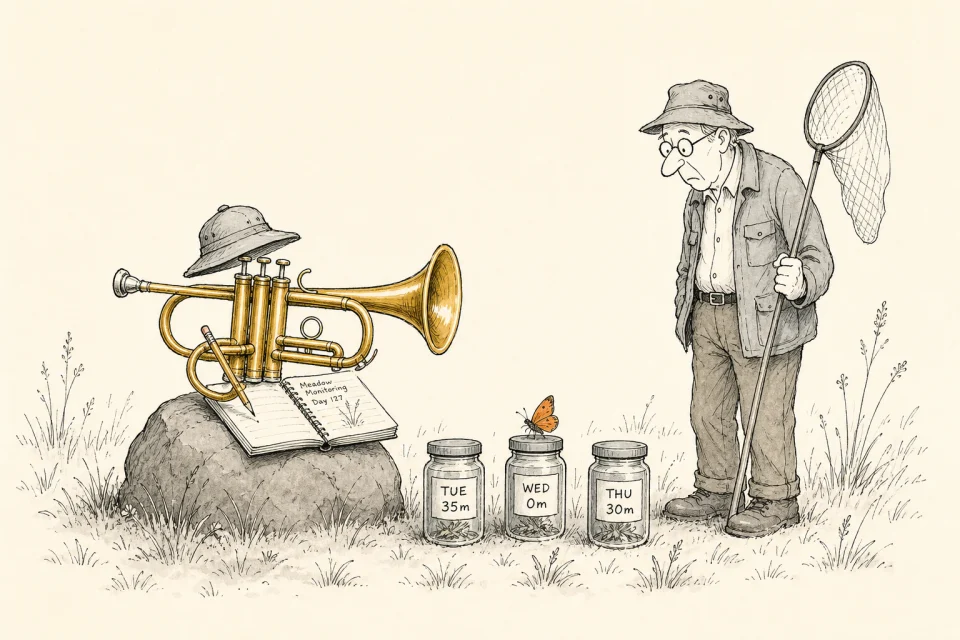
That’s it. “Tue, 35m, M, soft entrances on top-of-staff E, entrances centering by rep 4, tongue still crowding at mf+.” A specimen label, not an essay. Anyone can sustain this, which is the point, because a tracking system’s only unforgivable flaw is being abandoned. If some evening you genuinely can’t manage a sentence, log the numbers alone; a sparse notebook still beats a blank one.
Two optional columns earn their ink quickly. Your 2:1 tally totals, mistakes and fixes, straight off the tally sheet, because that ratio is the day’s quality score. And a weekly self-recording, dated and filed, because your ears standing outside the bell are a different instrument from your ears behind it, and the recording is the specimen your future self will thank you for keeping.
Reading the Notebook: Where the Discoveries Live
Daily entries are collection. The science happens on review day, once a week, five minutes, reading back over the notes the way Darwin read finches. You’re looking for patterns no single day could show you.
Consistency first, because it’s the master variable: how many of the last seven days have entries, and how does the thirty-day picture look? A rolling month of real entries is the single most honest measure of a practice life. Then focus integrity: does the focus column show one topic holding steady across weeks, or a new experiment every third day? Adaptation needs two to four weeks of repeated focus before it consolidates; the log is where topic-hopping, the great silent killer I break down in why you’re not improving, becomes visible and therefore fixable. Then intensity distribution: a healthy week shows a mix of light, medium, and heavy, per the Light, Medium, Heavy system; a column of seven mediums is a flat training signal announcing itself. And finally trend lines in the “what worked / what didn’t” pairs: complaints that recur for two straight weeks are your next focus topic nominating itself, and strengths that keep reappearing are permission to move on.
This weekly read is also where the notebook starts doing your planning for you. The focused block finishing up, the recurring weakness, the fatigue pattern that keeps landing on Thursdays: next week’s plan is mostly sitting in last week’s data, which is exactly how session structure is supposed to get chosen.
Measuring the Playing Itself
The log tracks the practice. Twice a season, maybe once a month, measure the player, with a short standardized assessment you repeat identically: the same lyrical passage recorded at the same tempo, your highest reliable note (reliable meaning nine times out of ten, cold honesty required, as defined in the range guide), how long comfortable playing lasts before form degrades, softest clean entrance on a mid-staff note. Same conditions every time, results dated in the notebook next to everything else.
These periodic measurements are the difference between believing you’ve improved and knowing by how much. They’re also, on the hard days every adult player has, the receipts: mood says nothing’s changed; the March assessment against the June assessment says otherwise, in your own recorded sound.
“I’ll Remember” and Other Famous Last Words
Let me handle the standing objection, because I’ve heard every version: tracking is for data nerds, it kills spontaneity, I just want to play, I’ll remember the important stuff.
You won’t, and it doesn’t. The one-line log costs thirty seconds and constrains nothing about how you play; there’s no spontaneity being protected by refusing to write down what happened after it happened. What “I’ll remember” actually protects is the fog, and the fog is where every stuck year I’ve ever autopsied was hiding. Show me a player who’s been “practicing consistently for two years with nothing to show for it,” and the log, once it finally exists, shows me the real story inside a month: the four-day gaps, the seventeen focus topics, the intensity flatline. The data was always there. Nobody was collecting it.
Thirty seconds a day to never lie to yourself about your own practice again. As trades go, that one’s a gift.
From Field Notes to Findings
One caveat from the notebooks of every scientist who ever kept them: data collection and data interpretation are different skills. A faithful log will show you that Thursdays keep failing, that the same weakness has recurred for three weeks, that your ratio collapses whenever the focus topic changes. What it can’t always tell you is why, or which of five visible patterns is the one that matters, and this is where a second pair of trained eyes changes the game entirely. The players in the 1% Trumpet Program log exactly the way this article describes, and then their logs get read the way Darwin’s mentors read his early notebooks: someone who has seen a hundred other notebooks says “this pattern, right here, this is the finding.”
That reading skill, what to measure, what the patterns mean, and how to turn a month of field notes into next month’s plan, is part of what I teach in my free 30-minute training. Watch the free 30-minute training here.
Collect like a naturalist. Review like a scientist. A year of one-line entries will teach you more about your playing than a decade of feelings did.
— Jesse