You practice every day. You’re serious about it. And your playing today is, if you’re being honest over your morning coffee, roughly identical to your playing a year ago.
I want to start by taking something off the table: effort is not your problem. You wouldn’t be reading an article like this if you were lazy. The players who come to me with this exact complaint, and it’s the most common complaint I hear, are almost always the hardest workers in their section. So the answer isn’t “practice harder,” and anyone selling you that answer hasn’t understood the question.
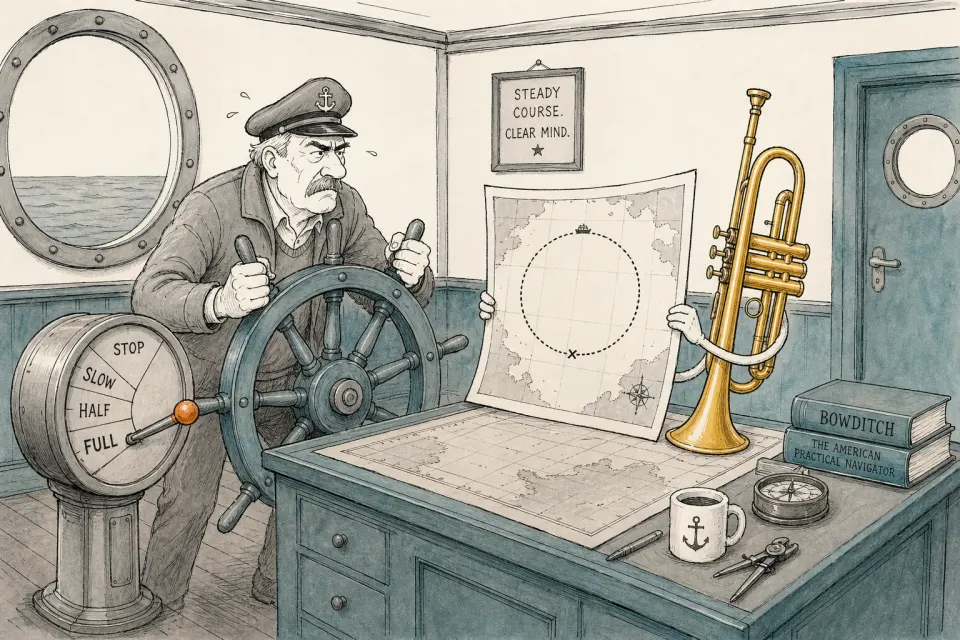
Your problem is navigation. A ship can run its engines at full power every single day and end up nowhere, if nobody’s reading the charts. Daily practice is engine power. Improvement is arrival. They are not the same thing, and here are the five ways the ship ends up circling, roughly in order of how often I see them.
1. You’re Sailing Without a Heading: No Single Focus
Ask a stalled player what they’re working on and you’ll get a weather report: “range, and my double tonguing, and this solo for church, and I found this new flexibility thing on YouTube.” That’s not a heading. That’s four compasses pointing four directions.
I call this stimulus hunting. Some players seek fundamentals, asking why something works and drilling toward the cause. Stimulus hunters chase novelty, collecting exercises the way tourists collect fridge magnets, and every new exercise feels like progress for about four days. The feeling is real. The progress isn’t, because adaptation takes two to four weeks of repeated focus on one coordination before it consolidates. Touch ten things for three days each and you complete ten beginnings and zero adaptations. A month of honest work, spent, with nothing banked.
The fix is almost insultingly simple: pick one specific weakness and keep it as your focus for two to four weeks, the way I lay out in the complete practice guide. One heading. Sail it until you arrive.
2. Your Correct-to-Incorrect Ratio Is 50/50
Here’s the invisible one. Watch a stalled player practice: they make a mistake, fix it once, feel the relief of the fixed version, and move on. Mistake, fix, move on. It feels responsible. Run the math, though: one wrong rep, one right rep, all session long, is a 50/50 diet of correct and incorrect. Your nervous system, which cannot tell which reps you meant, is learning both versions with equal enthusiasm. Fifty-fifty is a coin flip. Coin flips don’t compound.
The repair is the 2:1 practice ratio: every mistake gets fixed twice before you move on, which forces a two-thirds majority of correct repetitions and turns the same thirty minutes from a coin flip into a loaded die. Of everything in this article, this change produces visible results fastest.
3. You’re Reading the Wrong Map: Perception vs. Reality
The map is not the territory, and nowhere is that truer than behind a bell. What you hear while playing, filtered through bone conduction and hope, is not what comes out the front. What you feel your embouchure doing and what a camera shows it doing are frequently different films.
Practicing from the wrong map means correcting things that aren’t broken and protecting things that are. The stalled player who “has a pressure problem” often doesn’t; the one who “definitely doesn’t” often does. Without instruments, you’re navigating by vibes.
So use instruments. Record audio weekly and listen like a stranger. Use a tuner and drones and a metronome, not because they’re musical, but because they don’t flatter. Aim a camera at your setup once in a while. And log your sessions, because a practice log is the only witness that remembers last month accurately. Every one of these tools answers the same question: what actually happened, as opposed to what it felt like?
4. Every Day Is the Same Intensity
Stalled players’ weeks are flat: the same medium-hard grind, seven days in a row, forever. No day hard enough to force adaptation, no day easy enough to allow it. The body reads that as weather, not training, and it adapts to weather by ignoring it.
Athletes solved this a century ago with periodization, and the trumpet version is Light, Medium, Heavy days. A couple of genuinely light days, a real heavy day on rested chops, mediums in between, and suddenly the same weekly minutes contain an actual training signal. If you’ve been flat-lining on flat intensity, this alone can restart progress in two weeks. And if your daily grind is also leaving you tired all the time, read should you practice when your chops are tired, because grinding on exhausted chops mostly rehearses your compensations.
5. You’re Fixing Things in the Wrong Order
Last one, subtle and expensive. There’s a rank order to mistakes. Response problems, wrong notes, excessive pressure, and weak breath support are foundation-level; intonation, stability, tension, and articulation come next; phrasing, dynamics, and range are refinements on top. Stalled players are almost always working the top of the pyramid while the bottom is cracked, drilling range while their response is late and their pressure is climbing. The building doesn’t rise because the foundation is eating every brick.
If nothing has improved in months, audit yourself against the foundation four first. I’ve written about the deeper version of this pattern in how to fix your trumpet playing, but the short version is: fix in order, and the top of the pyramid starts moving almost by itself.
The Plateau Isn’t Telling You to Quit. It’s Telling You Something Specific.
Add this up and the picture changes. You haven’t been failing to improve because you lack talent, or because adult brains can’t learn, or any of the other stories that show up at minute forty of a frustrating session. You’ve been running strong engines with no navigation: scattered focus, 50/50 reps, an inaccurate map, flat intensity, inverted priorities. Every one of those is fixable, most of them this week, and the players who fix them typically feel movement inside a month, precisely because all that stored effort finally has a direction to flow.
Here’s the honest catch, and then I’ll let you go. Four of those five problems, you can fix from this article. The fifth, the wrong map, has a hard limit: you cannot fully see yourself, no matter how good your instruments get. That’s not a trumpet fact, it’s a human one. It’s why a player can do everything right for another year and still circle, one invisible degree off course the whole time. Another year of daily engine-burn, spent arriving nowhere, is the single most expensive thing in this entire hobby.
Reading the chart from outside is exactly what I do in my free 30-minute training: the diagnostic system I use to find a player’s real bottleneck, the one they can’t see, and the practice structure that turns daily effort into arrival. It’s the same approach I’ve used with over a hundred trumpet players in the 1% Trumpet Program, most of whom showed up saying exactly what you said at the top of this page. Watch the free 30-minute training here.
Same engines. New heading. Watch what happens.
— Jesse