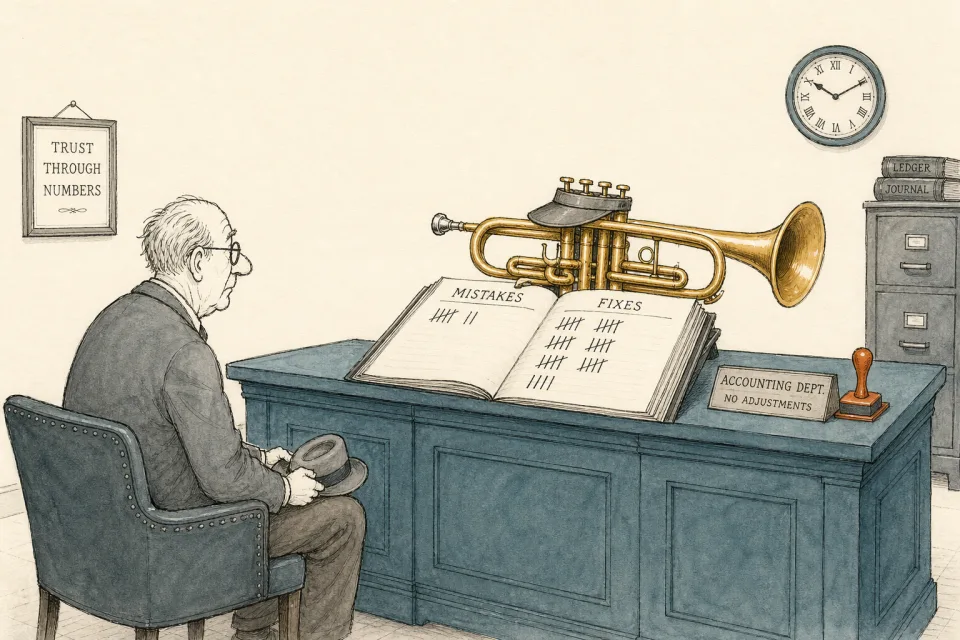
Every repetition you play goes into a ledger. Not a metaphorical one, a physiological one: your nervous system records every rep, correct or cracked, with the diligence of an accountant who never takes a day off and never asks which entries you meant.
Most players run this ledger into the red without knowing it, and the 2:1 practice ratio is the bookkeeping rule that fixes it. It’s one sentence long: for every mistake, fix it two times before moving on. Crack one note, play it correctly twice. That’s the whole rule. Of everything I teach in the complete practice guide, this is the piece players thank me for first, usually within two weeks, and this article is the full system.
The Ledger Problem: Why Well-Meaning Practice Stagnates
Watch an honest, hardworking player practice a passage. They miss the fourth note. They stop, play it again, get it, feel the little click of resolution, and continue. Mistake, fix, move on. It looks like discipline. Now audit the books.
One incorrect entry, one correct entry. Fifty-fifty. Every debit matched by exactly one credit, session after session, month after month. The account never grows because arithmetic doesn’t care about intentions: a body fed equal reps of the mistake and the correction learns both equally well. The passage stays “familiar but unreliable” forever, which is exactly how most adult players would describe half their repertoire.
Stagnation isn’t a mystery. It’s a balanced ledger, and a balanced ledger is precisely the wrong thing for a skill account.
The Rule: Two Credits Per Debit
The 2:1 ratio forces the books into surplus. Every mistake now costs two correct repetitions before you’re allowed to move on. One cracked entrance, two clean entrances. Two chipped notes in a phrase, four clean recoveries. Miss the same interval three times, and that interval owes you six.
Run the arithmetic on a whole session and you get roughly a two-thirds correct, one-third incorrect split. That’s the magic number, not because two-thirds sounds nice, but because a consistent majority is what compounds. A 66/33 account grows every single session, and small daily surpluses are how every fortune, financial or musical, actually gets built. The ratio also carries a quieter benefit: if you’re logging mistakes at all, you’re practicing material hard enough to produce them, which means you’re at the edge of your ability instead of coasting the middle of it.
One caution so you don’t over-apply it: the two fixes are for real attempts at material in your working zone, not for notes beyond your current ceiling. Grinding at your absolute limit generates mistakes faster than any ratio can pay for. If that’s where your errors are coming from, the problem is target selection, and the range pyramid is the article you need first.
The Tally Sheet: Running the Books in Real Time
The implementation costs a pencil. Draw two columns on whatever’s on your stand: mistakes on the left, fixes on the right. Every error gets a tick on the left the moment it happens. Every clean correction gets a tick on the right. You don’t leave the exercise until the right column is double the left. That’s the entire technology.
What the tally sheet actually does is protect you from four expensive habits at once. It kills mindless repetition, because every rep now has a purpose and a score. It kills playing through mistakes, because unpaid debits are sitting right there in graphite, looking at you. It kills challenge-avoidance, because an empty mistakes column means the material is too easy and you know it. And it kills self-deception, the biggest one, because at session’s end the sheet says what happened. Not what it felt like. What happened.
A tip from over a hundred players’ worth of coaching: define “fix” strictly. A fix is a genuinely clean repetition at the same tempo and dynamic where the mistake occurred, meeting the North Star: feels good, sounds good, responds easily. A slower, softer, luckier version is a different transaction and doesn’t pay the debt.
What Counts as the Debt: Fix the Right Mistake
The ratio tells you how many. Priority tells you which, because not all debits are the same size.
Fix first, always: response failures (notes that crack, speak late, or come out airy), wrong notes, creeping mouthpiece pressure, and collapsing breath support. These are foundation debts, and they charge interest, because every phrase built on them inherits the wobble. Second: intonation, embouchure stability, excess tension, articulation. Third, and only when the lower floors are paid: phrasing, dynamics, range.
In practice this means: if a passage contains both a rushed rhythm and a pressure spike, the pressure spike is the mistake you tally and fix. The rhythm gets its turn once the foundation stops leaking. Fixing refinement-level mistakes on top of foundation-level ones is polishing the second floor of a building whose ground floor is flooding, and it’s one of the main reasons daily practice fails to move, something I break down further in why you’re not improving despite practicing every day.
When the Fix Won’t Stick
Sometimes you’ll hit a debt that won’t clear: you fix the note twice, move on, and it cracks again tomorrow. Same entry, back on the left side of the page. That recurrence is data, and it usually means one of three things.
The chunk is too big: you’re re-attempting the whole phrase when the actual failure is one interval. Isolate the two-note transition, pay the debt there, then reinstall it into the phrase. The tempo is dishonest: you’re fixing at a speed you can survive rather than a speed you own. Drop to a tempo where the correct version is easy, bank several clean reps, then walk it back up. Or the mistake isn’t the mistake: a “missed note” that’s actually a late breath two beats earlier will never be fixed at the note itself. This is where a recording, or a practice log that shows the same debt recurring for a week, earns its keep.
A debt that survives honest 2:1 treatment for two weeks isn’t a discipline problem. It’s a diagnosis problem, and diagnosis is a different skill.
Thirty Days of Surplus
Here’s what I’d have you do with this. Run the tally sheet every session for thirty days, on your working material, with the strict definition of a fix. Most players notice the first effect inside a week, and it isn’t technical: sessions get quieter. Less flailing, more intent. The second effect shows up in two or three weeks, when passages that had been “familiar but unreliable” for years quietly stop cracking, because for the first time the reliable version holds a two-thirds majority in the ledger.
Now, the objection I can hear from here: “this sounds like a lot of bookkeeping for a hobby.” I’ll give you the honest answer. The tally sheet costs about four seconds per mistake, and it replaces the far more expensive accounting system most adults are currently using, which is practicing the same year of stagnant repetitions five years in a row and paying for it in frustration. Four seconds of graphite versus another year of 50/50. That’s the actual trade on the table, and it’s not close.
The ratio is one system from a larger set. How to find which mistakes matter most for you, how to structure the session around them, and how to know in weeks whether it’s working: that’s what I teach in my free 30-minute training, the same framework the adults in the 1% Trumpet Program run daily. Watch the free 30-minute training here.
Keep the books in surplus. The account does the rest.
— Jesse