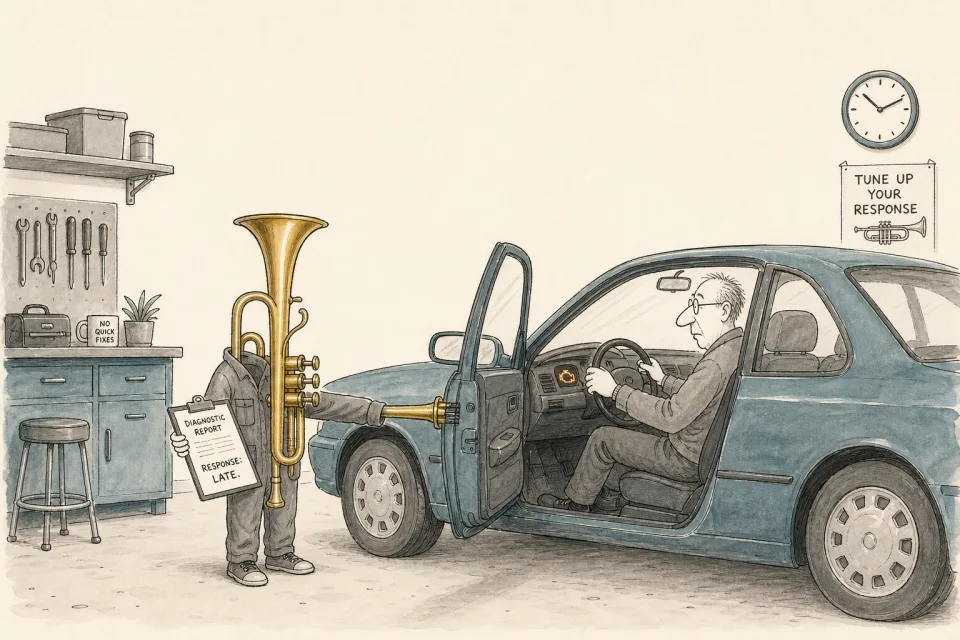
Somewhere on your car’s dashboard is a little amber engine light, and everything about how you respond to it depends on knowing one thing: is it the gentle “service due soon” glow, or is it flashing?
Tired chops work exactly the same way, and the reason this question tangles players up is that they treat all fatigue as one signal. It isn’t. Some tiredness is the ordinary service light of a body in training, and you can absolutely drive on, sensibly. Some tiredness is the flashing light that means pull over now, because continuing converts a minor issue into an expensive one. The skill isn’t a universal yes or no to “should I practice tired.” The skill is reading your dashboard, and it’s a skill that fits inside the intensity system from my complete practice guide.
The Two Kinds of Tired
Service-light tired is the normal fatigue of adaptation: yesterday was a heavy day, the muscles around your embouchure have that worked feeling, the first notes take a minute to wake up, but once you’re warm, notes respond on time, sound stays centered, and nothing hurts. This is training working. Muscles that were stressed are rebuilding, and mild fatigue during the rebuild is the receipt, not the problem.
Flashing-light tired is different in kind, not just degree: response stays late even after a patient warm-up, the sound is diffuse no matter what you do, you catch yourself pressing the mouthpiece harder just to get notes to speak, accuracy drops off a cliff, or there’s actual pain, not effort, pain. That’s not adaptation. That’s a system telling you its capacity is spent, and every rep you force past it gets built out of compensations: more pressure, more throat, more mash. I’ve written elsewhere about the difference between tired chops and done chops, and the one-line summary is that “done” doesn’t negotiate.
The dashboard check itself takes five minutes and you already own it: the diagnostic warm-up. Run your normal warm-up inspection and let it answer honestly. Response on time at soft dynamics? Sound centering? Nothing guarding? Service light. Response still late after ten patient minutes, pressure creeping, face not recovering between exercises? Flashing.
Service Light: Drive On, Gently
Ordinary training fatigue doesn’t cancel practice. It reroutes it, and this is where the Light, Medium, Heavy system earns its keep: tired-but-functional is precisely what light days were invented for.
A light day stays entirely inside comfortable territory, around a 3 or 4 out of 10 in effort. Soft long tones, easy slurs in the middle of the horn, simple melodies played beautifully, generous rest between everything, maybe twenty to thirty minutes total. Two rules keep it honest. Nothing ambitious: no range pushing, no endurance grinding, no new technique, because tired systems learn new coordinations badly. And the session must end feeling better than it started; a light day that leaves you more tired wasn’t light.
Played this way, a tired day isn’t a lost day at all. It maintains the daily habit, keeps blood moving through recovering tissue, and gives you low-stakes reps on fundamentals, which is why light days are a full citizen of any serious week and not an apology for one.
Flashing Light: Pull Over
When the warm-up says flashing, you have two legitimate moves, and I want to be careful here because players get preached opposite one-liners about this.
Option one is a complete day off the horn. No playing at all, real rest, and for genuine depletion, especially after an unusually heavy stretch, a brutal rehearsal week, or on the kind of accumulated fatigue that’s been building for days, it’s often exactly right. Adaptation happens during recovery, not during playing; a day off after real overload isn’t lost progress, it’s where the progress gets installed.
Option two is a feather-light recovery session: five to fifteen minutes, mouthpiece-soft dynamics, nothing above the staff, treated as circulation rather than training. For some players, particularly younger ones or anyone who gets anxious when the horn stays cased, this beats the full day off; it protects the daily habit, keeps the psychological streak alive, and gently confirms the chops are healing rather than leaving you to imagine the worst overnight.
Both are valid. Which one you reach for depends on how deep the fatigue runs, what tomorrow demands, and honestly, on your own temperament, and I lay the whole rest-day decision out in rest days for trumpet. What is not valid is option three, the one most players secretly choose: a normal or heavy session anyway, because the calendar said so.
Why Powering Through Costs So Much
Here’s the mechanical case against ignoring the flashing light, because “listen to your body” has never persuaded a determined trumpet player of anything.
Practicing hard on spent chops doesn’t just underperform. It trains the wrong player. With the primary system exhausted, your body recruits whatever gets notes out: extra mouthpiece pressure, throat squeeze, jaw clamp. Those aren’t random failures; they’re coordinations, and you are rehearsing them, efficiently, with full attention, exactly the way you’d rehearse anything you wanted to keep. A month of tired grinding can install compensations that take a season to remove. This is the engine behind the pattern I describe in why your range disappears when you’re tired, and it’s how one ignored warning light becomes a walletful of repair bills.
There’s a belief underneath the grinding that deserves to be named and retired: that playing through pain and fatigue is what dedication looks like, and that resting is what quitting looks like. It’s backwards. In every athletic discipline on earth, and trumpet is one, the professionals are the ones who take recovery seriously and the perpetually injured are the ones who “gutted it out.” Dedication isn’t measured by how you feel at the end of today. It’s measured by what you can still do at the end of the year.
The Dashboard Habit
Practically, this all compresses into a small daily ritual. Warm up as a diagnostic, every day, and let the reading pick today’s gear: all clear, run the day you planned; service light, downshift to light; flashing, day off or feather-light recovery, your call, made without guilt. Log the reading in your practice log, one word will do, because fatigue patterns across weeks are data your future planning needs. If most mornings read tired, the problem isn’t any single day; your week’s total load is set wrong, and that’s a programming fix, not a toughness fix.
And if the light keeps flashing for a week or more despite honest rest, or anything hurts in a way that feels like injury rather than effort, stop reading blog posts and get qualified eyes on it. Chops are the one piece of equipment you can’t replace.
The bigger skill here, reading your own gauges and building a week where hard days land on rested chops and tired days have a plan, is exactly what I teach in my free 30-minute training, the same system the adults in the 1% Trumpet Program run through every heavy season. Watch the free 30-minute training here.
Read the light. Pick the right gear. The engine lasts for decades that way.
— Jesse