A guy I worked with about a year and a half in showed me a recording of two trumpet players. Same key, same tempo, same range. Both basically clean. He asked me which one I thought was better.
I told him.
He looked at me like I had pulled the answer out of a hat. He couldn’t tell. To him, both clips sounded “good.” Both were trumpet. Both played the right notes. He had played the trumpet for over twenty years and he genuinely could not hear the gap between a player who was making music and a player who was operating the instrument.
That is not a hearing problem. His ears are fine. It is an aestheticism problem. And it is the single most common, most under-discussed, and most fixable issue I see in adult trumpet players.
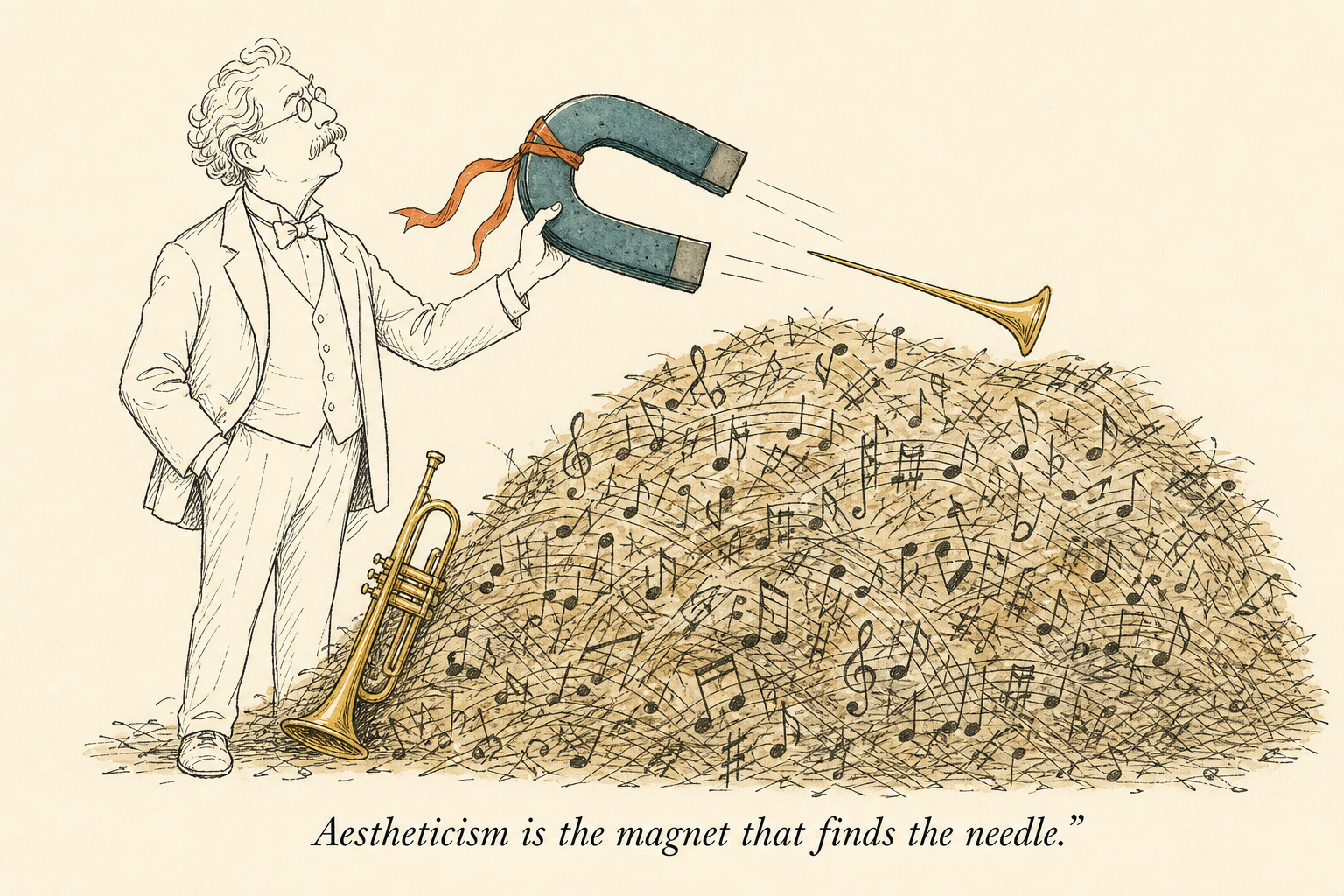
By the end of this article you are going to know what trumpet aestheticism actually is, why most players have been told a lie about whether they have it, and exactly how to start building it this week. We are going to use one image throughout: a magnet finding a needle in a haystack of generic sound. Hold that picture in your head. The whole argument hangs on it.
This article sits inside the larger frame I lay out in the trumpet sound guide. If you have not read that yet, you can come back to it. This one stands on its own.
What Trumpet Aestheticism Actually Is
Aestheticism, in the trumpet context, is your trained sense of what beautiful sound is.
Not what nice sound is. Not what acceptable sound is. Beautiful. The kind of sound that does something to a room. The kind that makes a non-musician stop talking. The kind that, when you hear it on a recording, you rewind and play again because you cannot quite believe a metal tube made that.
Aestheticism is the part of you that recognizes that sound when you hear it, and the part of you that knows immediately when a sound is not it.
That is the whole definition. There is no mysticism in it. It is recognition plus discrimination, and both of those are skills.
People hear the word “aesthetic” and they get nervous. They think it means art-school stuff. Brushed concrete and Mondrian prints and people who use the word “curate” about their bookshelf. That is not what the word means here. Here it means: do you have the trained capacity to tell good from bad, beautiful from generic, alive from dead, when sound enters your ears?
If you do, you can chase it. You can match it. You can develop it.
If you do not, you are wandering. You produce sound, you hear sound, and you have no ruler against which to compare what came out. You sit down to practice and you have no way to evaluate whether the long tone you just played was any good. You move on because you have to. You go on for years like this. You wonder why your sound never changes.
Aestheticism is the ruler. Without it the practice does not measure anything.
The Lie You Were Told About Taste
Every adult trumpet player I have coached, all over a hundred of them, has at some point either said out loud or believed silently: I’m not really artistic. I don’t have great ears. I’m more of a technical player.
That sentence is a lie you tell yourself to explain the absence of work you have not yet done.
The “gift” model of taste says some people are born with a built-in sense of what beautiful sound is and other people are not. The artistic ones get to have feelings about music. The technical ones play the notes and call it a day. You either have the magic or you do not.
That model is wrong. Every player you think of as having a gift for sound got that gift the same way. They were exposed to large amounts of beautiful music early, often, with attention, usually around somebody who could articulate why it was beautiful. Their nervous system absorbed it over years. By the time anyone called them “naturally musical,” their brain had been laminated, layer after layer, with high-resolution sound information.
That is not a gift. That is an environment. Environments can be replicated, just on a delay.
Your nervous system is still plastic. Adults learn languages. Adults learn to discriminate between different wines, different coffees, different woods, different fonts. None of those people had a gift for tannins or grain patterns or kerning. They paid attention, with structure, over time, in the presence of someone who could name what they were noticing.
You can do this for trumpet sound. The thing standing in the way is not your ears. It is the story you have been telling yourself about your ears. Drop the story. Pick up the work.
The Magnet, the Needle, and the Haystack
Here is the image. Hold it.
You are standing in front of a haystack. Somewhere in that haystack there is a needle. The needle is the sound you want. The trumpet sound that does something to a room, that has identity, that you would recognize on the radio in three notes. It exists. Other players have pulled their version of it out and held it up.
Without a magnet, your only option is to search by hand. You reach in. You feel hay. You reach again. More hay. You reach a hundred times and most of what you find is hay, because there is so much more hay than needle in there, and your hands cannot tell the difference at speed. Once in a while you brush the needle by accident, but you do not always know you did. You move past it.
That is what most trumpet practice looks like. Players grind reps in front of a sound they cannot accurately identify when they hear it, hoping volume of work will eventually produce something they will recognize as good. Sometimes it does. Mostly it produces more competent hay.
Now imagine you have a magnet. You sweep the magnet over the haystack. The needle jumps to it. The hay falls away. The instant the magnet passes near the thing you are looking for, the thing you are looking for finds you.
That magnet is your aestheticism. When your ears are calibrated, beautiful sound jumps out of the noise the moment it crosses your range. You hear three notes from a player and know whether it is a player or a guy who operates a trumpet. You play one long tone in your own practice room and you know whether it was a take to keep working off of or one to let die.
Without the magnet, you grind through hay. With the magnet, the needle finds you.
Aestheticism is upstream of everything else. People want to skip past this layer to get to drills. The drills are useless if your magnet is dull. You will run a thousand reps against a target you cannot accurately recognize, and you will get a thousand reps’ worth of approximation. The drills only work once you can hear what you are aiming at. The good news is that the magnet is something you build. The rest of this article is how.
The Engineer’s Answer and the Poet’s Answer
When you point at a sound you love and ask “what makes that beautiful,” you can answer two different ways. Both work.
The engineer’s answer. This sound is beautiful because the aperture is open enough to give it body without losing center. The air is fast enough to create brilliance, slow enough to keep warmth. The vibrato sits just under the threshold of conscious noticing, narrow. The articulation lands a hair behind the beat. The sustain holds and opens slightly through its duration instead of decaying. Now I can take that apart and put it back together.
The poet’s answer. This sound is beautiful because it carries grief. Because it sounds like a memory I cannot place. Because it makes the room feel warmer. Because there is a person in the sound, not just a player. Because it sounds the way the inside of a cathedral feels.
Both come from a trained ear. Neither is more rigorous than the other, and you do not have to pick.
The analytical players will default to the engineer’s answer. That is fine. Decompose what you hear. Name the components. You get a recipe you can replicate. The feelers will default to the poet’s answer. That is also fine. The poet’s answer saturates your imagination with target sound, and your body moves toward it over time whether you can decompose it or not.
The mistake is thinking only one is legitimate. The best players I work with do both. They are systematic decomposers AND they have ingrained so much beautiful music into their imagination that when they are not playing that way, they catch themselves immediately. The two paths are not in conflict. They are the same magnet, viewed from different angles.
When you hear a sound you love, do you reach first for “what is it doing” or “what does it feel like”? Whatever you reach for first, that is your default. Lean into it. Then over time, practice the other.
The Vocabulary You Have to Build
Here is where most players get stuck. They want to evaluate sound, but they do not have words for what they are evaluating. They listen to a recording, they can tell something is happening, but they cannot articulate what.
If you cannot put the words on it, you cannot chase it. The vocabulary IS the magnet’s calibration.
You do not need a hundred terms. You need maybe ten that you actually use. Here are the ones I drill into students in the 1% Trumpet Program. Run these as a working set and add to them over time.
Dark vs bright. Dark has more low-frequency body, less high edge. Bright has the opposite. Wynton Marsalis on classical leans dark. Maynard on a lead chart leans bright. Neither is correct. Both are choices.
Warm vs cold. Related but not identical to dark/bright. Warm has body and bloom. Cold has clarity but feels distant. You can have a bright warm sound and a dark cold sound.
Centered vs spread. A centered sound has a clear pitch core, the bullseye is dense. A spread sound has more air around it, less obvious center. Some players want centered every note. Some open the center for ballad effect.
Brassy vs smooth. Brassy has audible buzz and edge, the metal of the horn comes through. Smooth has sheen, more vocal, the metal hidden under the line.
Thin vs full. Thin sounds underfed. Full has body, support, presence. A thin sound can still be in tune and on time. It just does not fill a room.
Forward vs back. Forward sound has projection, sits at the front of the mix. Back sits behind, more recessed, more atmospheric.
Wide vs narrow vibrato. Harry James lives wide. Most classical lives narrow. Width is independent of speed. Train them as separate dials.
Fast vs slow vibrato. Slow vibrato feels stately. Fast feels nervous or ardent. Both are tools.
Pocketed vs pushed articulation. Pocketed lands exactly where the beat sits. Pushed lands a hair early and feels aggressive. Laid-back lands a hair late and feels relaxed. Placement is part of the sound, not separate from it.
Sustained vs decaying. Held notes either maintain and open through their duration, or they sag. Both are choices in different contexts.
That is ten dials. Not a bad starter set. Run any sound you hear through those ten and ask which slider sits where. Two weeks of doing this on your daily listen and you will start hearing things you did not know were there. The magnet is being calibrated.
The point is not to memorize a list. The point is to install enough hooks in your brain that when sound comes in, it has somewhere to land. Without hooks, sound just is. With hooks, sound becomes describable, comparable, replicable.
If you want to push deeper on this, the article on listening with specific questions goes through the drills in detail. For now, ten dials is more than most players ever build.
Listening Practice That Actually Builds the Magnet
Most trumpet players do not listen. They have music on. There is a difference.
Music on is passive. You are doing dishes, driving, answering email, and there is sound in the room. Your ears process it the way they process the refrigerator hum. None of it sticks. None of it calibrates the magnet.
Listening is active. Eyes closed. No phone. No second task. Twenty minutes minimum. You are putting one specific sound in front of your nervous system and asking, with intention, what is it doing.
Three drills that build aestheticism faster than anything else I have found.
Drill one. The single-note loop. Pick a recording. Find a single sustained note in it. Play that note in isolation, looped, over and over. Just that note. Twenty repetitions. Each rep, ask one of the dial questions from the vocabulary list. Is this dark or bright? Is this centered or spread? Is the vibrato wide or narrow? You will hear things on rep fifteen that you did not hear on rep one. The note has not changed. Your ear has.
Drill two. The blind comparison. Pick two recordings of two players playing the same piece, or close to it. Listen to ten seconds of one. Then ten seconds of the other. Then back to the first. Try to articulate, in your vocabulary, what is different. Not which is better. What is different. The comparison forces discrimination. Discrimination IS the magnet.
Drill three. The describe-it-out-loud test. Listen to thirty seconds of a player. Pause. Describe what you just heard, out loud, in your own words, using your vocabulary, for sixty seconds. Then play the thirty seconds again and check yourself. Did you hear what you said you heard? Did you miss something obvious? The discomfort of describing sound out loud is the discomfort that builds the skill. You are forcing your brain to translate sound into language, which is the same wiring you need to translate sound into reproduction.
Run any of these for two weeks at twenty minutes a day, and your magnet is sharper than it was. Run them for three months, and it is sharper than ninety percent of the players you know.
This is not glamorous work. It looks, from the outside, like a guy sitting in a chair with headphones on. There is no rep counter. There is no progress meter. The progress shows up two months later when you record yourself playing a long tone and the long tone sounds different than long tones used to sound, because the magnet that was aiming the practice was sharper this time around.
Most players will not do this. That is fine. That is part of why the players who do, win.
Listen to Things That Are Not Trumpet
If you only listen to trumpet players, your aestheticism will be narrow. It will tell you which trumpet players you like and which you do not. It will not necessarily tell you what beautiful sound is.
Beautiful sound is a category that exists outside the instrument. The trumpet is one entry in it. Singers, cellists, saxophonists, organists, gospel choirs, opera, qawwali, fado, all of those are in the same category. They all produce sustained, expressive sound with a human being behind the mechanism. The aesthetic principles that make a great cello tone beautiful are the same principles that make a great trumpet tone beautiful. Body. Center. Bloom. Restraint. Direction.
When you listen across instruments, you stop hearing the instrument and start hearing the sound. That shift is the most important shift in the whole project.
Specifically, listen to singers. Singers cannot fake a phrase the way a trumpet player can. They have to support every note with their actual body, not a $4,000 piece of metal. They can make you cry in the first six seconds of a recording with no harmony, no rhythm section, just sound.
Pick three singers from outside whatever genre you usually live in. If you are a jazz player, listen to opera. If you are a classical player, listen to Aretha Franklin and Sam Cooke and Sarah Vaughan. Whatever feels least native to you, listen there.
You are not trying to play like them or extract specific techniques. You are loading your brain with data points outside the trumpet category, so that when you come back to the trumpet category, your magnet is sensitive to qualities the in-category-only player cannot detect. This is how every great trumpet player you can name calibrated themselves. The cross-category listening is not optional decoration. It IS the playing.
What This Means For You, Starting Tomorrow
Here is the program, compressed.
One. Drop the story that you are not artistic. It is a story. It is not true. The proof is that every player you admire built their taste by listening, with attention, over time, exactly the way you are about to.
Two. Build the vocabulary. Use the ten dials in this article. Run them on every recording you put in your ears for the next two weeks. Force yourself to articulate what you are hearing.
Three. Listen actively. Twenty minutes a day, eyes closed, one task. Pick recordings deliberately. Loop notes. Run the blind comparison. Describe out loud.
Four. Listen across instruments. Pick three non-trumpet voices that move you and add them to your rotation. The breadth is not a luxury. It is part of the calibration.
Five. Anchor your in-category listening to one trumpet player. The next article in this series, Pick One Trumpet Player and Mean It, walks through how to pick the player whose taste calibrates yours. Read that next.
Do this for ninety days and tell me your magnet is not sharper than it was. I have watched players who told me, with full conviction, that they had no taste, become the most precise listeners in the room six months later. Aestheticism is built. It is built the same way every other adult skill is built: with reps, in language, with structure, with someone in the room who can name what you are noticing.
For more on how all of this fits together with the rest of sound development, the complete guide on building a great trumpet sound lays out the full inner game.
“But I’m Just Not Artistic”
I have had this conversation probably a hundred times. A player gets on a strategy call with me. Forty-three. Played for twenty-five years. Range fine, technique fine, sound competent. He says, almost as a confession: “I think my problem is I’m just not that artistic. I can do the technical stuff but I don’t have the ear.”
Here is what I tell him.
You do not have an ear problem. You have an exposure problem and a vocabulary problem. Your ears work. They have always worked. What you do not have is a structured way of listening, a calibrated set of words to describe what you hear, and a teacher in the loop to tell you when you are hearing accurately and when you are missing what is in front of you. Those three things are the entire game. None of them are talent.
People give up on aestheticism because they have been trying to build the magnet alone, with no vocabulary, against no reference, for years. The work was slow and invisible, so they decided they did not have the gene. There is no gene. There is just the work, done with structure or done without it.
If you have read this far, you are not the player who lacks taste. You are the player whose taste has not been trained yet. Those are different problems. The first is unfixable. The second is what I do for a living.
If you want to see how the 1% Trumpet Program handles this, alongside range, endurance, articulation, and the protective reflex that quietly kills most adult comeback progress, I run a free 30-minute training that walks through how the program builds these specific skills. You can grab it at toot-your-own-horn.com/landing-page.
Aestheticism is a magnet. The magnet is built. The needle is in the haystack right now. You are one trained ear away from being the kind of player who pulls it out.
Go put the work in.
Continue the series:
- How to Build a Great Trumpet Sound (Start Here) — The full inner game of tone, imagination, and musicality.
- Pick One Trumpet Player and Mean It — How to choose the player whose taste calibrates yours.
- Listening Deeply: The Questions That Make Sound Objective — Drill-level listening practice that sharpens the magnet faster.