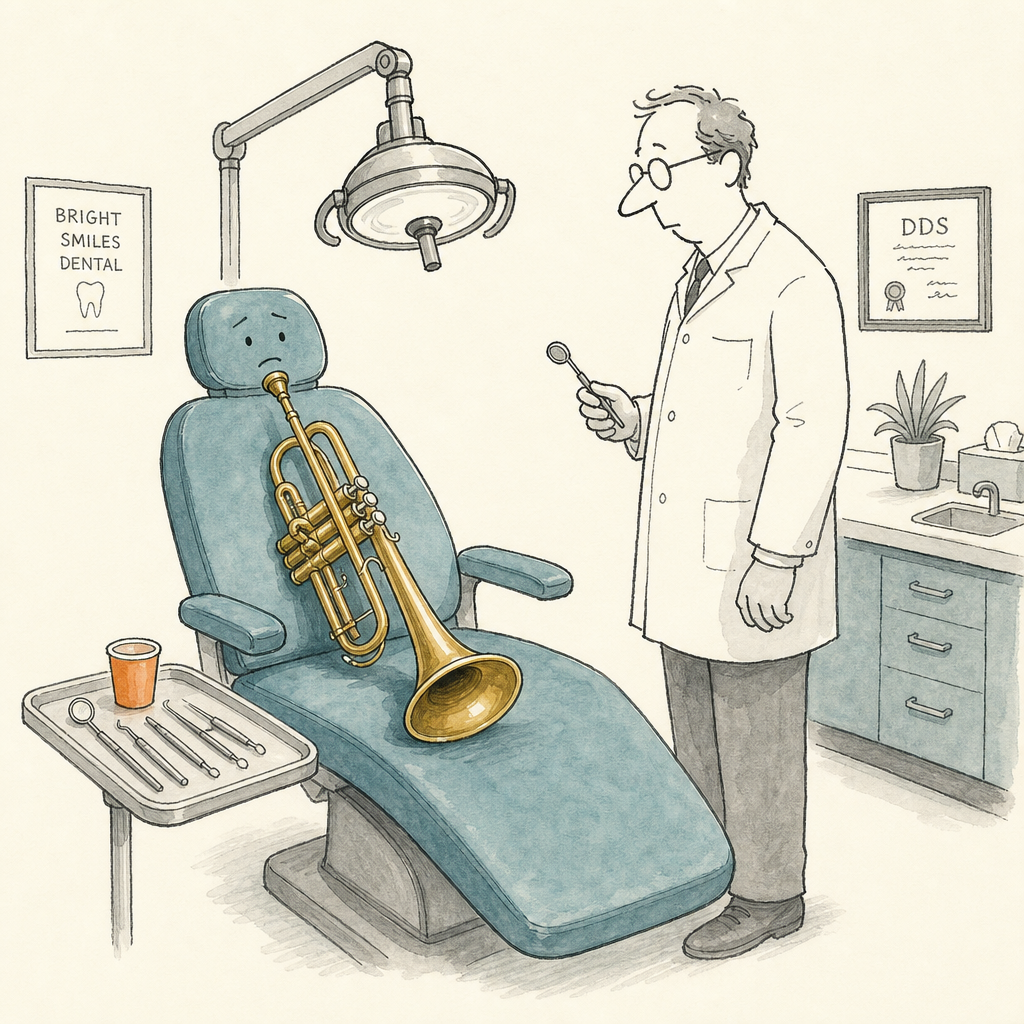
If you typed that sentence into a search bar, I want you to take a breath before we go any further. You are not crazy. You are not done. You are not the only person this has happened to.
What you are feeling right now is one of the most disorienting things that can happen to a brass player. The thing that worked yesterday does not work today, and the harder you try the worse it gets, and you do not know if you have lost something forever or if you just need a nap. I have coached over a hundred trumpet players through this exact moment. Almost every working player goes through it at least once. The reason it feels so awful is that your embouchure has always been the thing you could trust, and the floor just dropped out.
Good news. The floor did not drop out. Something specific is happening, and we can figure out which something.
This is a diagnostic walkthrough. Think of it the way a doctor thinks about a confusing symptom, or the way a mechanic thinks about a car that will not start. You do not throw your hands up and declare the patient incurable, and you do not yank the engine out before you check the battery. You go down the list. Most likely cause first. Rule it in or rule it out. Then the next one.
There are five branches on this tree. Work them in order. By the bottom of the page you will know what you are dealing with and what to do about it today.
Branch 1: Are You in the Death Spiral Right Now?
This is the most common diagnosis by a long way, so we check it first. The Death Spiral is the acute version of “my chops stopped working.” It usually shows up over the course of a single rough week, sometimes a single rough session.
Symptoms:
- High notes that worked last week are not there today.
- Response across the horn feels sluggish. Notes do not pop in the way they used to.
- You feel like you need to push harder, and pushing harder makes it worse, not better.
- After a session your lips feel swollen, slow, or numb for hours.
Here is the simple bedside test. Go play for ten minutes the way you have been playing the last few days. Then look in the mirror. If you see a visible white ring pressed into your lips where the mouthpiece sat, that is data, not failure. That white ring is capillary occlusion. The blood pressure inside a lip capillary is around 33 mmHg. The contact pressure of a mouthpiece during loud high-note playing has been measured at roughly 560 mmHg. That is an order of magnitude past the point where blood flow stops. A lip with no blood flow cannot vibrate cleanly. The chops feel “dead” because, in a local-tissue sense, they are.
This is the spiral. Your lips do not respond, so your nervous system calls for more force. More force collapses circulation. Reduced circulation makes the lips less responsive. Your nervous system calls for even more force. Around and around until the tissue gives up.
Here is the fix, and you have two valid versions. Take two to four days of either complete rest or light play only. Both work because both restore perfusion. A full day off lets the capillaries reopen and the tissue clear waste. A light day, twenty minutes of low-register tone work with a deliberately soft mouthpiece contact and no high notes, does the same thing AND keeps the motor pattern alive. Younger players and anxious comeback players usually do better with light days. Players in real pain or who can feel themselves white-knuckling should take the day off. Either is correct. Just stop feeding the spiral.
When you come back, come back at sixty percent of your usual volume with explicit attention to pressure economy. The article on /mouthpiece-pressure-trap/ walks through the exact drill for that. If branch 1 fits, you can be playing well again inside a week.
Branch 2: Tissue Change
If branch 1 does not fit and the timeline is recent (something changed in the last few weeks, not the last few days), check branch 2.
Possible causes:
- Dental work. Filling, crown, extraction, or a tooth that shifted after one of those.
- Lip injury. A cold sore, a chapped split, an accidental cut from a kid’s elbow during a game of tag, anything that changed the surface presented to the mouthpiece.
- Recent illness. Hydration changes, sinus swelling, post-viral mouth dryness from medication, lingering inflammation.
- Allergy season. Lip swelling, mucus changes, mouth breathing patterns that shift overnight.
Symptoms feel different from the spiral. The classic feeling is “something is in the way” or “my lips do not seal the same anymore.” The pitch is there but slightly off-color. The aperture refuses to find its old shape. You are not exhausted, you are misaligned.
What to do. Most tissue changes self-resolve in two to six weeks. The biggest mistake players make here is trying to overcome the change by force, which is just branch 1 with a different starting line. Do not overcome the change. Accommodate it. Adjust your aperture and your corner placement very slightly. Let the lip find a new working position around the new geometry. The article on /reading-your-embouchure/ is a useful companion here because tissue-change recovery is largely a re-listening problem. You are learning what your face does now, not what it used to do.
If the change is permanent (a crown, a missing tooth, an extracted molar) and four to six weeks have passed without things settling, that is when you start asking the branch-4 question. Most of the time you will not get there. The body is good at this.
Branch 3: Layoff (Rust)
If your chops did not collapse acutely and there is no tissue event, ask this. Have you been playing less lately?
Less can mean a lot of things. A busy stretch at work. A summer with the family. A pandemic. A move. A new baby. A few months where the horn lived in the case more than it lived in your hands.
Symptoms of layoff rust are different from the other branches. The loss is gradual rather than sudden. Things feel rusty rather than broken. You can sometimes get the old sound back for thirty seconds before everything tightens up again. The notes are there in your head. They are not coming out of the horn.
Frame this correctly. This is not personal failure and it is not your embouchure rebelling. This is procedural memory decay, and it is biology. A 2025 meta-analysis of motor skill retention found that roughly half of an accuracy-dependent motor skill is lost in six to seven months without practice. Twelve months gets you closer to a full decay curve. Three months off is not nothing. It is a real, measurable chunk of the precision-dependent component of your playing.
The fix here is comeback work, not embouchure repair. There is nothing wrong with your embouchure. There is something rusty about the procedural pattern that drives it, and the procedural pattern wants to be reawakened gently. Daily contact with the horn, even ten minutes, beats one weekend warrior session per week by a wide margin. The pillar at /trumpet-comeback-guide/ is the road map for this branch, and the conceptual model in /why-understand-how-trumpet-works/ is the protection against ever ending up here without a map again.
Branch 4: Real Embouchure Change Needed
Now we get to the branch most players are most afraid of. Honest assessment first.
Symptoms of a true reset moment:
- Nothing works the way it used to, across weeks of careful practice.
- There was no acute event you can point to.
- There is no obvious tissue change.
- You have already tried two or three weeks of rest and light play.
- The problem persists across registers, dynamics, and pieces.
If all of that fits, you might genuinely be at a reset moment. The honest article on what that means and whether you should pull the trigger is here: /practicing-embouchure-changes/. Read it before you do anything dramatic.
I want to be careful with you on this branch. In my experience most players who arrive at “I need a reset” are actually in branch 1 or branch 3 dressed up in scarier clothes. The Death Spiral feels like a broken embouchure because it functions like one in the moment. A layoff feels like a broken embouchure because the old pattern does not respond. Neither one is a reset situation. A true reset is rare and not to be entered casually. Most of the players I have walked back from “I need to reset” did not need to reset. They needed to rest, to rebuild, to vary their practice, and to understand what they were actually doing for the first time. That is usually the real fix.
If a careful working through of branches 1 through 3 has not moved you in four to eight weeks, then you have my permission to take the reset article seriously.
Branch 5: When to See a Professional
This is the branch nobody wants to read and the one you most need if it applies to you.
There is a small set of symptoms that mean stop diagnosing yourself and go see someone. Specifically a brass-specialist teacher who has handled serious embouchure cases, and in some cases a physician with experience in performing-artist medicine.
Red flags:
- Involuntary lip movement. Twitches, pulls, or locks that happen on their own and that you cannot suppress with attention.
- Sudden inability to make a sound at all, with no obvious tissue cause.
- Chronic facial pain that does not resolve with two weeks of rest.
- A pattern of failure that is task-specific (always on the same notes, always in the same way) but that has no mechanical explanation.
The reason to take these seriously is embouchure dystonia. It is rare but real, the onset is typically around age 36 in players with long histories of repetitive playing without conceptual reorganization, and outcomes are notably worse than for the hand dystonia that pianists and string players sometimes develop. I am not telling you this to scare you. I am telling you because I have seen players ignore the warning signs for a year, and the earlier this condition is identified the better the chance of a useful intervention. If branch 5 fits, you owe yourself a real consultation. Not a forum post at midnight. An actual specialist.
What to Do Today
Five branches is a lot to hold in your head. Here is the shortcut.
If you are in pain right now, put the horn down for the rest of the day. Pain is your tissue telling you it has run out of blood flow, and forcing it past that point is how a one-day problem becomes a one-week problem.
Tomorrow, do twenty minutes of low-register tone work. Long tones in the bottom octave, soft, with a mouthpiece contact so light you can barely feel the rim. No high notes. No exercises that scared you yesterday. No tunes that you are emotionally attached to performing. Twenty minutes is plenty.
The day after, evaluate. Are you better, worse, or the same? Use that data to figure out which branch you are on. Better with rest means branch 1 or branch 3. Same regardless of rest means tissue change (branch 2) or potentially branch 4. Worse despite rest with new symptoms in the red flag list means branch 5.
Write yourself a note. A line in your practice journal, a sentence in your phone, an entry in your weekly check-in. Track this over the next two weeks the way you would track any other thing that mattered. Most of the players I work with feel better just having a framework to think inside, because the worst part of this experience is the feeling that something invisible has gone wrong with no way to investigate it. Now you have a way.
“I Just Need to Push Through This”
No. That is literally the Death Spiral. The thing your nervous system wants you to do right now, more force more pressure more effort, is the thing that turns a three-day problem into a three-month problem.
I built a free thirty-minute training that walks through the full diagnostic framework and the recovery sequence. It is the same framework I use with my coaching students, and it is the difference between losing a week and losing months. You can watch it here: toot-your-own-horn.com/landing-page.
If you are reading this article at midnight because today was the day the chops finally cracked, that training is what I would hand you right now in person. Watch it before you pick the horn back up tomorrow. Your future self will thank you.