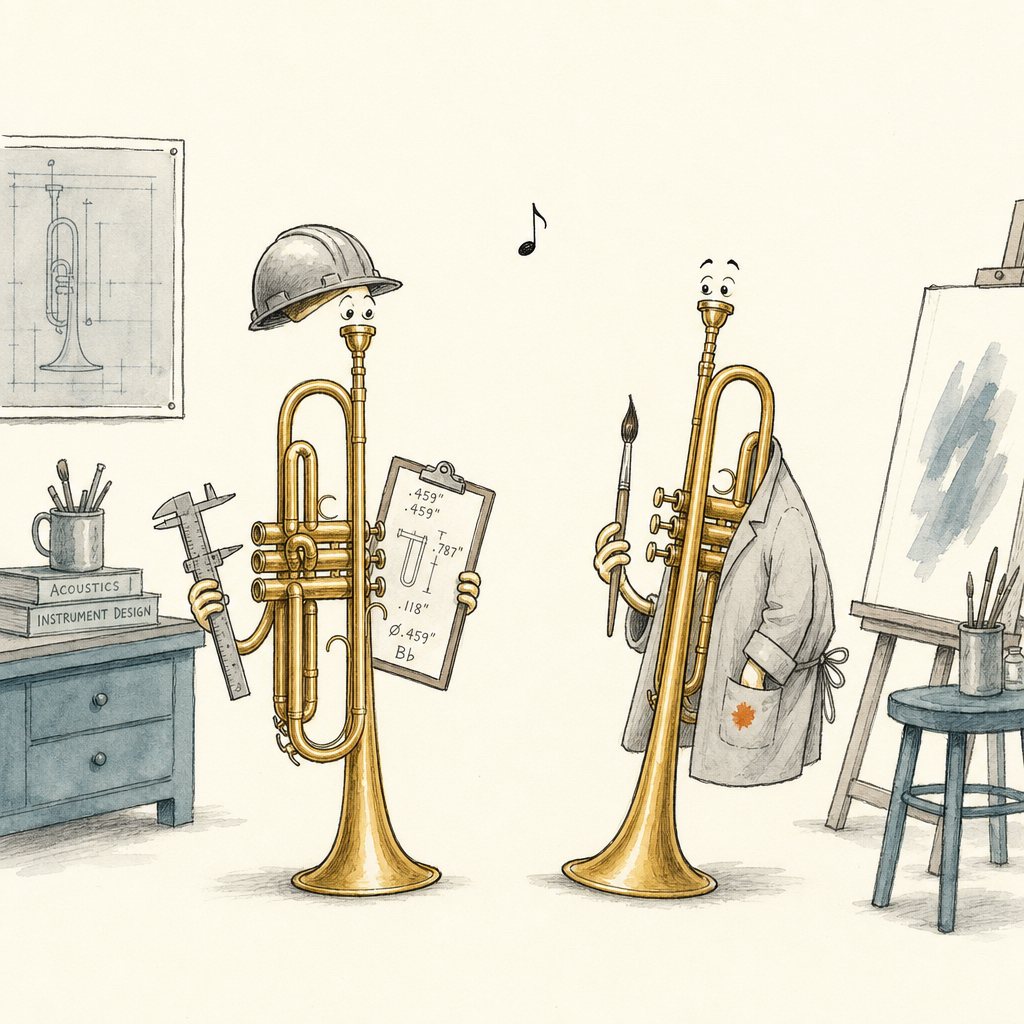
There are two ways to build a trumpet embouchure. Most players only know one of them, and that’s exactly why so many of them end up stuck.
Picture two people walking into a workshop with the same goal: build something that works.
The first one is a draftsman. Before they touch a single tool, they pull out a blueprint. They want to know what every part does. They measure with calipers. They label the components. They want to understand the system so completely that if something breaks, they can point straight at the broken piece and say, “There. That’s the problem. That’s why.”
The second one is a painter. They don’t measure anything. They have a picture in their head of the finished thing, and a trained eye that tells them when reality matches the picture and when it doesn’t. They don’t think in parts. They think in the whole. They put a stroke down, step back, look, and adjust. The image in their mind pulls their hand into place.
These are the two ways to build an embouchure. The engineer and the artist. And here’s the thing most players never figure out: you need to be both.
The engineer’s way
The engineer breaks the embouchure into components. The lips and how they’re vibrating. The aperture, the size of the hole the air travels through. The corners and how they’re set. The jaw position. The tongue. The air and how it’s compressed. The engineer wants to know how each of these works on its own and how they work together as a system.
This is useful, and not just a little useful. When you understand the embouchure as a system, you can do something the artist can’t. You can reverse-engineer a problem.
Say your high range disappears. The artist feels that something is wrong but has no map to find it. The engineer goes down the list. Is the air moving? Is there pressure on the lips cutting off the vibration? Did the aperture collapse? Is the throat closing? The engineer has a diagnostic process because the engineer built the thing on purpose and knows where all the wires run.
If you’ve read anything I’ve written about how the trumpet actually makes sound, you’ve seen the engineer at work. /how-a-trumpet-makes-sound/ is engineering. It’s me handing you a blueprint and saying, here’s the system, here’s what every part does, here’s why it works when it works. The whole /trumpet-embouchure-guide/ is built that way on purpose. The engineer wants the map.
Where the pure engineer goes wrong
But the engineer alone is not safe.
If you only ever think in parts, you stiffen up. You get on the horn and you’re running a checklist in your head. Corners set. Aperture open. Tongue arched. Air fast. And while you’re managing all of those parts like a control tower, the actual playing falls apart. The sound gets tight and small. The music disappears. You’ve turned a flowing physical act into a spreadsheet.
I’ve watched players do this. They know more about embouchure mechanics than I do, and they sound worse than a kid who’s never thought about it once. They’ve become so obsessed with the parts that they can’t hear the whole. They’re so busy reading the blueprint that they forgot to look up and see whether the building is actually standing.
A blueprint is a tool. It is not the building. The pure engineer confuses the two.
The artist’s way
The artist works completely differently. The artist has a sound in their head. A clear, specific, beautiful sound. And they let that imagined sound pull their body into doing whatever it needs to do to produce it.
The artist doesn’t think, “I need to arch my tongue and firm my corners.” The artist thinks about the sound they want, and the body, which is smarter than we give it credit for, figures out the arrangement of parts that gets there. The trained ear leads. The lips follow.
This is real, and it’s powerful, and I’ve written about it more than almost anything else. The whole body of work I’ve put out on sound, on aestheticism, on letting your ear lead your practice, all of that is the artist’s side of this. If that idea lands for you, that’s where to go deep. The sound is not a decoration on top of good technique. For the artist, the sound is the instruction. You hold the sound in your mind clearly enough and your body organizes itself around it.
Plenty of the best players who ever lived played this way. They never read a blueprint in their lives. They heard a glorious sound, they wanted it badly enough, and they chased it until their body delivered.
Where the pure artist goes wrong
So if the artist’s way works, and works beautifully, why not just do that?
Because feel is fragile. And one day it will desert you.
I’ve known players who could rip a double C without thinking. Effortless. Gorgeous. Pure feel, pure muscle memory, pure ear. And then life happened. They took three months off. Or they had some minor dental work and the inside of their mouth felt different. Or they just had a bad week. And suddenly the thing didn’t work anymore.
Here’s the cruel part. They couldn’t fix it. They were never sure what they were doing in the first place, so when it stopped working they had nothing to go back to. They were chasing a feeling, and the feeling was gone. You can’t reverse-engineer your way back to something if you never knew the steps that got you there. They were hunting for a sensation that no longer existed, getting more frustrated and more tense with every attempt, and the harder they hunted the further they got from it.
The pure artist plays beautifully right up until the moment they don’t. And then they’re standing in the dark with no map, no flashlight, and no idea which direction the door is.
That’s not a small risk. For an adult coming back to the horn, it’s the whole ballgame. A layoff is exactly the event that breaks the artist who has no engineering to fall back on.
The best players hold both
So here’s the truth, and it’s the whole point of this article.
The best players are both. They can feel their way, and they can think their way back.
Most of the time, they play like the artist. They’re not running checklists. They’re hearing the sound and letting it lead, because that’s how you actually make music and that’s how playing stays free and alive. The artist runs the show on a good day.
But underneath that, they have the engineer’s map. They know what the parts are and how the system works. So on the bad day, the day after the layoff, the week the feel won’t come, they don’t panic. They switch modes. They pull out the blueprint, run the diagnostic, find the part that drifted, and fix it. Then they hand the controls back to the artist and go back to playing.
The artist gets you the sound. The engineer gets you home when you’re lost. You need the painter’s eye and the draftsman’s map, and you need to know which one to use when.
A player with only feel is one bad month away from a crisis they can’t solve. A player with only analysis is technically correct and musically dead. The player who has both is the one who lasts.
How to actually build both
If all of this sounds like a lot to think about, good. It is. But you don’t build both sides at once, and you don’t build them by stressing about it.
You build the engineer slowly, in low-pressure moments. Not while you’re trying to play a hard passage. You learn the parts the way you’d study a diagram, calmly, off to the side, a little at a time. You play around. You experiment. You notice what changes when you change one thing. That’s how the map gets drawn.
And you build the artist by listening. Constantly. By holding a clear sound in your head and demanding that your playing match it. By letting your ear, not your checklist, be the final judge.
Over time the two stop being separate. The engineering sinks underneath the playing and becomes quiet. You stop thinking about parts and just play, the way the artist does. But the map is still there, drawn and folded in your pocket, ready for the day you need it.
That’s not two players fighting for control. That’s one complete player.
You don’t have to become an engineer
Here’s the objection I hear at this point: “Jesse, I’m not analytical. I don’t want to study diagrams and run diagnostics. I just want to play.”
Good news. You don’t have to become an engineer. You don’t have to love the blueprint, and you don’t have to think about parts while you play. The artist can still run the show. That’s how it should be.
You just need enough of the map that you can find your way back when feel deserts you. Not the whole engineering degree. Just enough. Enough to know what the parts are, enough to run a basic diagnostic on a bad day, enough that a layoff or a rough patch doesn’t end your playing. That’s the difference between a player who recovers in a week and a player who never recovers at all.
That “just enough” is exactly what I teach in my free 30-minute training. It’s the core map, in plain language, for players who want to play and not get a degree in chops mechanics. I’ve used it with over 100 trumpet players, and it’s the fastest way I know to give you a flashlight for the dark days without turning you into someone who can’t stop thinking.
Watch the free 30-minute training here: https://toot-your-own-horn.com/landing-page
Be the artist. Just keep the map in your pocket.