If you stopped playing the trumpet for a few months, a few years, or a few decades, your embouchure is going to be a problem when you come back.
Of course it is. It should be.
But here’s the wild part of every trumpet embouchure comeback I’ve coached: players get absolutely wrecked by this emotionally. Frustrated. Defeated. Angry at their own face. Meanwhile, in every other area of life, they’d shrug the same thing off.
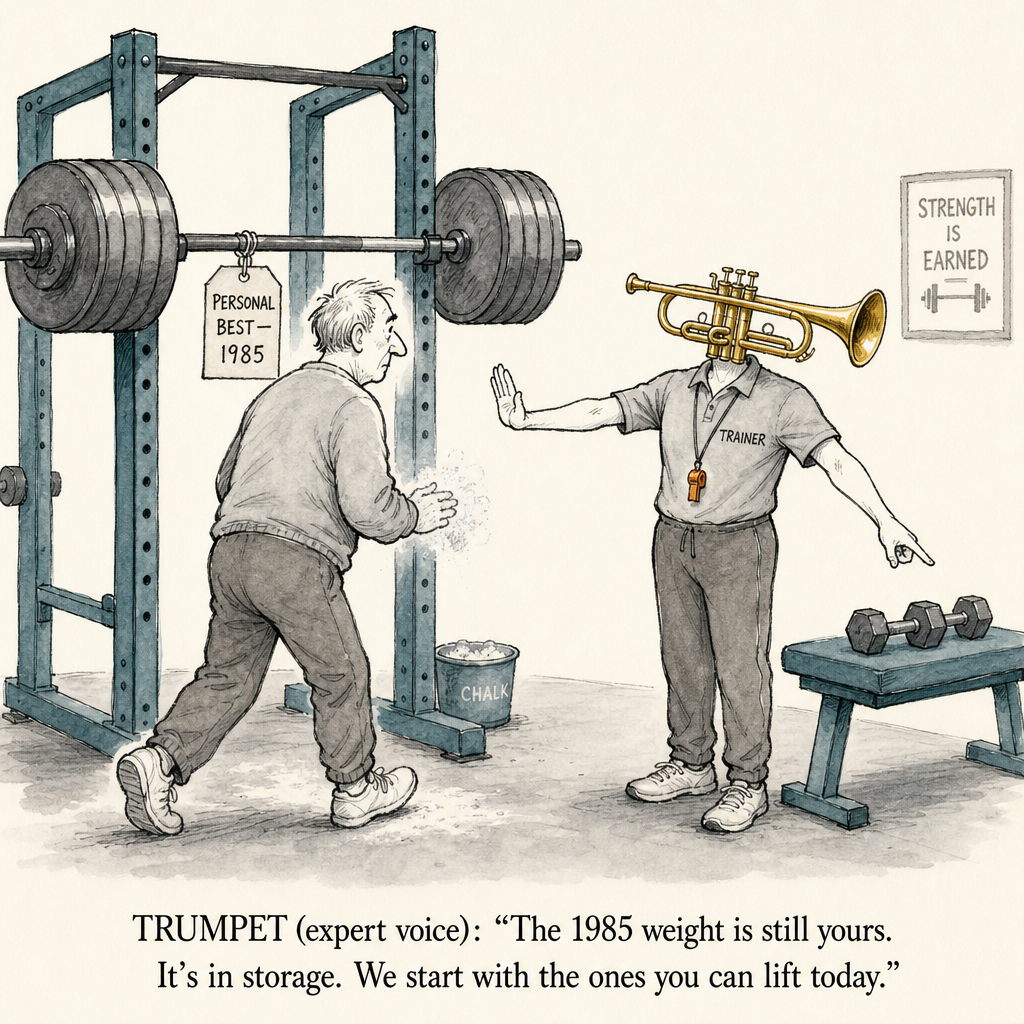
If you skipped the gym for a month, would you walk in on day one and load the bar with your old personal best? No. You know you’d hurt yourself. A month off means a short ramp-up. A year means a real one. A decade means you’re rebuilding from the ground up, and every experienced lifter knows it.
Nobody gets mad at their biceps for forgetting how to curl fifty pounds after ten years on the couch. But trumpet players get furious at their lips for forgetting how to play a high C after twenty years of silence.
Your embouchure is muscle, tissue, coordination, and habit. All four change when you stop using them. If you’re a comeback player whose setup feels broken, this article explains what’s actually going on and how to rebuild without making everything worse.
Your Memory Is Lying to You
Here’s something I’ve learned from working with over a hundred comeback players: your memory of how you used to play is almost certainly wrong.
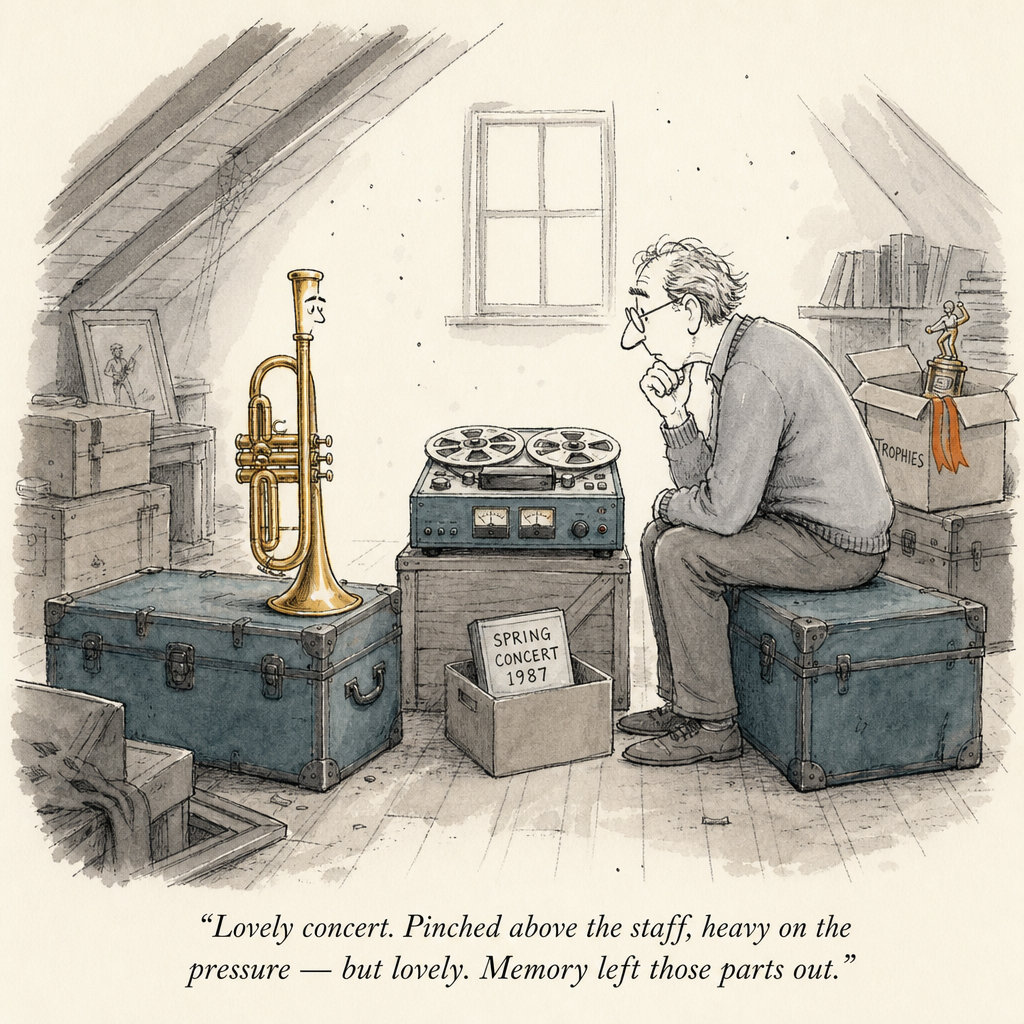
I know because I ask students to send me recordings from their glory days. Old concert tapes, recital recordings, marching band videos. And when I listen, one thing becomes clear fast.
They had embouchure problems back then too.
One of my students, a 56-year-old dentist who hadn’t played since high school jazz band, told me, “Jesse, I used to be able to play anything.” He dug up his senior year concert recording. Solid player, no question. But his tone was pinched above the staff, he was leaning on way too much pressure, and his timing got shaky whenever he reached. Classic forcing.
He didn’t remember any of that. He just remembered the standing ovation.
Memory glorifies things. It’s like remembering your college apartment as cool and funky, then seeing an old photo and realizing it was just dirty. Your brain keeps the highlights and edits out the rough patches.
Why does this matter? Because whatever problems you had back then will multiply during your comeback if you’re not careful. And because if you rebuild toward a standard that was already built on shaky technique, you’re aiming at the wrong target. That’s actually great news. Your comeback is a chance to build something better than what you had. But only if you know what you’re really dealing with.
The #1 Trumpet Embouchure Comeback Problem: Mouthpiece Pressure
This is the big one. The gravitational pull every comeback player has to resist.
Here’s what happens. You pick up the horn for the first time in years. Your brain remembers the music. It remembers what high Bb sounds like, how the lick you used to nail in jazz band goes. Your brain says, “Let’s go.” And your embouchure says, “Absolutely not.”
So you push harder. You press the mouthpiece into your face. You squeeze. And for a second, it kind of works. You eke out something that resembles the note. So your brain files it away: pressure equals results.
That’s the trap. Pressure isn’t a technique. It’s a crutch, and it gets more expensive every time you use it. More fatigue. Less flexibility. Thinner tone. Eventually, pain. It’s debt with compound interest.
Comeback players are especially vulnerable because there’s a gap between what your brain wants and what your face can currently deliver, and that gap screams at you to bridge it with force. It takes real discipline to say: not yet. I’ll get there, but not by crushing the mouthpiece into my teeth.
And here’s the part that stings if you’re over 40 or 50: some of what you got away with at nineteen, you can’t get away with now. A teenager can mash the mouthpiece into his face and still survive a three-hour rehearsal. At 52, the same pressure shuts you down in twenty minutes. It’s the twenty-year-old’s pizza-and-beer diet at fifty. The habit didn’t change. The body did. The margin for error got smaller, and the penalties got steeper.
The upside: players who rebuild with clean technique routinely play better at 55 than they did at 25. I’ve watched it happen dozens of times.
Coordination Before Strength
If I could tattoo one phrase on every comeback player’s forehead, it’s this: coordination before strength.
When you come back, think alignment, calibration, skill. Not strength. Not range. Not power. Not yet.
Why? Because muscle without coordination is worse than useless. It’s destructive. Think of a bicep curl with a bad grip that fires your forearm instead of your bicep. You can curl all day. Your forearms will get huge. The muscle you actually need never gets the message.
Your embouchure works the same way. If you’re playing with misaligned coordination — jaw tension, corners pulling the wrong direction, tongue in the wrong spot — then “building strength” means getting really strong at doing it wrong.
So start ridiculously conservative:
- Sound: the best tone you can produce right now, not the tone you used to have
- Range: stay where it feels easy and responsive, probably lower than you want
- Endurance: stop before you’re tired, not after
- Volume: softer than you think you should
- Rest: more breaks than feel necessary
- Comfort: if it hurts, stop. Period.
Yes, it sounds like I’m asking you to play like a beginner. In some ways I am. But you cannot build useful muscle without the coordination underneath it. Coordination is the foundation. Strength is the house. Pour the house before the foundation sets and the whole thing comes down.
Unfamiliar Is Not Broken
There’s a concept in the gym world called the mind-muscle connection: the neurological link between your brain’s intention and the specific muscle that executes it.
After a long break, that connection has been severed. The neural pathways that coordinated your corners, aperture, air, tongue, and jaw all at once have degraded. They’re still in there, buried under years of non-use, but they’re not running on autopilot anymore.
This is why the horn feels so foreign when you first pick it up. It’s not just a strength problem. It’s a communication problem.
And here’s the critical error comeback players make: they interpret unfamiliar as wrong. “My lips feel weird. Something’s off. My embouchure is broken.”
No. It’s unfamiliar. Those are two different things. Weird, different, strange — completely normal after a layoff. What’s not normal: pain, extreme fatigue after a few minutes, wheezing, turning beet red, sharp discomfort in your lips or teeth. Those mean you’re not rebuilding. You’re overloading.
Learn to tell the difference between “this feels different” and “this hurts,” and you’ll save yourself months of frustration.
The Micro-Adjustment Trap
This one gets the tinkerers. And comeback players are all tinkerers, because they’re searching for what they lost.
You watched the YouTube videos. You read the forums. Somebody said you need a bigger aperture, so you crank it open — and if you don’t compensate with air speed and tongue position, everything goes flat and airy and you can’t finish a phrase. Or you go the other way, clamp down for “more compression,” and now you’ve got compression and no vibration.
Here’s what nobody explains: the changes that matter on the trumpet are tiny. Minuscule. Almost invisible.
If I’m sustaining a lip buzz on a high C and I move my jaw forward by a millimeter or two, the sound stops instantly. Dead. That’s the margin. Could I override it with more air and more muscle? Sure. But that’s not technique, that’s brute force, and brute force has a triple cost: energy, sound quality, and response.
So resist the big adjustment. When something isn’t working, the answer is almost never a dramatic change to your setup. It’s a small, precise turn of one tuning peg, then listen. If you do need to change something mechanical, there’s a right way to do it — I laid it out in how to practice embouchure changes.
What to Actually Do
The rebuild framework I use with every comeback student:
1. Accept where you are right now. Not where you were. Not where you want to be. If your comfortable range is low C to third-space C with decent tone, that’s your foundation. Own it without shame.
2. Live within your limits, then expand slightly. About 80% comfortable playing, 20% gentle exploration. Never force. Never squeeze.
3. Let your sound be the truth-teller. If the tone is resonant, full, and free, your embouchure is doing its job. If it’s pinched, thin, or forced, something’s wrong no matter what note you’re on. Your sound is one of the clearest diagnostic signals you have — I wrote a whole piece on reading your embouchure.
4. Monitor the warning signs. Red face, pain, five-minute fatigue, swelling that lasts days. Those flags mean scale back, not push through.
5. Get trained eyes on it. The adjustments you need are too small to see in a mirror and too subtle to feel on your own. A teacher who understands the comeback process can spot in ten minutes what you might spend ten months guessing at.
This Is Your Chance to Do It Right
Your comeback is not a disadvantage. It’s an opportunity.
Yes, you’ve lost conditioning. Yes, the horn feels foreign. But starting over means you get to start right. The pressure, the tension, the forcing — this is your chance to leave them behind. You don’t have to rebuild to where you were. You can rebuild to something better, because this time you’re building on a foundation instead of compensations.
Alignment. Calibration. Coordination. Skill. Those are your four pillars. Build on them and you’ll surprise yourself.
If you want the full picture of how I walk comeback players through this — what to rebuild first, what to ignore, and how to tell progress from damage — I put it in a free training. It’s thirty minutes, it’s the same framework I use with players in the program, and you can use it Monday morning. Watch the free 30-minute training and start your comeback on the right foundation.
— Jesse