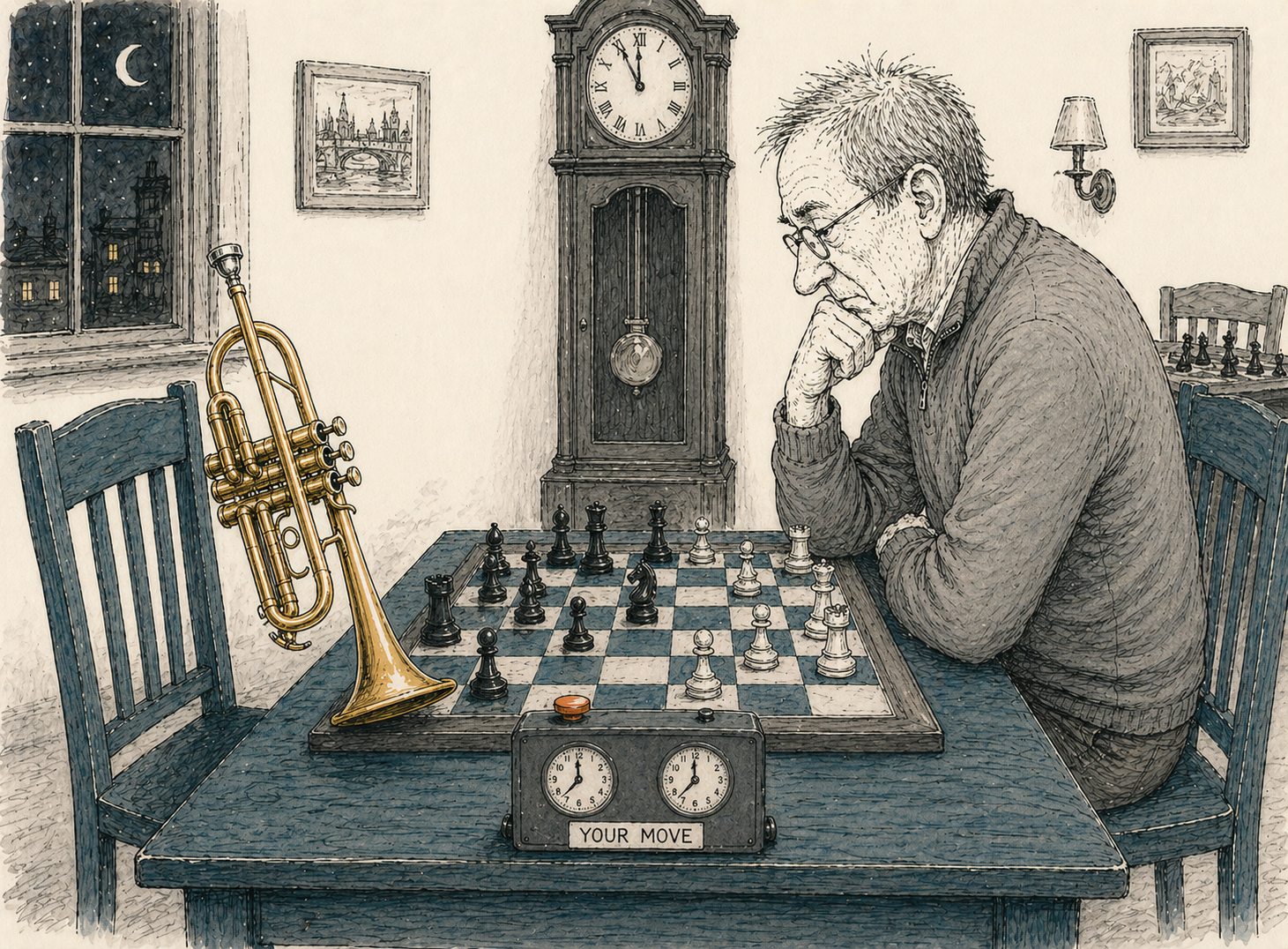
I play chess. I’m not great at it, but I enjoy the game. And over the years, I’ve noticed that chess players understand something about improvement that most trumpet players don’t understand. And I think that understanding could transform how trumpet players approach their practice.
Here’s what I mean.
In chess, there are essentially two types of decision-making: calculation and intuition.
Calculation is when you think through the consequences of your move. You say to yourself, “If I move here, my opponent can respond with that, and then I can respond with this.” You’re thinking ahead. You’re analyzing. You’re calculating.
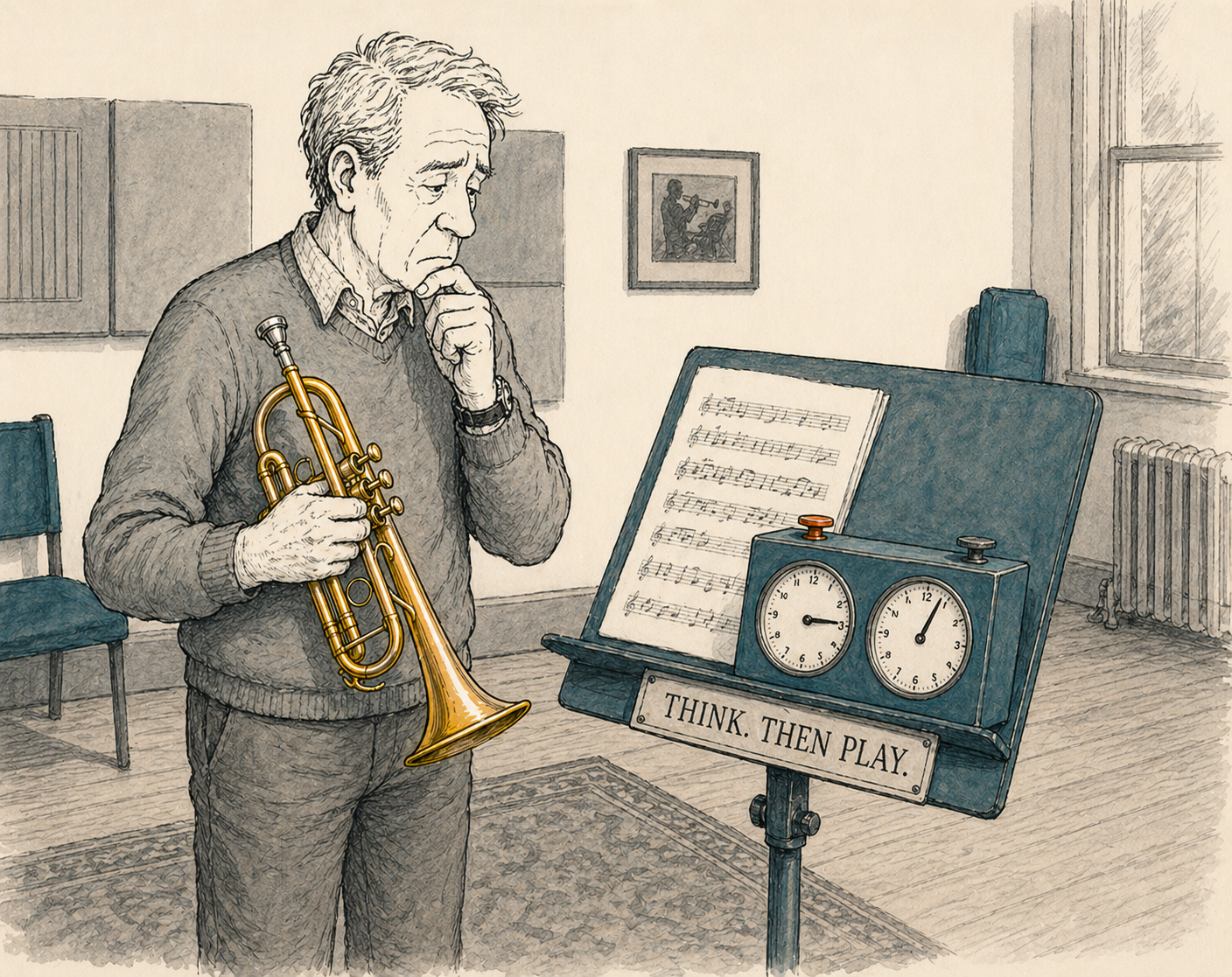
Intuition is when you know something without necessarily being able to explain why. You look at the board, and you just know that a particular move is good. You might not be able to calculate all the variations. You just have a feeling.
Both types of decision-making are valuable. But here’s what’s interesting: chess players understand that intuition is built on calculation. If you want to develop strong intuition, you have to do a lot of calculation first. You have to study positions. You have to analyze games. You have to think through variations.
And here’s the key: once you’ve done enough calculation, the intuition develops automatically. You don’t have to consciously think about it. The intuition is just there.
Now, what does this have to do with trumpet playing? Everything.
Most trumpet players operate primarily on intuition. They pick up the trumpet and play. They rely on feel. They rely on their ears. They rely on muscle memory. And all of these things are valuable. But they’re not enough.
What’s missing is the calculation. What’s missing is the analysis. What’s missing is the conscious understanding of what’s happening.
Let me give you an example. Let’s say you’re a trumpet player, and you’re working on the high C. You play it, and it cracks. You try again, and it cracks again. So you try a different approach. You loosen your embouchure a little. You try again. And this time it works. You hit the C.
Great. But here’s the problem: you don’t really understand why it worked. You just know that it worked. Your intuition is that loosening the embouchure helps. But you haven’t calculated why. You haven’t analyzed what’s happening.
So next time you’re playing high C, you might remember to loosen your embouchure. Or you might not. It depends on whether your intuition kicks in at the right moment.
But what if you understood the mechanics? What if you understood that tightening the embouchure creates tension, which makes it harder to produce the fast vibration needed for a high C? What if you understood that relaxing the embouchure allows the vibration to happen more freely? What if you understood the physics behind it?
Then, you wouldn’t be relying on intuition. You’d be relying on understanding. You’d be relying on calculation. And this understanding would carry over to all of your playing, not just high C.
This is what chess players understand. They understand that you have to invest time in calculation and analysis. You have to study. You have to understand the principles. And then, once you’ve done that work, the intuition develops.
But many trumpet players skip the calculation step. They rely entirely on intuition and feel. And as a result, their playing plateaus. They hit a ceiling because their intuition can only take them so far. To go beyond that ceiling, they need understanding.
So how do you develop this understanding? How do you do the calculation that builds intuition?
First, you need to study the fundamentals. You need to understand how the embouchure works. You need to understand how breathing works. You need to understand how the trumpet itself works. Not just in a vague, general sense, but in a detailed, specific sense.
Read articles. Watch videos. Take lessons. Absorb information about how trumpet playing works.
Second, you need to apply this understanding to your practice. When you’re practicing, don’t just play. Think about what you’re doing. Analyze your playing. Ask yourself: why did that note work? Why didn’t that note work? What mechanics are involved?
Third, you need to record yourself and listen critically. Record your practice sessions. Listen to them with a critical ear. What are you doing well? What are you doing poorly? What can you improve?
Fourth, you need to experiment. Try different approaches. See what works and what doesn’t. And more importantly, try to understand why certain things work.
This is the calculation. This is the analysis. This is the work that builds intuition.
Here’s something else that chess players understand: the best players in the world are not the ones with the best intuition. They’re the ones who have calculated the most. They’re the ones who have studied the most variations. They’re the ones who have analyzed the most games.
Garry Kasparov didn’t become the world chess champion because he had magical chess intuition. He became the world chess champion because he studied harder than anyone else. He calculated more variations. He analyzed more games. He prepared more thoroughly.
And here’s the thing: after studying all of those games, after calculating all of those variations, his intuition became incredibly strong. He could just look at a position and know the right move. But that intuition was built on a foundation of hard work and calculation.
The same is true for trumpet playing. The best trumpet players in the world are not the ones with the best natural instincts. They’re the ones who have worked the hardest. They’re the ones who have studied the most. They’re the ones who have analyzed their playing the most.
So here’s my challenge to you. The next time you’re practicing trumpet, don’t just play. Analyze. Calculate. Ask yourself questions. Understand what you’re doing and why you’re doing it.
Record yourself. Listen critically. Study the fundamentals. Experiment with different approaches. Do the work that builds intuition.
And here’s what will happen: your intuition will become stronger. Your playing will become more consistent. Your understanding will become deeper. And you’ll continue to improve in ways that you couldn’t improve by relying on intuition alone.
This is what chess players know. This is what the best trumpet players know. And now you know it too.
So go ahead. Stop relying solely on intuition. Start doing the calculation. Start doing the analysis. Start building the foundation that intuition rests on.
Your trumpet playing will thank you.
Want this kind of thinking applied to your own playing?
The free 30-minute training reveals the same framework I use with my 1% Trumpet Program students — the one most comeback players never figure out on their own.
Watch the free training →Want the full system in 30 minutes? Watch the free training — the same diagnosis-first framework I use with every player in the 1% Trumpet Program.