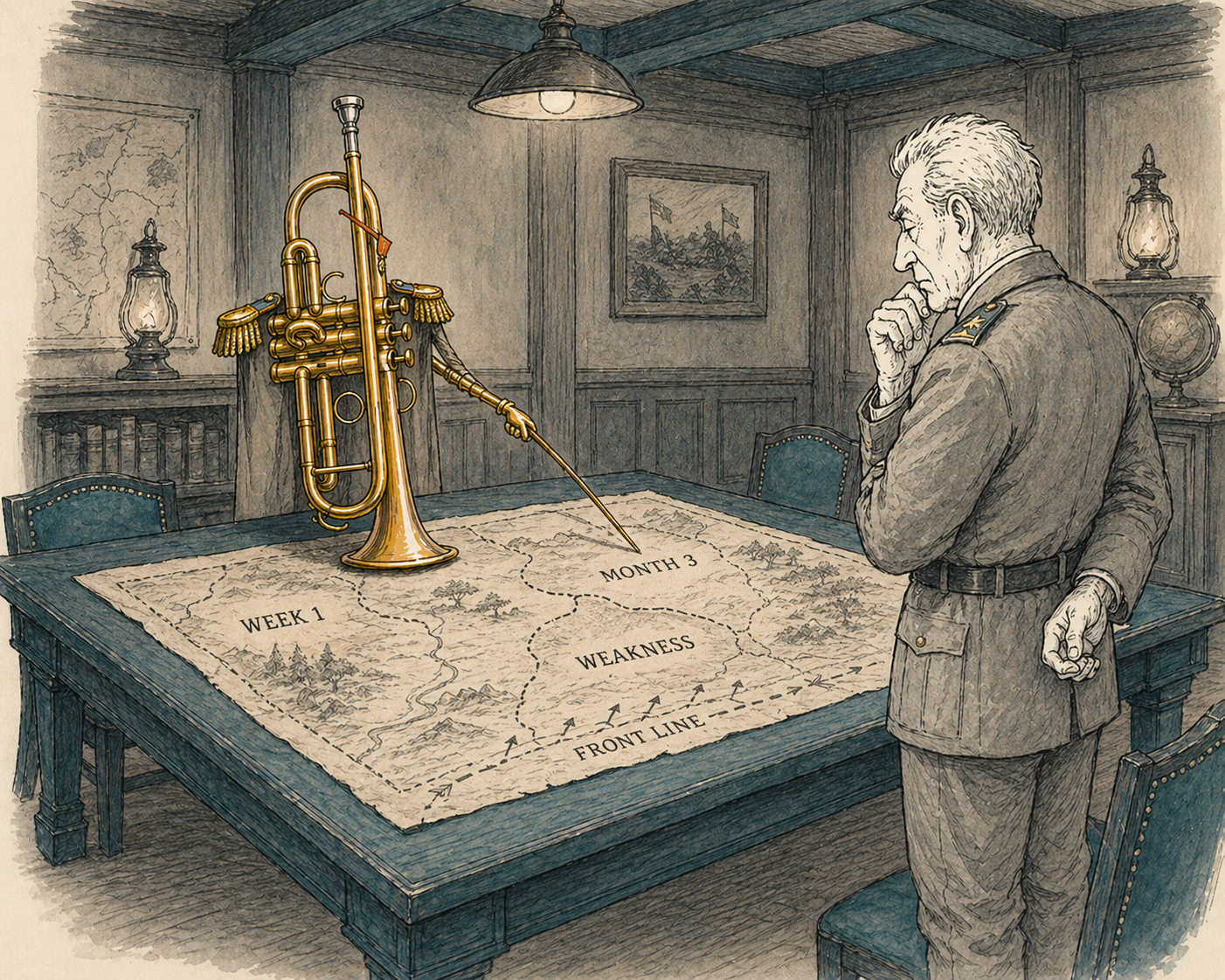
I want you to imagine something. Imagine you’re in a war. There’s an enemy that’s been holding you back, preventing you from becoming the trumpet player you want to be. This enemy has been robbing you of progress, sabotaging your efforts, keeping you stuck.
Now here’s the thing: you are both sides of this war. You are the general leading the charge. And you are also the enemy.
This is one of the most important concepts I want to share with you. Because the real battle in trumpet playing isn’t against external forces. It’s against yourself. It’s against your habits, your fears, your excuses, your self-imposed limitations.
So I’m going to suggest something radical. I’m going to suggest that you declare war on yourself. Not in a destructive way, but in a way that’s designed to overcome the obstacles you’ve created.
Here’s what that looks like.
First, you need to identify the enemy. Who is this enemy? What are they doing? What are the tactics they’re using to hold you back?
Maybe your enemy is procrastination. You know you should practice, but you find reasons not to. You tell yourself you’ll do it tomorrow. You tell yourself you’re too tired. You tell yourself you don’t have time.
Maybe your enemy is perfectionism. You’re so afraid of playing a wrong note that you don’t take any risks. You play it safe. You never push yourself.
Maybe your enemy is self-doubt. You don’t believe in yourself. You think other players are better than you. You think you’re not talented enough.
Maybe your enemy is impatience. You want results immediately. When you don’t get immediate results, you get discouraged and give up.
Maybe your enemy is distraction. You can’t focus during practice. Your mind is all over the place.
Whatever your enemy is, you need to identify it. You need to understand exactly what’s holding you back.
Second, you need to develop a strategy to defeat this enemy. This is where the war metaphor becomes useful. In a real war, you don’t just rush at the enemy without a plan. You develop a strategy. You figure out their weaknesses. You figure out how to exploit those weaknesses.
Let’s say your enemy is procrastination. What’s the weakness of procrastination? The weakness is that it depends on an action not being taken. If you can force yourself to take action, procrastination loses its power.
So your strategy might be this: every morning, before you do anything else, you’re going to practice trumpet. No exceptions. No matter how you feel, no matter what else is going on, you’re going to sit down and play.
Why is this effective? Because procrastination thrives on flexibility. It thrives on the idea that you can always do it later. But if you remove the flexibility, if you make it non-negotiable, procrastination can’t get a foothold.
Let’s say your enemy is perfectionism. What’s the weakness of perfectionism? The weakness is that it paralyzes you. It prevents you from taking action. So your strategy might be this: you’re going to play a passage, and you’re going to accept that it will be imperfect. You’re going to give yourself permission to make mistakes. Because the only way to improve is to try things, and trying things means making mistakes.
Let’s say your enemy is self-doubt. What’s the weakness of self-doubt? The weakness is that it doesn’t have evidence. Self-doubt is just a feeling. It’s not based on reality. So your strategy might be this: you’re going to write down every accomplishment, no matter how small. You’re going to track your progress. And whenever doubt creeps in, you’re going to look at this list and remind yourself that you are capable of improvement.
Third, you need to commit to the war. This is where most people fail. They identify the enemy. They develop a strategy. But then they half-heartedly implement it. They try it for a few days, and when it gets hard, they give up.
But if you’re going to declare war on yourself, you have to be serious about it. You have to commit fully. You have to understand that this is a real conflict, and you’re going to fight it with everything you’ve got.
This means some things are going to be hard. This means you’re going to have to push yourself in ways that are uncomfortable. This means you’re going to have to say no to things you want to do in order to stay true to your strategy.
For example, if your strategy is to practice first thing every morning, that means you might have to go to bed earlier. You might have to skip a social event to get enough sleep. You might have to wake up an hour earlier than you’re used to.
Is that worth it? That depends on how serious you are about becoming a better trumpet player.
Fourth, you need to keep track of the war. This is important. In a real war, you’d keep track of victories and defeats. You’d know which strategies are working and which ones aren’t. You’d make adjustments based on what you learn.
You should do the same thing in your personal war. Keep a journal. Write down what you’re doing. Write down how it’s working. Are you making progress? Are you still struggling with procrastination? Is your strategy effective?
If something isn’t working, change it. Don’t be married to a particular strategy. Be willing to adapt.
Fifth, and this is important, you need to understand that this war never ends. You defeat one enemy, and another one takes its place. You overcome procrastination, and now perfectionism becomes the problem. You overcome self-doubt, and now impatience becomes the problem.
But that’s okay. That’s actually a sign of progress. Because at least you’re no longer dealing with the same enemies. You’re moving forward, even if you’re still fighting.
So here’s what I want you to do. I want you to declare war on yourself. I want you to identify the internal enemy that’s holding you back. I want you to develop a strategy to defeat that enemy. And I want you to commit fully to that strategy.
Because the truth is, you’re more powerful than you think. You have the ability to overcome anything that’s standing in your way. But you have to be willing to fight for it.
So what do you say? Are you ready to declare war on yourself? Are you ready to win this battle?
The only enemy standing between you and the trumpet player you want to become is yourself. And you have the power to defeat yourself.
So go ahead. Declare war. And then get to work.
Want this kind of thinking applied to your own playing?
The free 30-minute training reveals the same framework I use with my 1% Trumpet Program students — the one most comeback players never figure out on their own.
Watch the free training →Want the full system in 30 minutes? Watch the free training — the same diagnosis-first framework I use with every player in the 1% Trumpet Program.