Picture two archers at the same range, with the same draw weight, the same arrows, the same wind.
The first archer steps to the line and shoots. The arrow lands somewhere in the grass. He nods, picks up another, shoots again. Lands somewhere else. A hundred arrows later, the arrows are scattered across the field in roughly the same pattern they were at the start. He had a good time. He drew the bow a hundred times. He thinks he is getting better.
The second archer steps to the line and looks at a specific target. A circle painted on a bale of hay forty yards away. She shoots. The arrow lands two feet left and a foot low. She makes a note. Draws again. Lands a foot left and six inches low. Makes a note. Two hundred arrows later, the arrows are clustered in a tight grouping a few inches across. Half of them are inside the painted circle.
Same draw weight. Same equipment. Same hours. Completely different outcomes.
The difference is not effort. It is not talent. It is that one archer was aiming at a specific target and one was aiming at the field.
Most trumpet players are the first archer. They practice for years, they put in the reps, and the arrows stay scattered because they never aimed at a specific target. Their sound never converges, because there is nothing for it to converge toward.
This article is about how to be the second archer. It is about the single most powerful self-evaluation framework I have found for sound development, which I call the Probability Game. The broader frame for sound development is laid out in the trumpet sound guide. This article zooms into the actual practice mechanism, the loop you run on every note, every day, for the rest of your playing life.
Want the full walkthrough? Watch the video.
The Fuzzy-Target Trap
Here is the question most trumpet players ask themselves when they finish a long tone, a scale, a phrase, or a piece.
Did that sound okay?
That is the question. Not even consciously. It runs as a background process while you play. The reps go by, and you are vaguely monitoring some internal mood-meter that is supposed to tell you whether what just came out of the bell was acceptable or not.
The problem is that “okay” is not a target. Okay is the field. Okay is anywhere within a wide acceptance band that drifts based on how you feel that morning, how tired your face is, what kind of week you have had, whether you compared yourself to a recording you heard yesterday, whether you are upset with your dog. Okay floats. Okay is hay.
The result is what happens to the first archer. You shoot a hundred arrows. The arrows land all over the field. You go home pleased that you drew the bow a hundred times. The next day you do it again.
Three years go by. You are stronger. You have more endurance. You can play higher than you used to. And your sound, the actual quality and identity of the sound coming out of the bell, is roughly where it was three years ago. Maybe a little more polished. The pattern of arrows on the field has not tightened.
This is not because you did not work. It is because the question you were asking did not have a target attached to it.
The question you need is not did that sound okay. The question is did that sound like the specific player I have chosen as my reference, yes or no.
Yes or no.
That is the Probability Game.
Why You Need a Reference Before You Run the Loop
Before I unpack the loop, I have to flag something that will trip you up if I do not.
The Probability Game does not work without a singular reference player. You have to have already done the work of picking one trumpet player and meaning it before this loop has any traction at all. If your reference is fuzzy, if your reference is “good trumpet sound in general,” if your reference is a smear of every player you have ever liked, then the binary question collapses back into the fuzzy one. Does this sound like good trumpet? is just did that sound okay wearing a different hat.
You need a target. A specific target. A circle painted on a bale of hay.
For most of the players I work with in the 1% Trumpet Program, that target is one of four canonical North Stars: Wynton Marsalis, Miles Davis, Nicholas Payton, or Harry James. There are dozens of other legitimate options. Pick yours from the article above, install it for at least six months, and only then come back here and start running the loop.
Everything below assumes you have done that. If you have not, the loop will not converge, and you will think the loop is broken when really it is the missing reference that is broken.
The Probability Game Defined
Here is the loop, in its simplest form.
You play a note. Any note. A long tone. The first note of a scale. The third note of a phrase you are working on.
Then you ask yourself one question, and the question only has two acceptable answers.
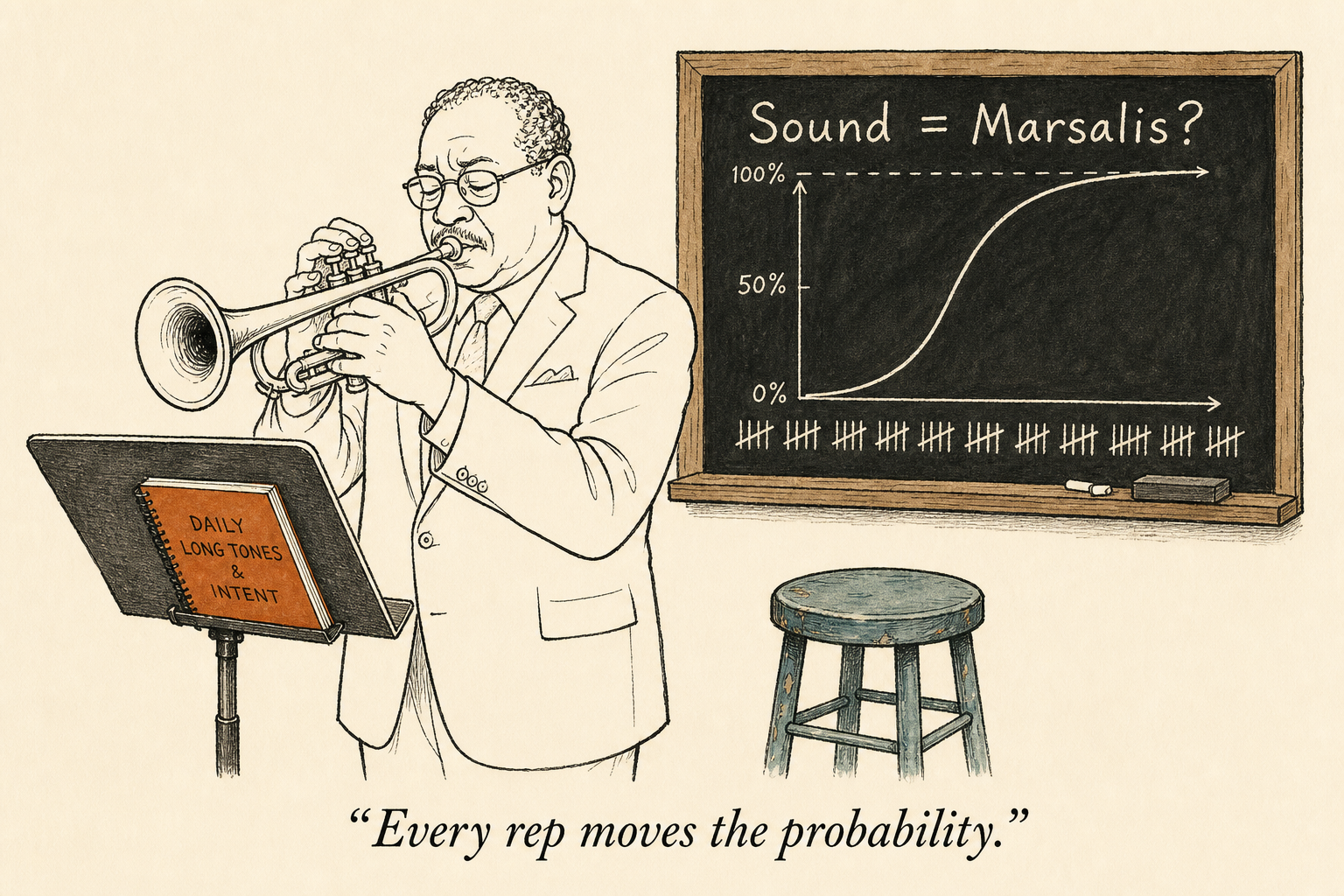
Does this sound like Marsalis? Yes or no?
If the answer is no, which it will almost always be at the start, you ask a follow-up question. What is different? Is the aperture wrong? Is the air thinner than his? Is the vibrato in a different place, or not there when it should be? Is the articulation pinched? Is the sustain decaying when his would open?
You make a small adjustment. Just one. Then you play the note again.
Same question. Yes or no.
That is the loop. Two questions. A small adjustment. Repeat.
The first time you run it on a single note, you will probably get a 2% match. The aperture is off, the air is off, the vibrato is wrong, the articulation lands in the wrong place, the sustain is decaying. There is a lot wrong.
That is fine. The probability is what it is.
The next time you run it on that note, with one small adjustment, the probability creeps to maybe 3%. A hundred reps later, with active attention to what you hear in your head versus what is coming out of the bell, the probability is 8%. A thousand reps later, 25%. Ten thousand reps later, 60%. A hundred thousand reps later, you are closer to your North Star than you are to your prior self.
That is the Probability Game. It is not magic. It is the simple binary question, asked with discipline, over a very large number of reps, against a specific target.
This is also exactly what the second archer is doing. Every shot, the question is the same. Did the arrow land in the circle, yes or no? Every miss is information. Every miss tightens the next shot. The cluster on the bale tightens not because of any single arrow but because of the pattern of evaluation across all of them.
Why Binary Works
You might ask why the question has to be yes or no. Why not a 1-to-10 scale? Why not “pretty close” or “kind of”?
I will tell you why, because this is the part most players miss.
A scale invites waffling. If you give yourself a 1-to-10 to grade your note against, the part of your brain that does not want to face the truth will always argue you up half a point. It was a 6, not a 5. It was almost a 7. It was getting there. The grading drifts, and the cumulative effect is that you stop noticing the gap between your sound and the reference, because the half-point lies aggregate into a feeling of progress that is not real.
Binary kills the waffle. Yes is yes. No is no. Did this sound like Marsalis? If it sounded like Marsalis, the answer is yes. If it sounded almost like Marsalis, the answer is still no. Almost is not a yes. Close is not a yes. The bar is high and the bar is fixed.
This is why the loop converges. The pressure of an honest binary question, asked thousands of times against the same fixed target, forces your nervous system to actually solve the problem. There is no soft middle to retreat into. Either the bell is producing the reference sound or it is not. Adjust. Try again.
The other reason binary works is that it makes the feedback decisive. When the answer is no, the next move is obvious: change something. When the answer is yes, the next move is also obvious: lock that in and try to repeat it. There is no analysis paralysis, no sliding scale of “well it was kind of like him but also kind of not, so I guess I will just play it again the same way.” The loop has clean entry and clean exit.
The Convergence Curve
Here is what running this loop actually looks like over time, so you know what to expect and you do not abandon it three weeks in.
Month 1. Mostly noes. The probability of any given note sounding like your reference is in the low single digits. You are mostly hearing the gap. This is uncomfortable. Most players quit here, because the loop feels like it is making them worse. It is not making you worse. It is making the gap visible. The gap was always there. You just had not been measuring it.
Month 3. Still mostly noes, but now you can hear specifically what is wrong. The aperture is too small. The air is not warm enough. The vibrato kicks in too early. You are starting to decompose the gap into named components. Your sound has not changed dramatically yet, but your ear has.
Month 6. The yeses start happening, mostly on individual notes in your middle register. Long tones in the second-line G area start to feel like they are landing closer. You start catching your sound on a recording and going, wait, that one phrase actually had something. The cluster on the bale is starting to tighten.
Month 12. Whole phrases start to sound right. Not all the time. But often enough that you can recognize the sound when it shows up. People around you start to comment, even if they cannot say what changed. You sound different. That is the cluster moving.
I want to be honest with you about this timeline because the work is real and I do not want to sell you a six-week miracle. Sound development is not a six-week thing. It is a six-month thing at the earliest, and a multi-year thing in full. But the curve is reliable. If you run the loop, the curve happens. If you do not, it does not.
Where the Reps Go
You do not run the Probability Game everywhere at once. You run it in a specific sequence, and getting the sequence right matters.
Long tones first. This is where the loop has the cleanest signal. One note, sustained, your full attention on the sound coming out. Does this sound like Marsalis? Yes or no? The long tone is the unit cell of sound development. If you cannot win the loop on a long tone, you cannot win it anywhere else. Spend the first thirty days mostly here.
Scales next. Once a single note can land in the yes column with some regularity, you move to scales. The loop now runs on every note inside the scale, and you start to notice that some notes in your range are easier to land than others. The G in the staff might land yes most of the time, but the C-sharp above it lands no, and the low F-sharp below it lands no. The scattered notes are where the next batch of reps goes.
Phrases after that. You take a short phrase from one of your reference’s recordings and try to match it. Not the rhythm, not the notes. The sound. Does each note inside that phrase sound like him? Yes or no? This is harder than the scale, because phrases require the loop to run faster, and your evaluation has to keep up with playing.
Full pieces last. Eventually you can run the loop in real time across an entire piece, but this takes a long time and you should not rush it. If you try to evaluate the sound on every note of a six-minute piece while you are playing it, your playing falls apart. Build the loop in long tones, then scales, then phrases, then pieces. In that order.
This is the same way the archer trains. You start at a stationary bale, forty yards out, painted circle. You learn to land arrows in the circle. Then you back up. Then the target moves. The loop is the same. The conditions get harder.
The Recording Habit
There is a second arrow in the Probability Game, and most players never use it.
The first arrow is the live evaluation. You play the note, you ask the question, you adjust.
The second arrow is the recording. You record the practice session, and you listen back the next day with the same binary question. Does this sound like Marsalis? Yes or no?
Your in-the-moment evaluation lies to you. The sound you hear while you play is mixed with the resonance of your own skull, the breath in your nostrils, the buzz of your lips against the mouthpiece. You are not hearing what comes out of the horn. You are hearing what comes out of the horn plus all of that.
Recording strips that out. You hear what the bell actually produced. The gap between what you thought you played and what you actually played, the first dozen times you do this, is shocking. Players cry the first time they do it honestly. Not because their sound is bad. Because their sound is not what they thought it was.
That is good. The truth is information. The truth tightens the next shot.
Record yourself once a week, listen back the next morning, and run the binary question on the playback. Do not listen the same day. Sleep in between. Your ear resets overnight, and the day-after listen is more honest. A phone six feet from the bell is fine. You do not need a studio mic.
The loop is also where audiation comes in. The inner-ear rep, where you hear the note in your head before you ever play it, primes the actual rep. You audiate the Marsalis sound, you produce the note, you compare. The cleaner the inner-ear rep, the more useful the comparison. If you are not audiating before you play, the binary question has nothing to compare to except the open field.
Pacing the Work
This is the part that will save you, so spend a minute here.
The Probability Game is intense. Every rep, you are running an honest evaluation against a high bar, and every honest no is a small ego hit. You cannot do this for four hours a day, every day, for a year. You will burn out. Your face will blow up, your patience will collapse, and you will end up resenting the horn.
The way to avoid that is to alternate. There are two valid models. Pick the one that fits your body.
The first model is hard days alternated with full rest days. You run the loop hard for a session. The next day, the horn stays in the case. The rest day is not optional and it is not lazy. It is when the nervous system consolidates the learning from the day before.
The second model is hard days alternated with light days. The light day is twenty or thirty minutes of soft, easy playing, no evaluation, no Probability Game. You are just blowing air through the horn at low volume, keeping the muscle warm, letting your ear coast. This works particularly well for younger players, players in comeback mode, and anxious players who cannot tolerate a full day off without spiraling.
Both work. Pick the one that fits. The thing that does not work is grinding the loop seven days a week with no recovery until your face quits and your ear gives up. The Probability Game compounds with patience. It does not compound with grinding.
When You Hit “This Is Too Slow”
You are going to hit a moment, somewhere in the first month, where the answer to the binary question is no for the hundredth rep in a row, and a voice in your head says this is going to take forever. I cannot wait six months for the cluster to tighten. I want results faster than this.
I get it. Every player I have coached has been there.
Here is the reframe. Every other path is slower.
If you abandon the loop and go back to the fuzzy version, you go back to scattering arrows across the field. Your sound does not converge. You can play for twenty more years and end up where you started. If you switch references every two months because you are bored with the one you picked, you reset the loop every time. Six iterations of two-month resets equals zero progress. The convergence curve does not start ticking until the reference is stable. If you chase fast-feedback work instead, like high notes and articulation drills, you will improve at high notes and articulation. Those things matter and you should keep doing them. But your sound will not change. Sound work is slow-feedback work, by nature, and the only way to improve it is the slow-feedback path.
The Probability Game is not the slow path. It is the only path that converges at all. Every other path is a flat line dressed up as motion.
The archer who shoots scattered arrows for an afternoon feels like he is doing something. He is not. The archer who shoots ten arrows at a circle, evaluates, adjusts, and shoots ten more, looks like she is doing less. She is not. At the end of an hour, her arrows are clustered. His are still scattered. That is the whole story.
What This Has to Do With Why You Are Stuck
If you have been practicing for years and your sound feels stalled, the Probability Game is almost certainly the missing piece.
Not because you have not been working. You have been working. You have been drawing the bow. You have been shooting arrows. The arrows have been landing in the field, where the field is “okay trumpet sound, somewhere in the broad acceptable middle.”
What is missing is the painted circle.
When you install the circle, the pattern of your work starts to converge. Every rep starts to count toward something specific instead of toward “general improvement.” Six months in, the arrows are clustered. A year in, the cluster is small enough that someone else can see it from across the field.
This is the work I do every day with the players in the 1% Trumpet Program, and it is exactly the kind of work that is structurally hard to do alone. Your own ego will lie to you about whether the answer was yes or no. You need someone in the room who can hear what you cannot hear yet, run the loop with you, and tell you, with calibrated honesty, whether the bell is producing the reference sound or not.
If “this will take forever” is the voice in your head, here is the honest counter. The path you are on now takes forever and never arrives. The Probability Game takes a year and arrives. Pick the one that arrives.
We run a free 30-minute training that walks through the broader practice system underneath this loop, including how the program structures the slow-feedback work alongside the fast-feedback work, the protective reflex that quietly kills most adult players’ progress, and the 2:1 practice ratio that makes the convergence curve actually compound. It is the same training I use to walk new students through what we actually do.
You can grab it at toot-your-own-horn.com/landing-page.
If you want a sound, this is how you build one. Pick your reference, paint the circle, ask the binary question on every rep, and let the loop converge. The arrows will cluster. They always do, when you aim.
Continue with the rest of the Sound & Musicality series, or start with Pick One Trumpet Player and Mean It if you have not yet chosen your reference.