Before Michael Phelps swam a single stroke of an Olympic final, he had already swum the race a thousand times in his head.
He talked about it openly. Lying in bed the night before, eyes closed, he ran the entire race in his imagination. The dive off the block. The first stroke. The turn. The breath. The kick into the wall. He saw it from the inside. He felt the water. He felt the burn. He saw the scoreboard light up with his name at the top. By the time he climbed onto the block in real life, his body wasn’t searching for the race. It was executing a race it had already done.
NBA free-throw shooters do the same thing. The good ones step to the line and run the rep mentally before they let the ball go. They feel the bend in the knees, see the arc, hear the swish. The body then has a target to chase rather than a guess to take.
Now picture a trumpet player. Decent technique. Maybe twenty years of playing under his belt. Steps up to the front of the rehearsal, takes a breath, and goes for the entrance. The note cracks. Not because the chops are weak. Not because the air was bad. Because his inner ear had no clear picture of the note before it left the bell. He took a stab at it. The body had nothing to aim at, so it aimed at the field.
This is the article on the part of trumpet practice almost nobody talks about. The mental rep that comes before the physical rep. The thing every great player does whether they have a word for it or not.
The word is audiation. And if you build it, your sound, your accuracy, and your range will all move at the same time.
What Audiation Actually Is
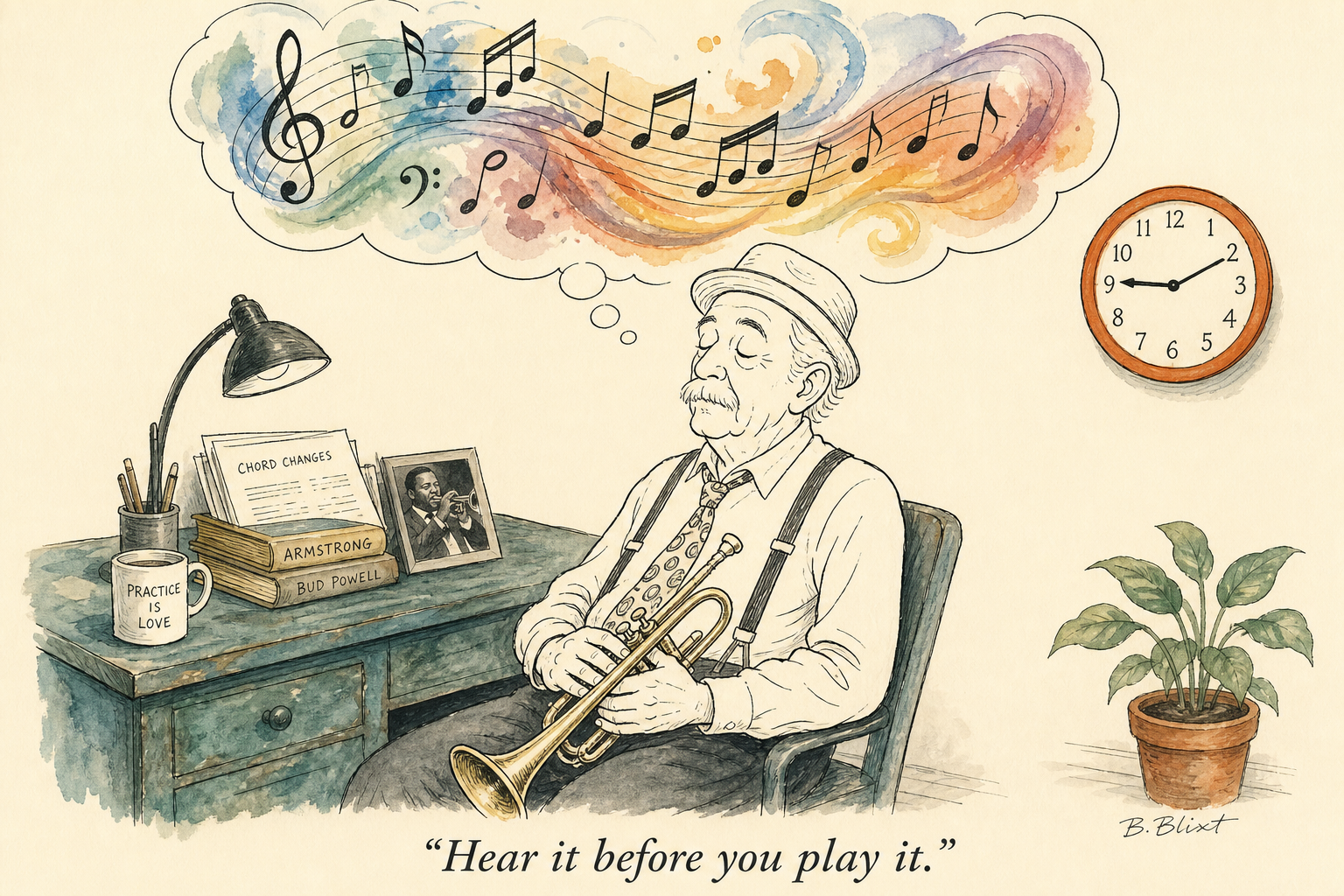
Audiation is the act of hearing a note, a phrase, or an entire piece of music inside your head before you play it. Not vaguely. Not “I kind of know how this goes.” Specifically. With pitch, with sound color, with rhythmic placement, with all the components stacked. It is the inner-ear rehearsal of what is about to come out of the horn.
Audiation gets confused with ear training all the time, and they are not the same thing.
Ear training is what you do to be able to identify and produce pitches when you encounter them. You hear a note, you can name it. Someone plays a major third, you can sing it back. That’s a real skill, and most band programs train it.
Audiation is upstream of that. It’s your ability to generate a sound in your imagination at will, with enough resolution that your body can chase it. You don’t need someone to play a note for you to hear. You hear it because you summoned it.
You can have great ear training and weak audiation. Plenty of trumpet players can identify any pitch you throw at them on a piano and still step up to a phrase with no clear inner picture of the sound they’re about to produce. They know what a high C is. They have not, at any specific moment before lifting the horn, imagined the high C they are trying to play. So the body fires off whatever average it has on file.
Audiation is the bridge between the imagination work this whole series has been about and the physical act of playing. Without it, the inner work stays trapped in your head. With it, it shows up at the bell.
What Phelps Was Actually Doing
When Phelps imagined the race, he was not idly daydreaming. He was rehearsing a specific motor pattern. Sports neuroscience has been clear on this for thirty years. When you vividly imagine performing a movement, the same neural circuits that fire during the real movement fire during the imagined one. Not as strongly. But the same wiring. The brain is, in a real sense, practicing.
That is why athletes who do mental rehearsal hit harder rep counts than the ones who do pure physical work. The pure-physical guy did a hundred reps. The mental-rehearsal guy did a hundred physical reps and another four hundred mental reps. He was practicing while he was driving home, while he was lying in bed, while he was eating breakfast. His total volume was multiples of the other player’s, with no extra wear on the body.
The free-throw shooter does it on a smaller time scale. The pre-shot routine you see at the line, the dribble and the breath and the look at the rim, that’s not superstition. That’s him running the rep in his head one last time. Loading the target so the body has something to aim at when the ball leaves his hands.
Audiation is the same mechanism applied to sound instead of motion. You rehearse the note in your inner ear. The neural circuits associated with producing that sound start to warm up. The body has a target. When the air starts moving, you are not searching for the note. You are executing against an internal reference.
Why Audiation Works
Here’s the simple version. Your body executes against a target. If there’s no target, the body picks one for you, and the one it picks is whatever average is on file.
When you play a note without audiating it first, your body has to make about a hundred micro-decisions in a fraction of a second. Aperture. Air speed. Air volume. Vibrato width. Vibrato onset. Articulation timing. Sustain shape. We covered this in the components piece. Each of those decisions has to come from somewhere.
If you have not pre-loaded a clear target sound, those decisions get made by your default settings. The default is whatever your nervous system has converged on after years of playing without conscious sound work. For most adult players, the default is the low-resolution average we talked about in the guide. Generic. Acceptable. Forgettable.
If you have pre-loaded a clear target sound, those same decisions get made in service of matching what you just heard internally. Aperture goes where it needs to go to produce that sound. Air does what it needs to do. Vibrato is shaped or suppressed based on what the inner ear demanded. The body executes against a real target instead of falling back on the default.
This is why audiation is the inner-ear rep that primes the actual rep. It is also why, as I argued in the probability game piece, the binary self-evaluation only works if you have something specific to evaluate against. Audiation is what loads that something into your nervous system in the moment, right before you check whether the bell delivered it.
You can do all the listening work in the world. If you don’t audiate at the moment of execution, the listening work doesn’t transfer. Audiation is the transfer mechanism.
The Three Levels of Audiation
Most players who try this hit a wall on day one because they expect their inner ear to be vivid right away. It usually isn’t. Audiation has levels, and you have to know which level you’re operating at so you can keep building toward the next one.
Level one. Faint impression. You know the rough shape of the note. You can sense it more than hear it. You know it’s higher than the last note. You know it’s somewhere in the middle of your range. You couldn’t hum it accurately if pressed. This is where most adult comeback players start, and it’s fine. It’s a starting point.
Level two. Clear pitch. You can hear the pitch in your head. If you hummed it, the hum would land on the actual note. The pitch is correct, but the sound color is still vague. You’re hearing “a note,” not “Marsalis playing a note.” Most players who do six months of dedicated listening work get to this level on most of their range.
Level three. Full sound with components. You can hear the pitch, the timbre, the vibrato, the articulation, and the sustain shape. The note in your head sounds like a specific player playing a specific note in a specific style. When you produce the actual note, you can compare it against this internal version with surgical precision. This is what the great players are doing, all the time, on every note. This is the level you’re building toward.
The progression is not linear. You’ll have notes in your range where you’re at level three. You’ll have other notes, often the high or low extremes, where you’re stuck at level one. That’s normal. The work is to systematically pull each note up the ladder. You can’t fix every note at once. You fix them in order of how often you play them.
Drill One: Pre-Hearing the Next Note in a Scale
Start small. Embarrassingly small. The first audiation drill I give players is to pre-hear individual notes inside a slow scale.
Here’s how it goes.
Pick a major scale you know cold. C major works. Put the metronome on something slow. Sixty beats per minute. Each note gets a full beat.
The horn stays on your lap. You don’t play yet.
Beat one. You audiate the first note of the scale. Hear it in your head. Pitch, timbre, vibrato if applicable, articulation. Whatever level you can get to.
Beat two. You audiate the second note. Different pitch, same care.
Run through the entire scale this way, octave up and back, just listening internally.
Then you do it again, this time playing the scale, but with one rule. Before each note, you audiate the note for half a beat, then play it. The horn comes up, the breath comes in, but the air doesn’t move until you’ve heard the note in your head. Then you play it. Then you check. Did the bell match the inner ear? Yes or no?
This drill takes about three minutes. It is brutally hard to do well. You will catch yourself playing without audiating constantly. That’s the drill. Every time you catch yourself, you’re getting better at noticing the absence of the inner-ear rep.
Run this drill at the start of your practice session for a week. Do not skip ahead until the catch rate is high. The catch rate is what compounds.
Drill Two: Full-Phrase Audiation
Once individual notes feel reliable, the next move is phrases. This is where audiation starts paying compound interest, because phrases are where actual music lives.
Pick a four-bar phrase from something you’re learning. Doesn’t matter what. Could be the opening of a Charlier etude, could be the head of a tune, could be a lick from your North Star player.
Sit with the music in front of you. Horn on lap. Read the phrase silently. Then close your eyes and audiate the entire four bars in your head, in tempo, with the sound you’re after. Pitch, articulation, dynamics, the whole package.
You’ll get partway through and lose the thread. Some bar in the middle goes fuzzy. The pitches drift. The timing slips. That’s information. Where the audiation breaks is where the playing will break.
Do it again. Try to get further before it goes fuzzy. Then again. Then again.
Only then pick up the horn and play it.
What you’ll notice is that the actual playing comes out cleaner than it ever has. Notes you usually crack don’t crack. The phrasing has shape because you heard the shape before you produced it. The dynamics are real instead of generic. The body is executing a phrase it has already, in a sense, played.
This is the drill that turns audiation from a curiosity into a permanent part of your practice. Once you experience the difference between an audiated phrase and a non-audiated phrase, you’ll start doing it on every phrase you care about.
Drill Three: Silent Practice
This is where audiation goes from a tool inside your practice room to a tool inside your entire life.
Silent practice is audiating your daily routine without the horn in your hands.
You sit somewhere quiet. Eyes closed. You run through your warm-up routine, your long tones, your scales, your etudes, your repertoire, exactly as you’d do them in the practice room. Except you don’t play. You hear it. Note by note. Phrase by phrase.
You do every breath. Every articulation. Every vibrato. Every dynamic shape. Internally.
A full silent run of a thirty-minute practice session takes about thirty minutes if you’re doing it right. Some players say it takes longer because the inner ear is slower than the body. That’s fine. Slower is better. Slower means more resolution.
The first time you do this, you will be shocked at how much of your routine you cannot actually hear in your head. You’ll get to a passage and realize you have no idea what your inner ear thinks the next note should sound like. You’ve been playing the passage from muscle memory, with no internal target, for years.
That moment is the entire point of the drill. You just found a hole in your inner ear. Now you can patch it.
Silent practice is the closest thing the trumpet has to Phelps in a hotel room with his eyes closed the night before the race. It’s the move that lets you keep practicing when you can’t pick up the horn. Your body needs rest. Your inner ear doesn’t.
The ROI Math
Here is the part that addresses the objection most players have, which is “I don’t have time to add another thing to my practice.”
Drill one costs you three minutes a day. At sixty days, that’s three hours of focused inner-ear training. At six months, nine hours of dedicated work on the bridge between imagination and execution.
Most adult players have not spent nine hours of focused inner-ear training in the last decade. The compounding from those nine hours, distributed across thousands of physical reps where the inner ear is now active during practice, is enormous. Your accuracy on the rest of your routine improves. Your sound moves toward whatever target you’re loading. Your range opens up because the body finally has something to aim for in the high register instead of guessing.
Five minutes a day for six months is a different player.
It gets better than that, because audiation isn’t only an addition to your practice. Once you build the habit, it starts running automatically during the rest of your physical practice. Your scales become audiated scales. Your etudes become audiated etudes. The five minutes you spent in dedicated drill mode upgraded the rest of the hour. You didn’t add work. You upgraded the work you were already doing.
That’s what compounding looks like. A small daily input that doesn’t take resources from anything else, that quietly raises the ceiling on every other piece of practice you’re doing.
The Time-Poverty Answer
Most players who say “I don’t have time” are reasoning about practice time, not total time. Silent practice fits in dead time. That’s the secret most players miss.
You drive somewhere. Twenty minutes in the car. Radio off. Audiate the etude you’re working on.
You walk the dog. Thirty minutes. Audiate the head of a tune you’re trying to internalize.
You lie in bed before sleep. Eyes closed. Five minutes. Run a long tone exercise, slowly, internally, hearing the sound you’re trying to build.
These are not stolen hours. These are reclaimed minutes. Minutes that were already going to pass whether you used them or not.
Phelps did most of his Olympic preparation lying on his back in hotel rooms. He physically swam, of course. He couldn’t have swum that fast without the work. But he doubled his training volume by using the hours when he wasn’t in the pool to swim in his head.
You have the same option. The hours when you can’t have the horn in your hands are not lost hours. They are inner-ear hours, if you decide to use them that way.
The trumpet players who get great in adult life almost always do this. They don’t have eight hours a day to physically practice. They have an hour, maybe two on a good day. They extend their effective practice into the rest of their day by audiating during the dead time. Their actual practice volume, counted honestly, is multiples of what their physical-only peers are doing.
This is how you get good without quitting your job. Not by finding more practice hours. By using the hours you already have for inner-ear work.
The Player Who Skips This
There’s a recognizable type of player who does everything else and still has the cracked-note problem from the top of this article.
Range is solid. Articulation is clean. Air support is real. Endurance is in the right zone. He’s done all the physical work that gets covered in pedagogy on the internet. His sound is fine. His accuracy is inconsistent. His expression is flat.
Watch him practice and you’ll notice something. He plays through his routine with no pause between notes. No moment of inner-ear rehearsal. The horn comes off the knee, the air starts moving, the note happens. Then the next note. Then the next.
He is not, at any moment in his practice, hearing a note before producing it. The inner ear is dark. The body is firing off averages.
This player has skipped audiation. Not on purpose. He just never built the habit because nobody told him to. His teachers worked on his technique. He worked on his technique. The technique got good. The sound stayed average and the accuracy stayed unreliable, because the link between imagination and execution was missing.
The fix is not more reps. The fix is putting an inner-ear rep in front of every physical rep he’s already doing. That’s the entire intervention. It changes everything downstream.
What This Builds Over Time
Audiation, done daily for a year, builds a player who can hear what they’re about to play with full resolution and execute against it with calibrated precision. It also builds the habit of treating every note as a deliberate choice rather than an automatic firing. The player who audiates is awake during practice. The player who doesn’t is sleepwalking through reps.
This is most of the difference between the players who become 1%ers and the players who don’t. It is not raw hours. Plenty of trumpet players have logged more raw hours than the great ones. It is the percentage of those hours spent awake, with the inner ear active, with a clear target loaded, comparing the bell against the imagination on every rep.
The Time Excuse Doesn’t Hold
If you’ve read this far and you’re thinking “this is great but I really don’t have time,” I want to be direct with you.
You have the time. You don’t have the structure.
The trumpet players in the 1% Trumpet Program range from busy professionals with kids to retirees with eight hours of free time a day, and the audiation work doesn’t take more from any of them than they were already willing to give. The professionals do five minutes of dedicated drill plus reclaimed minutes from their commute. The retirees integrate it into longer sessions but still spend most of their audiation time during dead time, because dead time is free time.
The structural problem is that nobody told you the dead time was practice time, and nobody gave you a system for using it. You’ve been treating mental rehearsal as something that maybe elite players do, when in fact it’s the move that lets the rest of us get to where they are.
We run a free 30-minute training that walks through how the program builds inner-ear capacity alongside the physical fundamentals, and how to fold audiation into a life that already has too much in it. The point isn’t more for you to do. The point is to show you how the work you’re already doing can be upgraded by adding an inner-ear layer that costs almost nothing in time and pays compound interest in sound, accuracy, and expression.
You can grab it at toot-your-own-horn.com/landing-page.
If the time excuse is real, the training will save you time, not cost it. If the time excuse is something else, you already know what to do.
You can only play what you can hear. So before the next note comes out of the bell, hear it.
Continue with the next article in this series:
- Why Aestheticism Is Your Moat — The closer that bridges sound development to the AI question every musician is starting to ask.
Or jump back to the foundational pieces: