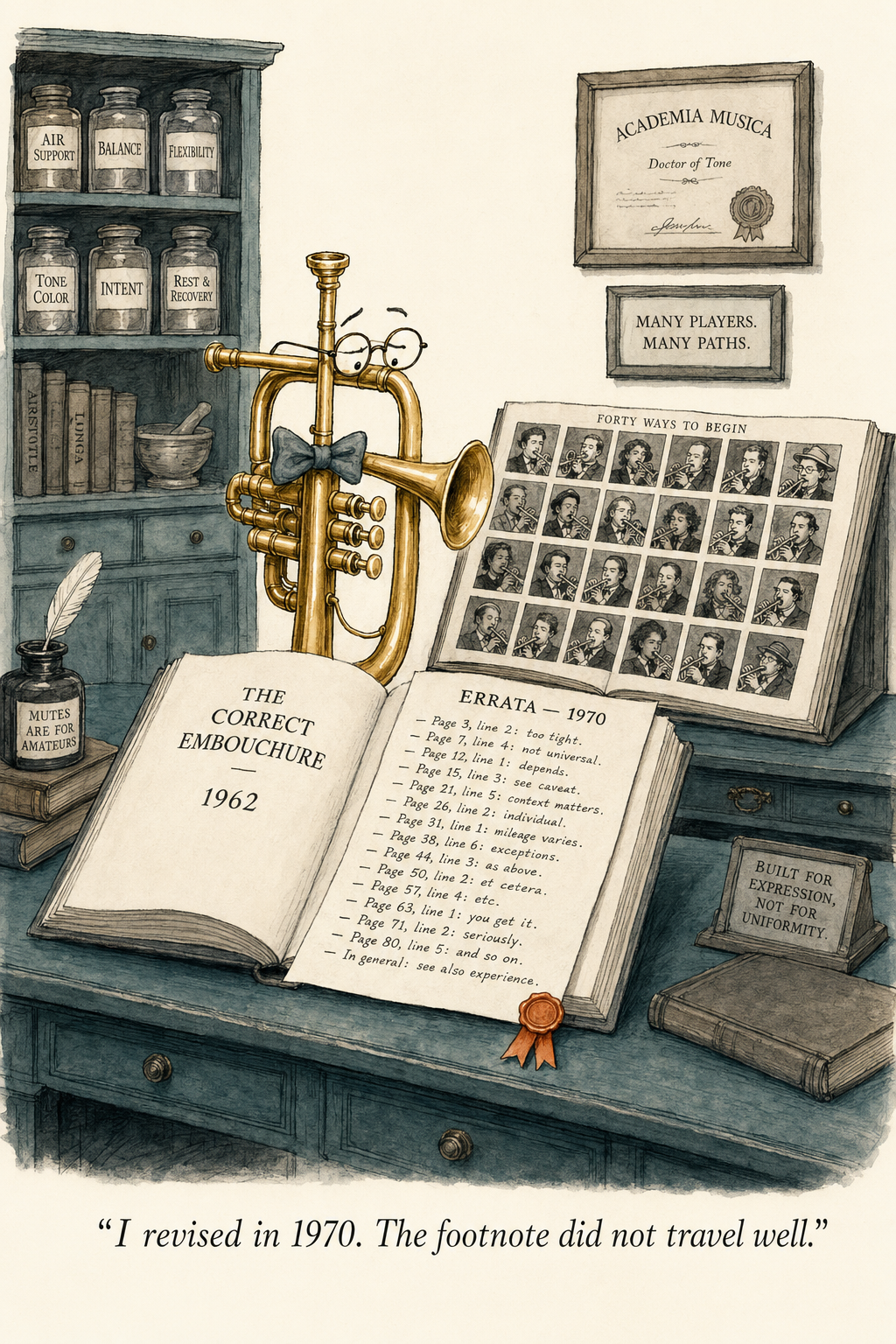
You used to be able to play this thing.
Maybe it was twenty years ago. Maybe thirty. You sat in a high school jazz band, or you played first chair in college, or you toured for a while and then life took you in another direction. Whatever the story was, there was a version of you that could put the horn up and a real sound came out. Not perfect, maybe, but yours. You knew what you were doing without thinking about it.
Now you’re back. The horn is on your face again. And the sound that comes out is not the sound you remember.
If you’re like most comeback players, the first thing you reach for is a routine. What should I practice? In what order? How many minutes a day? You want a workout plan. That’s a totally rational instinct, and I respect it. But it’s the wrong first move, and the reason it’s the wrong first move is the most important thing you can understand about your comeback.
The comeback feels harder than the original learning curve did. There’s a reason for that, and it’s not personal failure. It’s biology. And once you understand the biology, the right first move becomes obvious: before you build a routine, build a model.
This article is a permission slip. Permission to do the unsexy upfront work of understanding what your chops actually are before you start grinding them back into shape. If you skip this step, you can still get there. It just takes years instead of months. And there’s a worst case you should know about that the upfront work protects you from.
The Biology of Why Comebacks Are Hard
When you first learned to play, your brain was building two different kinds of memory at the same time. They sit in different parts of your nervous system, they decay at different rates, and the difference between them is the whole story of why your comeback is hard.
The first kind is procedural memory. That’s the feel. The way your lips knew, without being told, how to set when you took a breath. The shape your tongue arched into for a high note. The micro-adjustment your jaw made between the staff G and the high C above it. Procedural memory is what people mean when they say “muscle memory,” though the storage is in the brain, not the muscle. It’s fast, it’s automatic, and you can’t really put it into words.
The second kind is declarative memory. That’s the knowing. What an aperture is. Why the corners matter. What “compression” means and what it does. The map of the thing.
Here is the part the research is really clear on. Procedural memory decays faster than declarative memory. A 2025 meta-analysis of motor skill retention found that about half of a precision-dependent procedural skill is lost in roughly six and a half months without practice. Speed-based versions of the same skill take eleven to thirteen months to lose half. Trumpet playing is both precision and speed, which puts it squarely in that window.
Read that again. Half. In months, not years.
So if you took twenty years off, the math is brutal. The procedural side of your chops is essentially gone. Not dimmed. Gone. The feel that used to run the show has decayed to the point of being unrecoverable in its original form.
But here is the kinder half of the story. Declarative memory does not decay anywhere near that fast. If you understood what you were doing back in the day, if you had words for what the corners were doing, what the air was doing, what the aperture was doing, that map is mostly still in there. It survived. The territory changed. The map did not.
If you built only feel, you lost almost all of it. If you built feel and understanding, you kept the map even when the territory shifted under you.
This is biology, not failure. The twenty-year layoff didn’t take everything because you weren’t talented or didn’t care enough. It took the part that depreciates fastest. The fact that your chops are not where they were has the same explanation as the fact that your body is not where it was at twenty-five. Tissue and skill both decay on schedules you didn’t choose.
The Trap Most Comeback Players Fall Into
Here is the trap. Almost every comeback player tries to rebuild the same way they built it the first time.
How did you build it the first time? Pure feel. Pure trial and error. You sat in the band room or your bedroom and you played, and slowly, over years, a thing emerged. Nobody walked you through the physics. Nobody handed you a diagnostic checklist. You just played, and your seventeen-year-old nervous system, with infinite time and infinite resilience, figured it out.
That works at seventeen. It does not work the same way at forty-seven or sixty-two.
The reason is not that your nervous system has stopped working. It is that the conditions are different. You have adult mouth tissue, which is less elastic. You may have had dental work done in the meantime. You may have a slightly different bite than you had in 1998. Your practice time is finite in a way it wasn’t when you were a kid. Your patience is finite in a way it wasn’t when you were a kid. And the bad habits you developed before you walked away are still in there, sitting next to whatever good habits you had, with no one telling them apart.
Pure feel, the second time around, takes years. Not because the system is broken. Because trial and error without a map is slow, and you don’t have unlimited time to throw at it.
With a model, it takes months. Sometimes weeks. The difference is the map. When something doesn’t work, the player without a model has to keep trying random things until something clicks. The player with a model can look at the map, narrow the problem to one of three or four candidate causes, test each one, and move on. The whole feedback loop runs ten times faster.
The trap is treating “I figured it out before” as evidence that pure feel will work this time. It’s not. It’s evidence that pure feel works when you have unlimited time, a young nervous system, and no competing demands on your attention. None of those conditions apply to your comeback. Different rebuild calls for a different method.
What Building a Model Actually Gets You
This is the part where I make the case concretely. Five things you get from doing the conceptual work first.
One, you can diagnose when something goes wrong. Something will go wrong. Some morning the high A won’t speak, or the sound will get thin, or the corners will start to ache, and you’ll need to know why. A player with no model just panics. A player with a model goes down the list. Is the air moving? Is the pressure climbing? Did the aperture collapse? Is the throat closing? Diagnosis is impossible without a vocabulary, and vocabulary is exactly what the model gives you.
Two, you can rebuild from a blueprint instead of from guessing. When you know the parts, you know where to look. The bad practice session doesn’t become a referendum on whether you should have come back to trumpet at all. It becomes one signal you can interpret.
Three, you practice efficiently because you know what you’re trying to do. Most comeback players burn enormous amounts of practice time grinding on things that don’t need grinding, and avoiding things that desperately do, because they have no way to tell the two apart. A model is a sorting algorithm. It puts every minute of practice toward the part of the system that actually needs the minute.
Four, you’re protected against the worst case. I’m going to mention something carefully here because I don’t want to scare you. The research on embouchure dystonia, which is the catastrophic version of “my chops stopped working,” consistently shows a pattern in the case histories: long stretches of repetitive playing without reorganization of the motor pattern. A pure-feel player on autopilot for decades is exactly the profile that shows up. A player with an explicit model, who can rebuild the system instead of just running the same loop until it breaks, is much further from that worst case. The point isn’t that pure feel causes dystonia. The point is that having a model is cheap insurance against a category of problem you don’t want to be inside of.
Five, and this is the big one, you build something that survives the next layoff. Life is going to take your chops away from you again. I’m sorry to be the one to tell you, but the same way the twenty-year break happened, something will happen again. Illness. Dental work. A medication that dries your mouth. A surgery. A move. A new baby. Age. You will, at some point in the future, have to come back to this instrument for a second time.
If you rebuild on pure feel now, you’ll be in exactly the same spot the next time life intervenes. You’ll lose most of the procedural skill again, and you’ll have no map to rebuild from again. You will, in effect, be making the same trip twice with the same vehicle and the same fuel.
If you rebuild with a model now, the model is yours forever. Procedural skill decays in months. Declarative knowledge of how your own playing works does not. The third comeback, if it ever has to happen, takes weeks instead of years. You are not just rebuilding chops. You are building the kind of chops that come back when something else takes them.
That is the long-tail argument for doing the upfront work. It is not about this comeback. It is about every comeback after this one.
“But Isn’t This Just Overthinking?”
I know what you’re thinking. Caruso said don’t analyze. Jacobs said don’t think about the chops, think about the song. Half the great players of the twentieth century told you to stop messing with the mechanism and just play.
They were not wrong. They were addressing a specific failure mode. The failure mode is the player who micromanages every muscle in their face while they play. The player who can describe their embouchure beautifully and cannot make a phrase land. That player exists, that player is real, and “don’t analyze” is the correct prescription for them.
But there’s a piece of the Caruso quote that gets cut off when people repeat it. Caruso assumed your chops already worked. He was writing for the player whose embouchure was functional and who needed coordination training. “Don’t analyze” is excellent advice for a working system that needs to keep running. It is terrible advice for a broken system that nobody has explained.
If yours doesn’t work right now, “don’t analyze” is a sentence that leaves you stuck.
The point of building a model isn’t to micromanage your face while you play. That’s the failure mode the old masters warned against, and they were right to warn against it. The point of the model is to know what’s happening so you can diagnose and fix things when they break, and so you can recognize and protect what you’ve rebuilt. While you’re playing, the model gets folded up and put in your pocket. Your ear runs the show. Your sound leads. The model is just there for the days the sound stops cooperating.
You are not becoming an engineer. You are putting a flashlight in a drawer. The flashlight stays in the drawer until the lights go out.
Where to Start
If this is making sense, here are the three concrete pieces of the model. Each of these has its own deep-dive article. Don’t read them all today. Read this one, sit with the idea, and walk into the rest in your own time.
Know how the trumpet actually makes sound. Not the pop-physics version where your lips buzz and the horn amplifies. The real version, which is that your lips and the air column inside the horn are coupled oscillators negotiating a note together. The horn isn’t a microphone. It’s a partner with opinions. Understanding this changes how you think about every other part of the system. The deep dive lives at /how-a-trumpet-makes-sound/.
Know the main levers of your embouchure. Corners. Aperture. The compression vectors of your lips. Tongue position. Jaw alignment. You don’t have to memorize a textbook. You have to know enough of the parts that when one of them drifts, you can name the part that drifted. Most comeback players cannot name a single one of these concretely. The full guide lives at /trumpet-embouchure-guide/.
Know your own patterns. This is the metacognitive piece, and it’s the one nobody tells you to do. What failure mode do you slide into when you’re tired? Do you press? Do you smile? Do you close the throat? What does your recovery look like? A day off works for some players. A light day works better for others. The relationship between feel-only chops and the worst case is covered at /embouchure-stopped-working/, and the engineer-versus-feel question is at /engineer-vs-artist-embouchure/.
Before You Go Grind Out a Routine
The free training I run is the model. Thirty minutes. In thirty minutes, you get the map of the whole system, in plain language, with the parts named and the levers identified. The free training is not a class. It is a flashlight.
Work the free training here: https://toot-your-own-horn.com/landing-page
Build the map. Then grind. Not the other way around.
RELATED READING
- The Trumpet Embouchure Pillar Guide — the full map of the system this article tells you to build.
- How a Trumpet Actually Makes Sound — the physics most players were taught wrong.
- Engineer vs Artist: Two Ways to Build a Trumpet Embouchure — why the best players are both.
- How to Read Your Own Embouchure — the diagnostic dashboard.