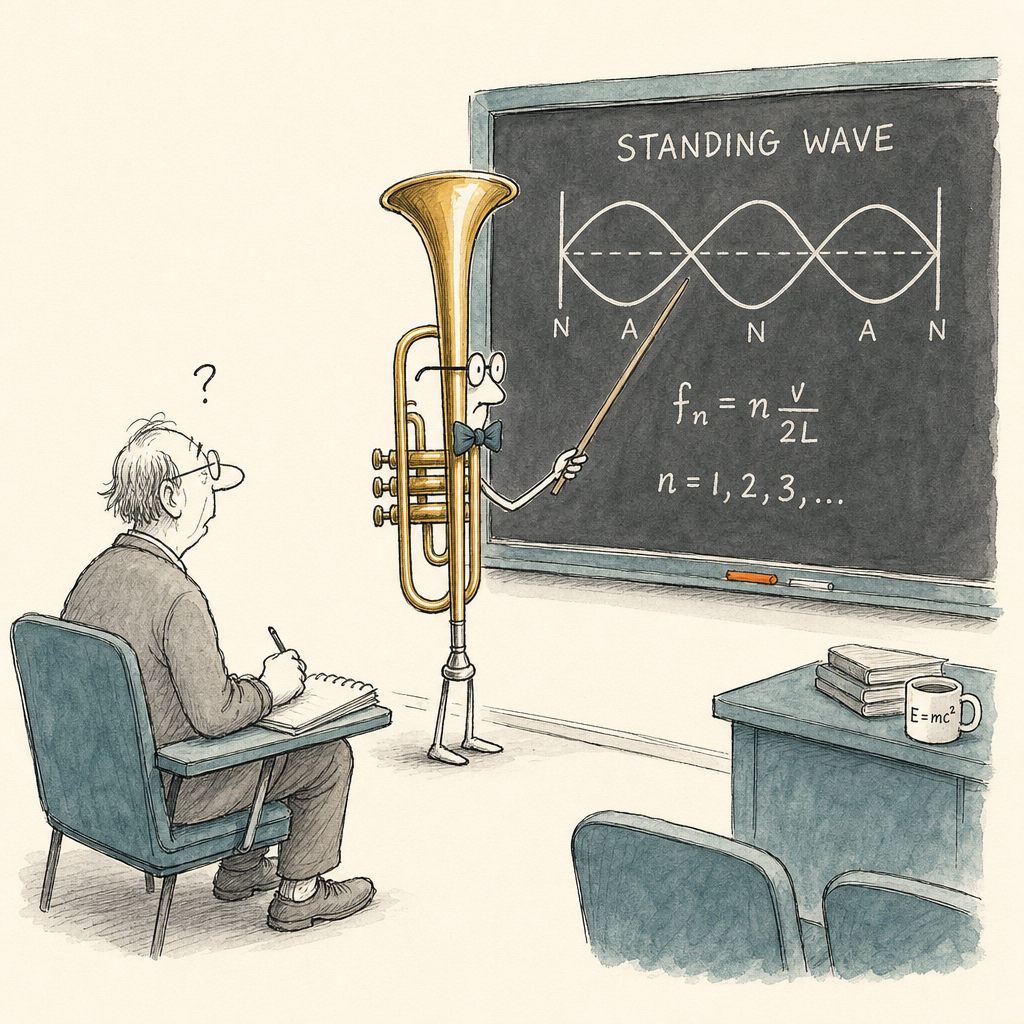
Most trumpet players have been told the same story about how their instrument works. The lips buzz. The horn amplifies the buzz. Out comes a trumpet sound.
It is a tidy story. It is also wrong in the way that matters most.
The horn is not an amplifier. The horn is a partner. When you play a note, your lips and the air column inside the trumpet are locked into a feedback loop, and the horn has more say in what comes out than your lips do. That is not a small correction. It rewrites what you think your job is when you’re playing, and it explains a lot of things that “lips buzz, horn amplifies” cannot explain. Like why a free buzz never matches your played pitch. Why notes slot. Why high notes feel like they’re fighting you. Why some mouthpieces feel like home and others feel like sandpaper.
If you understand how does a trumpet make sound at the level the physics is actually operating, you stop fighting the horn. You start meeting it. That is a fundamentally different way to play, and almost no one teaches it correctly. Let’s fix that.
The Three Different “Buzzes” (And Why People Confuse Them)
When trumpet players say “buzz,” they usually mean one of three completely different physical events. Mixing them up is where the bad pedagogy starts.
Free lip-buzz. Your lips, alone, no mouthpiece, no horn. You press them together, blow, and they vibrate. This is the experiment your band director showed you in 6th grade. It is also the version most people mean when they think “the lips make a buzz and the horn amplifies it.” Acoustically, free-buzzing is a forced oscillator with nothing downstream. There is no resonator pulling on your lips, no feedback loop, no slotting. The pitch is whatever your lips decide to make. The spectrum is mushy because lip tissue is broadly tuned and there’s nothing else in the room to sharpen it up. It feels a little like playing, but physically it isn’t.
There’s a popular demo where you free-buzz, rest two fingers lightly across your lips, and the pitch rises. That is real. It happens because adding resistance forces the lips to close faster each cycle. It is also a demonstration of free-buzz behavior, not playing. The two-fingers test belongs to the mouthpiece-pressure conversation, where it shows up again with consequences. (More on that in /mouthpiece-pressure-trap/.) For “how does a trumpet make sound,” the two-fingers trick tells you something about isolated lip tissue. It does not tell you what happens when a horn is attached.
Mouthpiece buzz. Lips plus mouthpiece, no horn. Now there is a small acoustic load on the lips. The mouthpiece cup acts like a tiny chamber with one broad resonance of its own, around 800 to 900 Hz. The lips feel something pushing back. The pitch is more stable than free-buzzing, the tone is more focused, but there is still only one weak resonant peak available, and it doesn’t slot any actual playing-range notes. Mouthpiece buzzing is closer to playing than free-buzzing is, but it’s still not playing. You’re training a different oscillator regime.
Playing. Lips plus mouthpiece plus horn. Everything changes. Now the air column inside the trumpet presents the lips with a whole series of strong resonant peaks at frequencies that exactly match the notes you want to play. The system flips from “lips do everything” to a coupled, self-sustained oscillation between the lips and the air column. This is the only one of the three that is actually trumpet playing.
Most pedagogical mistakes come from coaching the wrong one of these three and assuming the lesson transfers. Free-buzzing teaches lip strength and articulation. It does not teach what playing feels like, because playing involves submitting to a partner, and free-buzzing has no partner.
What the Horn Is Actually Doing
Here is the real picture. Strip the metaphor of “amplifier” out of your head and replace it with this.
The air column inside your trumpet has a list of notes it wants to play. Literally a list. The bore profile, the bell flare, the leadpipe taper, and the mouthpiece together create a specific pattern of acoustic resonances called impedance peaks. There are about eight to ten of them in playable range. Each peak corresponds to a note the horn naturally rings at when something at the mouthpiece end excites it. With no valves down on a Bb trumpet, those peaks line up with a low C, a G, another C, an E, a G, and so on up the harmonic series. Press valves, and the tube gets longer, and the whole list shifts down.
Those peaks are tall and narrow. Acousticians measure how sharply tuned a resonator is using something called a Q factor. The bore’s impedance peaks have Q values around 30 to 100. Your lips, by comparison, have a Q of about 1 to 2. The lips are broadly tuned, mushy, willing to go anywhere. The bore peaks are sharp, opinionated, and stubborn. When you put a mushy oscillator and a sharp oscillator in the same feedback loop, the sharp one wins. The horn pulls your lips into alignment, not the other way around.
This is the move that overturns the standard story. You are not generating a pitch from nothing and feeding it into a passive tube. You are getting your lips into the neighborhood of one of the horn’s natural notes, and the horn is reaching out and pulling your lips into the slot. Once they’re in the slot, your lip vibration locks to that frequency, and the harmonics of your lip motion (the 2x, 3x, 4x of the fundamental) lock onto the higher impedance peaks of the bore, and the whole system settles into what physicists call a regime of oscillation. The note is no longer a thing you’re making. It’s a thing the system is doing, together. You’re the energy source. The bore is the conductor.
Think of two dance partners. Neither is leading entirely. They negotiate every step in real time. Your job is not to drag the horn around the floor. Your job is to show up in the right neighborhood, with the right posture, and let the horn take over.
This is also why your free-buzz pitch never matches your played pitch on the same note. When you free-buzz, your lips choose the frequency unilaterally. When you play, the horn negotiates the frequency with your lips, and the result settles slightly above whichever impedance peak is in charge. Two different physical systems. Two different answers. That is not a flaw in your buzz. That is the physics.
Why High Notes Are Physically Harder
Here is what nobody tells you about the upper register. It’s not that you’re weak. The acoustics are abandoning you.
In the low and middle range, the impedance peaks are tall, well-separated, and the lips have multiple peaks cooperating to hold each note in place. Play a low G and there are three or four bore peaks all reinforcing the same regime, lining up at 2x, 3x, 4x, the frequency. The horn is holding you up from several directions at once. Notes feel stable. The lipping window is wide. If you’re a little flat or sharp, the slot tugs you back into place.
Now go up. Three things happen simultaneously, and all of them make the horn less helpful.
First, the impedance peaks shrink. Wall losses inside the bore scale with frequency, and the bell radiates short waves out instead of reflecting them back. So the higher peaks are physically shorter than the lower ones. Less horn, less pull on the lips, less margin for error.
Second, the peaks get closer together. The harmonic series compresses logarithmically. Between peaks 2 and 3 you have a perfect fifth of breathing room. Between peaks 8 and 9 you have a whole step. Up around the altissimo you’ve got a quartertone between peaks, and a small targeting error puts you on the wrong note entirely.
Third, fewer peaks contribute to each regime. A high E above the staff is governed almost entirely by a single impedance peak. There’s no peak 12 worth recruiting to help out. You have one weak peak holding the note in place, and your lips are doing more of the work themselves.
This is what people mean when they say high notes “feel like nothing’s there.” Acoustically, there really isn’t much there. The horn helps you less the higher you go. Your lips have to oscillate faster, with less help, against a thinner acoustic load. Strength matters in the upper register, but accuracy matters more, and meeting the slot exactly matters most of all. Forcing doesn’t help. There’s nothing to force against.
The Mouthpiece’s Real Job
The mouthpiece is not just a comfortable interface between your face and a cold piece of brass. It is a small Helmholtz resonator with its own broad resonance, and where that resonance sits on the spectrum determines which of the horn’s natural notes get boosted and which get suppressed.
A larger cup with the same throat shifts the boosted band downward. The lower register gets fuller and the upper register feels less supported. A smaller cup raises the boost band, supports the high register, and thins the bottom. This is not subjective. It is a measurable change in the impedance curve at the lips. It is why mouthpiece shopping is a real activity and not just gear-acquisition syndrome. Different cups give you different opinions from the horn about which notes it wants to play. You’re choosing whose side the mouthpiece is taking in the negotiation.
What This Changes About Your Practice
Now the practical part. If the horn is doing half the work (often more than half), then your job is less about generating pitches and more about meeting the horn where it wants to go. That sounds touchy-feely. It is actually the most concrete piece of pedagogy in this article.
Slotting is real. A “centered” note is a note where your lip frequency, your aperture, your air, and the bore’s impedance peak are all lined up cleanly. The note locks in by itself. You don’t have to hold it. The regime holds it. If you find yourself fighting to keep a note in tune, the slot isn’t really finding you. You’re trying to manufacture a pitch the horn isn’t supporting. Adjust position and pressure, not effort.
Forcing almost never works. When a note won’t come out, the instinct is to push harder. Blow more, squeeze more, push the horn into your face. But forcing assumes the horn is passive and the failure is yours alone. It isn’t. If the horn isn’t pulling, more push doesn’t fix that. It just inflicts damage on the lip tissue while the slot continues not to support you. The fix is almost always to back off, find a smaller, freer vibration, and let the horn re-engage. (This is the entry to a much bigger conversation in /lip-compression-trumpet/ and /trumpet-aperture-guide/, which both build on what’s happening at the lips during this negotiation.)
Once you find the slot, the slot finds you. This is what every working pro means when they talk about a note “locking in.” Mode-locking is a real acoustic phenomenon. The system snaps into a stable regime, and from that point on, your job is not to hold the note. Your job is to stop interfering with the regime you’re already in. Most embouchure tension you feel during sustained notes is you fighting a slot you’d actually settled into ten milliseconds ago.
Yes, This Matters. Here’s How to Use It.
Reasonable question: does any of this change what I do tomorrow when I pick up the horn?
Yes. If you walk in believing the horn is a passive amplifier and your lips do all the work, every problem you have looks like a “you” problem to solve with effort. Pitch flat? Push harder. Note won’t come out? Force it. Range stalled? More pressure. That mental model puts you alone against a piece of metal, and the only tool you have is more effort. That is the road to mouthpiece pressure, dead lips, and a stalled-out career.
If you walk in believing the horn is an active partner, you have a second tool. You can ask whether the horn is even helping you on this note, and if not, what you can change to get back into the slot. Sometimes the answer is a small jaw adjustment. Sometimes it’s a tongue position shift to nudge the air speed. Sometimes it’s backing off the pressure so the lips can vibrate freely enough for the regime to lock in. None of those moves are “more effort.” All of them are “better collaboration.”
That shift is the foundation everything else in the /trumpet-embouchure-guide/ is built on. The pillar walks through the rest of the chops system from there. Corners, aperture, lip compression vectors, tongue position, jaw, air. Each one is a knob you can turn to meet the horn more cleanly.
If reading this made something click and you want to go further, I put together a free 30-minute training that walks through how to build a free, efficient lip vibration and the range and endurance that come with meeting the horn instead of fighting it. It’s not a sales pitch dressed up as a lesson. It’s the actual foundation, with the cues you can use today.
Watch the free 30-minute training here.
The horn is a partner, not a megaphone. Once you know that, you can stop dragging it around and start dancing with it.