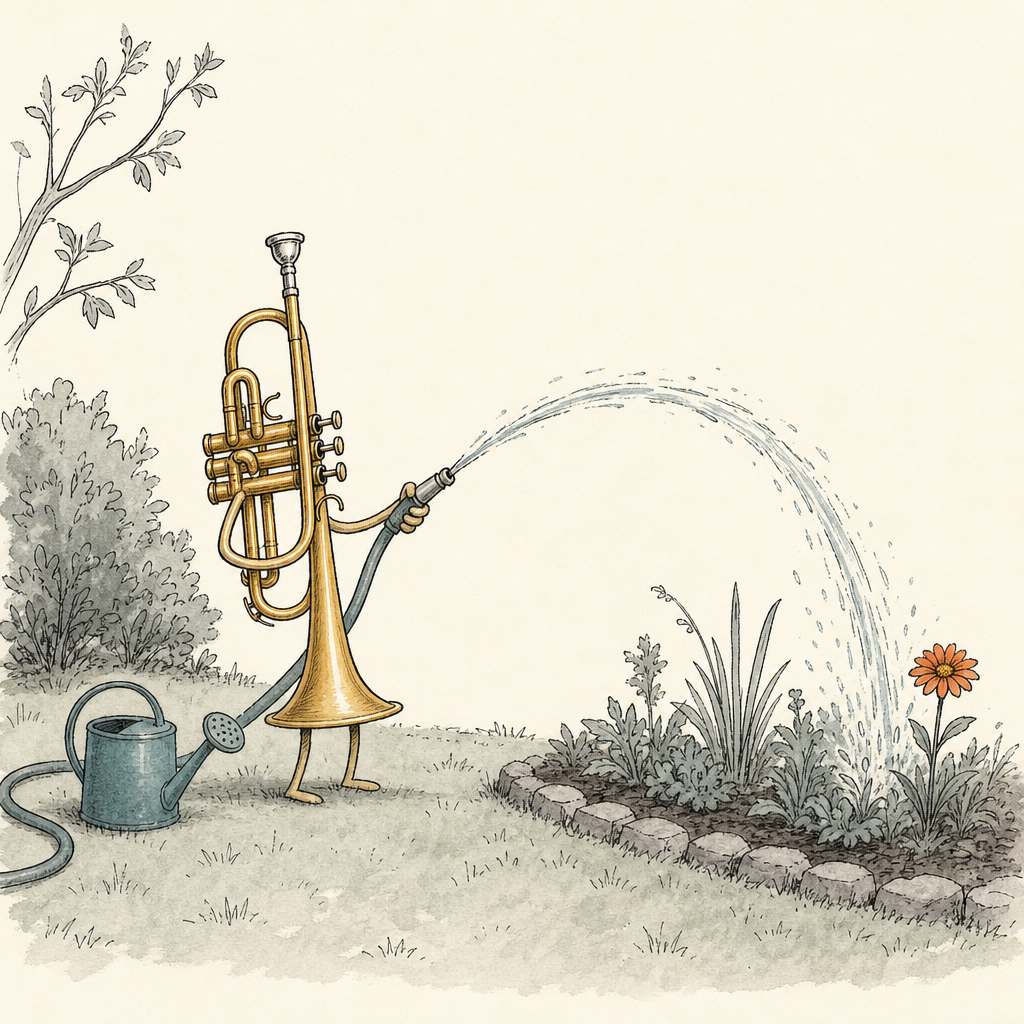
If you have spent any time on the trumpet, you have heard the word aperture thrown around like everyone agreed what it meant. They did not. Most of the time it is used as a verb, as in “tighten your aperture,” as if it were a knob you reach in and turn. That is the move that is keeping you stuck.
The aperture is real. It is the single most important opening in your setup, and it is the lever in your chops with more leverage than anything else. Almost every player who tries to control it directly makes themselves worse the moment they start trying.
Once you see what the aperture actually is and how it actually behaves, three or four other problems on your horn quietly solve themselves.
What the Aperture Actually Is
The aperture is the small opening between your lips where the air passes through and the vibration happens. A tiny hole, a few millimeters across, that opens and closes between roughly 230 times per second on a low G and over a thousand times per second on a high C.
That hole is where everything meets. The air from your lungs has to get through it. Your lips are the tissue forming it. The horn is sitting on the other side of it waiting for what comes out.
When players say “aperture” they usually mean the resting shape of that opening when they take a breath and prepare to play. That is part of it, but the aperture worth paying attention to is the one that exists while you are playing. The vibrating one. The one that opens and closes a thousand times a second and changes size constantly as you move through your range.
That aperture is not a setting. It is a result.
Why It Is the Highest-Leverage Lever You Have
Here is what makes the aperture special. It is doing two jobs at the same time, and both of them are critical.
Job one: it is the throttle. Air comes from your lungs into your mouth at some pressure. The aperture decides how fast that air shoots out the other side. Smaller aperture, same upstream pressure, faster air. That fast, focused stream is what gives your lips the energy to vibrate at speed.
Job two: it is the speaker. The vibration itself is happening at the aperture. The lip tissue right at the edge of the opening is what is opening and closing. The opening is the actual sound source. The pressure waves that travel down the horn and become a trumpet note are being generated right there.
Most components in your setup do one thing. Your tongue arches the air. Your corners stabilize the lip. Your abdominals build pressure. Each lever does its job and hands off to the next. The aperture is the only place where two of the most important jobs happen in the same square centimeter of tissue.
That is what makes it the highest-leverage lever in your chops. One small change at the aperture moves both the throttling of the air AND the vibrating surface at the same time. Get it right and the whole system locks in. Get it wrong and nothing downstream can save you. The aperture is so leveraged that any heavy-handed input you push into it shows up doubled in your sound.
The Garden Hose
Picture a garden hose with the water running at a steady rate from the spigot. You walk over and put your thumb partway over the end. What happens? The water shoots out faster, in a narrower, more focused stream. You did not turn the spigot up. You did not push more water into the hose. You narrowed the opening at the other end and the velocity climbed all by itself.
That is the aperture, exactly. Same air pressure from your lungs. Smaller opening at the lips. Faster air through the hole.
Now do the opposite. Take your thumb off entirely and let the hose flop open. The water still flows, maybe even at a higher volume, but it comes out lazy and slow. It dribbles out the end. Big aperture, no velocity, no focus.
Faster air drives faster lip vibration. Faster lip vibration is a higher note. The physics is identical to the hose. Squeeze the opening, the stream speeds up. Open the opening, the stream slows down.
Here is the part most players miss. The hose works because the water has somewhere to go. It is being pushed from upstream. If you crimp the hose closed entirely with no water flowing, your thumb is not creating any velocity. It is just blocking a dead pipe. The narrowing only helps when there is real flow coming through.
Same with the aperture. Closing your lips down without air coming through is not “tightening your aperture.” That is just clamping a dry hole shut. You will produce no sound, or a strangled one, and you will be using lip muscles to hold a shape against nothing.
The aperture works when air is moving through it. Not before.
Why Setting the Aperture Directly Is a Disaster
This is where most players go wrong, and where the cluster terminology rule matters: aperture is an OUTPUT, not a setting.
Picture what happens when a player decides they need a smaller aperture to get a higher note. They take a breath and before the air even arrives, they pinch their lips down into a small hole. They have set the aperture. Then they blow.
Three things happen. None of them are good.
One. Their lips are static. A static shape cannot vibrate well, because vibration requires the tissue to be free to open and close. They have clamped the opening into a fixed geometry. The air arrives and meets a wall instead of a valve. Vibration dies. The sound either does not start or starts strangled.
Two. They have to fight their own muscles to make any sound at all. The clamp resists the air, so they push harder. More pressure in the chest, more pinch at the lip, often more force from the arms pressing the mouthpiece in. The arms are stronger than the lip, so they win, and the player gets a thin, pressed note doing none of the things a trumpet note should do.
Three. The leverage works against them. The aperture is doubly leveraged. A static, over-clamped aperture is both throttling the air badly AND killing the vibration at the same time. One mistake, two simultaneous penalties. The sound thins, the response dies, and the player concludes they need to push harder still.
That whole loop is what most players think of as “playing high.” It is also what destroys their endurance and their tone. The aperture got set wrong, and because the aperture has so much leverage, everything downstream got worse at once.
The same is true in the other direction. A player trying to “open up for a fatter sound” consciously relaxes the aperture into a wide hole, and the result is a fuzzy, unfocused tone with no center. The throttle is gone. The hose is flopping.
You cannot win by setting this thing directly. Any heavy-handed input becomes a doubled mistake.
The Right Way to Control the Aperture
Here is the move that flips the whole thing right-side up. The aperture is the output of two inputs.
Input one: lip tension. Not lip clamp. Tension is what the muscles around the lip are doing to support the framework. Firm corners, controlled compression, the right tissue presenting to the mouthpiece. Which compression vector is doing the work, and how the four of them combine, is its own conversation. See /lip-compression-trumpet/. Higher tension means the vibrating tissue is stiffer, which means it wants to vibrate faster, and the aperture naturally settles smaller. Lower tension means more compliant tissue, slower vibration, bigger aperture.
Input two: airflow. Not air volume. Air velocity. How fast the air is moving when it arrives at the lips. That is controlled by your abdominal compression upstream and the shape of your oral cavity above the lips. The tongue is the main shaper there. Full breakdown at /tongue-position-trumpet/. Faster, more focused air creates a higher-pressure stream at the lip surface, and the lip tissue organizes around that stream into a smaller working opening on its own.
Get the tension right. Get the air right. The aperture shows up at the right size on its own. You did not have to set it. It happened.
That is not mystical. That is just the physics. The aperture is a resonant geometry that emerges from how stiff the tissue is and what the air is doing to it. If you build the inputs, you get the output for free.
How to Tell If Your Aperture Is Wrong
You do not need to feel for the aperture directly. The aperture tells you what it is doing through your sound. Learn to listen, and you have a real-time diagnostic running every time you play.
Signs your aperture is wrong:
- The sound thins out, especially on the way up. Not just brighter. Thinner. Less core.
- Response gets sluggish. Notes do not start cleanly. The horn hesitates before speaking.
- Your range ceiling drops earlier in a session than it should. You had a high G this morning and now it is fighting you.
- Your lips fatigue fast. Not “tired after a long gig” fatigue. Burned-out after twenty minutes of normal playing.
- You feel a pinch. If you are aware of the aperture as a thing you are doing with your muscles, it is too set.
Signs it is right:
- Sound is free, clear, has a center.
- Response is immediate. The note speaks the moment you ask.
- Endurance is reasonable. The lip is moving, not clamping, so circulation stays open. (More on the endurance side of this at /trumpet-endurance-guide/.)
- You are not thinking about the aperture. You are thinking about the note.
That last one is the giveaway. If the aperture is doing its job, it is invisible to you. You hear the note, the inputs land, the opening settles. Conscious attention on the aperture is almost always a symptom of an aperture problem somewhere else in the system.
How to Develop Aperture Awareness Without Micromanaging It
The goal is not to ignore the aperture forever. The goal is to develop a fine sense of what the aperture does without trying to grab it with your hands and steer.
A few practice pieces help.
Long tones at quiet dynamics. When you play soft, small changes in the aperture become audible. Loud playing covers errors. Quiet playing exposes them. Pick a mid-register note and hold it at piano. Listen for the moment the sound thins or fattens. You are not adjusting the aperture, you are letting your ear notice it. Over months, the ear starts to feed back into the tension and the air automatically.
Lip slurs. Slurring between partials forces the aperture to adjust dynamically without you setting it. You change the air velocity and the lip tension, the aperture moves in response, you get the next note. Slow lip slurs are aperture-awareness training without aperture-micromanagement.
Free lip-buzzing as a separate exercise. A short, careful round of free lip-buzzing (lips alone, no mouthpiece, no horn) is the cleanest way to feel the lip tissue compress and vibrate without the horn doing any of the work for you. A word on terminology: this is a different physical system from playing. Free lip-buzzing is your lips running solo, and the pitches you make there will not match the pitches you make on the horn. Use it as isolation, the way a weightlifter uses an accessory exercise. It builds capacity. It is not the lift.
Whistling. Whistle a clean octave. The pitch change you hear is mostly tongue and aperture, with almost no air-pressure change. If you can do that, you have the motor program. You can do the equivalent on the horn.
And on the rest side of this, because somebody is going to ask: when your lips have been working hard, give them recovery. That can be a cold day off, or a light day where you play quiet long tones and easy material for twenty minutes. Both work. Light playing keeps the pattern alive while circulation restores. Younger players who panic at the thought of not touching the horn usually do better with the light day. Older or more anxious players sometimes do better with the full day off. Pick the version that fits you.
The Aperture Is Not Alone
The aperture is downstream of three other levers. It is shaped by your lip compression — which is itself a vector quantity, not a single thing (/lip-compression-trumpet/). It is fed by your air, throttled by your tongue position (/tongue-position-trumpet/). It exists because of the coupled-oscillator physics that makes the trumpet make sound at all (/how-a-trumpet-makes-sound/). And it lives inside the bigger system covered in the pillar (/trumpet-embouchure-guide/).
The reason it has so much leverage is also the reason it cannot be solved in isolation. The aperture is where the entire system shows its work. If the air is bad, the aperture is bad. If the corners are bad, the aperture is bad. If the tongue is wrong, the aperture is wrong. You do not fix the aperture by reaching in and fixing the aperture. You fix the aperture by fixing what feeds it.
That is the trick. And it is the part that takes most players the longest to accept, because the aperture is the thing they want to control. The whole point of this article is that the way to control it is to stop trying.
The Free Training
You wanted the trick for higher notes. Here it is, and you are not going to like it. Aperture control IS the trick. But the second you try to set the aperture directly, you make every problem you have worse. The trick is the input model. Train the corners, train the air, train the tongue, and the aperture takes care of itself. The high notes follow.
I built a free 30-minute training that walks you through the input model end to end. Same physics, same diagnostics, applied in the right order. It is what my coaching students use to add a fifth to their range without grinding through more pressure or more clamp.
You can keep pinching a smaller hole and pushing harder air against it. Players who do that long enough end up with the white ring on their lips, busted endurance, and a range that goes backward every year. Or you can spend half an hour learning the input model and let the aperture solve itself.
Free 30-minute training: https://toot-your-own-horn.com/landing-page