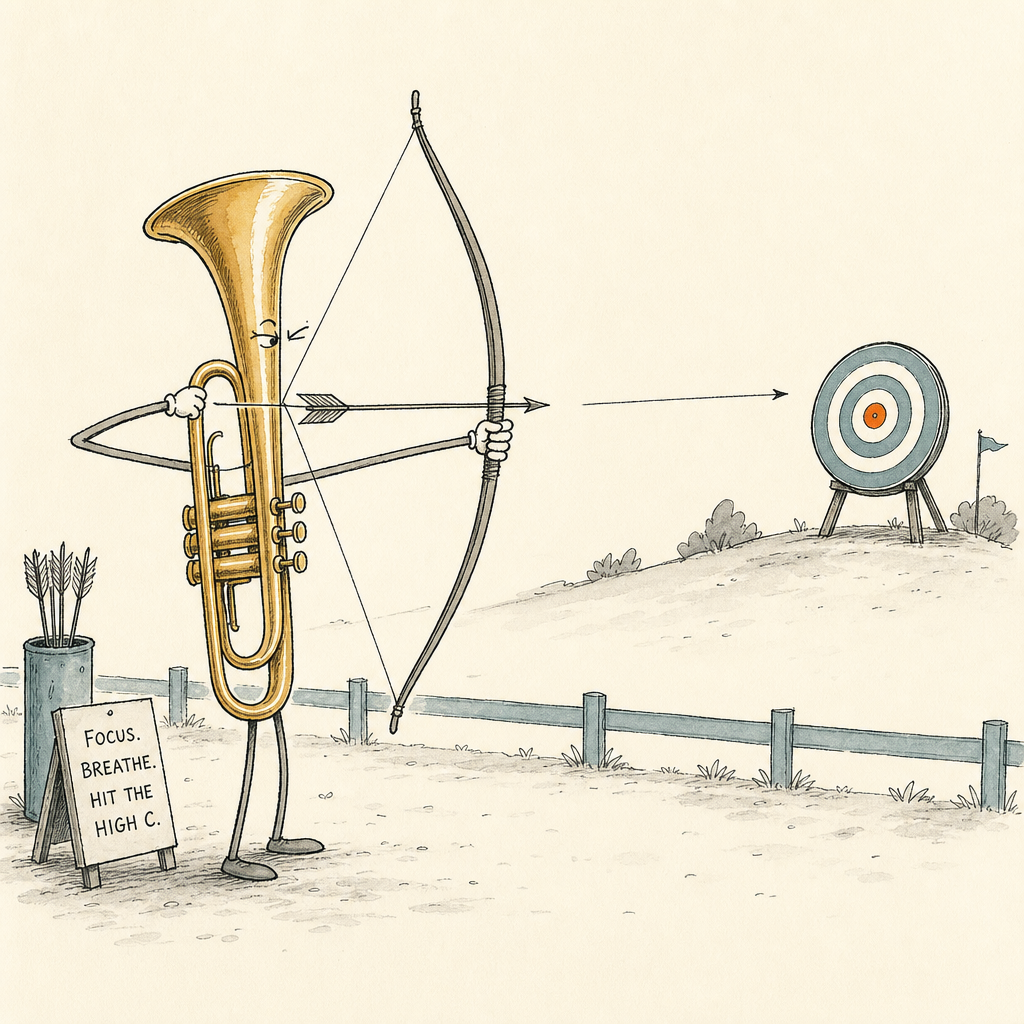
Ask a trumpet player to describe their embouchure and you will hear about lips. Maybe corners. Maybe aperture if they have read a few articles. Almost nobody mentions their jaw, and almost nobody mentions where the air is actually pointed once it leaves the aperture and enters the cup.
Which is strange, because these two things determine more about your sound than most of what gets argued about online. Jaw and air direction are the alignment levers. They decide where the energy of your playing gets aimed. If you are aimed wrong, no amount of working on your lips will fix it.
The reason these levers get ignored is not that they are unimportant. It is that they are invisible. You can see your lips in a mirror. You can feel your corners. You cannot see the angle of the air leaving your aperture. So a generation of trumpet players have been working on the visible parts of their embouchure while the lever with the most leverage sits quietly in the background.
This article is about that lever. What it is, why it matters, and how to find out what yours is currently doing.
The Neglected Pair
Most chops articles obsess over the lips. That is reasonable up to a point. The lips are the vibrating valve. They are where the sound starts. But the lips do not float in space. They sit on top of a jaw that can move in three directions, and they sit at the end of an air column whose angle is set by the geometry of that jaw and the position of those lips together. Change the jaw, you change the angle. Change the angle, you change the sound.
If you have read the pillar guide on /trumpet-embouchure-guide/, you already know your embouchure is a small system of moving parts. The jaw and the air direction are the two parts of that system most players have the least conscious access to. Pulling on these levers without seeing them is the brass equivalent of taking a pool shot blindfolded.
Donald Reinhardt built an entire pedagogical system around exactly this insight. His Pivot System, published in 1973, was the first major brass method to insist publicly that anatomy varies, jaw alignment varies, and the angle of the airstream varies with it. The taxonomy he built around that insight is overcomplicated, and most teachers today have either ignored him or simplified him down to something more usable, but the underlying observation is correct. This article is essentially what Reinhardt got right, simplified.
What the Jaw Can Actually Do
Your lower jaw is mounted on a hinge and a slider. The hinge lets it open and close. The slider, the temporomandibular joint, lets it move forward and back. It can also tilt slightly side to side, though most players do not use that range much.
For trumpet purposes, three movements matter.
Forward and back. Most resting jaws sit slightly retracted, with the lower teeth a little behind the upper teeth. That is a mild overbite, and it is the most common resting position in adults. Some jaws sit aligned, top and bottom teeth meeting evenly. A smaller number sit forward, lower teeth ahead of the uppers, which is an underbite. Trumpet players from any of these starting points can play well. The trick is that the resting alignment shapes how the air comes out of the aperture before you do anything else.
Drop and close. How far open you set your teeth determines how much room the air has inside your mouth. Too closed and you choke the airflow. Too open and you lose the lip stability the mouthpiece is supposed to provide.
Tilt and shift. Some players unconsciously tilt the jaw or push it sideways under load, usually as a workaround for some other problem. This is information when you see it happening. It is rarely a feature.
Each of these movements affects the angle of the lip aperture relative to the mouthpiece, which affects the angle of the air stream inside the horn. They are not independent levers. Move the jaw, the air follows.
Work With the Alignment You Have
Here is where a lot of well-meaning instruction goes wrong. You may have read that you should “tuck the jaw under” or “push the jaw forward” to get a better sound. Both pieces of advice get handed out as universals. Both can be disastrous if they fight the structure you were born with.
If your jaw naturally sits a quarter inch back, and someone tells you to thrust it forward and hold it there, you are now playing the trumpet while consciously bracing a joint against its own resting position. That tension radiates out to the corners, into the throat, down into the shoulders. You will not last long playing that way. The day the muscle holding that fight gets tired is the day your playing falls apart. The opposite advice, “tuck the jaw under,” is just as bad for a player whose lower jaw is already receded.
Work with the alignment you have. The point of paying attention to the jaw is not to override your build. It is to understand what your build is doing and stop fighting it. If your jaw is receded, your air is likely angling downward and your top lip is doing most of the vibrating work. That is fine. That is over half of all trumpet players. If your jaw is forward, your air is angling upward and your bottom lip is doing more of the work. That is also fine. The job is to find what your face is built to do, then build the rest of the embouchure to support it.
What “Air Direction” Actually Means
When players ask “where do I aim the air?” they are usually expecting a single answer. Down. Across. Up. As if there is a correct compass bearing.
Air direction is a real, measurable thing, but it is not chosen the way that question implies. Air direction is the angle the air leaves the aperture, which determines where it strikes the inside of the mouthpiece cup and continues on into the lead pipe. That angle is set primarily by two factors. The angle of the horn against your face, which you do choose, and the geometry of your jaw plus lips at the aperture, which is mostly set by your build.
The angle matters more than the velocity. Think of aiming a flashlight in a dark room. If you point it at the floor, you see the floor. If you point it at the ceiling, you see the ceiling. Whether the bulb is bright or dim is a separate question from where the beam lands. Air direction is the beam. Air supply, compression, and aperture are the bulb. They are not the same lever.
When the angle matches your build, your lips vibrate easily, the horn finds its slot quickly, and the note speaks without a fight. When the angle fights your build, you are aimed at the wrong wall, and no amount of brightness from the bulb fixes that.
Upstream and Downstream, Without Going Full Reinhardt
There are essentially two basic patterns of air direction in trumpet playing, and you almost certainly default to one based on your dental geometry.
Downstream players have the upper lip overlapping the lower lip slightly inside the cup, so the aperture opens angled downward. The air leaves the aperture, strikes the lower wall of the cup, and continues into the lead pipe with a slight downward bias. The upper lip is doing most of the vibrating work. This is the more common pattern, and somewhere in the neighborhood of three quarters of trumpet players play this way. Worth noting that the exact prevalence number is trade lore from the Reinhardt tradition, not a peer-reviewed study, but the broad pattern is well-attested in the high-speed video work that David Wilken and Doug Elliott have done over the last twenty years.
Upstream players have the lower lip taking more of the cup, the aperture opens angled upward, and the air leaves the aperture with an upward bias before continuing into the lead pipe. The lower lip is doing more of the vibrating work. This pattern is less common but produces some of the strongest lead players in the field.
Both work. Both produce world-class trumpet players. The error is not being one or the other. The error is being one while trying to play like you are the other.
If you have an overbite, you are probably built for downstream. If you have an underbite, you are probably built for upstream. Trying to flip your default by force is one of the most expensive things you can do to your playing.
The Pool Cue
Here is the analogy that finally makes the jaw-and-air thing click for most players I work with.
You are at a pool table. The cue ball sits in front of you. You have a cue in your hands and a target ball across the table. The force you put into your stroke matters. But how you aim the cue matters more. A two-degree change in cue angle sends the ball to a completely different part of the table. A huge increase in force, with the cue aimed wrong, sends the ball harder to the wrong place.
Air direction inside the trumpet works the same way. The air leaves the aperture, hits the inside of the mouthpiece cup at some angle, and that angle determines what happens next. Two degrees of difference in the angle of attack shows up as a clearly different sound. A clean, centered attack on the cup walls produces a tone that locks into the horn easily. A glancing or skewed attack produces a tone that feels harder to control, harder to project, and harder to sustain, even though your air supply is identical.
The pool shooter does not muscle the ball into the pocket. They aim and stroke. That is the model. Aim the air. Let the horn do its half of the work.
The Levers Are Coupled
One thing to understand before you go diagnosing your own jaw. Jaw position and air direction are not independent. They are coupled. You cannot move one without moving the other.
Change your jaw position and the angle your teeth present to your lips changes. That changes the angle of the aperture, which changes the angle the air leaves it. Cause, cause, cause. If you experiment with jaw position, you are also experimenting with air direction, whether you meant to or not.
The jaw position also helps set the volume of your oral cavity, which affects what your tongue is doing in there, which affects air velocity. That conversation lives in /tongue-position-trumpet/. The jaw shift also changes which of the four lip compression vectors becomes dominant at the aperture, which is the subject of /lip-compression-trumpet/. The levers connect.
This is one reason isolated chop experiments often fail. You think you are working on one thing, but the system is moving four other things at the same time, and you cannot tell what actually changed.
The Diagnostic
Before you change anything, you have to see what is happening. The simplest mirror exercise I know:
Set up so you can see your jaw clearly from the front. Play a simple ascending pattern through your usable range. C in the staff, G on top, C above, as high as you can go cleanly. Run it again and watch your jaw the whole time. Three questions. Does your jaw move as you ascend? If yes, in what direction (forward, back, dropping, closing)? When in the ascent does the movement happen?
The answers are information, not yet a fix. Most players will notice some jaw motion. That is normal. The question is whether it is consistent and controlled, or chaotic and shifting. A small, repeatable jaw movement that helps you change registers is the embouchure motion Reinhardt called a “pivot,” and it is what virtually every working trumpet player does whether they notice or not. A jaw that locks up at certain pitches, or shifts wildly between adjacent notes, is a coordination problem worth working on.
Do the same exercise from the side if you can manage a side mirror or a phone camera. Side view tells you about forward and back motion, which is hard to see straight on.
The Fix, When There Is One
If your jaw moves consistently and the air seems to be going where it wants, leave it alone. You are not broken. Most working players have some pivot, and yours is doing its job.
If your jaw shifts wildly at certain pitches or locks up at one spot in your range, you have a coordination issue at a specific transition point. The work is not to overhaul your whole setup. The work is to bring deliberate attention to the transition, slow it down, and rebuild the coordination at that one spot.
The way you do that is in /practicing-embouchure-changes/, which walks through how to make a deliberate change to a working embouchure without blowing the whole thing up. Short version: do it slowly, do it away from performance pressure, and accept that it will get worse before it gets better. If you realize your default direction has been wrong for your build all along, do not start that conversation without a coach. The stakes are too high to guess.
I Never Thought About My Jaw. Am I Doing It Wrong?
If you read this far and a small voice in your head is going “I have been playing trumpet for fifteen years and never thought about my jaw, am I screwed?” the honest answer is probably not. You almost certainly have a default jaw position and a default air direction that work well enough, because if they did not, you would have quit by now.
What you do have is a blind spot on a lever with a lot of leverage. You are flying without one of the gauges. That is not the same as the engine being broken. It just means when something goes wrong, you have one less piece of information to work with, and the day comes when that piece is the one you need.
The free training introduces this diagnostic and shows you how to read your own jaw and air direction in real time. Thirty minutes. After you watch it, you will be able to look at your own playing in a mirror and tell me what your jaw is doing. That is more information than most lifelong trumpet players have about themselves.
Pool players spend hours practicing aim before they ever shoot a tournament. Trumpet players have been told to focus on power and forgotten about angle for a generation. The training is how you stop missing the lever.
Watch the free 30-minute training here: https://toot-your-own-horn.com/landing-page