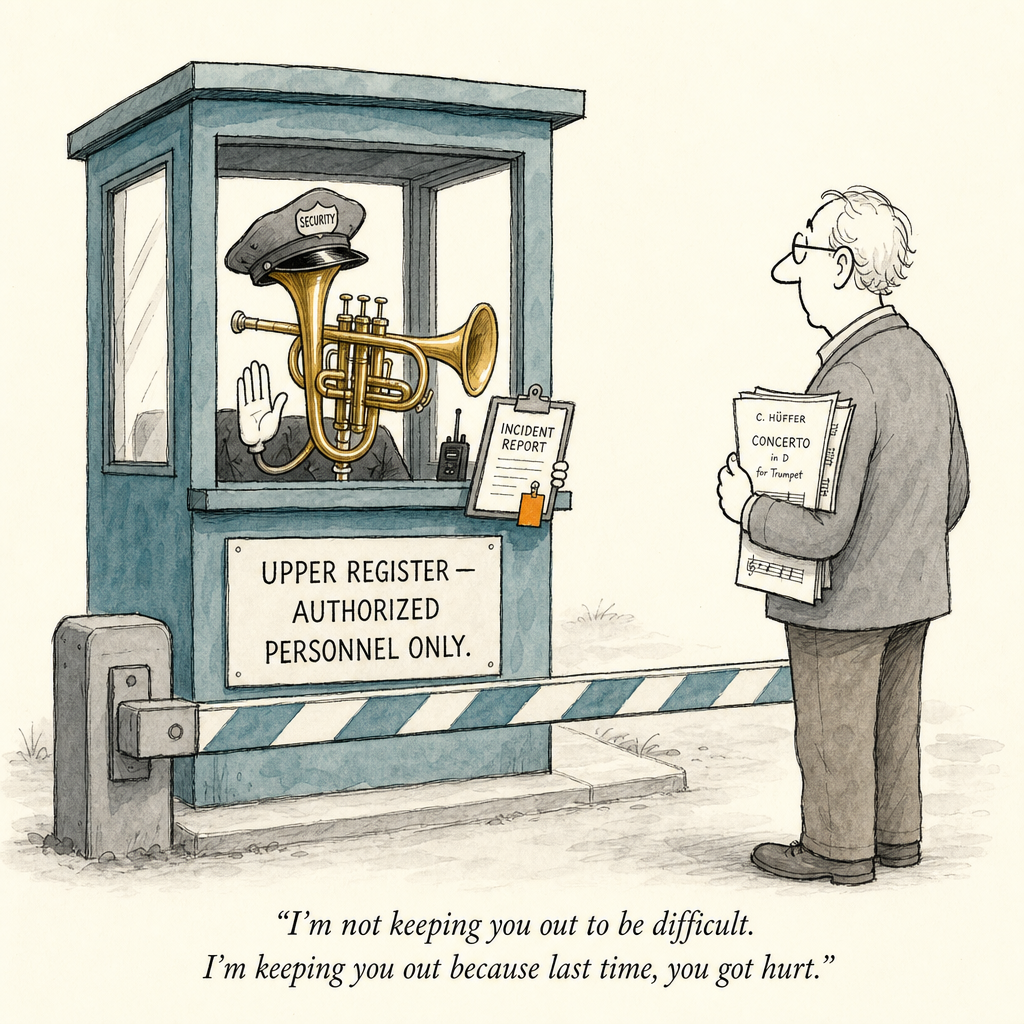
Your solo is coming up. You’ve been waiting all set for this moment. You take the big breath, you go for the scream, and… nothing. Air. A fizzle. You lower the horn and try to look like you meant to do that.
If you’ve lived through that, you’ve probably typed some version of “why can’t I play high notes on trumpet” into a search bar on the drive home. And you got the usual answers. More air. Stronger chops. A shallower mouthpiece. Just practice more, kid.
Here’s the problem. Most of those answers are wrong, and a couple of them will actively hurt you. The real reason you can’t play high notes has almost nothing to do with strength. It’s simpler than that, and once you see it, you can’t unsee it.
This article is one piece of a much bigger system I’ve laid out in the complete guide to building trumpet range. But before any exercise on earth will help you, you need to understand where high notes actually die.
Prefer to watch? Here is the short version.
Why you can’t play high notes: your lips stop vibrating
A trumpet only makes sound while your lips are vibrating. That’s the whole deal. Air crosses the opening between your lips, the lips vibrate, the horn amplifies that vibration into sound. The second the vibration stops, the sound stops.
Not gradually. Instantly.
That is the point of failure in your high notes. Your note doesn’t die because you ran out of air. It doesn’t die because you didn’t want it badly enough. It dies at the exact moment your lips stop vibrating. Everything else is the story you tell yourself afterward.
This matters because it completely changes the question you should be asking. “How do I get stronger?” is the wrong question. The right question is: “What is stopping my lips from vibrating up there?”
There are a handful of usual suspects, and I’d bet money at least two of them are living rent-free in your playing right now. Let’s go down the list.
Low notes forgive you. High notes don’t.
First, understand why this problem only shows up at the top of your range.
Down low, your lips vibrate at a relatively slow frequency. There’s margin for error. You can mash on a little extra mouthpiece pressure, tighten things up that shouldn’t be tight, and the lips will still find a way to vibrate. The note comes out. You get away with it.
As you go higher, the vibration gets faster and faster, and that margin evaporates. A fast-vibrating surface is delicate. Any little bit of extra interference kills it instantly. The same sloppy habits that were invisible on a second-line G become fatal on a high C.
So here’s the uncomfortable truth: you don’t have a high note problem. You have a technique problem that your low notes have been covering for. The upper register is just where the bill comes due.
The pressure trap
Suspect number one, and the most common killer by a mile: mouthpiece pressure.
When a note feels hard, the instinct is to jam the horn harder into your face. It even works for a while, which is exactly what makes it such a trap. But keep adding pressure and eventually your lips get pinned against the inside of the mouthpiece cup. A pinned lip cannot vibrate. And the moment it can’t vibrate, it’s game over. That’s the moment your big scream dies on stage.
Jamming the horn into your face is a losing strategy every single time. You either lose the sound, hurt your chops, or both. I’ve written a whole article on the mouthpiece pressure trap because it quietly ruins more players than any other habit on this instrument.
What replaces the pressure? Compression from the right sources. Your abdominal muscles, your tongue position, and your aperture control are what should be doing the work up high. Firm corners hold the structure. The abs energize the air. The air pushes the note up, not your right hand.
This is the difference between good compression and bad compression. Good compression comes from the tongue, the abs, and the aperture. Bad compression comes from the throat, the mouthpiece pressure, and pinching the lips together. Both can feel like “effort,” which is why players confuse them. Only one of them builds range. I break down the full distinction in air compression vs. pressure.
The protective reflex: your body is fighting you
Suspect number two lives deeper, and most players have never heard of it.
Your body has a built-in survival mechanism I call the protective reflex. It’s the body’s instinctive resistance to having air compressed and pushed through it. When you load up a big breath and start to squeeze, your body braces. The throat closes. The face tenses. You end up pushing against your own plumbing instead of blowing through it.
You know this feeling even if you’ve never named it. Playing high feels like shoving against a wall. Your throat gets tight. You gas out fast. The sound comes out strained and small even though you’re working harder than ever.
Here’s the brutal math of it: the protective reflex is bad compression at the source. All that effort you’re generating is being spent fighting yourself, and whatever air survives the fight arrives at your lips slow and disorganized. Slow air can’t produce fast vibration. No fast vibration, no high note.
I use a simple standard for evaluating everything on the trumpet, and I call it the North Star: feels good, sounds good, responds easily. All three. If your high register fails the “responds easily” test, if every note above the staff feels like a fight, the protective reflex is almost certainly active. The fix isn’t more force. It’s training your body to allow air through without bracing against it. Think “through,” not “against.”
You’re set up for the wrong note
Suspect number three is sneakier, because it happens before you ever get to the high note.
Try this thought experiment. If you can play an exercise from high to low, you can play those exact same notes from low to high. Same notes, just flipped. So why does ascending fall apart when descending feels easy?
Because when you start on a low C and climb toward a high C, you’re set up for the low note, and you’re trying to adjust your way up. Every step of that climb is a mid-flight renovation: aperture shifting, tongue moving, air changing, all while the phrase is happening. That’s a dozen opportunities to mess it up before you ever arrive.
Going downhill is easier because you started already set for the top.
So flip the logic. Set up for the top note of the phrase before you play the bottom one. If the phrase starts on low C and peaks at high C, you’d better be set for that high C from the very first note. Your aperture, your tongue, your air support, already living where the high note lives. Then the climb isn’t a transition. It’s a release.
The single biggest lever inside that setup is your tongue, and it deserves its own deep dive: tongue position for high notes.
You’re going for your ceiling on an empty tank
Suspect number four isn’t mechanical at all. It’s scheduling.
Here’s how most players “work on range”: they practice for forty-five minutes, get good and tired, and then, right at the end, they grind on the highest notes they can barely reach. Squeaking them out. Mashing. Missing. Trying again.
Stop doing that. Think about what you’re actually asking for. You’re trying to reach a brand new level of energy and power. You cannot get there with nothing in the tank. It’s exactly like sprint training. Nobody tries to set a sprint PR on exhausted legs, because tired sprinting doesn’t train speed, it trains bad form. Trumpet is the same.
Play near the max of your range only when you’re absolutely fresh. Three to five attempts, with two to three full minutes of rest in between. That’s it. That’s a serious range workout for your top end.
This is why I teach range through a pyramid. In a well-built range session, 60 to 70 percent of your time lives in notes that are completely comfortable, and only 2 to 5 percent touches your true limit, always fresh, never fatigued. The notes beyond your limit get exactly 0 percent. Tired limit-testing isn’t brave. It’s how you burn down the foundation the high notes need to stand on. If your practice sessions leave you wrecked, read how to build trumpet stamina without destroying your chops before you do anything else.
What actually fixes it
Notice what’s not on the list of suspects. Weak lips. Insufficient talent. The wrong mouthpiece. The fixes that get sold hardest are the ones that matter least.
Here’s the order of operations that actually works.
First, protect the vibration. Become obsessive about how much mouthpiece pressure you use as you ascend, especially when you’re playing louder up top, because volume is where the extra mashing sneaks in. The instant you feel the horn digging in, you’ve found your leak.
Second, get your compression from the right sources. Abs, tongue, aperture. If your throat is squeezing, you’re compensating for something. Take the compensation away and fix what it was covering for.
Third, practice your high notes soft. If you can’t bench 135 pounds, you don’t load up 205, yet trumpet players try the equivalent every day, barely able to reach a note and trying to play it fortissimo. Play it soft first. Find exactly where the air speed needs to be, what the embouchure has to do, where the tongue sits. Master the note at a normal, easy volume until it meets the North Star: feels good, sounds good, responds easily. Then expand the volume.
Fourth, respect the tank. Fresh reps at the top, generous rest, and the bulk of your practice in the comfortable range that builds the pyramid underneath.
Do those four things and the question stops being “why can’t I play high notes on trumpet” and becomes “why did nobody tell me this sooner.” And if the foundation itself is shaky, the fundamentals underneath all of this live in the complete trumpet embouchure guide.
Stop guessing. Learn the system.
Everything in this article is a piece of the system I teach inside the 1% Trumpet Program: how to find your real point of failure, remove the compensations, and build range that shows up every day instead of once a week. I put the core of it into a free 30-minute training so you can see exactly how the pieces fit together before you change anything in your practice.
Watch the free 30-minute training here. Your lips already know how to vibrate. Your job is to stop stopping them.
— Jesse