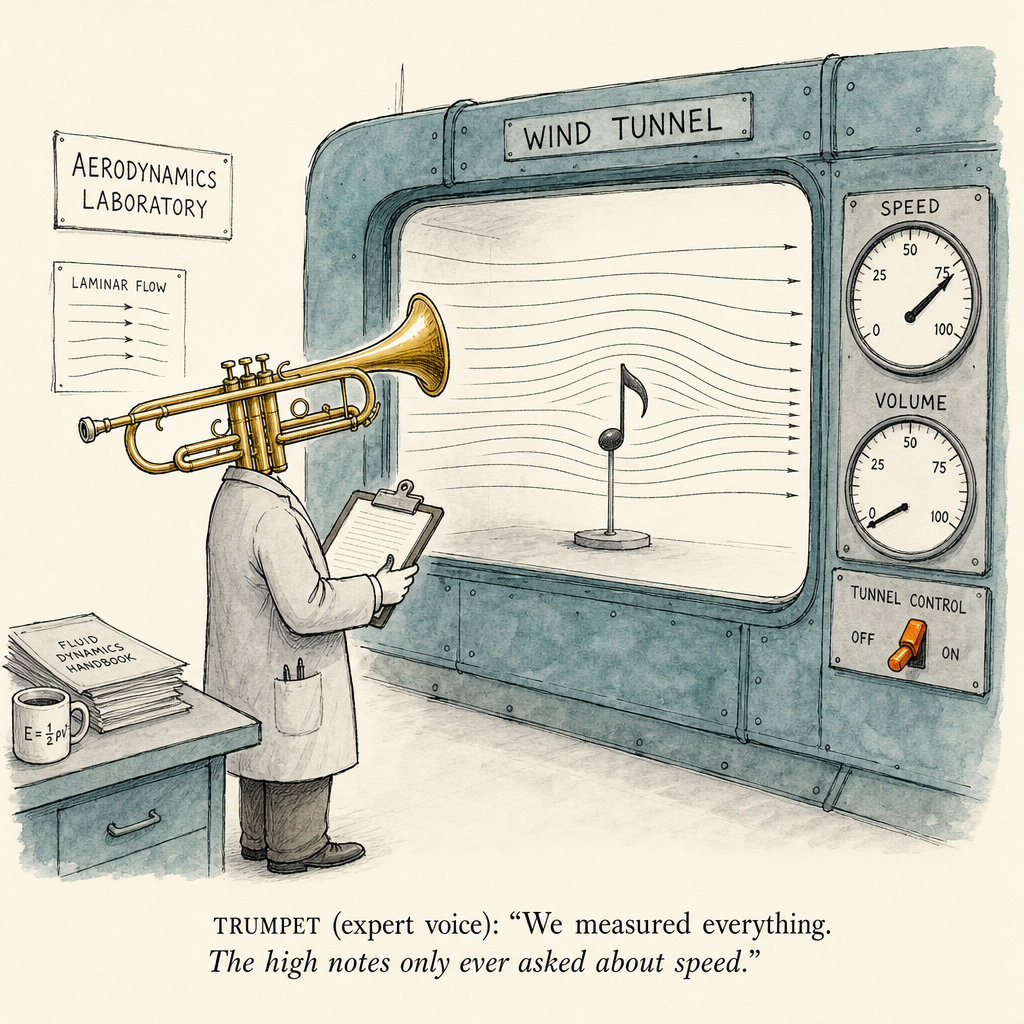
Somewhere along the way, somebody told you the secret to high notes was “more air.”
So you took the advice literally. You sucked in the biggest breath you could hold, aimed everything you had at the note, and pushed. And you got a louder middle register. A red face. Maybe a headache. Everything except the high note.
Here’s the problem. “More air” measures the wrong thing. The trumpet does not reward you for moving more air. It rewards you for moving faster air. Air speed is what creates trumpet high notes. Air volume mostly creates loud.
Confusing those two is one of the most common reasons range plateaus, and untangling them is one of the load-bearing ideas in my complete guide to building trumpet range. This article unpacks the distinction properly, because once you have it, half the breathing advice you’ve ever heard suddenly sorts itself into two piles: useful, and actively hurting you.
Volume and Speed Are Two Different Jobs
Air volume is the amount of air you move. How big the breath is, how much of it travels through the horn every second. Volume is a quantity.
Air speed is how fast that air is traveling at the moment it reaches your lips. Speed is a velocity.
Those are different physical properties, and the trumpet assigns them different jobs. Volume controls the size of your sound. More air through the horn means a bigger, louder note. Speed controls pitch. Your lips are the gatekeeper here: the note you get depends on how fast your lips vibrate, and your lips will only vibrate as fast as the air passing between them lets them. Slow air, slow vibration, low note. Fast air, fast vibration, high note. A high C asks your lips to vibrate twice as fast as the C in the staff below it. That’s just the physics of the octave.
So when a player wants a higher note and reaches for a bigger breath, the horn gives them exactly what they asked for: a bigger, louder version of the note they were already on.
You asked for volume. You got volume. The pitch never had a reason to move.
Why Air Speed, Not Air Volume, Creates Trumpet High Notes
I’ve said this on YouTube more than once: if you just blow air, it comes out and falls flat. Nothing is energizing it. You can blow harder and push it a little farther, but raw blowing is the least efficient way to move pitch that exists on this instrument.
Getting better at high notes is not a weightlifting competition. There is a system underneath every high note, and that system has two pillars. One, air arriving at the lips fast enough for the note you want. Two, an embouchure efficient enough to handle that air. If the embouchure is too weak, nothing comes out. If you’re mashing the mouthpiece into your face, you stop the vibrating surface and nothing comes out either. But notice what’s not on that list: lung size. Brute force. Heroic breathing.
The players with effortless range are not moving more air than you. Most of the time they’re moving less. They’re just doing more to the air before it leaves.
The Swimming Pool Breath
Let me show you what volume-thinking does to a player in the wild.
There you are, end of the chart, the big note coming up. You know it’s coming, so you prepare. You tense everything. You inhale a swimming pool. You hit the note, it speaks for a second, and then comes the rush to your head. Pressure behind the eyes. Dizziness. For some players, the lights actually go out.
Here’s what happened. You took in far more air than you could release through the horn. A trumpet is a small pipe with a small opening at your end of it. When you shove a huge breath at that small opening, the extra air has nowhere to go, so the pressure backs up, and it backs up into your head. That back pressure is the headache. That back pressure is the dizziness. The breath you take in and the breath you let out need to be roughly equivalent, and volume-thinking wrecks that equation from the first inhale.
And it gets worse, because your body is smart. When you brace to shove a wall of air at a closed system, your body treats that pressure as a threat and resists it. The throat narrows. The face tenses. Everything clamps down to protect you. That instinctive bracing is what I call the protective reflex, and once it kicks in you’re no longer playing the trumpet. You’re arm-wrestling your own body, and your body doesn’t lose that match.
Big breath, blocked airway, back pressure, bracing. That’s the full price of “more air.” No half steps included.
Compression: How Air Actually Gets Faster
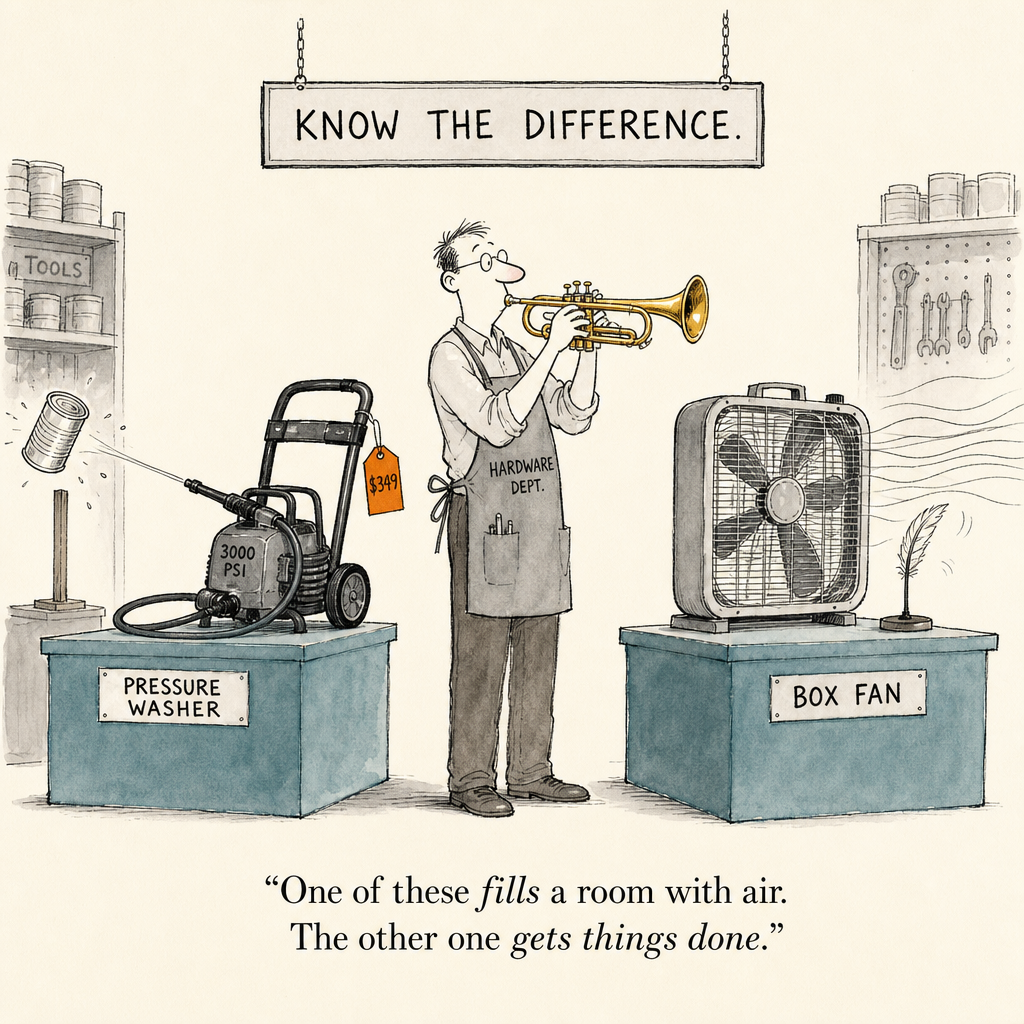
So if volume doesn’t create speed, what does? Compression. Squeezing the air into a smaller space so it’s energized before you release it.
Try this right now, away from the horn. Put a finger over your mouth so no air can escape, and blow. Now squeeze. Try to compact all the air inside your mouth into a smaller and smaller space, like you’re squishing it together as tight as it will go. Feel that? That’s compression. That air is energized. And when you let it go through a small opening, it doesn’t drift out. It launches.
That’s the entire mechanism of a high note: energized air released through the aperture, speeding the lips up, moving the horn higher. And there are four good places on your body to create it.
Your abdominals. Years ago, in college, I got to play a big band concert with Bobby Shew. At the end of a tune I played a high F sharp and prayed he’d turn around and give me the nod, like the end credits of an 80s show. He did. Then he turned back to the audience and played a double C so destructive I nearly fell off the riser. After the concert I found out where that monstrous power came from: his abdominal muscles. Abdominal support compresses the air column from the bottom, and by doing that it spreads the kinetic energy of the note across your body instead of dumping the whole job on your lips. Think of a water bottle: twist it hard so the air inside has nowhere to go, then pop the cap. That twist is your abs bracing.
Your tongue. Raise the tongue inside your mouth and the room the air travels through gets smaller. Same air, smaller channel, faster flow. This is the same move you make when you whistle from low to high, and it’s such a big lever that I gave it its own article on tongue position for high notes.
Your inner oral cavity. That finger-over-the-mouth squeeze you just did. Building pressure inside the mouth itself is a third compression source, and you can feel it any time by trying to blow without letting air out.
Your aperture. A big lip opening lets more air through. A smaller one makes the air that does pass move faster. It’s not the primary source, but it helps, especially when you’re playing quietly.
Four sources. Mix them and you get high notes. Skip them and you’re back to shoving volume at a note that only responds to speed.
Good Compression vs. Bad Compression
Now the warning label, because there are also bad ways to compress air, and your body will find them on its own if you let it.
Good compression comes from arrangement: tongue position, abdominal support, aperture size, the shape of the oral cavity. These squeeze the air without fighting it, and you can run them all night.
Bad compression comes from constriction: squeezing the throat, jamming the mouthpiece into your lips, pinching the lips together. Here’s the trap. These technically work, for a moment. A closed throat does speed up air. Mouthpiece pressure does stabilize things briefly. That short-term payoff is exactly why players build entire embouchures on top of them. But every bad source collects its fee from the vibration itself. The throat chokes the sound, the pressure stops the lips from vibrating, the pinch strangles the aperture. You gain a note today and lose the register next year.
I’ve written a full breakdown of this trade in compression versus pressure, and if mouthpiece pressure specifically is your habit, the article on extending your range without pressure walks through the escape route.
The test for any compression source is my North Star: feels good, sounds good, responds easily. All three. A source that produces the note but feels like strangling fails the test. It’s a compensation, not a technique.
How to Train Air Speed
You don’t need a gadget or a breathing gym. You need a few honest reps a day at the right target.
Start off the horn. Do the finger-seal squeeze until you can produce that compacted, energized feeling on command, and notice your abs firing when you do it. Then whistle, low to high, and pay attention to the tongue rising and funneling the air. Those two drills are the whole mechanism in miniature, free, and impossible to fake.
Then take it to the horn, and here’s the key: play soft. Softness is the lie detector for air speed. At full volume, sheer air quantity can smear you onto a note that your compression never earned. At pianissimo there’s nowhere to hide. If a note only speaks when you play it loud, that note is running on volume, not speed, and it will abandon you the day you’re tired. Take a note near the top of your comfortable range and play it quietly, using abs, tongue, and aperture to keep the air energized at a whisper. When that note speaks easily and softly, the speed is real and it’s yours.
And keep the exhale honest. Take in the breath the phrase needs, not the biggest breath you own. Air in should roughly match air out. Your head will thank you.
One more payoff while we’re here: everything above is also endurance training. When speed comes from compression instead of from shoving, the lips stop absorbing the whole workload, which is why the same principle sits at the center of my trumpet endurance system. Fix the air and two problems fall over at once.
Keep the Two Jobs Separate
From today, use the words precisely, because your practice follows your vocabulary. Volume is for size. Speed is for pitch. When you want louder, move more air. When you want higher, energize the air you already have.
The players you envy figured this out, some of them on purpose, most of them by accident. You don’t need the accident. You need the mechanism, a few weeks of honest soft reps, and the patience to let compression replace force.
Learn the Full System
Air speed is one piece of a bigger machine, and the pieces work best when they’re installed in the right order. That’s exactly what I walk through in my free 30-minute training: the full system I use in the 1% Trumpet Program to build range that feels easy instead of forced. If this article connected some dots, the training connects the rest. Watch the free 30-minute training here.
— Jesse