Here is an uncomfortable piece of math. A player who practices two hours a day with no system will lose, over one year, to a player who practices thirty minutes a day with a good one. Not “might lose.” Will lose, reliably, in tone, range, endurance, and confidence. I’ve watched it happen with over a hundred trumpet players I’ve coached, and it never stops surprising people.
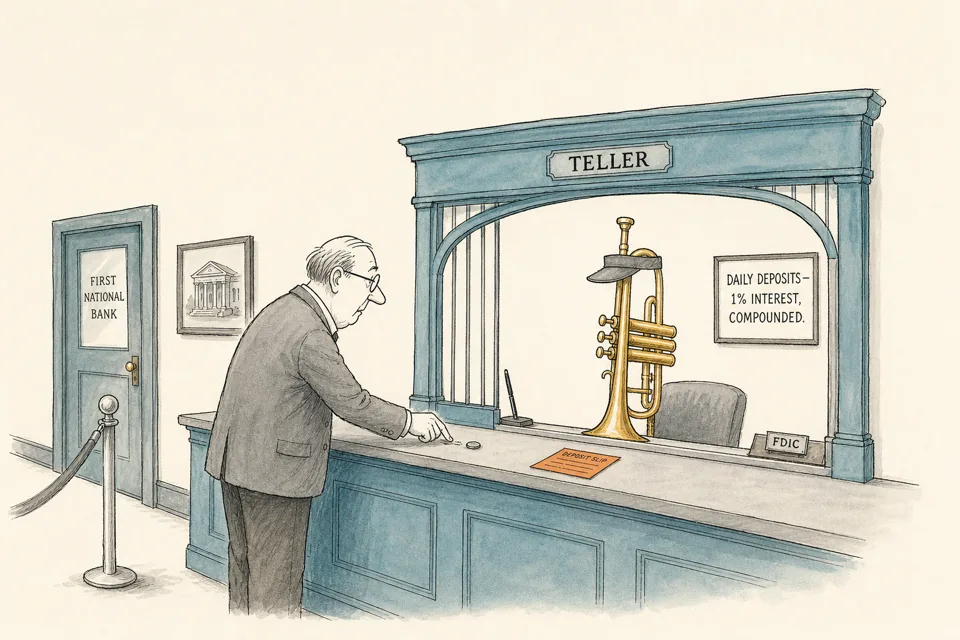
That’s because practice doesn’t pay you for hours. It pays you for compounding, the same way money does. An investor who deposits a small amount into the right account every single day ends up wealthy, while the guy who dumps a windfall into a random account once a month ends up wondering where it all went. Your practice routine is the account. The interest rate is the quality of the system. The deposits are your daily minutes. This guide is about getting all three right.
Everything here is the same framework I use inside the 1% Trumpet Program, named for exactly this idea: get 1 percent better every day and let compounding do what compounding does. You can run all of it with a pencil, a timer, and thirty minutes.
The North Star: How to Know Practice Is Working
Before structure, you need a compass, because most players can’t actually tell whether a practice session helped or hurt them.
The compass is what I call the Trumpet North Star: your playing should feel good, sound good, and respond easily. All three. Not two out of three. A high note that sounds impressive but requires mashing the mouthpiece into your face fails the test. A comfortable mid-register that speaks a half-second late fails the test. Every exercise in every session gets measured against this, and the moment you adopt it, a whole category of “productive” practice reveals itself as expensive noise.
Write it somewhere you can see it from the music stand. When something goes wrong in the next thirty days, your first question is which of the three legs wobbled.
The Non-Negotiables
Three rules sit underneath everything else in this guide. Players who keep them improve. Players who negotiate with them don’t. After coaching over a hundred trumpet players, I have yet to meet the exception.
Thirty minutes minimum, every day. Not when it’s convenient. Daily. Everyone has thirty minutes; if you believe you don’t, you have a priority problem, not a time problem, and it’s worth saying that plainly because the reframe is the fix. Consistency beats heroics because motor learning rewards frequency. Six days of thirty minutes will outperform one three-hour Saturday every single week of the year, and the Saturday binge usually damages the chops it claims to be training. If your day truly fractures, split it: fifteen minutes in the morning, fifteen at night. Leave the horn on your desk and steal ten-minute pockets. The rule survives every schedule I’ve ever seen.
Track everything. What gets measured gets managed, and what doesn’t get measured gets remembered wrong. Memory is a flattering biographer. The log is the honest one. Tracking is important enough that it gets its own full article, how to track your trumpet practice progress, but the minimum viable version is one line per day: minutes, focus, what worked, what didn’t.
Own your results. No excuses about age, genetics, old teachers, or busy seasons. Data and action. If the week’s log shows three practice days, the problem isn’t mysterious, and neither is the solution. This mindset is the difference between players who drift and players who build.
The Engine: The 2:1 Practice Ratio
If you take exactly one thing from this guide, take this, because it’s the single highest-leverage change an adult player can make.
For every mistake you make, fix it two times before moving on.
Crack a note? Play it correctly twice. Crack two notes in a phrase? That phrase owes you four clean repetitions. Miss the same interval three times? Six fixes. Keep a tally sheet with two columns, mistakes and fixes, and don’t leave an exercise until the fixes column is double the mistakes column.
Why two? Because of the ratio it forces. Most players unconsciously practice at 1:1: make the mistake, fix it once, feel resolved, move on. That’s a 50/50 split between correct and incorrect repetitions, and 50/50 is stagnation. You’re teaching your body the mistake exactly as often as the correction. The 2:1 ratio locks in a two-thirds majority for correct reps, and a two-thirds majority compounds. It’s the difference between an account earning interest and an account treading water, and it’s why I call the ratio a bulwark: it structurally prevents mindless run-throughs, playing past errors, and self-deception about how the session actually went.
The deep dive, including how to run the tally system and what to do when the fix won’t stick, is in the 2:1 practice ratio article.
Not All Mistakes Are Equal: The Rank Order
The 2:1 ratio tells you how to fix. This tells you what to fix first, because fixing in the wrong order is another way practice quietly fails.
First priority, always: response issues (cracked, airy, or late-speaking notes), wrong notes, excessive mouthpiece pressure, and poor breath support. These four undermine everything built on top of them. Pressure in particular is a debt collector; ignore it and it comes for your endurance, your range, and eventually your lip.
Second priority, once the critical layer is handled: intonation, embouchure stability across registers, excess body tension, and articulation clarity.
Third priority, the refinement layer: phrasing, dynamic range, and range extension. Notice that range is last, which is the opposite of where most frustrated players put it. Range built on top of unresolved response and pressure problems isn’t range, it’s rented squeaking. When you’re ready to build it properly, the system lives in my complete guide to building trumpet range.
The Session: What Thirty Minutes Actually Looks Like
A working session has three parts, and none of them is complicated.
Open with a warm-up, five to ten minutes. The warm-up is a diagnostic, not a ritual; it tells you what showed up today so you can practice the player you are this morning instead of the one you were yesterday. The full method, including when to use a fixed routine versus a find-the-bottleneck approach, is in the warm-up routine article.
Spend the middle fifteen to twenty minutes on your one focus topic, running the 2:1 ratio the whole time. One topic, not four. This is where the deposit gets made.
Close with a few minutes of music you enjoy, played beautifully at an easy level. It consolidates the session, reminds you why you do this, and ends the day with your body’s last memory of the horn being a good one.
Two duration rules bracket the whole thing. Thirty minutes is the daily floor. Forty-five continuous minutes is the ceiling; past it, fatigue starts signing bad habits into law, so long days get split into multiple sessions rather than one grind. The complete blueprint, with variations for shorter and longer days, is in how to structure a trumpet practice session.
The Calendar: One Focus for 2 to 4 Weeks
Here’s where adult players sabotage themselves most reliably. Monday is range day, Tuesday is double-tonguing day, Wednesday brings a new YouTube exercise, and by Sunday the week touched ten skills and improved zero. I call this stimulus hunting: chasing the novelty of new exercises instead of seeking the fundamentals underneath them. It feels like curiosity. It performs like channel-surfing.
The rule that kills it: pick one specific weakness and keep it as your focus topic for two to four weeks. Shorter than two weeks and no adaptation completes; you’re sampling, not training. Longer than four weeks on the same plateau usually means you’re stuck and need outside eyes, not more of the same. Inside the window, real coordination moves from “thing I can do when I concentrate” to “thing my body does.”
A year holds roughly twelve to twenty of these focused blocks. Choose them deliberately and that’s twelve to twenty permanent upgrades, compounding on each other. That’s what a year of interest looks like.
The Week: Light, Medium, Heavy
Musicians are athletes, and no athlete trains at maximum every day. Assign each day an intensity. Light days, around a 3 or 4 out of 10 in effort, stay in completely comfortable territory: fundamentals, easy tone work, recovery. Medium days, 5 to 6, carry your normal focus-topic work. Heavy days, 7 to 8, are where you push limits, and they only work when they land on rested chops.
A simple week: medium Monday, light Tuesday, heavy Wednesday, light Thursday, medium Friday, light Saturday, and Sunday either completely off or light, whichever your body and your life ask for. Both count as recovery; a cold day off and an easy day on the horn are both legitimate tools, and which one you reach for is a real decision, not a moral test. The adaptation you’re practicing for happens between sessions, so skipping recovery doesn’t accelerate anything. It cancels the gains you already paid for. The full system is in Light, Medium, Heavy training, and the rest-day question gets its own honest treatment in rest days for trumpet.
Measure Reality, Not Memory
Your perception of your playing and the reality of your playing are different documents, and the gap between them is where progress goes to die. The map is not the territory. So use instruments: a metronome for time, a tuner or drone for pitch, a recorder for the sound you actually make versus the one you hear from behind the bell, a mirror or camera for form, the tally sheet for your 2:1 ratio, and the log for the long arc.
Recording yourself is the cheapest coaching on earth and the one players avoid hardest, because the recorder has no manners. Embrace the truth anyway. Objective feedback is crucial precisely when it’s uncomfortable, and every tool in that list is a way of asking the only question that matters: what actually happened?
Ask Better Questions While You Play
The last layer is attention. Between repetitions, interrogate the rep: What just happened there? Where did I feel tension? What was different about the one that worked? Did that meet the North Star, all three legs? What would happen with less pressure?
Questions create awareness, and awareness is what turns repetitions into learning. A player running the 2:1 ratio while asking these questions is doing more real training in thirty minutes than an unexamined two-hour session accomplishes in a week. That’s the entire thesis of practicing smarter: the quality of your repetitions beats the quantity of them, every time it’s tested.
Your First Thirty Days
Here’s the whole guide compressed into a starting protocol. Commit to thirty minutes daily for thirty days. Pick one focus topic and defend it for the full month. Run the 2:1 tally every session. Assign each day light, medium, or heavy before the week starts. Log one line a day. Record yourself once a week. At the end of the month, read the log and let the data, not your mood, tell you what changed.
That’s it. No secret exercises, because there are no secret exercises. There is only a system that compounds and the daily deposit that feeds it.
If You Want the Account to Grow Faster
I’ll be straight with you about the do-it-yourself path, because I respect it and I came up on it. You can build this routine alone. The system above is complete, and a disciplined player will get real results from it. What you can’t do alone is see yourself. The expensive part of self-teaching isn’t the information, which is free; it’s the months you spend perfecting the wrong diagnosis, the plateau you sit on for a year because the bottleneck is visible to everyone except the person behind the mouthpiece. That is the actual cost, and adult players pay it in the one currency they can’t earn back: playing years.
If you’d rather skip that bill, I teach the entire system, the ratio, the structure, the diagnostics, and how to find your real bottleneck, in a free 30-minute training. It’s the same framework the players in the 1% Trumpet Program use every day, built for adults with real schedules. Watch the free 30-minute training here.
Small deposits, good interest rate, every day. A year from now the account balance will look like talent.
— Jesse