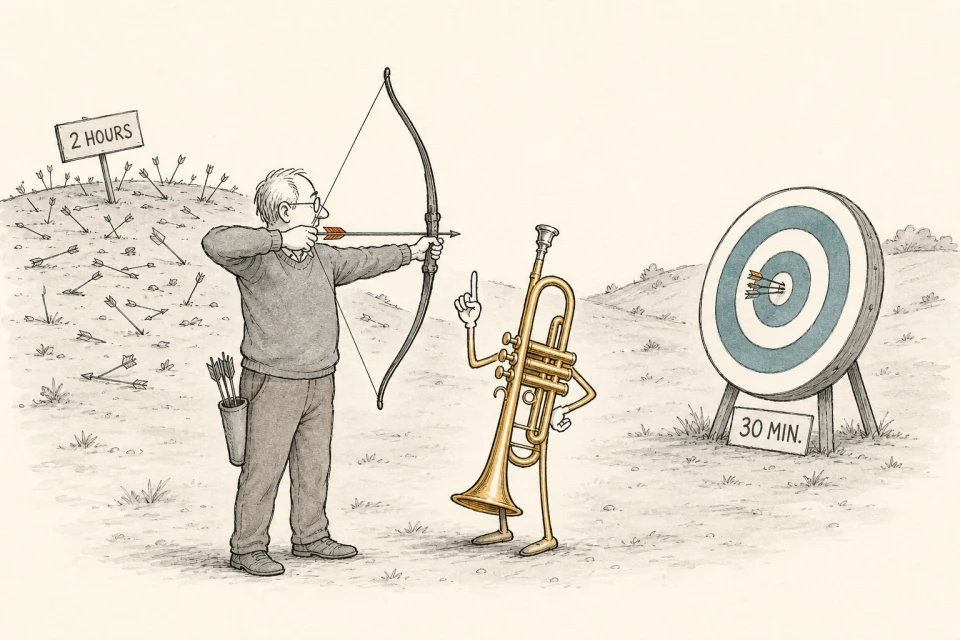
An archer who looses a hundred arrows without aiming isn’t practicing archery. He’s practicing littering.
It sounds obvious on a range and gets ignored in every practice room in the world, where “how long did you practice” remains the only question anyone asks. Two hours reads as devotion, thirty minutes as dabbling, and the hours-equal-progress equation is so embedded in music culture that questioning it feels vaguely heretical. So let me be precise about the heresy: past a modest threshold, session length is one of the weakest predictors of improvement I’ve seen across more than a hundred trumpet players. What predicts improvement is the number of aimed arrows.
What an Aimed Arrow Is
A quality repetition, the unit that actually builds skill, has three properties, and it’s worth being exact because most reps in most practice rooms have none of them.
It has a target. Not “play the passage” but “keep the third note from cracking at this dynamic.” An archer aims at a spot, not at the general concept of the hillside.
It gets full attention. The rep is watched while it happens: what the air did, where tension crept, whether the attack centered. An arrow you don’t watch land teaches you nothing about the next arrow.
It gets scored honestly. Against the North Star I use for everything: did it feel good, sound good, respond easily? All three or it doesn’t count as a hit, and misses get logged as misses. This is where the 2:1 ratio takes over: every scored miss owes two clean hits before you move on, which is simply what aiming looks like when it’s enforced.
A repetition with a target, attention, and a score is worth some large multiple of a repetition with none. That multiple is the whole quality-versus-quantity argument in one sentence.
Why the Unaimed Hours Feel So Productive
Here’s the trap, and it’s a nasty one because it’s built out of virtue. Volume feels like commitment. The two-hour player finishes tired, lips buzzing, case latched with the satisfaction of a day’s work done, and every signal his body sends says progress. But fatigue is not evidence of adaptation, it’s just evidence of expenditure. The littering archer also goes home with a sore shoulder.
Worse, unaimed volume isn’t neutral. It’s negative, for two mechanical reasons. First, attention is a resource that runs out well before the arm does; the reps in hour two are being fired by a mind that left the range in hour one, and unwatched reps rehearse whatever happens to occur, including every compensation your fatigue invents. Second, the trumpet is an athletic instrument, and past roughly forty-five continuous minutes, form degradation stops being occasional and becomes the medium you’re practicing in. Long undisciplined sessions don’t merely waste the extra time. They spend it installing habits that the next week has to uninstall, which is one of the engines behind the plateau I dissect in why you’re not improving despite practicing every day.
The thirty-minute player with a target list, by contrast, fires maybe a hundred and fifty aimed arrows and stops while form is intact. Fewer arrows. More hits. Better year.
When Quantity Actually Matters
I’m not going to pretend volume is worthless. That’s the mirror-image error, and players use “quality over quantity” as a hall pass for practicing eleven minutes a day and calling it elite.
There’s a floor: thirty minutes daily, minimum, because a nervous system needs a minimum daily stimulus for anything to consolidate, and I hold that line with every player I coach, for reasons covered in how long you should practice each day. There’s also a legitimate role for accumulated volume in pure conditioning; endurance, in particular, is partly a story about total workload managed intelligently over months, which is its own system in the endurance guide. And a player preparing for a heavy gig season genuinely needs more total minutes than a hobbyist maintaining.
The honest formula isn’t quality instead of quantity. It’s quality first, then as much quantity as you can hold quality through. The ceiling on useful volume is your attention and your form, and both are trainable. As they grow, so does the number of aimed arrows you can loose in a day. What never works is reversing the order: pursuing volume first and hoping quality survives the ride. It doesn’t.
Converting an Hour of Quantity into an Hour of Quality
If you currently practice long and want the upgrade without giving up your minutes, don’t shorten the day, split and aim it.
Two sessions instead of one marathon, separated by real recovery hours, each one structured: diagnostic warm-up, single focus block with the tally running, musical close, the full blueprint from how to structure a trumpet practice session. Cap each sitting at forty-five minutes. Assign the day an intensity before it starts, per Light, Medium, Heavy, so hard aiming lands on rested chops. Same total minutes you were already spending. Double-digit multiple on aimed arrows.
And if you can only find thirty minutes, take heart: you’re holding the most defensible position in this whole debate. A structured, aimed thirty is not the budget option. It’s the professional one.
The Target Nobody Checks
There’s a layer under all of this that quality-versus-quantity debates never reach: an aimed arrow at the wrong target scores a perfect hit that doesn’t matter. You can run flawless quality reps for a month, every arrow watched and scored, at a target that was never your actual bottleneck. Beautiful grouping, wrong hillside. This is the most sophisticated way to stagnate, because every session passes every test you know how to give it, and it’s the failure mode I see most in precisely the disciplined players who’ve already read all the articles.
Checking the target is diagnosis, and diagnosis is the one part of practice that’s nearly impossible to do from behind your own bell. It’s the heart of what I teach in my free 30-minute training: how to identify the bottleneck that deserves your aimed arrows, and how to structure the daily thirty around it so quality lands where it counts. Same framework the players in the 1% Trumpet Program use, most of whom arrived as two-hour litterers and became thirty-minute archers. Watch the free 30-minute training here.
Fewer arrows. Real aim. Right target. That’s the whole sport.
— Jesse