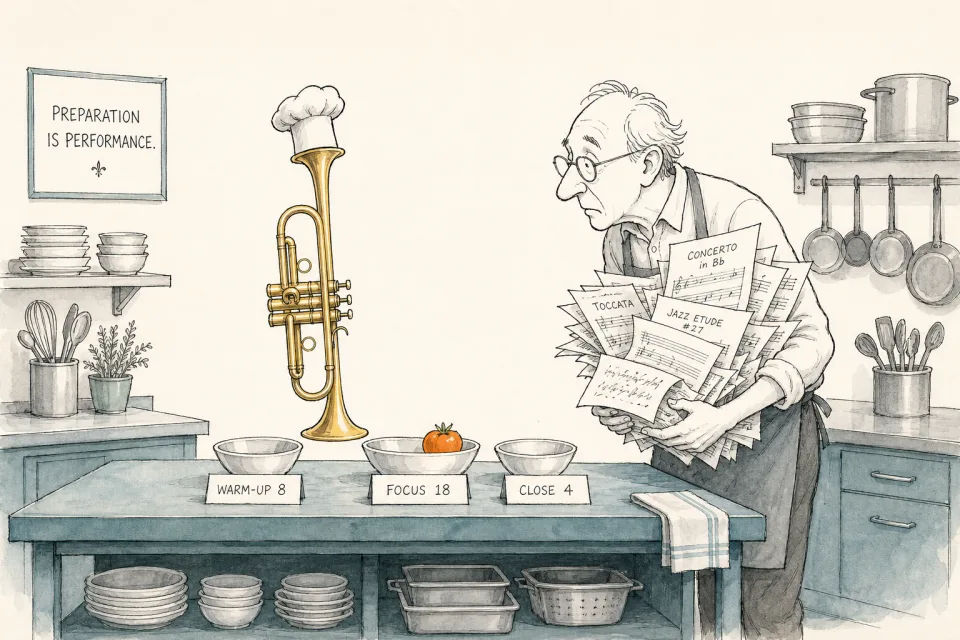
Walk into a professional kitchen an hour before service and you won’t see chaos. You’ll see mise en place: every ingredient prepped, every station laid out, every cook knowing exactly what happens first, second, and third. Dinner for two hundred comes off that line not because the cooks are frantic but because the structure did the thinking in advance.
Now picture the average adult trumpet session. Open the case, noodle. Play the fun lick. Remember the hard passage, poke at it, wince, retreat to the fun lick. Try some high notes. Look at the clock, feel vaguely guilty, pack up. That’s a kitchen with no stations: real ingredients, real effort, no dish. The fix isn’t more time or more discipline in the moment. It’s structure decided before the first note, so the session runs itself, and it’s the operational core of my complete practice guide.
The Three-Course Structure
Every effective session I’ve ever built, for myself or for the hundred-plus players I’ve coached, has the same three parts. The proportions flex with your time; the order doesn’t.
Course one: the diagnostic warm-up, 5 to 10 minutes. Before you cook, you check your ingredients. The warm-up’s job is finding out which player showed up today: how’s the response, the air, the sound, the flexibility. It’s an inspection, not a ritual, and I’ve written the full warm-up method separately. The one structural rule that matters here: the warm-up’s findings are allowed to modify the plan. A failed inspection downgrades the day. That’s the system working, not failing.
Course two: the focus block, 15 to 25 minutes. This is the main course and the only part of the session where improvement actually gets built. One topic. Not three, one, the same one it’s been for the past couple of weeks, because real adaptation needs two to four weeks of repeated attention before it consolidates. Inside the block, the 2:1 ratio governs everything: every mistake fixed twice before moving on, tally sheet on the stand. This is deliberate, slightly uncomfortable, deeply unglamorous work, which is exactly how you know it’s the right block.
Course three: the musical close, 3 to 5 minutes. End with something you love, played beautifully, well inside your comfort zone. This isn’t dessert as indulgence; it’s consolidation. It lets the session end with your body’s final memory of the horn being ease and music rather than struggle, it reconnects the day’s grind to the reason you own a trumpet, and it makes tomorrow’s session something you walk toward instead of away from. Players who skip the close for one more minute of grinding are saving pennies and burning the reason they started.
The Blueprint at Three Session Lengths
Thirty minutes, the daily minimum: eight-minute warm-up, eighteen-minute focus block, four-minute close. This is the workhorse. Run it six days a week and it will outbuild any unstructured ninety-minute wander, for reasons I lay out in practice quality vs. quantity.
Forty-five minutes: ten-minute warm-up, twenty-five-minute focus block, five-minute close, and the extra focus time goes deeper into the same topic, not wider into a second one. Forty-five continuous minutes is also the ceiling. Past it, fatigue starts cooking the food badly no matter how good the recipe is.
An hour or more: don’t stretch one session, split into two. Morning session runs the full blueprint on your focus topic; the second session, separated by real hours of recovery, carries repertoire, ensemble prep, or a second short focus block. Two well-spaced forty-minute sessions beat one eighty-minute slog so consistently it isn’t worth debating. How hard each session runs is set by your Light, Medium, Heavy day, decided when you plan the week, not negotiated mid-session with your fatigue.
Prep the Station the Night Before
Here’s the mise en place habit that makes the whole thing frictionless: the session gets planned before it starts, ideally the night before, in one written line. Tomorrow: warm-up, focus = soft entrances on the E at the top of the staff, close = the Gershwin. That’s it. Ten seconds of pencil.
The line does two jobs. It removes the most expensive minute in amateur practice, the first one, where a player stands in front of the stand deciding what to do and drifts into noodling instead. And it connects today to the two-to-four-week arc, because the line isn’t invented nightly, it’s copied forward from the focus block you committed to. Decision-making is prep work. Do it during prep, not during service.
A note for the skeptic who says “I already have a routine”: a routine and a structure aren’t the same thing. A routine is a sequence of exercises you’ve grown comfortable playing in order. A structure is a machine with a diagnostic, a target, an enforcement mechanism, and an exit. I’ve met many hundred-session routines that contained zero structure, and the tell is simple: if you can’t say in one sentence what this month’s focus is and how you’ll know it improved, you have a habit pile, not a system.
What Goes on the Stand
Physical mise en place matters more than it should. On the stand before you play: the one-line plan, the tally sheet for the 2:1 count, a pencil, a metronome and tuner, and the actual materials for the focus block. Phone across the room unless it’s the metronome, and if it is, airplane mode; a notification mid-focus-block is a dropped pan in the kitchen. Horn on a stand where you can see it during the day, because visible instruments get played.
And one line in the log when you’re done: minutes, focus, what worked, what didn’t. Thirty seconds. That line is the bridge between today’s session and the pattern-reading that makes next month smarter, which is the entire subject of how to track your trumpet practice progress.
The Recipe Isn’t the Cook
I’ll leave you with the honest limit of every blueprint, including mine. Structure solves the how of a session: order, proportions, enforcement, exit. It cannot solve the what. The focus block only builds the right thing if it’s aimed at your actual bottleneck, and choosing that target is diagnosis, which is a different skill from discipline. A perfectly structured month aimed at the wrong ingredient produces a beautifully cooked dish nobody needed, and I’ve watched disciplined adults do exactly that for a year at a stretch. The structure was flawless. The menu was wrong.
Choosing the menu is what I teach in my free 30-minute training: how to find the bottleneck that deserves your focus block, and how to run this exact session structure around it so every thirty-minute shift moves the same wall. It’s the system the players in the 1% Trumpet Program cook on daily. Watch the free 30-minute training here.
Set the stations. Cook one dish at a time. Taste as you go, and end with something delicious.
— Jesse