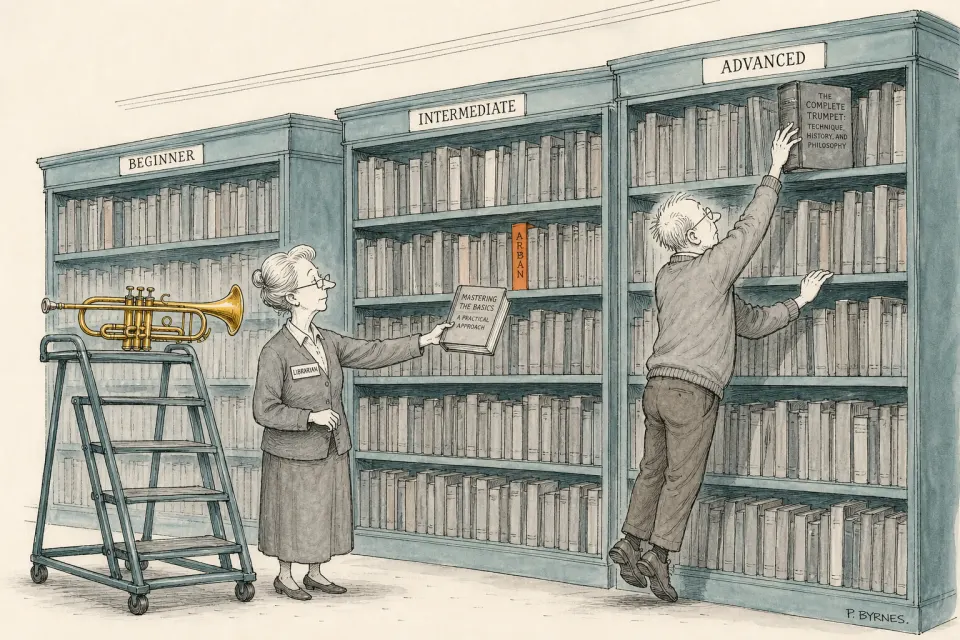
Walk into any decent library and the books are already organized by reading level, and nobody is embarrassed about it. Third-graders aren’t handed Dostoevsky to prove a point, and adults aren’t sent back to picture books because they once took a decade off from reading. You find your shelf, you read from it daily, and you move up when the current shelf stops challenging you.
Etude books are the trumpet’s library, and choosing from the right shelf matters more than choosing the “best” book, because the famous books are famous at every level and most players are reading two shelves above or below where they should be. Below are the shelves as I assign them, and then, because it’s worth more than the list itself, how to actually practice an etude, which is where the real value hides.
The Beginner Shelf: First Books of Real Music
For first-year players and early comeback players rebuilding from zero, the standard is Getchell’s First Book of Practical Studies: short, melodic, and honest about its job, which is making fundamentals feel like music instead of medicine. Its sequel, the Second Book, extends the same idea. Sigmund Hering’s Forty Progressive Etudes belongs on this shelf too, slightly more athletic, wonderful for building clean articulation early.
Don’t rush past this shelf out of pride, especially as a comeback player. Easy etudes played beautifully, with real attention to sound and response, rebuild coordination faster than hard etudes survived, a theme I return to constantly in how to practice after a long break.
The Intermediate Shelf: Where Most Adults Actually Live
This is the crowded shelf, and the honest home of most adult amateurs and comeback players. The cornerstone is the Arban Complete Conservatory Method, which isn’t strictly an etude book but contains the studies and characteristic pieces every trumpet player eventually meets. Treat Arban as the reference section: you don’t read it cover to cover, you work assignments from it. Concone’s lyrical studies, vocalises borrowed from the singing world, are the melodic counterweight, and they will expose every bump in your legato that faster material lets you hide. Voxman’s Selected Studies rounds out the shelf with well-curated variety across keys and styles.
A good intermediate rotation touches one technical source and one lyrical source in the same season. The technical study builds the machine; the lyrical study reminds the machine it exists to sing. Skip the lyrical half and your playing gets the specific gray competence of someone who only ever lifts weights and never plays a sport.
The Advanced Shelf: The Standard Literature
When intermediate material stops producing mistakes worth fixing, the classic advanced sequence is waiting. Charlier’s 36 Études Transcendantes is the summit most serious players circle for years: musically rich, technically honest, every etude a small recital piece. Theo Charlier sits beside Brandt’s 34 Studies, orchestral in flavor and rhythmically demanding, and Bitsch’s Vingt Études, which will audit your modern harmonic reading along with your technique. For players headed toward the profession, Smith’s Top Tones extends the project into the upper register with musical, not macho, intent.
One caution about this shelf, earned from watching over a hundred players self-assign: advanced etudes played with intermediate fundamentals don’t build advanced players. They build elaborate compensations at higher difficulty. If response, pressure, or sound degrade partway down the page, the message isn’t “try harder,” it’s “wrong shelf this season,” and there’s no shame in it. The shelf will still be there.
How to Actually Practice an Etude
Here’s the section that should be the whole article, because the librarian’s dirty secret is that owning books and reading them are different hobbies. An etude only builds your playing if you practice it as training material rather than performing it as repertoire, and the difference comes down to three habits.
First, one etude for a stretch of weeks beats a new etude every session. Adaptation needs repeated exposure to the same demands, the two-to-four-week window I use for every focus topic in the complete practice guide. Grazing a fresh etude daily feels productive and trains almost nothing; that’s stimulus hunting with a nicer cover, the exact pattern behind practicing daily without improving.
Second, the etude is a mistake-delivery system, and that’s a compliment. Its job is surfacing your weaknesses in musical context; your job is paying for them, on the spot, with the 2:1 ratio: every crack, smear, or late entrance fixed twice, cleanly, before you continue. Playing through an etude top to bottom, wincing and continuing, is reading with your eyes closed. The tally sheet belongs on the stand next to Charlier just as much as next to a scale sheet.
Third, respect the priority order inside the mistakes. When an etude produces five different problems in one line, and a good one will, fix response and pressure issues before intonation, and intonation before phrasing polish. Foundation first, always, or the etude teaches you to decorate cracks.
Run those three habits and a single well-chosen etude becomes a month of structured training. Skip them and a shelf of masterworks becomes expensive sight-reading.
Choosing Your Book Tomorrow Morning
Practical selection rule: pick the book where you make real mistakes at a rate you can afford to fix. If a page produces nothing to tally, you’re grazing beneath your level; if it produces more than you can pay for with 2:1 fixes inside your focus block, you’re drowning above it. The right etude generates a handful of honest, fixable mistakes per session, which is the sweet spot where the quality-over-quantity math pays best.
And now the objection this article exists to answer: “just tell me the right book, and my playing will finally move.” I understand the hope, and I’ve watched a lot of players spend a lot of years testing it, buying shelf after shelf while the playing stayed put. The hard truth is that no etude book has ever fixed a trumpet player, for the same reason no library card has ever produced a scholar. Books supply the material. The method, which mistakes to hunt, how to pay for them, how long to stay, is what converts material into progress, and the method is precisely what isn’t printed in any of these books. Players with a great method and a mediocre book improve. Players with the perfect book and no method own a beautiful, unread library.
The method is what I teach in my free 30-minute training: how to diagnose what your playing actually needs, pick material that targets it, and practice that material so the improvement sticks. It’s the same system the players in the 1% Trumpet Program use on everything from Getchell to Charlier. Watch the free 30-minute training here.
Find your shelf. Take one book down. Read it the way it was meant to be read.
— Jesse