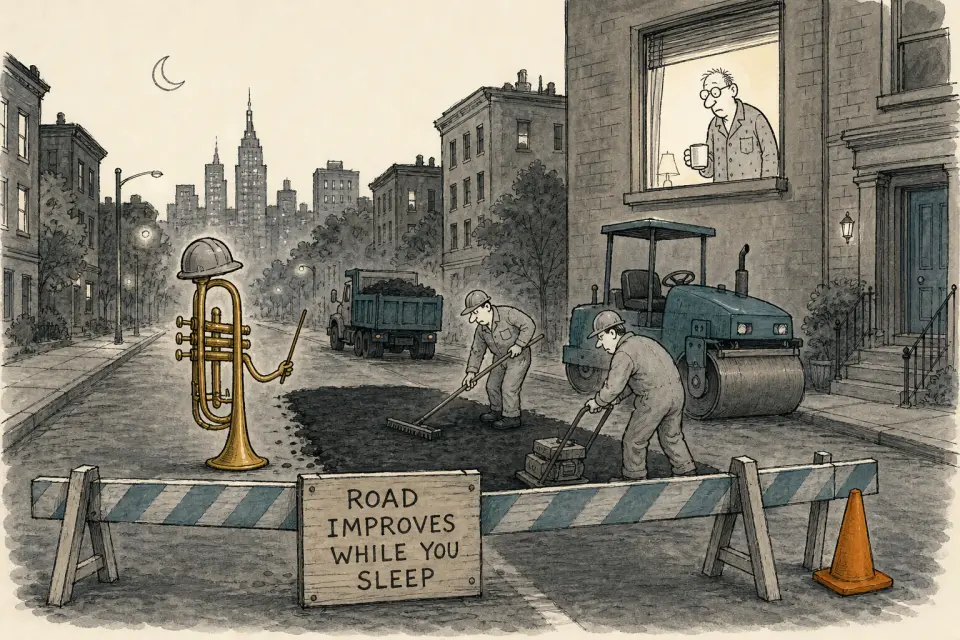
Every big city repaves its roads at night. The crews roll out after the traffic dies, do the actual repair work in the dark, and by morning rush hour the lanes are open again, better than yesterday. Nobody calls the overnight closure “lost driving time.” The closure is when the road gets rebuilt.
Your embouchure runs the same operation. Practice is traffic: it stresses the surface, wears the material, creates the damage that signals where rebuilding is needed. Recovery is the night crew: the actual repair, the laying down of stronger tissue and cleaner coordination, happens while the horn is in the case. This is the least understood sentence in all of trumpet training, so it gets its own paragraph:
Improvement doesn’t happen during practice. Practice creates the stimulus. Improvement happens during recovery.
Once that lands, the rest-day question stops being a guilt negotiation and becomes what it should have been all along: a scheduling question about road crews. Here’s how I schedule them, inside the same weekly system as my complete practice guide.
The Two Kinds of Night Crew
First, widen the menu, because most players think recovery only comes in one flavor: the full day off. It comes in two, and both are legitimate tools.
The full closure: a complete day off the horn. No playing, period. This is the right call after genuine overload: a brutal gig weekend, an unusually heavy training week, or the deep accumulated fatigue where even your morning warm-up inspection reads badly day after day. Full rest lets every system rebuild at once, and for many players one planned full closure per week is a sustainable rhythm that keeps the whole operation healthy.
The single-lane closure: a light day that works as recovery. Ten to twenty-five minutes of genuinely easy playing, soft long tones, gentle slurs, simple tunes played beautifully, nothing above comfortable range, everything at a 3 out of 10. Traffic still flows, but it’s light enough that the crew keeps working. For a lot of players this beats the full day off: it preserves the daily habit and the streak, keeps blood moving through recovering tissue, and, for younger players and for anyone who gets twitchy when the horn stays cased, it quiets the anxiety that a silent day breeds. A light day only counts as recovery if it’s honestly light; a “light day” that drifts into range testing is just a medium day wearing a disguise.
Neither option is morally superior. Full closures suit deep fatigue and players who trust their comeback; single-lane closures suit mild fatigue, anxious temperaments, and streak-keepers. Pick per situation, not per ideology, and say so in your practice log so you can see, over months, which recovery style your body actually responds to.
How Much Rest Does a Week Need?
Now the scheduling math. In the Light, Medium, Heavy system, a healthy week already breathes: hard days are followed by easy ones, and the week contains at least one true recovery slot, either a full day off or a deliberate recovery-light day, most weeks. During heavy building phases, recovery needs rise with the load; after a maximal week or a taxing performance run, two closures close together is prudence, not weakness.
The signals that you need more rest than you’re getting are the flashing-light symptoms I detail in should you practice when your chops are tired: response that stays late through a patient warm-up, creeping mouthpiece pressure, sound that won’t center, accuracy falling for no visible reason, or soreness that survives the night. Those symptoms trending across several days mean the road crew is losing to the traffic, and the schedule, not the player, needs fixing.
The “Too Much” Side of the Question
The question in the title cuts both ways, so here’s the other edge. Yes, there is such a thing as too much rest, and it has a shape: rest without a stimulus worth recovering from.
The night crew rebuilds what traffic stressed. No traffic, nothing to rebuild; a week of closures on an empty road just grows weeds through the asphalt. Trumpet-wise, coordination is perishable in a way strength isn’t: after roughly two consecutive full days off, most players notice response and flexibility dulling, and past three or four the first session back is spent mostly reopening lanes rather than building anything. That’s why even in deload weeks I keep players touching the horn most days, however lightly, and why “took two weeks off to let my chops fully heal” so often ends in the comeback dynamics it was trying to avoid.
The working rules of thumb, then: one genuine recovery slot most weeks, extra closures after real overload, almost never two consecutive full days off outside of illness, travel, or deliberate deload, and if you do land a long break, re-enter through light days rather than resuming the old schedule cold.
Rest Guilt, Retired
Finally, the objection that makes this whole topic emotional instead of logistical: “if I take a day off, I’m falling behind.” I’ve heard it from retirees and from pros, and it deserves a direct answer.
Behind whom? The player grinding seven hard days a week isn’t ahead of you; he’s a road that never closes for repairs, and everyone has driven on one of those. Potholes, patches, and eventually the full teardown. The fear treats practice as deposits and rest as theft, but the physiology runs the other way: the deposit isn’t banked until recovery clears it. Skipping recovery doesn’t protect your gains. It voids them, and then it starts billing you extra, in the compensations and overuse problems that tired grinding installs.
So retire the guilt and replace it with bookkeeping. A rest day chosen for a reason, logged, and followed by a good week isn’t a hole in your record. It is your record working. On the flip side, if “rest day” is what you’re calling the fourth unplanned skip this week, that’s not recovery either; that’s the road quietly closing for lack of traffic, and the fix for that lives back at the thirty-minutes-daily commitment.
Building a week where the traffic and the road crews are both scheduled on purpose, hard days that stress the right things, recovery that actually banks them, is exactly what I teach in my free 30-minute training. It’s the same system the adults in the 1% Trumpet Program use to train hard for years without the breakdowns that end most comeback stories. Watch the free 30-minute training here.
Run the traffic. Schedule the crews. The road gets better every morning.
— Jesse