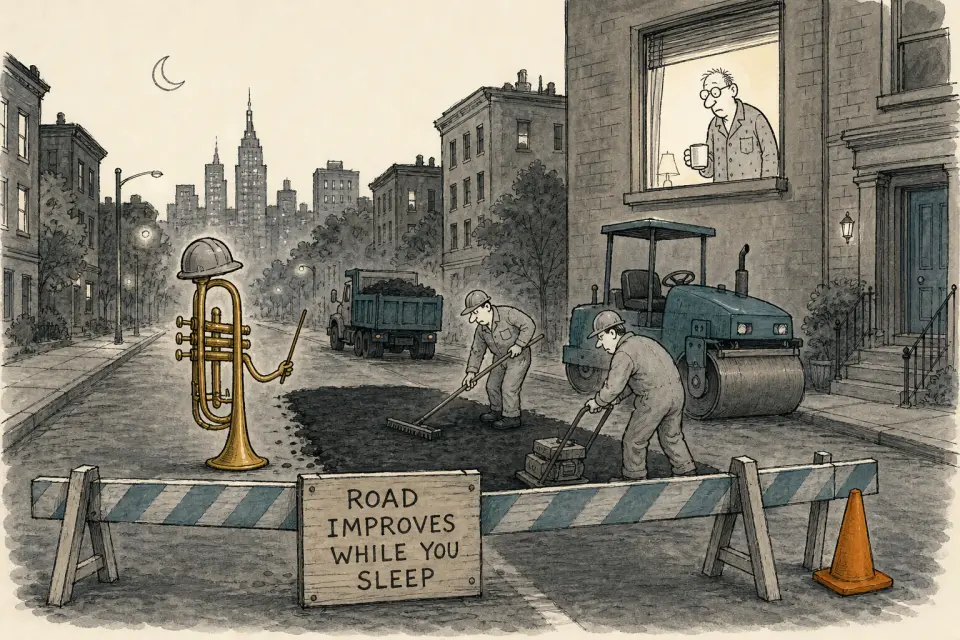
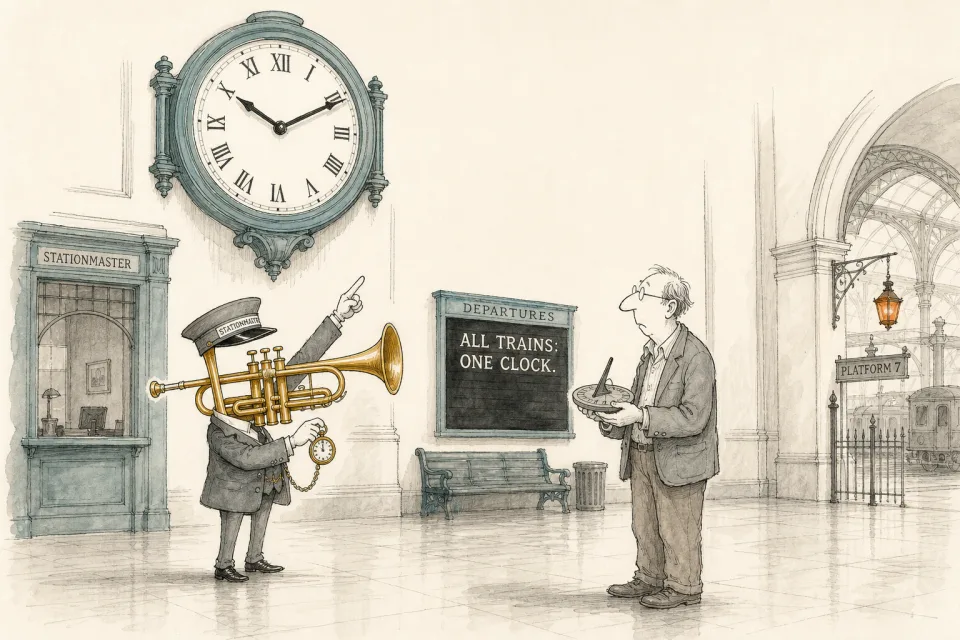
The railways of the nineteenth century had a problem: every town kept its own time, set by its own sundial, each one a little different and each one certain it was right. Trains made that impossible. You cannot run a network where every station has a private noon, so the timetable arrived, standard time, one clock everybody answers to, and suddenly the whole system could interlock.
Every musician you’ll ever play with is a town with a sundial. Your inner clock, left alone, drifts exactly the way theirs does: it rushes what’s exciting, drags what’s difficult, and remains, like every private noon, certain it’s right. The metronome is standard time. It’s not there to make you mechanical, any more than the timetable made trains boring; it’s there so your playing can interlock with music outside your own head. Used well, it’s one of the highest-leverage tools on the stand, right beside the tally sheet from my complete practice guide. Used the way most players use it, it’s a background click they’ve learned to ignore. Here’s the difference.
Prefer to watch? Here is the short version.
First Job: Find Out What Your Sundial Actually Says
Before the metronome fixes anything, let it measure something. Play a passage you know well, alone, recorded. Then play it with the click and listen to the recording of that. The gap between the two performances is your drift, and I’ve never met a player, myself included, who didn’t have a signature: rushing into technical passages like a train trying to make up minutes, dragging through the wide slurs, clipping the long notes at phrase ends.
This is the map-versus-territory problem that runs through everything I teach: your felt time and real time are two different documents, and only one of them is admissible. The metronome, like the tuner and the recorder, is an instrument that refuses to flatter. That refusal is the entire value. Log what you find in your practice log, because your drift pattern is a bottleneck with your name on it, and bottlenecks are what focus blocks are for.
Slow Practice: The Local Train That Arrives First
The metronome’s most valuable service isn’t keeping you steady at speed. It’s making slow practice honest, because unsupervised slow practice barely exists; count the players who claim to practice slowly, then count the ones whose “slow” tempo quietly accelerates the moment a passage starts to feel good. The click is what holds the local train local.
The protocol I give players is boring and it works. Set the metronome at a tempo where the passage is genuinely easy, not survivable, easy, meeting the North Star: feels good, sounds good, responds easily. Bank clean repetitions there, with the 2:1 ratio taxing every miss. Then advance the dial a few clicks, four to eight beats per minute, never more, and bank cleanliness again. Any tempo where mistakes outrun your ability to pay for them is a tempo you haven’t earned; drop back down without drama. Progress by timetable, not by mood.
Players resist this because the express train feels like progress and the local feels like remediation. But the arithmetic doesn’t care how it feels: clean reps at 80 that walk to 120 over two weeks arrive before sloppy reps at 120 that stay sloppy forever. The slow train, run on schedule, is the fast one.
Subdivision: Hearing the Timetable’s Fine Print
Second service: the metronome teaches subdivision, which is the real difference between players who keep time and players who have time.
Steady quarter-note clicks tell you where the stations are. Subdivision is knowing where the train is between them. Practice a passage with the click on eighths, then return it to quarters and notice how the space between beats has structure now. Then go the other direction, fewer clicks, more responsibility: put the click on beats two and four only, jazz-style, or on beat one of each bar, and feel how much of the timekeeping just moved from the machine to you. That’s the progression that matters, the metronome gradually handing you the timetable: click on every beat, then on some beats, then on almost none, your inner clock carrying more of the load at each step while the click stays around purely as an audit.
This graduated handoff answers the objection every metronome article has to face: “the click makes my playing robotic.” Understandable, and backwards. Robotic playing comes from players who never internalized time and therefore cling to the grid or ignore it entirely. Rubato, swing, the pushed phrase, the held moment: all of it is expressive precisely because it bends a timetable that demonstrably exists. You can’t play meaningfully around the beat until you can play dead on it. The freest players you’ve ever heard have the strictest internal clocks; that’s not a coincidence, it’s the mechanism.
Where the Click Belongs in Your Week
Practical placement, because the metronome is a tool with specific jobs, not a lifestyle. It belongs on technical material in your focus block, running the slow-practice timetable. It belongs on rhythm-critical repertoire in scheduled audits, click on, find the drift, click off, fix it, click on, verify. It’s spectacular on etudes, where new material hides old rhythm sins, a pairing I cover in how to actually practice etudes. And it has real business in parts of the warm-up, where a steady grid under long tones and slurs exposes response timing you’d otherwise miss.
It does not belong on everything. Lyrical work needs unclocked time to breathe; the musical close of a session should almost never have a click under it. And no metronome session should run mindlessly: a click you’ve stopped hearing is a screensaver. Attention is the active ingredient, same as everywhere else in practice, which is the whole quality-versus-quantity argument in miniature.
Standard Time for Your Whole Practice Life
Step back and the metronome turns out to be a small model of everything this practice series argues. An external standard that doesn’t flatter. Honest measurement before correction. Progress in small, earned increments rather than heroic leaps. The gradual handoff from external structure to internal skill. Get those right with a fifteen-dollar click and you’ve rehearsed the exact habits that fix a whole practice life; get them wrong and the finest gear on earth is a screensaver with a speaker.
Wiring all of it together, the measurement tools, the tempo protocols, the weekly structure they live inside, is what I teach in my free 30-minute training, the same system the players in the 1% Trumpet Program run their timetables on. Watch the free 30-minute training here.
One standard clock. Every station on time. That’s how networks run, and playing is a network.
— Jesse