
Long tones. They’re simple, right? You pick a note, you hold it for a while, and then you’re done. It’s one of the most fundamental exercises in trumpet playing, something that even beginners learn in their first week of lessons. Pick a note. Hold it. Let it decay naturally. Simple.
Except it’s not simple at all. Long tones are deceptively complex. There are probably a hundred different ways to practice them incorrectly, and only a few ways to practice them correctly. And the scary part is, you can practice them incorrectly for years and not even realize it.
Want the full walkthrough? Watch the video.
Let me give you an example. Let’s say you’re a student, and your teacher assigns you long tones. You pick a note, let’s say a middle C. You hold it for four beats. You sound mediocre. You move on to the next note. Technically, you’ve done the exercise. But have you actually done the exercise?
The answer is probably no. Because long tones aren’t just about holding a note for a certain amount of time. They’re about quality. They’re about control. They’re about awareness.
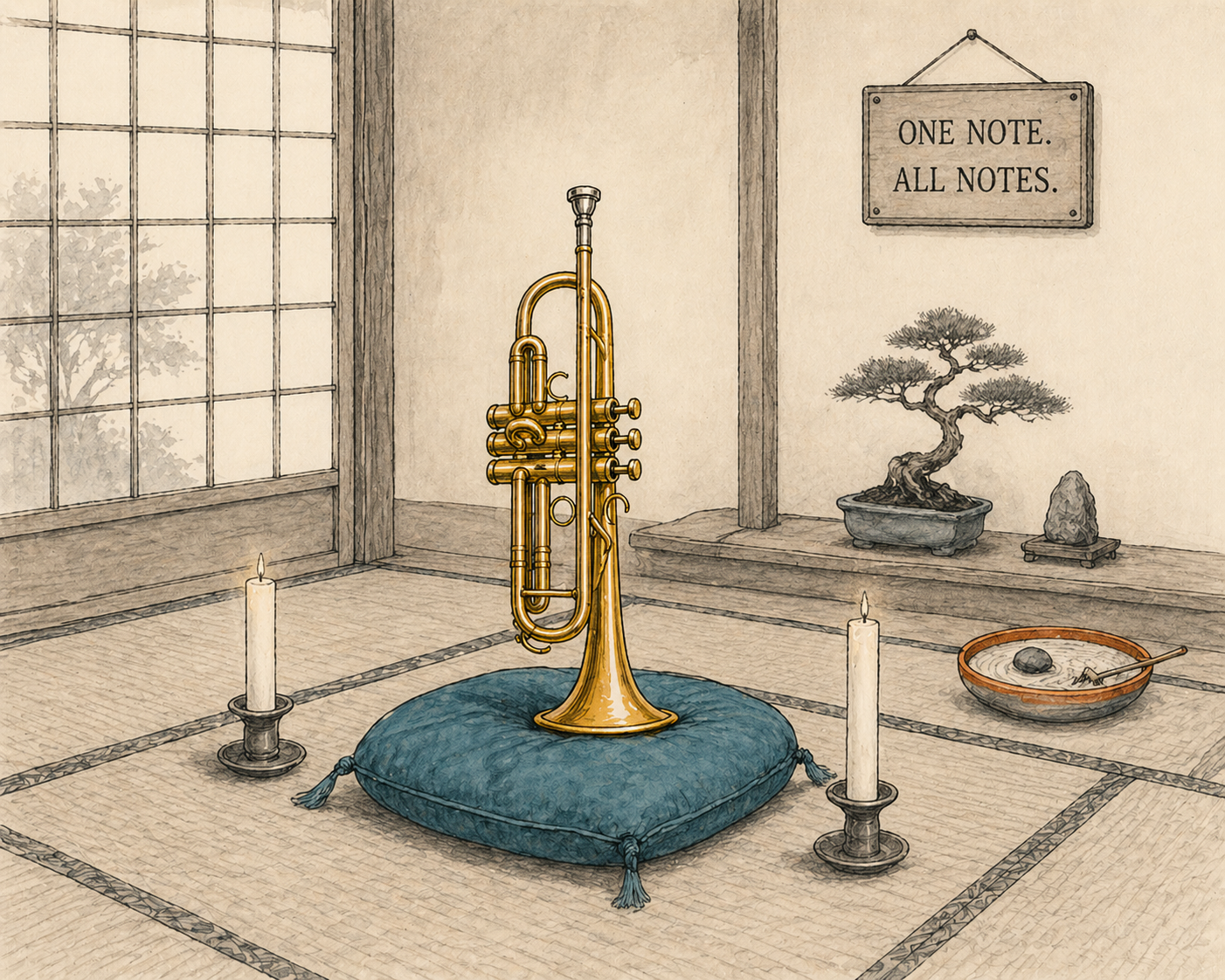
Here’s what a real long tone should involve:
First, you need to think about your air support. Are you breathing from your diaphragm? Are you maintaining consistent air pressure throughout the note? Or are you using your throat to hold the note? These are the kinds of things you need to be thinking about.
Second, you need to think about your embouchure. Is it steady? Is it relaxed? Is there tension? Long tones are an excellent way to diagnose embouchure problems. If you can’t hold a steady pitch for eight beats, if the pitch wavers or dips, that’s a sign that something’s wrong with your embouchure.
Third, you need to think about your tone quality. Is the note full? Is it focused? Does it have a good sound? Or is it thin, airy, or weak? These are subjective questions, but they’re important ones. Long tones are an excellent tool for developing a good sound.
Fourth, you need to think about your listening. Are you actually listening to the note you’re playing? Or are you just letting it happen? This is a big one. Many students practice long tones while completely zoned out. But if you’re not listening, if you’re not actively engaging with the sound you’re making, then you’re wasting your time.
So a real long tone practice session looks something like this: pick a note. Take a good breath from your diaphragm. Start the note cleanly. Then, while the note is sounding, actively listen to it. Monitor the pitch. Monitor the tone quality. Make adjustments as needed. Maintain consistent air pressure. Keep your embouchure relaxed but engaged. All of this, while the note is sustaining.
That’s a real long tone. And it’s way more complex than just holding a note.
Here’s another thing that makes long tones complex: the length. How long should a long tone be? Some teachers say four beats. Some say eight. Some say sixteen. Some say you should hold it until you run out of air.
My take is that length matters less than quality. A four-beat long tone where you’re really focused, really listening, and really working on your tone quality is more valuable than a sixteen-beat long tone where you’re just letting it happen.
That said, longer long tones do have value. They force you to maintain air pressure for longer. They force you to maintain embouchure control for longer. They’re challenging in a way that shorter long tones aren’t.
So here’s what I recommend: start with a reasonable length, like six or eight beats. Make sure you’re doing the exercise correctly (good air support, steady embouchure, active listening, good tone quality). Once you’re comfortable with that, gradually increase the length. Work your way up to longer and longer long tones. But never sacrifice quality for length. A shorter long tone done well is always better than a longer long tone done poorly.
Here’s another thing that makes long tones complex: the register. Long tones in the upper register are much harder than long tones in the lower register. As you go higher, it takes more air pressure, more embouchure control, and more focus to maintain a steady pitch and a good tone quality.
This is actually a feature, not a bug. Long tones in the upper register are more challenging, which means they’re more valuable. They force you to work harder, and they develop your skills more quickly.
But they also require more care. If you’re trying to work on long tones in the upper register and you’re forcing, if you’re using throat tension or mouthpiece pressure, then you’re going to develop bad habits. So take it easy. Build up gradually. Don’t jump straight to sustained high notes if you’re not ready.
Finally, here’s one more thing about long tones that many players don’t realize: the decay. What happens at the end of the note matters. A good long tone doesn’t just end abruptly. It decays naturally, with the sound gradually getting softer while maintaining its pitch and quality. If your notes are ending with a sudden drop in pitch, or if they’re getting fuzzy or airy at the end, that’s a sign that something’s going wrong.
So the exercise doesn’t end when you stop blowing. You need to think about how the note ends just as much as you think about how it sustains.
Long tones. Simple exercise, deceptively complex. But if you take the time to do them correctly, if you really focus on quality and awareness, they can be one of the most valuable exercises in your practice routine.
Don’t just hold a note. Really play it. Really listen to it. Really work on it. That’s what separates the players who improve quickly from the players who improve slowly. It’s not about how many hours you practice. It’s about how much you’re really present during those hours.
Long tones. Give them the respect they deserve.
Want this kind of thinking applied to your own playing?
The free 30-minute training reveals the same framework I use with my 1% Trumpet Program students — the one most comeback players never figure out on their own.
Watch the free training →Want the full system in 30 minutes? Watch the free training — the same diagnosis-first framework I use with every player in the 1% Trumpet Program.