Before we get to the list, you need one idea, or you’ll chase symptoms forever.
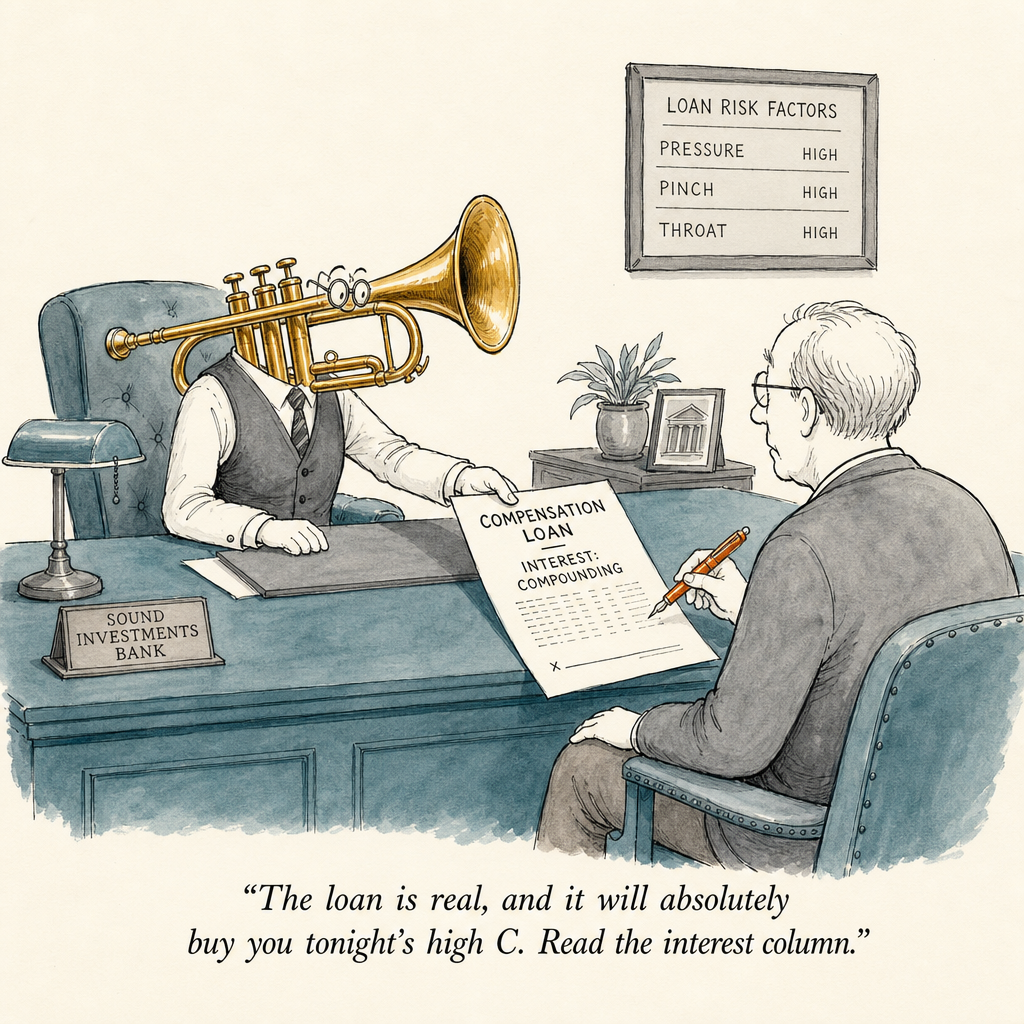
Trumpet embouchure mistakes are not random. They’re not ignorance, laziness, or bad genes. Every single one is a compensation — a solution your body invented to deliver a result you wanted.
You wanted a sound. A range. A pitch. And your body, which is extraordinarily good at solving problems, found a way to deliver it. The problem isn’t that the solution doesn’t work. The problem is that it doesn’t scale. Pressure works — it does compress the lips. Pinching works — it does shrink the aperture. Throat tension works — it does add resistance. They all “work.” They just carry hidden costs that compound until the system breaks down.
It’s a business growing revenue on maxed-out credit cards. The revenue is real. The growth is real. The mechanism producing it is going to crush you.
So don’t read these as moral failures. Read them as solutions that stopped serving you. For each one I’ll show you what your body was trying to accomplish and what the sustainable alternative looks like. If you haven’t read the complete embouchure guide, start there — it maps how the whole system works together. This article is what happens when links in that chain start covering for each other.
Mistake #1: Too Much Mouthpiece Pressure
The granddaddy. Responsible for more plateaus and more horns back in the case than anything else, and one of the hardest to fix because it works so well in the short term.
Your body does it for two logical reasons. First, the seal: air can’t leak around the mouthpiece, and when the seal feels loose, the fastest fix is to push the rim harder into your face. Second, compression: pressing physically shoves the lips closer together, and closer lips vibrate faster. Higher notes. For about fifteen minutes. Then blood flow drops, tissue swells, vibration degrades, and you need even more pressure to get the same result. A treadmill that only speeds up.
Pressure is leaning your body weight against a warped door to keep it shut. The moment you stop pushing, it springs open. The alternative is fixing the hinge: strengthening the corners and lip-to-teeth contact that should create the seal from the inside, so the rim confirms the seal instead of replacing it. Do that and the pressure fades on its own, because it’s no longer needed.
Mistake #2: Pinching the Lips Together
Pressure’s cousin. Pressure compresses the lips against your teeth from the outside; pinching compresses them against each other from the inside. Different direction, same problem.
Squeezing does shrink the aperture and speed up vibration — briefly. But pinched lips can barely vibrate at all. You’re clamping the one thing that has to move freely. So you blow harder to force air through, which makes you squeeze harder to hold pitch, and you’re back on the treadmill. Combine pinching with pressure and you’ve paralyzed the vibrating surface from two directions at once.
The fix: get compression from the good sources — tongue arch, abdominal support, and an aperture that adjusts as part of that coordination — so the lips can stay firm without clamping. I broke down exactly how that works in lip compression on trumpet.
Mistake #3: An Undefined Aperture
Usually downstream of #1 and #2. When the lips are crushed from two directions, they can’t form a clear, controlled opening. Air leaks, vibration goes unfocused, notes get fuzzy, response gets sluggish.
The aperture can also be wrong on its own. Too big, and the sound is diffuse and loud without being resonant — you’re filling a shot glass with a fire hose, and range stalls because you can’t speed up vibration through that wide an opening. Too small, and the sound is thin and pinched, dynamics disappear, and the moment the music asks for warmth or flexibility, it can’t deliver.
The fix: dynamic studies. One comfortable note, pianissimo to fortissimo and back, pitch locked. The aperture has to adjust at every dynamic to hold that pitch, which trains it to be responsive instead of fixed. Lip buzzing without the mouthpiece helps too — it forces the lips to form an aperture with no equipment to lean on.
Mistake #4: Wrong Mouthpiece Placement
Sneaky, because you can’t see where the mouthpiece sits while you play, and by the time it’s a habit it feels “normal.”
Too high, too low, off to one side — any of these unbalances the vibration between your upper and lower lip, and if rim pressure isn’t distributed evenly, all the force funnels to one point. That point fatigues first, vibrates least, and becomes the bottleneck for your whole system.
Placement isn’t just where the rim lands, either. It’s the chain that puts it there: horn angle, head angle, how you hold the instrument. Plenty of players have perfect placement at rest, and the moment they start playing, the horn shifts and dumps extra load onto one lip. If your playing is wildly inconsistent day to day, placement belongs on your diagnostic shortlist.
The fix: record yourself from the front. Watch where the mouthpiece sits at rest versus where it migrates under load. Then experiment with horn angle and head angle separately — small changes here dramatically redistribute pressure.
Mistake #5: Too Much Smile or Too Much Pucker
Two extremes, both expensive.
Too much smile stretches the lips thin, and the rim cuts through them like a cookie cutter. Bright, brittle sound. Endurance craters. Usually this comes from over-applying “firm the corners” — pulling them back into a grin instead of anchoring them.
Too much pucker pushes the lips too far forward. Blatty, unfocused sound, huge air requirement, limited range — and more mouthpiece pressure, because now you have to compress all that forward lip mass back into a position where it can buzz.
Same family: rolling the lips too far in (pins them against the teeth and kills vibration) or too far out (too much vibrating mass, no control).
The fix is firm neutral: corners engaged without pulling back, lips forward enough for cushion without pushing out. If you’re consciously cranking your lips in or out to change registers, something else in the chain — usually tongue or air — isn’t contributing enough.
Mistake #6: Tension That Cascades
You tense one thing — clamped corners, locked jaw, tight chin — and it doesn’t stay contained. Muscles work in groups. Tight corners drag the lips into a smile. A locked jaw restricts the tongue. A tense chin shoves the lower lip into the rim. One point of tension stiffens half your face.
Make a fist and try to wiggle just your pinky. You can’t. That’s your embouchure with one clenched area.
This is also why “just relax” never works. The tension is compensating for something. Release it without addressing the cause and something else tenses up to fill the vacuum. Find the source instead: clenched corners are usually chasing stability, a locked jaw is usually bracing against pressure. Fix the root and the tension releases because it’s no longer needed.
Mistake #7: Not Adjusting the Tongue for Register Changes
One of the most underdiagnosed trumpet embouchure mistakes, because the tongue is invisible.
Your tongue is a compression engine. It arches to shape the oral cavity and accelerate the airstream for higher notes. But many players park it in one position and play a low C and a high C with the same tongue arch. When the tongue doesn’t do its job on the way up, three bad substitutes jump in: the lips pinch, the mouthpiece presses, the lungs overblow.
The fix: practice register changes with the syllable framework — “ah” low, “oh” middle, “ee” high — until the arch becomes automatic. This lever is worth an entire article, and it has one: tongue position on trumpet.
Mistake #8: Treating the Embouchure as Static
The mistake underneath many of the others. Players find one position that works for a comfortable middle-register note and try to hold it for everything — same corners, same jaw, same tongue, whether they’re playing low F# or high D.
Your embouchure isn’t a position. It’s a response. It adjusts for every register, dynamic, and phrase. Locking it in place is driving in third gear on both city streets and the highway — technically possible, wildly inefficient, eventually destructive. Worse, a pre-set face means built-in rigidity: everything is committed before the first note, so when the music demands a change, the setup either breaks or grabs a compensation.
The fix: long, slow scales with attention to how your setup shifts through the registers. Notice the changes instead of fighting them. They’re not errors. They’re the system working.
Mistake #9: Forcing the Buzz Into the Horn
A semantic problem that became a playing problem. Free lip buzzing — no mouthpiece, no horn — takes a lot of muscular effort, because nothing is helping you. No backpressure, no rim, no standing wave. Some players carry that effort level into the trumpet and buzz at the instrument instead of with it.
But the trumpet helps you. The instrument’s resistance and backpressure support the vibration, so you need far less effort with the horn than without it. Forcing the buzz is revving the engine at 8,000 RPM in neutral: all that effort, nowhere productive to go, and a strained sound to show for it.
The fix: think allow, not force. Set the embouchure, deliver the air, and let the horn do its part.
Mistake #10: Neglecting Air Support
Not technically the embouchure — but leaving it off this list would be irresponsible. Your abs are one of the three good compression sources, alongside tongue and aperture. When the air is weak or lazy, the other sources pick up the slack, and it looks exactly like every mistake above: more pressure, more pinching, more throat.
Plenty of “embouchure problems” are air problems wearing a disguise. Fix the air — engaged like a cough, not clenched like a plank — and the embouchure compensations often dissolve on their own.
Mistake #11: Overloading
The one nobody wants to hear, and the one that blocks every other fix.
You want to improve, so you push: higher, louder, longer, past the point where your form collapses. And every time you play past that point, you’re practicing the compensations. You’re training your nervous system that this is what playing feels like — pressure, pinching, throat, all of it at full power.
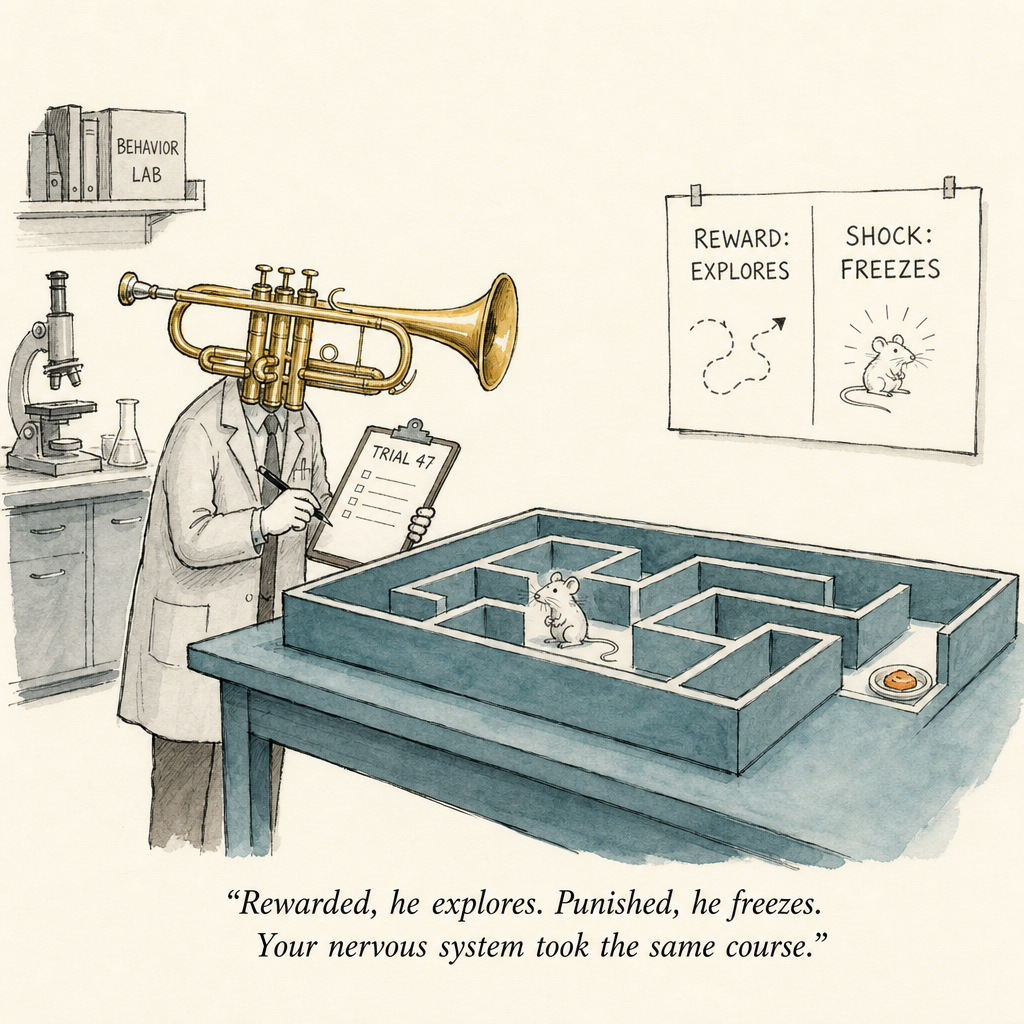
Here’s the deeper issue: the coordination in this article has to develop unconsciously. You can’t micromanage your face in real time. And the nervous system only refines subtle skills when it feels safe enough to experiment. Train a dog through a maze with treats and it explores and learns. Shock it at every wrong turn and it freezes. Chronic overload puts your system in survival mode, grabbing whatever gets it through the next note. No refinement. No learning. That’s why some players practice for years and never move.
The fix: spend most of your time where the North Star holds — feels good, sounds good, responds easily. Challenge the edges, but if more than 15-20% of your practice happens where your form breaks, you’re rehearsing the very habits you’re trying to erase.
The Thread That Connects All Trumpet Embouchure Mistakes
Every mistake on this list has the same structure: your body wanted a result, found a mechanism, the mechanism worked short-term, and it doesn’t scale.
So the fix is always the same principle: find the efficient system that’s underperforming — tongue, air, corners, aperture — and bring it up to standard. When the good systems do their job, the compensations release on their own. You never have to force yourself to stop pressing. You make pressing unnecessary.
That’s the difference between fighting your compensations and making them irrelevant. One is a daily battle. The other is a permanent fix.
The hard part is diagnosis — you can’t see your own face, and most players guess wrong about which link is failing. That’s exactly what my free 30-minute training is for: it walks you through finding your own compensations and the good compression sources that replace them, in plain language you can use at your next practice session. Watch the free 30-minute training — then go play something easy and pay attention.
— Jesse