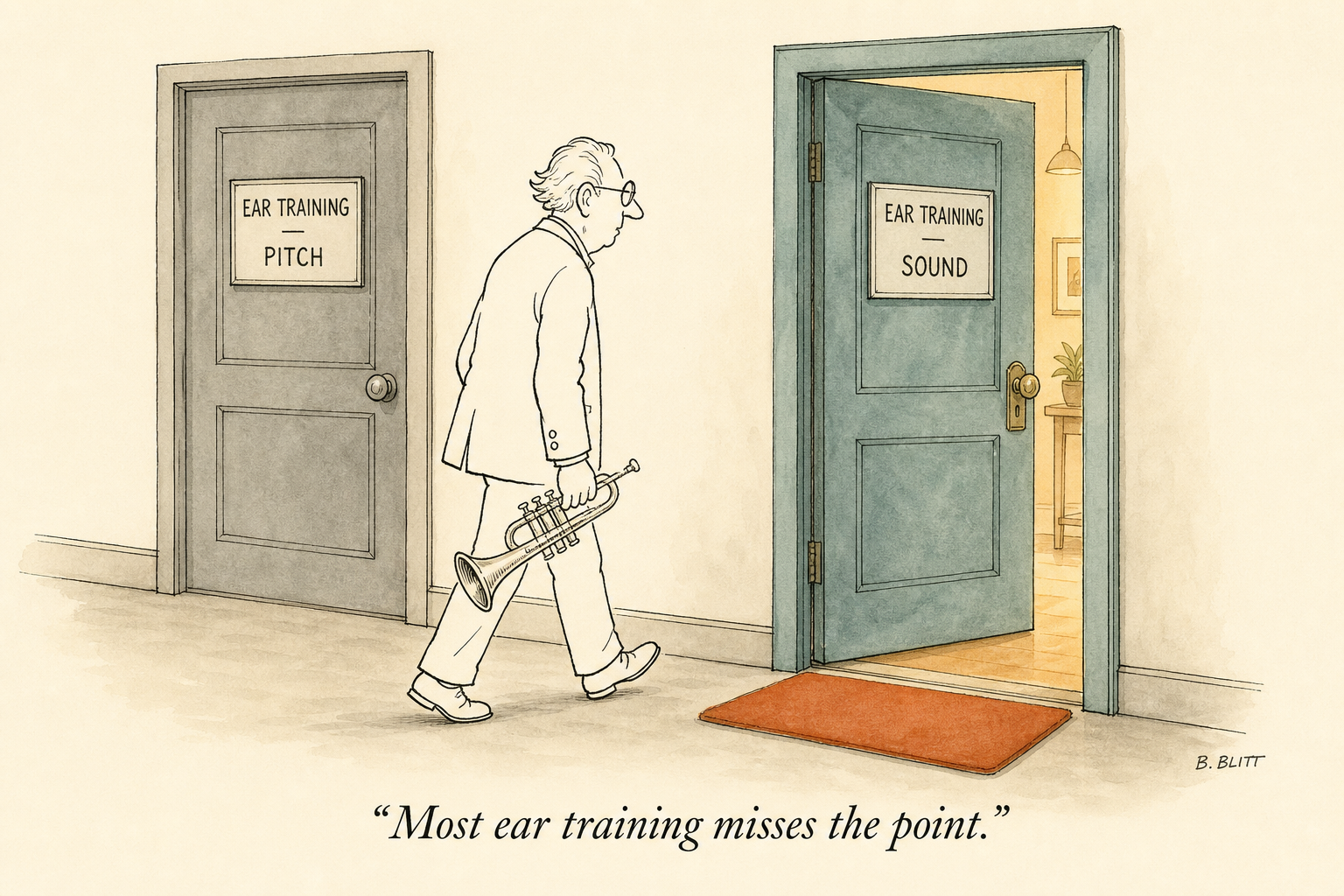
I had a player in my studio a few years ago who could win interval-recognition contests. You could play him a half-step, a tritone, a major seventh, a minor ninth, and he’d name them back to you faster than you could say the word “augmented.” His pitch ear was fluent. He’d done years of solfege. He’d transcribed solos by hand in college. By any metric your university music theory department cares about, he was an excellent ear-trained musician.
I sat him down one afternoon and played him five seconds of Wynton Marsalis followed by five seconds of Maynard Ferguson. Both clips pulled from the middle of a phrase. Both at roughly the same volume. I asked him which player was which.
He guessed. He got it wrong. Then I played him five seconds of Miles Davis followed by five seconds of Nicholas Payton, and he got that one wrong too. Then I played him Harry James followed by Clifford Brown, and he stared at the ceiling and said, “I think this one is the older recording?”
This is not a man with a bad ear. This is a man with one ear, fluent in one language, who didn’t know the other language existed.
Most trumpet players are this guy. They’ve spent years on pitch ear training and zero minutes on sound ear training, and they don’t realize they’re two different disciplines. The gap shows up in their playing. Their intonation is fine. Their reading is fine. And their sound is generic, because the ear that would have shaped their sound has never been trained.
This article is about that other ear. The one nobody at your music school taught you to develop. The one that, once you start training it, will change what comes out of your bell faster than any embouchure adjustment you’ve ever attempted.
Two Languages, One Brain
Here’s the framing that will reorganize how you think about all of this. Pitch ear and sound ear are two different languages.
I mean that almost literally. They’re processed in overlapping but distinct ways. They’re trained with different drills. The skill of being good at one of them transfers only marginally to the other. And almost every trumpet player you’ve ever met is a monolingual speaker without realizing they’re missing a whole second tongue.
Pitch ear is the language your music theory professor taught you. It answers questions about what the notes are. Is that a major third or a minor third? Is the singer flat or sharp? Did the bass play the root or the fifth? It’s a categorical, discrete language. Notes have names. Intervals have names. Chords have names. You learn to map sounds onto those names, and once you can do that reliably, you’re considered to have a good ear.
Sound ear is a completely different language. It answers questions about how the notes feel. How wide is the vibrato? Where does the articulation sit in the beat? Is the front edge of that attack rounded or chiseled? Is the core of the tone bright or dark, and is the brightness coming from a fast air column or from a thin aperture? It’s a continuous, descriptive language. It doesn’t have neat names for things, because the things it describes don’t sit on a grid the way pitches do.
Most trumpet players have spent thousands of hours becoming fluent in the first language and approximately zero hours on the second. So when they listen to Marsalis, they hear the notes. They might even hear the rhythm and the harmony. They don’t hear the sound, in the technical sense, because the language for hearing it was never installed.
This is not a knock on pitch ear. Pitch ear is necessary. You can’t play in tune without it. You can’t transcribe without it. You can’t hear changes without it. We’re not anti-pitch-ear. We’re anti-stopping-there.
The thing the bilingual players can do that the monolingual ones can’t is the thing this whole series is about. They can match a sound. They can listen to a Clifford Brown phrase and tell you what’s happening inside the note, not just which notes were played. And then, because they can hear it, they can start to play it. As we said in the guide, you can only play what you can hear. Pitch ear lets you hear what. Sound ear lets you hear how. You need both.
Why Pitch-Only Ear Training Has a Ceiling
Let’s talk about why this matters in real terms.
Take two players, both adults, both ten years into their playing. Same total practice hours. Same teacher. Same range, same articulation chops, same repertoire under the fingers. The only difference is that Player A has spent a hundred hours on traditional pitch ear training (intervals, melodic dictation, sight singing) and zero hours on sound ear training. Player B has split that hundred hours fifty-fifty between the two.
Run them both through a recording session. Have them each record a ballad they’ve never played before, after listening to a reference recording twice.
Player A’s recording will be in tune. The notes will be right. The phrasing will follow the page. And the sound will be whatever his sound currently is, which is to say, generic. He didn’t hear what the reference player was doing inside the note, so he didn’t have a target to aim at. He aimed at “the notes.” He hit the notes. The sound is whatever his nervous system defaulted to.
Player B’s recording will also be in tune. Notes also right. But there will be moments, several of them, where you can hear him reaching toward something. The vibrato wakes up at the right place in the phrase, because he heard that the reference player did it there. The articulation softens on the third bar because he heard the reference player soften. The front edge of the long note has a hint of breathiness because he heard the reference player do that, and his sound ear logged it.
Player B isn’t a better trumpet player than Player A in any traditional sense. He’s a bilingual trumpet player. The second language let him perceive things in the reference recording that Player A didn’t even know were there.
This is the ceiling. If you train only pitch ear, the most you’ll ever be able to do is play the right notes. Which is the price of admission, not the prize.
What Sound Ear Training Actually Is
Sound ear training is the discipline of learning to perceive, identify, and eventually reproduce the components of tone. Not the pitches. The components.
We’ve already named the components in the guide and walked through them in detail in earlier articles in this series. Aperture. Air. Vibrato. Articulation. Sustain. Each one of those components is independently variable on every individual note, and each one is something you can learn to hear specifically, not as part of a general impression but as a discrete element you can name and describe.
Sound ear training is the work of building that perceptual ability.
It’s the work of being able to listen to a single sustained note and tell yourself, with confidence, “the vibrato on that note is wide and slow with a delayed onset, the air is moving fast inside a relatively closed aperture, the articulation was a soft front-of-the-tongue placement, and the sustain opens slightly toward the end of the duration.” Not as a guess. As an observation.
If you’ve read the previous article in this series on listening deeply, you know that the question set you use during listening reps is what makes that level of perception possible. The questions ARE the listening practice. Sound ear training is the same skill, taken into a more focused training context with specific drills designed to build perception fast.
What you’re building is a second language for sound. The drills below are how you install it.
Drill 1: Blind A/B Player Identification
Here’s the entry-level drill, and it’s the one I gave the player from the opening of this article. It cures the gap fast.
Pick six trumpet players whose sounds are distinctly different from each other. Marsalis. Miles. Maynard. Clifford Brown. Harry James. Nicholas Payton. Or whatever six work for you, as long as they don’t sound similar to each other.
Make a playlist of fifteen-second clips, two per player, pulled from the middle of phrases (not the beginning, not the cadence, the middle, where the sound is just the sound). Mix them up. Don’t label them.
Now play yourself one clip. Pause. Write down which player you think it is. Then play the next clip. Write down. Continue.
At the end of twelve clips, check your answers.
The first time most players run this, they get four or five out of twelve. That’s barely above chance for a six-option test. They’re shocked, because they’ve been listening to these players for decades. They thought they knew them.
What they had was recognition of the players in context. They knew Marsalis when they heard him because the recording was a Marsalis recording. They could read the cover. They could hear the band. They could hear the genre. Strip all of that away and force them to identify the player by sound alone, and the recognition collapses.
The drill is simple, but it forces sound ear training to happen. You can’t get better at this without paying attention to the components. Your brain, when it doesn’t know which player is which, starts asking the right questions on its own. What’s the vibrato doing? Where does the articulation sit? How wide is the core of the tone? What’s the air doing on the long notes?
Run this drill once a week for a month. Your scores will climb. So will the rest of your sound perception.
Drill 2: Component Isolation on a Single Note
The next drill drops the variable count and increases the depth.
Pick one trumpet player. Pick one recording. Find a single sustained note in that recording. Anywhere. Doesn’t matter. Just a note that’s held long enough to have a vibrato and a sustain you can study. Set it up so you can loop that one note.
Now listen to it ten times. Each time, focus on a different component.
Listen one: aperture. Is the sound coming from a tight, focused aperture or a more open one? You can hear this. A tight aperture has a centered, narrower core. An open aperture has more body around the core. Train yourself to hear the difference.
Listen two: air. Fast or slow? Volume: how much air is moving? Quality: does the sound feel pressurized from a strong core, or does it feel breath-driven from the chest?
Listen three: vibrato. Width (how far does the wave go from the center pitch). Speed (how many oscillations per second). Onset (does it start at the beginning of the note, halfway through, only at the end). Is the vibrato pitch-based or intensity-based?
Listen four: articulation. Even though you’re focusing on the body of the note, listen specifically to the front edge. How was that note attacked? Tongue placement? Hardness?
Listen five: sustain. What does the note do during its hold? Stay flat? Open up? Decay? Bloom?
Then run the same five components again on listens six through ten, and see if you hear more the second pass.
What this drill is doing is building the perceptual hooks. Once you’ve heard “this player’s vibrato has a delayed onset” forty times in forty different notes, your ear starts catching it everywhere. The component starts existing as a discrete thing in your perception. That’s the bilingualism activating. The new language is gaining vocabulary.
This is also the drill that pairs best with audiation work, because hearing the sound internally before producing it requires that you can hear the components in the first place. Drill 2 builds the inner library that audiation later draws from.
Drill 3: Sing Before You Play
Drill 3 is the bridge between perception and production, and it’s the one most adult trumpet players are squeamish about. Do it anyway.
Pick a phrase from your reference player. Three to eight notes. Play the recording. Then, before you pick up the trumpet, sing the phrase back. Not in your head. Out loud. With your mouth.
But here’s the trick. You’re not singing the pitches of the phrase. You’re singing the sound.
That sounds weird until you do it. What it means is, when Marsalis plays a phrase with a particular vibrato width, a particular articulation, a particular shape of dynamic across the line, you sing all of that. You imitate his vibrato with your voice. You imitate his articulation with your tongue. (Yes, even when singing. Your tongue is right there.) You imitate the way his sound opens up on the third note. You’re not trying to hit the pitches accurately. You’re trying to imitate the sound character with whatever vocal apparatus you have.
You’ll sound silly. That’s fine. There’s nobody in the room.
The reason this drill is so powerful is that singing forces your sound ear to do a real-time A/B against the reference. Your brain has to compare what you just heard to what you’re producing. If your imitation is bad, you hear it instantly, because you just heard the original. The feedback loop is closed and tight, and it’s running on the sound itself, not on the pitches.
When you then pick up the trumpet and play the phrase, the sound that comes out is closer to the reference than it would have been if you’d skipped the singing. Significantly closer. I’ve watched this happen with player after player.
Most adults skip this drill because they think they can’t sing. You don’t have to be able to sing well. You have to be able to imitate. If you can mimic someone’s accent in conversation, you can do this drill. The bar is that low.
Drill 4: Transcription for Tone, Not for Notes
Last drill. This one’s the biggest leverage move and the one that usually takes a player from “I do some sound listening” to “I have a real sound ear.”
Standard transcription is what you did in college. You take a solo, listen to it, write down the notes. Maybe you mark the rhythm. Maybe you mark the articulations as slurs and tongues. Maybe you mark the dynamics. The output is a piece of sheet music that tells you what notes to play.
Tone transcription is different. The output is a written description of what you HEARD, with no notes on it.
Here’s what a tone transcription of an eight-bar Clifford Brown phrase might look like:
Bars 1-2: Articulation is rhythmically pocketed, slightly behind the beat. Vibrato is absent on the eighth notes, kicks in only on the half note at the end of bar 2. Air is fast, sound is bright but not brassy. Aperture feels relatively closed for a jazz player.
Bars 3-4: Same articulation feel. Sound darkens slightly, suggesting either a slight aperture opening or a small pull-back of air speed. Vibrato width is medium, speed is medium-fast.
Bars 5-6: Phrase climbs. Vibrato disappears completely on the climb. Articulation gets a hair softer on the highest two notes. Sound stays focused; he doesn’t blow through it for power. The intensity comes from articulation choice, not air volume.
Bars 7-8: Resolution. Vibrato comes back. The last note has a long sustain that opens slightly, with a soft release.
That’s a tone transcription. There are no notes on it. There are no rhythms on it. There’s just a written description of every component across the phrase.
Doing this is harder than it looks. You’ll find, the first time you try, that you don’t know what to write because you didn’t actually hear the phrase that specifically. You only thought you did. You’ll go back and listen again. You’ll listen ten times. You’ll write more. Each time you go back, you’ll hear something you missed.
That’s the whole point. You’re not producing a useful document. The transcription itself doesn’t matter. The act of producing it forces a level of listening that nothing else does, because you have to commit your perception to language. Vague impressions don’t survive the transcription process. Either you can put words to what you heard, or you didn’t hear it.
This is the same impulse the listening deeply article is built around, the question set you use during listening reps. Tone transcription is that question set turned into a written output.
Run one tone transcription a week, on whatever your North Star recording of the moment is. After three months, your sound ear will be a different organ.
What the Bilingual Player Can Do
Here’s the payoff. This is what you get when you do this work.
The bilingual player can listen to a phrase by their North Star and tell you what’s happening inside the notes. Not just which notes were played, but how each one was shaped. Width of vibrato. Placement of articulation. Direction of sustain. The components.
The bilingual player can listen to themselves on a recording and hear the gap between what they intended and what came out. Not just “I missed that high note” or “I sounded okay.” But “the vibrato came in too early on bar four, the articulation got harder than I wanted on the climb, and the sustain on the last note collapsed instead of opening.” That kind of self-feedback is what powers the Probability Game laid out in the guide on a phrase-by-phrase basis. Without sound ear, the Probability Game is mostly guessing.
The bilingual player can also, eventually, do the thing that monolingual players can’t do at all. They can switch deliberately between sounds. They can decide, before a tune starts, that they’re going to play the first chorus with a wide slow vibrato in the Harry James zone, and the second chorus dry and conversational like Miles, and the third chorus rhythmically pocketed like Marsalis. And they can actually do it, because they can hear the difference internally before they play it.
The monolingual player has one sound, whatever that sound happens to be, and they think “expression” means “playing louder on the climaxes.” The bilingual player has access to the entire palette of trumpet sounds in history, and they can pick from it at will.
This is the difference. This is why the work matters.
“But Ear Training Is for Music School Kids”
I hear this objection from adult comeback players constantly, and I want to handle it directly.
The objection goes, “I’m forty-five. I’m a hobbyist. I’m not preparing for a degree recital. Ear training is something kids do in college because it’s required. I just want to sound better. I don’t need that academic stuff.”
Three things.
First, what we just walked through is not what they did to you in college. College ear training was pitch ear, almost exclusively. Intervals, dictation, solfege, voice leading. The discipline this article is about, sound ear, was almost certainly never taught to you in a structured way at any point in your formal music education. So the objection “I already did this in school” doesn’t apply to most adult players, because most adult players didn’t do this in school. They did the other one.
Second, sound ear training is the cheapest, lowest-risk, highest-leverage skill an adult player can develop. It doesn’t require chops. It doesn’t require time on the horn. It doesn’t risk overuse. It doesn’t fight your protective reflex. You can do every drill in this article on a couch with headphones and a notebook. The bottleneck most adult players think they have, I don’t have enough practice time, my chops can’t take more reps, does not apply to this work at all. This work happens off the horn.
Third, and this is the one that matters most. The adult player’s actual problem is almost never technique. It’s almost always sound. The adult player who comes back after twenty years and grinds for two years to get range and endurance back is going to find, at the end of those two years, that they have range and endurance and a generic sound. The same generic sound they had at age sixteen. Because they spent two years on chops and zero on the ear that shapes the chops.
Sound ear training is the lever. It’s the thing that, if you do it, makes everything else you’re working on actually go somewhere.
The DIY problem is that doing this work alone is structurally hard. You need someone to play A/B clips you haven’t heard before. You need someone to tell you whether your tone transcription is accurate or whether you’re hearing what you wish you heard. You need feedback on whether your singing imitation actually matches the reference, because your own ear, the one you’re trying to train, isn’t yet reliable enough to grade itself. Trying to coach the second language using only the first language’s ear is the snake eating its own tail.
This is part of what we do in the 1% Trumpet Program. The drills above work better with a coach who can run them with you and call your perception when it drifts. Not because you can’t do the work alone. You can, and most of the players I’ve worked with do plenty of it on their own time. But the calibration step, the part where someone with a trained ear tells you whether you’re actually hearing what you think you’re hearing, is hard to do solo and easy to do with someone in the room.
If you’ve read this far and you’re feeling the pull, we run a free 30-minute training that lays out how the program builds sound, technique, and the inner ear that drives both. It’s the same training I use to walk new students through what we actually do, including how the ear training piece fits into the broader sound development work.
You can grab it at toot-your-own-horn.com/landing-page.
The player from the opening of this article, the one who couldn’t tell Marsalis from Maynard, ran these drills for six months. He’s now bilingual. His pitch ear is still excellent, the way it was when he walked in. His sound ear is suddenly a thing that exists. And his playing, predictably, sounds like a different musician.
You can do this. The drills are simple. The discipline is the whole game.
You can only play what you can hear. Pitch ear lets you hear what. Sound ear lets you hear how. Train the second language and the rest of your sound work suddenly has somewhere to go.
Want to go deeper? Continue with the next articles in this series:
- Listening Deeply: The Questions That Make Sound Objective — The question set that turns vague impressions into specific perception.
- Audiation: Hearing Before You Play — Hearing the sound internally before producing it, and how to train the inner ear to do that work.
- How to Build a Great Trumpet Sound — The complete guide to sound, imagination, and the inner ear that drives both.