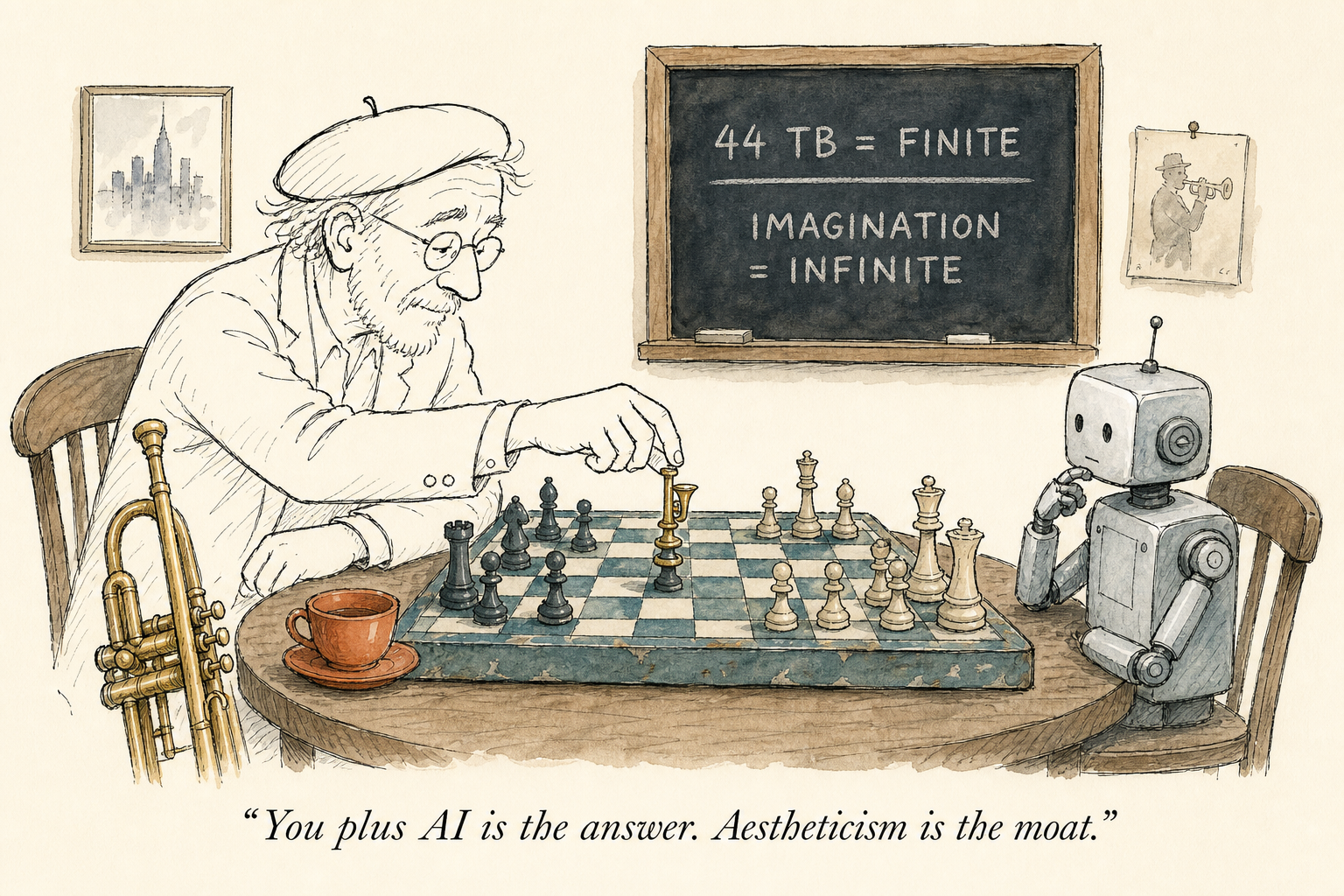
A trumpet player I talked to last year quit playing.
He was in his late forties. Comeback player. Real chops underneath the rust and a sound, even on a bad day, that you could pick out of a lineup. He had been getting back into a regular practice rhythm. Things were starting to move.
Then he watched a YouTube video about AI generating music. Then he read a few X threads about AI replacing musicians. Then he scrolled some Reddit doom about the death of art. And he sold his horn.
Years of work, sold for whatever a B-flat trumpet goes for on Facebook Marketplace, because somebody on the internet told him a robot was going to do it better.
I am still mad about it. I am also writing this article so it does not happen to you.
This is the closer of the Sound & Musicality series. The first eleven articles were about how to actually build a great trumpet sound. We covered aestheticism as the magnet, the North Star principle, the algorithm of trumpet playing, the components of sound, the Probability Game, listening deeply, ear training, the five-player mistake, long tones as sound work, vibrato as identity, and audiation as the inner-ear capacity AI cannot grow for you.
Eleven articles on building the inner game.
This article is the meta payoff. The reason that work matters is not just that it makes you a better trumpet player. It makes you irreplaceable in a world where everything mechanical and mid is about to get a lot cheaper.
The musicians who fear AI have not actually thought about AI. They have absorbed dread. They have outsourced their thinking to whoever shouted the loudest in their feed. We are going to do something different in this one. We are going to think.
The Recap, in One Sentence
Everything in this series has been one argument with eleven angles.
Your trumpet sound is built on top of your aestheticism, which is your trained sense of what beautiful sound is, broken down into components you can describe and reproduce.
If your aestheticism is fuzzy, your sound is fuzzy. If your aestheticism is sharp, your sound has a chance to be sharp. The horn is a delivery mechanism. The taste is the engine.
Hold onto that. The whole AI argument hangs on it.
Chess Met AI First. Pay Attention.
Before we get to trumpet, we have to talk about chess.
In May of 1997, the IBM supercomputer Deep Blue beat Garry Kasparov, the reigning world chess champion, in a six-game match. Two wins for Deep Blue, one for Kasparov, three draws. It was the first time a computer had beaten a sitting world champion under standard tournament time controls.
People lost their minds.
The takes from that week, if you go back and read them, sound exactly like the takes you are reading right now about AI and music. Chess is dead. The romance is gone. The art form is finished. Why would anyone bother becoming a chess master if a machine can do it better. Some chess writers said openly that the game would shrink, fade, and eventually become a curiosity, like checkers.
That was the consensus. Smart people. Serious people. Chess people. They all said the same thing.
Now look at chess in 2026.
Chess is not dead. Chess is the biggest it has ever been in the entire history of the game. More players, more content, more money, more streamers, more masters, more children studying chess seriously than at any point since the invention of the rules. Magnus Carlsen is a household name. Hikaru Nakamura streams to millions. The Queen’s Gambit was a global phenomenon.
Why?
Not because AI failed. AI absolutely crushes humans at chess now. Stockfish would beat Magnus the way Magnus would beat me. It is not close. The strongest engines have been beyond human in chess for two decades.
The reason chess is bigger than ever is that nobody wants to watch AI play AI.
That is the whole story.
People want to watch humans play chess. People want to watch humans struggle, and lose, and win. People want to watch the look on a grandmaster’s face at move 29 when she finds the move that the engine has been suggesting for two minutes but which she had to discover with a human nervous system on a clock under stage lights. The art of chess is not the moves. The art of chess is the human running the algorithm under pressure, fallibly, beautifully.
And here is the part most musicians have completely missed.
AI made humans better at chess. Way better. Players today routinely train against engines, study engine analysis, prepare openings with engine help, and review their games with engines after. The 2026 grandmaster is a stronger player than the 1996 grandmaster, in large part because of twenty years of access to AI training partners. The bar went up. The art got deeper. The audience got bigger. The masters got better.
Hold that picture while we talk about trumpet.
What Is About to Happen to Music
Here is the honest part. AI-generated music is real and it is going to keep getting better. AI-generated trumpet sounds are real and they are going to keep getting better. There will be AI tracks in advertising, in stock libraries, in royalty-free game music, in YouTube backing tracks, in soundtracks for projects that used to hire a human session player and from now on will not.
Pretending that is not happening makes you sound like a guy in 1997 saying Deep Blue’s win was a fluke.
And it does not matter to you the way the doomers think it does. The part of music AI is going to flood is the part that was already a commodity. Generic background trumpet. Forgettable lead lines. Stock-library jazz. The exact “technically correct, emotionally anonymous” sound the guide warned against. Bland sound was already replaceable. Sample libraries and loop packs were eating it ten years ago. The AI just makes the replacement faster.
What AI cannot do, and is structurally unable to do, is generate taste from nothing. Stay with me. This is where the article actually lives.
The Doomer Mindset (Bless Their Hearts)
The way musicians are processing AI right now is mostly not thinking. It is absorption.
They watch a YouTube video. They read a tweet. They see a comment on Reddit. They feel a flutter of dread in their chest. They scroll to the next thing. The dread compounds. They never sit with it long enough to ask whether the argument is actually correct.
Bless their hearts. Genuinely. I am not making fun.
But this is a serious cost. People are quitting. People are selling instruments. People are telling their kids not to bother. People are making lifelong decisions on the basis of internet vibes from people who, in many cases, have never built anything beautiful in their lives and would not know a great trumpet sound if it landed in their lap.
There is also a specific tradition inside the musical community that makes this worse. The “starving artist” frame. The romance of suffering for your art. The shrug about money and audience and skill development as if those were vulgar concerns and the real artist was the one who failed nobly while complaining about it.
That is not cute. It never was.
That mindset will, in the AI era, eat the musicians who hold it. The ones who treat stale, lame ideas about art as gospel, the ones who absorb every doomer take without testing it, the ones who think being broke and bitter is somehow proof of artistic seriousness, those musicians are going to lose to AI not because AI is stronger than them but because they were never strong to begin with. They were averaging. AI is going to average them out.
The musicians who win in this era are the ones who think clearly, develop real taste, build a real sound, and use AI as a training partner instead of fearing it as a replacement. Let me show you the math.
The 44 TB Observation
Here is the fact about AI that almost nobody in the musical world has actually engaged with.
The training data for the current generation of frontier large language models is roughly 44 terabytes of text and code. Some are larger now, some smaller. Hold the order of magnitude. Tens of terabytes. You can fit it on a hard drive you can buy at a big-box store for a couple hundred dollars.
Forty-four terabytes. The thing that knows every Wikipedia article and a huge fraction of the public internet and most of the books ever digitized, that thing fits on a hard drive you could put in your pocket.
It is finite. It is bounded. It is, on a cosmic scale, small.
Now consider what you are.
Napoleon Hill, in Think and Grow Rich, wrote about something he called “infinite intelligence.” His framing was that human creativity is plugged into a source that is not bounded by what has already been done. Every new idea, every new combination, every new sound a human has not yet made, is available. You do not have to take the metaphysics on; the practical observation is the same. The space of possible human creative output is not a finite dataset. There is no hard drive big enough.
Your imagination is generative in a way the AI is not.
The AI is a very impressive interpolation engine. It takes the patterns in the data it has seen and produces new arrangements of those patterns. Within the convex hull of its training data, it can do remarkable things. Outside of it, it cannot. It cannot want a sound that has never existed. It cannot decide that the entire mid-register of the trumpet should sound like a human voice with a Harmon mute on a microphone the way Miles Davis decided. It cannot suffer through a ten-year apprenticeship and emerge with a vibrato that nobody else has. It does not have a body. It does not have a life. It does not have things it has lost and things it loved when it was eight.
You do. That is your moat.
Aestheticism IS the Moat
Now we can put the series argument and the AI argument together.
AI can mimic style. It is good at that and it is going to get better. Feed it a thousand Wynton Marsalis solos and it will produce something that sounds, on a casual listen, plausibly like Marsalis. The same way it can write something that sounds plausibly like Hemingway. It mimics the surface.
AI cannot generate taste from nothing. It cannot decide what is beautiful, because deciding what is beautiful is an act that requires being a creature with stakes. The AI does not have a “care” function. It has a “match training distribution” function. Those are very different things, and the difference is exactly the gap a real musician lives in.
When you build aestheticism, you are doing something the AI cannot do. You are deciding, in a particular way that nobody else has decided, that this sound is more beautiful than that sound. That decision comes from the specific accident of being you, with your ear, your history, your players, your losses, your room. The AI can imitate the result of that decision. It cannot make the decision.
This is why the eleven articles before this one matter the way they do.
When you pick a North Star and run the Probability Game and listen deeply and decompose components and develop your audiation and build your singular sound, you are not just becoming a better trumpet player. You are becoming the one thing AI cannot replace: a human with a specific, articulated, defended taste.
The trumpet players who get replaced by AI in the next decade will be the ones whose sound was already an average of fifty other people’s sounds. AI will average those people out cleanly and cheaply. The trumpet players who do not get replaced are the ones whose sound is recognizably theirs, built on an aestheticism that lives in their nervous system, defended by reps, refined by years.
You cannot scrape that off a database. The database is a person who lived a life and made specific choices about beauty. That is the moat.
You + AI = Stronger
The chess lesson has one more part, and it is the most actionable.
Top chess players in 2026 are not running from AI. They are training with it. The strongest engines are sparring partners. Grandmasters use them to prepare openings, find blunders, study endgames, and stress-test ideas. The result is a generation of human players sharper than any that came before, because they had a tireless, perfect, free training partner from the moment they were old enough to push pieces.
You + AI = stronger. That is the formula.
For trumpet, here is what that looks like. You can generate practice tracks at any tempo and any key. That used to require Aebersold records, expensive software, or a piano player who would put up with you. Now it is free. You can transcribe a Marsalis solo in two minutes and spend your hour listening and matching instead of writing dots on staff paper. You can use AI as a coach for theory and harmony, asking questions you would have been embarrassed to ask a human teacher, getting answers at three in the morning when the question hit you. You can record yourself, get a rough analysis of what your sound is doing, and run that against your North Star. The Probability Game with a calculator.
None of those things replace the work. All of them compress the time between question and answer, between target and rep. They give you back hours. The hours go into the horn.
If you sell the horn because you are afraid of AI, you are losing twice. You are losing the music. You are also losing the most powerful training partner anyone in the history of trumpet has ever had access to.
The Stakes for the Adult Comeback Player
I want to talk about the specific stakes for the people I work with most often, because this is where the doom hits hardest and where it is most wrong.
The adult comeback player is, on paper, the player AI threatens most. He is not gigging professionally. He does not have a career to defend. He is doing this because he loves it, which means the love itself is what gets attacked when somebody on the internet says the love is pointless.
There is no AI that can have your hour of practice for you. There is no AI that can feel the muscle memory rebuild in your face after twenty years away. There is no AI that can sit in your basement at 6:30 in the morning before work, with the dog asleep on the couch, and feel the C above the staff finally come back the way it used to. There is no AI that can play a wedding for your daughter in eight years. There is no AI that can sit in front of your eight-year-old grandkid with a horn and let him watch his grandpa do something hard, on purpose, well, for love of it.
That is the asset. The asset is the human life in which the trumpet sits.
The trumpet, for the comeback player, is a vehicle for the inner work the rest of his life does not have room for. It is one of the few places he can be honest with himself about whether he showed up today. It is a slow-feedback environment in a fast-feedback world. It is a way to find out whether he is still the kind of person who can want a thing and grind at it.
None of that depreciates because some company released a model that can generate plausible trumpet audio. The asset is the practice. The asset is the sound that is recognizably yours. AI cannot have any of that for you any more than a fitness app can do your push-ups.
The adult comeback player who actually does the work has built a self that plays the trumpet. That self does not sit in any market AI is competing in. The value is denominated in a currency the AI does not have access to.
That is the moat. It is, if you let it be, the deepest one you will ever dig.
Quit Doom-Watching. Start Practicing.
If you have spent the last year absorbing AI dread and wondering whether the trumpet is worth it, I want to be very direct with you.
You have been thinking about this wrong. Your thinking has been mostly other people’s thinking, downloaded into you through a feed. None of those people were going to play your trumpet for you anyway. None of them know what your sound is. None of them have any idea what your aestheticism, fully developed, would be capable of.
The doom is bad analysis. The actual analysis says the players who develop real taste are about to be the most interesting humans in their part of the world, because everybody else is going to drift into AI-flavored mediocrity and the one or two people in the room with a real, defended sound are going to feel like fresh water in the desert.
You can be one of those people. The work is the work this series has been describing for eleven articles. None of it is glamorous. All of it compounds.
Quit watching videos about AI replacing musicians. Quit reading threads about the death of art. Open the case. Pick your North Star. Run the Probability Game on five long tones. Listen to one player for twenty minutes today with your eyes closed. Tomorrow, do it again.
You Said AI Would Replace Musicians Anyway. Why Bother.
If you are still on the fence, here is the version of you I am actually writing this for.
You have a horn. You used to play. You loved it. You have read, somewhere in the last eighteen months, that AI is going to take it. You think, what is the point. You think, why bother developing taste. And the horn sits in the case, and the months go by, and the question you actually wanted answered, which was am I still the kind of person who could be good at this, never gets asked, because you let some YouTuber answer a different question for you.
The cost of believing the doomers is not abstract. It is the rest of your trumpet life. It is every morning you do not pick the horn up. It is the Probability Game you do not run on your sound. It is the aestheticism you do not build. It is the sound that does not become recognizably yours. It is what your grandkid does not see you do. That is the actual cost.
The cost of believing me is one hour a day on something that compounds. If I am wrong, the worst case is that you become a much better trumpet player who happens to live in a world with a lot of AI-generated music. Your sound is still yours. Your taste is still yours. The hour was the asset.
If I am right, you have built the only kind of musical life that holds value when the commodity layer of music gets eaten by machines. You have a North Star, an aestheticism, a sound nobody else has. You are not in the same market as the AI.
Either way, the move is the same. Practice. Build the taste. Run the loop.
In the 1% Trumpet Program, we run that loop with you, on every dimension, every week. Range, endurance, articulation, the protective reflex that quietly kills most adult comeback players’ progress, the 2-to-1 practice ratio that compounds over time, and the inner work this whole series has been about, all aimed at the player you actually want to be ten years from now, AI or no AI.
If you want a real first look at what that work looks like, we run a free 30-minute training that walks you through how the program builds these skills together. You can grab it at toot-your-own-horn.com/landing-page.
The chess players who took AI seriously and trained with it became the strongest generation of chess players in human history. The trumpet players who do the same thing are going to be the most interesting horn players of the next thirty years. The doomers are going to be selling their horns on Facebook Marketplace.
Pick which one you want to be. Then go practice.
Aestheticism is the moat. The moat is dug one rep at a time. Start digging.
This is the closer of the Sound & Musicality series. Start the series from the top with the trumpet sound guide, or revisit the central idea in aestheticism as a magnet and the inner-ear capacity in audiation.