I had a guy come on a coaching call about a year ago. Mid-fifties. Played all his life. Decent technique. Range up to a high C on a good day. Clean articulation. Air was fine.
He told me he didn’t know why he sounded “generic.”
I asked him to play sixteen bars of a ballad. Anything he liked.
He played it. Sweet enough. Notes in tune. And every single sustained note had the exact same wave on it. Same width. Same speed. Same point where it kicked in. Reflexive. Locked. The kind of vibrato you don’t choose. The kind that just happens.
I told him I knew exactly why he sounded generic.
He had an accent he wasn’t aware of. And the accent was doing more to shape his sound than anything else he was thinking about during the take. He was pouring his attention into air and aperture and articulation, and the thing actually defining his sound, more than any of those, was the wave he had no idea he was putting on every note.
That’s what this article is about. Vibrato is one of the most powerful identity-shaping levers on the trumpet sound. Most players treat it as default. The 1%er treats it as a deliberate choice every time the horn comes off the knee.
The Vibrato-as-Default Trap
Most adult trumpet players have one vibrato.
I don’t mean they prefer one. I mean their body produces exactly one wave, on every note that holds long enough to wave, no matter what the music asks for. They’ve been making that wave since they were sixteen and someone told them to “warm the note up a little” without telling them how. Their lips, jaw, or hand worked something out, that something stuck, and now thirty years later that same little wave shows up on every sustained note they play.
They’re not making a choice. They’re running a default.
The default came from somewhere. Maybe a teacher who modeled it. Maybe a player they happened to listen to during a critical year. The origin doesn’t matter. What matters is that the default is now baked into the algorithm of their playing, the same way every other component of their sound got baked in. And like every other component, the default wins by inertia until you decide to override it.
Here’s the part that makes this hard to see. When you ask most trumpet players about their vibrato, they say, “yeah, mine is fine.” They mean: it’s there, it sounds like vibrato, nobody has ever stopped a take to complain about it.
Fine is not a target. Fine is the average of every wave you’ve ever absorbed, run through your jaw, and produced reflexively for thirty years. Fine is exactly what’s making you sound generic.
The fix is to treat vibrato the way the players you actually admire treat it. As a deliberate identity choice, not a body reflex.
Vibrato Is Your Accent
Here’s the analogy I want you to sit with for the rest of this article.
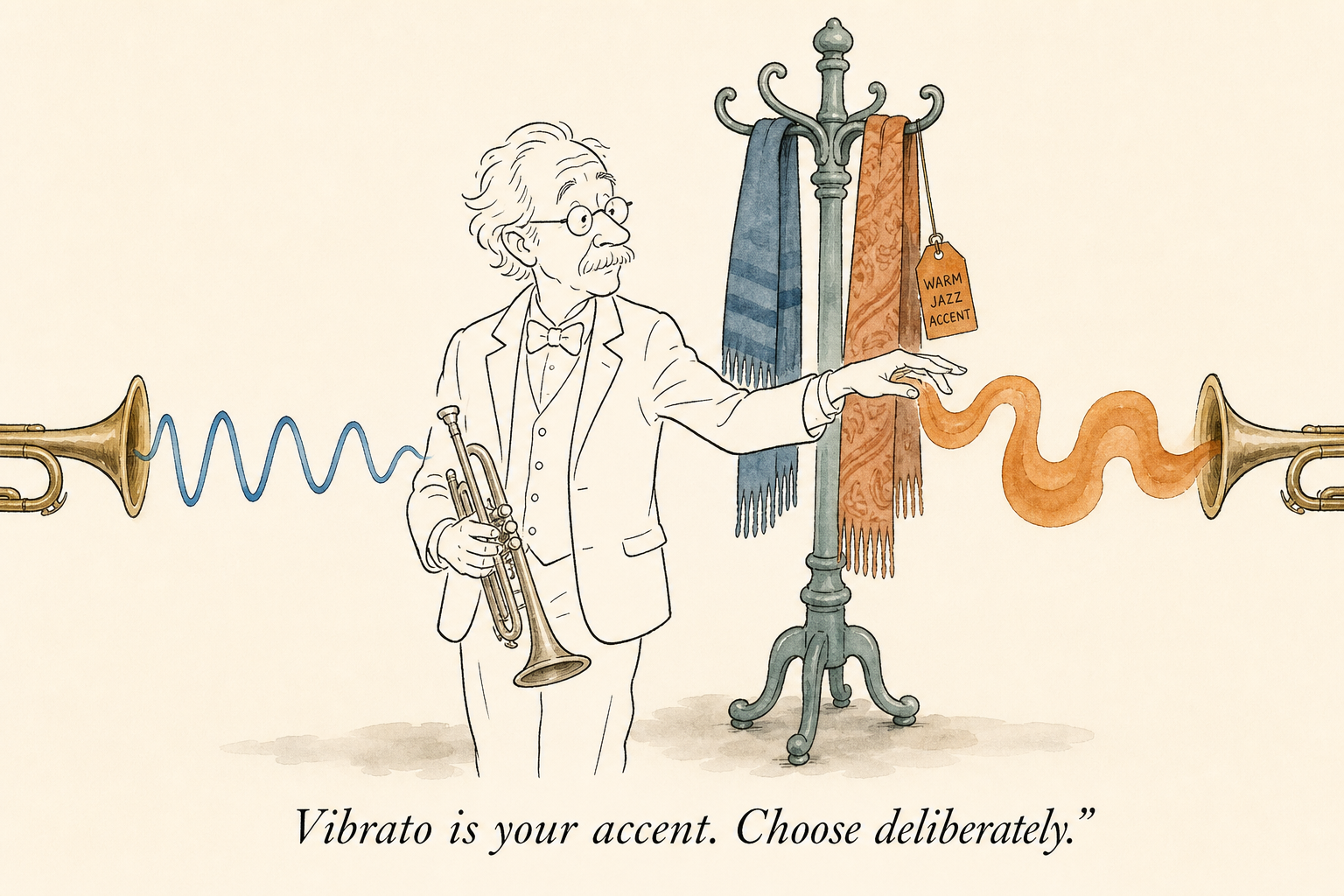
Vibrato is to your trumpet sound what accent is to your voice.
Think about that for a second. When you hear someone speak, your brain identifies their accent inside the first two or three syllables. Texan. Boston. Midwest flat. Australian. You don’t have to think about it. The accent is the texture sitting on top of every word, and it tells you almost everything about who that person is before the content of what they’re saying lands.
Now think about how accents form. Nobody chooses their first accent. You absorb it in childhood from the people around you. You don’t notice it until somebody from a different region points it out, or you travel and hear yourself the way other people hear you. By the time you’re an adult, your accent is so locked into your motor system that even when you try to fake another one, you mostly fail. The vowels betray you.
That’s exactly what vibrato is on a trumpet.
You absorbed your vibrato from the players you grew up around. From your band director. From the recordings you happened to listen to in the year your sound was forming. It went into your jaw or your lips or your hand and it stayed there. By the time you’re forty, your vibrato is your accent. It announces who you are inside the first half-second of any sustained note, whether you want it to or not.
Most trumpet players have one accent and they don’t know it. They speak in flat Midwest forever, and they wonder why they don’t sound like Harry James or Wynton Marsalis or anybody else with a genuine voice.
The 1%er knows the accent is there, knows what it currently is, and switches it deliberately. Not in some fake, costume-y way. Actually. The way a great actor can give you a credible Texan one minute and a credible Bostonian the next, because they know what each accent is made of and they have control of the muscles that produce it.
You can’t sound like a Texan if you mumble in flat Midwest. You can’t sound like Harry James if your jaw is wired for whatever default you absorbed at sixteen. The accent comes off the same way it went on. With deliberate work, and only after you know what you’re actually changing.
So let’s talk about what you’re actually changing.
The Four Dials
Most players, if they think about vibrato at all, think about it as one thing. Either you have vibrato or you don’t. Either it’s “good” or it’s “too much.”
This is the same mistake people make about sound itself. They treat it as one slider when it’s actually a stack of independent components. Vibrato has the same structure. It’s four dials, and every one of them moves independently.
The dials are:
- Width. How far does the pitch swing above and below the center?
- Speed. How fast is the wave per second?
- Onset. When in the duration of the note does the vibrato start?
- Prominence. How front-of-mix is the wave inside the overall sound?
Every great trumpet player has a fingerprint that lives in those four dials. Harry James is wide, slow, immediate, and very prominent. Miles Davis is essentially zero across all four. Marsalis varies it by genre. Payton runs subtle and tightly controlled.
Once you can name the four dials, you can hear them on any recording, describe what your own vibrato is doing, and start moving the dials on purpose. Without them, you’re stuck with “mine is fine” forever.
Let’s walk through them.
Width: Narrow vs. Wide
Width is how far the pitch swings around center. A narrow vibrato barely moves the pitch. You hear the wave more as a shimmer in the timbre than as a pitch change. A wide vibrato is a real, audible bend. You can hear the note climbing and falling.
Most trumpet vibrato lives in a fairly narrow band, especially in classical playing. The classical aesthetic for trumpet has gone toward shimmer-vibrato over the last half-century. You’re meant to hear a glow on the note, not a wobble.
But a wide vibrato isn’t bad. It’s just a different identity. Harry James lived in a wide, singing vibrato that came straight out of his circus and big-band roots, where you needed the note to project across a hall and grab people. A wide vibrato says, “this note has weight, sit with it.”
The choice between narrow and wide is the choice between elegance and song. Marsalis on a Haydn concerto runs narrow because the music wants elegance. The same Marsalis on a ballad with his quartet runs wider. Same player, same horn, two different widths because the music asks for two different things.
When you record yourself, listen for the width specifically. Is your wave a shimmer or a bend? Most players’ width is locked. They have one width and they use it everywhere. That’s the default. That’s what we’re trying to break.
Speed: Slow vs. Fast
Speed is how many oscillations per second. A slow vibrato might be four cycles per second. A fast vibrato is seven, eight, sometimes more. Some players land around five and a half to six.
Speed has a huge effect on the emotional read of a note.
A slow vibrato sounds patient, weighted, sometimes mournful. It tells the listener you have time. The wave breathes with the note. Harry James is your reference here. His vibrato is slow enough that you can almost count the cycles. It feels like the note is leaning into something.
A fast vibrato sounds urgent, anxious, often more nervous. It tells the listener something is being held tightly. Some classical traditions favor a faster vibrato because it integrates more cleanly into ensemble blend. Some old-school commercial players ran fast because that was the sound of the era.
Where speed gets bad is when it’s nervous-fast without intention. A lot of adult trumpet players have a slightly too-fast vibrato they don’t know they have, because their jaw or hand is making the wave under low-grade tension. The wave is going six and a half cycles per second when the music wants four. They never tested. The default just runs.
Test yours. Record a sustained note in the middle of your range. Count the cycles by ear or with software. Then ask: is that the speed I’d want to hear coming out of a player I admire? Or is that the speed my body happens to produce under the tension I happen to carry?
Almost always, the answer is option two. Which means almost always, there’s a dial to move.
Onset: Immediate vs. Delayed
This is the dial almost nobody talks about. It’s also one of the most powerful for shaping identity.
Onset is when in the duration of a note your vibrato actually starts. There are two main moves.
Immediate onset. The vibrato is on from the first millisecond. The note is born wobbling. There’s no straight tone, no point where the listener gets a pure pitch before the wave starts.
Delayed onset. The note arrives clean. It sustains as a straight tone for some fraction of a beat, sometimes a full beat or longer. Then the vibrato kicks in.
The emotional difference is massive.
Immediate onset is busier. The note is alive from the start, which sounds expressive on first listen but can sound jittery on long notes or in classical contexts. Players who run immediate onset sound restless if you put them in a slow piece.
Delayed onset is patient. The note arrives, holds, and then blooms. The listener gets to hear the pitch land before the expressive layer comes in. This is what Marsalis does on most of his classical playing. The note arrives perfectly straight, sits there for a beat, and the wave opens up if the music asks for it. Sometimes it never opens up at all.
Almost every adult trumpet player I’ve worked with runs immediate onset by default. Their vibrato is on from the first instant of every sustained note longer than a quarter note. They’ve never tried delayed. They don’t know it’s an option.
The first time I have a student practice delayed onset, it feels alien. They hold a note straight for what feels like an unbearably long time, then let the vibrato in. They listen back, and the note has weight it never had before. The straight portion of the note is doing real work. The vibrato is more meaningful when it arrives because the listener heard the pure tone first.
This one dial alone, just moving from immediate to delayed onset on the long notes, will reshape your whole sound. Try it tomorrow.
Prominence: Subtle vs. Prominent
Prominence is how front-of-mix the vibrato sits in the overall sound. You can have a vibrato that’s narrow and slow but still feels like the main event because it’s pushed forward in the timbre. You can also have a wide, slow vibrato that sits underneath the note like a slow current, supporting it but not announcing itself.
If your vibrato is the loudest part of the note’s wave, it’s prominent. If the note’s body is what you hear and the wave is a quiet undulation under that body, it’s subtle.
Nicholas Payton is your reference here. His vibrato is present but it never steals the foreground. The body of the note carries the music. The wave is a texture you notice on second listen, not first. That’s controlled prominence. The opposite is when somebody’s vibrato is the first thing you hear on every note, and the actual pitch and tone are doing less work than the wobble. That kind of vibrato wears thin in about thirty seconds.
Most players who think their vibrato is “too much” actually have a prominence problem, not a width problem. The width might be reasonable. It’s just that the wave is louder than it needs to be inside the timbre. Pull the prominence down without changing the width and the same vibrato suddenly sounds tasteful.
That’s the four dials. Width, speed, onset, prominence. Every great vibrato in trumpet history is a specific setting on those four. Every default vibrato is whatever your body happened to land on at sixteen and never moved.
The Four Reference Points
Here’s the part where the dials become an actual identity menu.
Pick any of the four canonical players whose vibrato styles you’d model and you can describe their fingerprint in one line.
Harry James. Wide, slow, immediate onset, prominent. All four dials cranked toward maximum. His vibrato is the first thing you hear on any sustained note, it’s audibly bending the pitch, the cycles are slow enough you could count them, and it’s running from the first instant. That fingerprint is most of what makes him sound like Harry James. Take it away and you’ve taken away a huge chunk of his identity.
Miles Davis. None across the board. Miles essentially trained vibrato out of his playing. The story goes that his teacher rapped his knuckles every time he wobbled, and Miles ended up with a sound where the note arrives, holds, and decays without a wave. That’s not laziness. That’s a deliberate choice that defines the entire Miles aesthetic. The note has to be its own statement. There’s no expressive layer hiding the pitch.
Wynton Marsalis. Switching. Marsalis moves the dials by genre. On a classical recital, he runs essentially zero vibrato until the music explicitly asks for it. Even then, narrow, slow, delayed, very subtle. On a jazz ballad, he opens up. Wider, slower, sometimes immediate, more prominent. He’s running a different fingerprint per context, all of them controlled.
Nicholas Payton. Subtle and controlled. Payton’s vibrato in his ballad playing is narrow, medium speed, often delayed, never prominent. You hear it as warmth more than as wave. The body of his sound carries the music. The vibrato lives underneath, supporting the warmth without stepping forward as the main event.
These four are the menu. Not exhaustive. Maurice André runs a fast, narrow, prominent classical vibrato that’s part of why his Baroque playing has that very specific French sound. Lee Morgan runs a medium-wide, medium-fast, immediate, moderately prominent jazz vibrato that’s part of why he sounds like Lee Morgan. Maynard Ferguson on a held high note runs a wide, slow, prominent wave that signals “this is the climax, sit in it.”
Pick one and start there. Don’t try to develop a “balanced” vibrato in the middle of every dial. The middle of every dial is exactly the default you already have. The work is at the edges.
How to Deliberately Rewire Your Default
Once you’ve picked a target, the practice is straightforward. It’s the same loop you’d use for any other component of sound. Listen, decompose, attempt, evaluate, adjust, repeat.
Here’s what that looks like specifically for vibrato.
Step one. Record your current vibrato. Pick three sustained notes in different registers. Low F. Middle G. High C if you can hold one. Play each note as you’d normally play it in a ballad. Record. Listen back with the four dials in your head. Width: narrow or wide? Speed: slow or fast? Onset: immediate or delayed? Prominence: subtle or prominent? Write down the fingerprint of your current default. Most people have never done this once.
Step two. Pick a target fingerprint. Listen to your North Star player on a ballad or any tune with sustained notes. Listen specifically for the four dials. Write down their fingerprint. If you picked Harry James, you’ll have something like “wide, slow, immediate, prominent.” Marsalis on a classical piece might be “narrow, medium, delayed, subtle.” Be specific.
Step three. Play one note at a time and chase the target. Hold a note. Try to make the wave match. Record. Listen back. How close is each dial? Adjust. Try again. Don’t move to a second note until you’ve moved at least one dial visibly closer on the first.
Step four. Test in context. Once you can produce the target on isolated notes, put it back into a phrase. Play eight bars of a ballad. Listen back. Did the new vibrato hold up? Or did the default sneak back the second your attention shifted to the music?
Step five. Repeat for months. This is the same long-game work as any other piece of sound development. The default has been running for thirty years. It’s not going to flip in a week. Six months of deliberate work will move every dial measurably. A year will give you something approaching real control.
That’s the program. The dials don’t move themselves.
“Mine Is Fine”
Here’s the objection I hear more on this topic than on any other component of sound.
Mine is fine. I don’t really think about vibrato. It just happens. I don’t need to overhaul it.
Let me be honest about what’s happening when a player tells me that.
About ninety percent of the time, “mine is fine” is a way of saying “I’ve never thought about it and I don’t want to start.” The vibrato in question is the default the player absorbed as a teenager. It’s been running on autopilot for decades. Nobody has ever specifically called it out as bad, because most listeners can’t isolate it as a separate component of sound. So the player concludes the absence of complaint is the presence of quality.
It isn’t. The absence of complaint is just the absence of attention.
When I record those same players and walk them through their own takes with the four dials in their head, almost every one of them realizes within ten minutes that their vibrato is the loudest single thing they’ve never been working on. It’s the dial they could move the most and have the biggest effect on their sound, and it’s the one they’ve spent the least time on, because nobody ever told them it was a dial.
If “mine is fine” is your reaction to this article, I’d push back gently. Run the test. Record the three notes. Identify the four dials of your current default. If you’re delighted with that fingerprint and you’d be proud to have it identified as your accent for the rest of your playing life, keep it. You’re already a 1%er on this dimension and you didn’t need this article.
If you can’t identify the fingerprint, or if you can and you don’t love it, you have a lever. A real one. One of the highest-leverage levers on the horn, sitting underneath every sustained note you’ll play for the rest of your career.
This is the kind of work I do every day with the trumpet players in the 1% Trumpet Program. Vibrato work is structurally hard to do alone because your own ear adapts to your own default within seconds. You need somebody outside your head who can hear the four dials, tell you which one is moving and which one is locked, and run the loop with you until the default rewires.
If you want a deeper version of how the program builds this kind of decomposition skill, on top of the range, endurance, articulation, and protective-reflex work most adult comeback players need to handle in parallel, we run a free 30-minute training that walks through the whole approach. Grab it at toot-your-own-horn.com/landing-page.
The vibrato in your playing right now is an accent you absorbed without choosing. It’s doing more to shape your sound than almost anything else. You can keep running the default for the rest of your life, or you can make the accent a deliberate choice.
Pick a fingerprint. Move the dials. The note will sound like a player instead of a default.
Want to go deeper? Continue with the next articles in this series:
- How to Build a Great Trumpet Sound — The complete guide to the whole inner game.
- Pick One Trumpet Player and Mean It — The four canonical North Stars whose vibrato styles you’d model.
- The Components of Sound on a Single Note — Vibrato is one of the five components. Here’s the others.