14 min read
What changes for players returning after 5, 10, or 20+ years away.
In this guide:
Let me save you some time.
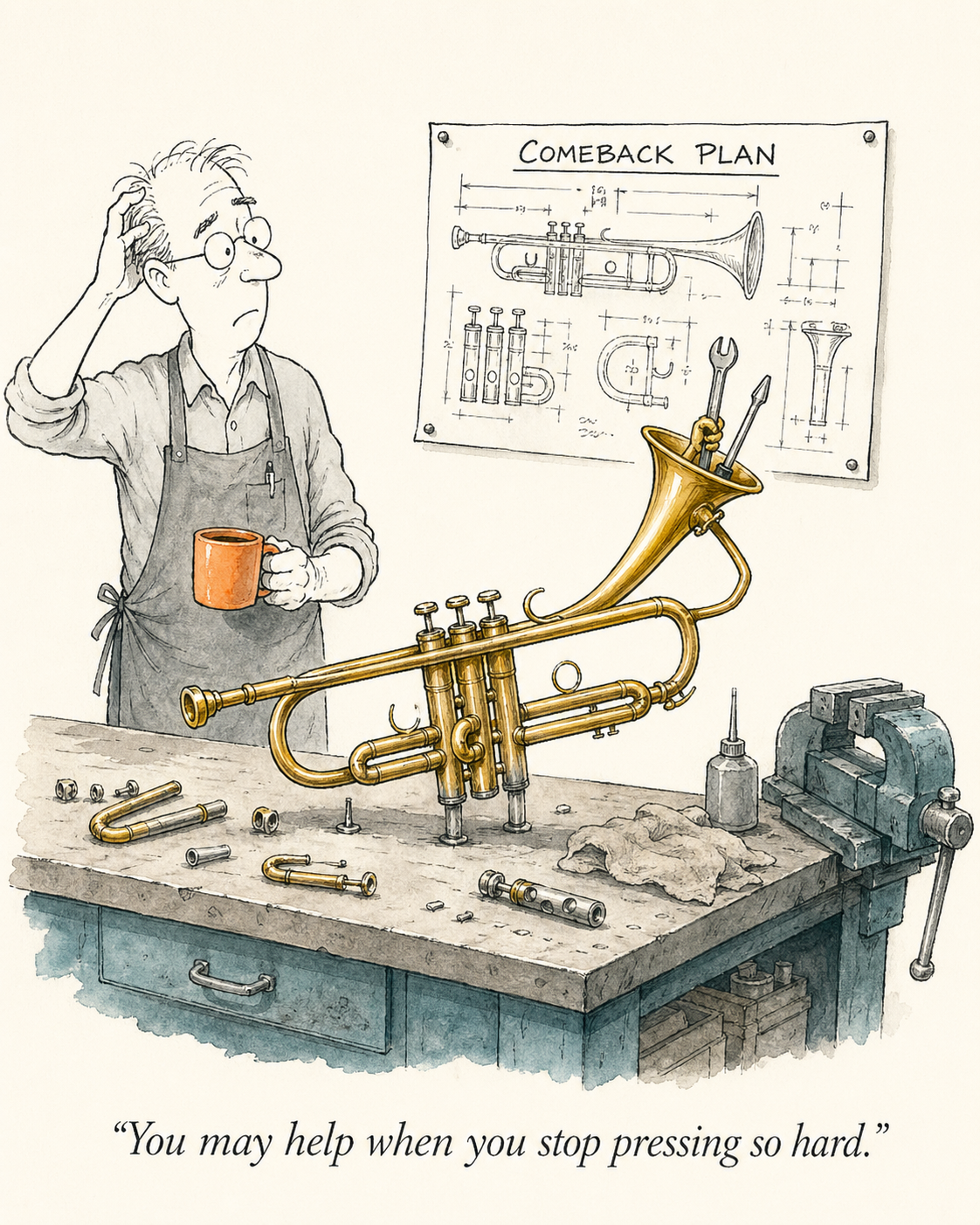
You opened your case. Maybe for the first time in a decade, maybe two, maybe three. You put the horn together, buzzed a few notes, and something between nostalgia and nausea hit you. It didn’t sound like you remembered. It didn’t feel like you remembered. And now you’re here, searching for some reassurance that this isn’t going to be as bad as it felt.
Here’s what I can tell you: it’s going to be harder than you think. Not harder than it needs to be — but harder than the version you’ve been imagining.
Because here’s what nobody warns you about a trumpet comeback: you don’t have the advantage of beginner’s naivete anymore. When you were 12 and picked up this instrument for the first time, you didn’t know how much there was to learn. You didn’t know what a high C was. You didn’t know you were supposed to be able to double-tongue at tempo or sustain a phrase for eight bars without breathing. You just played, and it was fun, and you got a little better every week without the weight of knowing how far the road stretched.
Now you know. You know exactly what you signed up for. You can hear the gap between where you are and where you used to be with excruciating clarity. And that knowledge — the thing you think is your advantage — is actually going to be one of your biggest obstacles.
It’s like re-learning a language you used to speak fluently. The words are in there somewhere, buried. You can feel them on the tip of your tongue. But they won’t come when you call them, and the frustration of almost remembering is worse than not knowing at all.
So here’s what I’m going to do. I’m going to paint you two pictures. Two versions of what comes next. One is the path most comeback players walk — the one that leads to frustration, burnout, and the case going back into the closet. The other is the path the successful ones take. And the gap between them is narrower than you’d think, but it makes all the difference.
Think of this like Virgil guiding Dante. I’m going to walk you through the underworld first — not to scare you, but so you recognize the circles when you see them. Because if you don’t know what the traps look like, you’re going to walk straight into every one of them.
The Seven Circles of Comeback Hell
This is what most trumpet comebacks actually look like. Not the inspirational YouTube story. Not the forum post where someone claims they “got it all back in three months.” The real version. The one nobody talks about.
Circle One: The Ghost of Who You Were
You pick up the horn expecting your old self to show up. After all, you did this for years. You marched, you gigged, you soloed. Trumpet was part of your identity. Surely the body remembers.
It doesn’t. Not the way you want it to.
And so the very first thing that hits you isn’t a physical limitation — it’s an identity crisis. You’re not the player you were. You’re not a beginner either. You’re stuck in a painful no-man’s-land where you know enough to hear everything wrong but can’t do anything about it.
This is where the measuring-backward trap starts. Every note gets compared to a version of you that no longer exists. Every session ends with the same thought: “I used to be able to do this.” And that thought poisons everything that follows.
Circle Two: The Information Avalanche
So you go looking for help. YouTube. Facebook groups. Reddit. TrumpetMaster forums. And suddenly you’re drowning.
“Use this warm-up.” “Try the Stamp method.” “No, do Caruso.” “Have you tried Balanced Embouchure?” “You need to do flow studies.” “Just long tones.” “Long tones are a waste of time.” “Play as high as you can every day.” “Never play above your comfort zone.”
Everyone has an opinion. Everyone contradicts everyone else. And you — sitting there with dead chops and a decade of rust — have no way to filter which advice applies to YOUR situation and which is going to make things worse.
So you try everything. A little of this on Monday, a little of that on Tuesday. You strategy-hop every week because nothing seems to be working fast enough, and every new YouTube video makes you think you’ve been doing it wrong.
You haven’t found the right answer because you don’t even know the right question yet. And the information avalanche is burying you deeper.
Circle Three: The Equipment Rabbit Hole
Now you start wondering if it’s the gear.
“Maybe I need a different mouthpiece.” “My old horn is probably shot.” “I’ve been reading about the Bach 3C vs. the 1.5C — maybe that’s why my upper register is gone.”
So you spend $200 on a new mouthpiece. Then another. Then you start eyeing horns on eBay. You join mouthpiece swap groups. You read forty threads about backbore tapers and throat sizes. You become an expert in equipment specifications while your actual playing stays exactly where it was.
This circle is seductive because it feels productive. You’re doing something. You’re researching. You’re investing. But you’re investing in everything except the thing that actually matters — what’s happening between your ears and behind your lips.
The gear isn’t the problem. If it were, every pro would play the same setup. They don’t. Chasing equipment is one of the most common mistakes comeback players make, and it’s an expensive one.
Circle Four: The Overblowing Death March
At some point — usually after the first few weeks when the initial shock fades — you start pushing. Hard.
“I just need to build my chops back up. I need to get stronger. I need to push through this.”
So you practice for an hour and a half. You blow until your face is numb. You chase notes that aren’t there, muscle through passages that require finesse, and measure the quality of your session by how wrecked you feel afterward. The gym mentality: no pain, no gain.
And every single rep you take while your chops are trashed, while your body is bracing, while your throat is closed and your jaw is locked — you’re not rebuilding. You’re reinforcing the exact reflex that’s going to keep you stuck. You’re training your nervous system that trumpet equals pain, effort, and survival. You’re digging the groove deeper.
But it feels like discipline. It feels like dedication. That’s what makes this circle so dangerous — it disguises self-destruction as work ethic.
Circle Five: The Strategy Carousel
Nothing’s working fast enough (because you keep overplaying and then need days to recover, which kills your consistency, which is the one thing that actually matters). So you change your approach. Again.
New warm-up routine. New method book. New embouchure concept you found on a forum at 1 AM. You give each one about four days before deciding it’s not working and rotating to the next.
This is what I call stimulus hunting — chasing the next shiny thing because the current thing doesn’t feel magical enough. The problem is that nothing works in four days. Real change takes two to four weeks of focused, consistent work on ONE thing. But consistency requires patience, and patience requires trust, and trust requires a plan you believe in.
Without that plan, you’re spinning. And spinning feels like progress until you realize you haven’t moved.
Circle Six: The Isolation Spiral
By now, weeks or months have passed. You’re frustrated. You’ve tried multiple approaches. You’re not where you want to be, and the gap between expectation and reality has become demoralizing.
And you’re doing all of this completely alone.
No teacher. No peers. No section to play beside. No one to tell you “hey, that actually sounded better than last week.” No one to diagnose the one thing you can’t see about your own playing. No one to keep you accountable on the days when the couch sounds better than the practice room.
Just you, the horn, and a growing sense of disappointment.
Circle Seven: The Case Goes Back in the Closet
The last circle isn’t dramatic. There’s no blow-up, no single bad day that ends it. It’s quiet. You just… stop. You skip a day. Then three. Then a week. You tell yourself you’ll get back to it. You don’t.
The case goes back in the closet, and the comeback dies — not from failure, but from slow surrender.
This is where most trumpet comebacks end. Not because the player lacked talent or potential. Because they walked the path without a guide and hit every trap along the way.
The Road Out: What Successful Comebacks Actually Look Like
Now let me paint the other picture. Because the difference between the seven circles and a successful comeback isn’t talent, age, or hours. It’s approach.
The successful comeback player expects to feel uncomfortable — and doesn’t interpret discomfort as failure. They know the first few weeks will be rough. They know the gap between memory and reality will hurt. They’ve been told what to expect, so when the frustration hits, they don’t spiral. They recognize it as part of the process and keep moving.
The successful comeback player has a system, not a collection of tips. They’re not cobbling together advice from twelve different YouTube channels. They have a framework — a clear structure for what to play, how much, and how hard — and they follow it with discipline even on days when it doesn’t feel exciting. They understand that boring consistency beats inspired chaos every single time.
The successful comeback player manages their load. They practice 30 minutes a day — every day — and they don’t blow past it in the first month trying to accelerate the timeline. They have light days and medium days and the occasional heavy day, planned with intention. They treat recovery as part of the training, not as lost time.
The successful comeback player builds forward, not backward. They’re not trying to restore a museum exhibit of their 22-year-old self. They’re building a new player — one with better habits, better understanding, and a healthier relationship with the instrument.
And the successful comeback player doesn’t do it alone.
The Infrastructure You Forgot About
Here’s the part that’s going to challenge some of you. Because if there’s one thing adult comeback players have in abundance, it’s hubris. Not the arrogant kind — the quiet kind. The kind that says “I’ve done this before, I know what I’m doing, I can figure this out myself.”
Let me ask you something. How did you learn to play trumpet in the first place?
You had a band director. Most of you had a private teacher, at least at some point. You had a section — other trumpet players sitting next to you every single day. You had friends who played. You had rivals who pushed you. You had ensembles that required you to perform regularly. You had concerts with deadlines that forced preparation. You had chair placements that gave you honest feedback on where you stood. You had a community that kept you accountable just by existing.
You had all of that. Every single day. For years.
And now you’re sitting in your living room, alone, trying to do this in complete isolation. With a YouTube video as your teacher and a Facebook forum as your section.
Think about that for a second. You had an entire infrastructure built around your development — teachers, peers, rivals, ensembles, performance deadlines, daily immersion — and THAT’S how you became the player you’re trying to get back to. Now you’ve stripped away every single piece of that infrastructure and you’re expecting the same result?
It’s like trying to get back in shape with no gym, no trainer, no workout plan, no training partner, and no accountability — just a vague memory of being fit and a pair of running shoes in the closet. Could you do it? Maybe. Some rare, extremely self-disciplined people could. But even they’d get there faster with help. And for everyone else, the isolation is what kills the comeback.
This isn’t weakness. This is how learning works. This is how it has always worked. The first thing I do when I encounter a new endeavor is find someone who’s already done it and pay them to help me shortcut the mistakes. Not because I’m incapable. Because I’m not interested in spending six months learning what I could learn in six weeks with the right guide.
What Changes at 10, 20, and 30 Years Away
Now let me get specific, because the experience isn’t identical depending on how long you’ve been gone.
10 years away: Your muscle memory is dormant but not dead. The physical patterns — tongue position, air coordination, embouchure shape — are still in your body. They’re buried under rust, but they’re there. The first two weeks will feel terrible, and then things will start clicking faster than you expect. Your biggest danger at this distance is overconfidence: “It’s only been ten years, I should be able to do this.” That overconfidence leads to pushing too hard, skipping the fundamentals phase, and ending up in Circle Four. Play like you’re starting from scratch for the first month even if it feels like overkill. Your body will thank you.
20 years away: The muscle memory is significantly degraded. Some patterns will feel familiar, like riding a bike with flat tires — you remember the concept, but the execution is rough. Your musical brain is still sharp — you hear music the same way, you understand the instrument intellectually — but the physical connection needs serious rebuilding. Endurance is usually the first thing that shocks you: you might get 10 to 15 solid minutes before your face gives up. This is completely normal at 20 years. The advantage at this distance is that you’ve had enough life experience to be patient if you choose to be. The players who succeed at 20 years are the ones who embrace the beginner phase fully. The ones who resist it end up in the circles.
30+ years away: Let’s be real — this is a full rebuild. The physical patterns are largely gone. What remains is your ear, your musicality, your understanding of the instrument, and your love for it. Those are more valuable than you think. I’ve worked with players in their 60s and 70s who hadn’t touched a horn since high school — and within six months of consistent, intelligent practice, they were making real music again. Not the music they made at 18. Different music. Often better music, because they had a lifetime of listening and feeling to bring to it. The timeline is longer, the patience required is greater, and the load management is critical — your recovery needs are real, and ignoring them will crater you. But the destination is still there.
Across all three: the thing that changes most with time away isn’t your potential. It’s how honest you’re willing to be about your starting point. The 10-year player who accepts where they are moves faster than the 10-year player who pretends they’re still at year zero. The 30-year player who commits to 30 minutes a day with the right system gets further than the 10-year player who wings it alone.
Time away is the variable everyone obsesses about. Consistency and approach are the variables that actually decide the outcome.
Frequently Asked Questions
I was pretty good before I stopped — does that help?
It depends on how you were “good.” If you had solid fundamentals — efficient air, minimal pressure, good balance — then yes, your body has a better blueprint to rebuild from. If you were good through compensations — white-knuckling the high notes, pressing hard, muscling through — then your comeback is actually a chance to rebuild better than what you had. That takes longer upfront but pays off permanently.
I’m overwhelmed by all the information out there. Where do I even start?
Stop looking. Seriously. The information avalanche is Circle Two for a reason — it paralyzes you. You need one system, not twelve opinions. Start with the Complete Trumpet Comeback Guide and follow it. If you want personalized guidance, get a teacher. The worst thing you can do is try to Frankenstein a method together from forum posts.
Should I buy new equipment before I start my comeback?
No. Play what you have for at least the first three months. Your old horn and mouthpiece are fine for now. Changing gear during a rebuild adds variables you can’t control and can’t evaluate — you won’t know if a change helped or hurt because everything is changing at once. Get your playing stabilized first, then consider equipment adjustments from a position of clarity instead of desperation.
Is it normal to feel worse before I feel better?
Very normal, especially in weeks 2-3. The initial excitement fades, the physical reality sets in, and there’s often a psychological dip when the gap between expectation and reality hits hardest. This is temporary. If you’re following a structured plan and managing your load, the trajectory bends upward quickly — you just can’t always see it day to day.
What if I can’t practice every day?
Then practice as many days as you can, knowing that every skip costs you more than you think. Daily practice isn’t just about accumulating minutes — it’s about maintaining the neuromuscular calibration your body is rebuilding. Missing one day means your next session spends time recovering ground instead of gaining it. Six days a week is the minimum for serious progress. Five will work but it’s slower. Fewer than five and you’re going to struggle.
Which Path Are You Going to Walk?
You now know what to expect. Both versions — the circles and the straight line. The slow surrender and the real comeback.
The path through the circles is what happens by default. It’s where you end up when you try to do this alone, without a system, without guidance, powered by nothing but memory and hope. It’s not that you’re incapable — it’s that the traps are invisible until you’ve already fallen in.
The other path — the one that works — requires three things: a system you trust, consistency you commit to, and the humility to accept help.
That’s it. Not talent. Not youth. Not the right mouthpiece. A system, consistency, and help.
The Complete Trumpet Comeback Guide is the system. The 30-minute daily commitment is the consistency. And the help? That’s up to you.
See how the pieces fit together
This article covers one piece of your playing. Jesse’s nine-minute training explains the wider approach. Paid coaching adds individual feedback, priorities and support.
You’re not the first person to make this journey. You don’t have to figure out the map alone.
About the Author
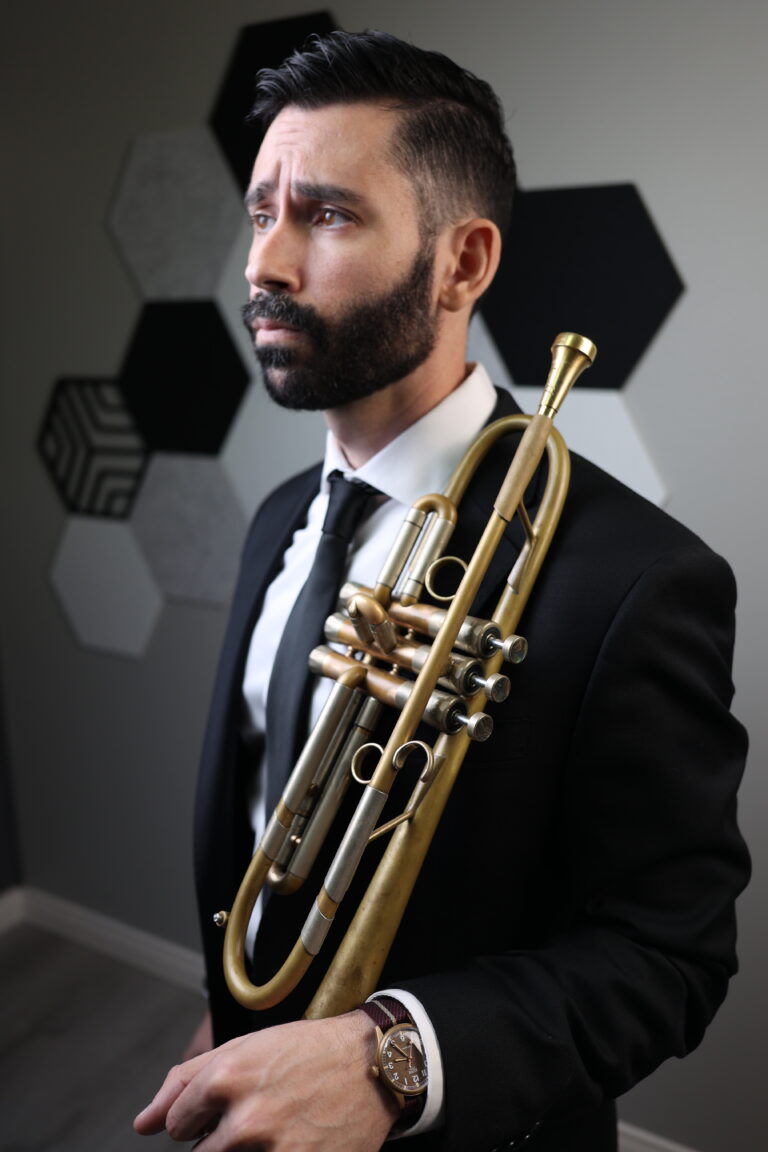
Jesse Garcia
Founder, 1% Trumpet Program
Jesse is a working trumpeter and teacher. He’s performed with the Glenn Miller Orchestra, freelanced on the Las Vegas commercial scene, played extended cruise ship contracts around the world, and served as a trumpeter in the United States Army. He’s worked hands-on with over 100 trumpet players — from beginners to comeback players to seasoned pros — and reaches an audience of 75,000+ across his social platforms. He founded the 1% Trumpet Program to teach what actually works for adult players, drawing on the same systems he uses to keep his own chops sharp on the road.