
17 min read
The protective reflex that’s keeping you stuck — and how to spot it.
In this guide:
- You Don’t Have an Information Problem
- What the Protective Reflex Actually Is
- How You Trained the Reflex (The Physical Side)
- How You Trained the Reflex (The Psychological Side)
- The Part Nobody Wants to Talk About: Your Ego
- How You Brainwashed Yourself
- Why Everything You’ve Tried Has Failed
- The Loop You’re Stuck In
- Your Relationship With the Trumpet
- What “Secure” Actually Feels Like
- So What Do You Actually Do About It?
- Frequently Asked Questions
- What Comes Next
I want you to try something before you read another word.
Close your eyes. Seriously — close them for ten seconds.
Picture a high note on a piece of music. Whatever note scares you. Maybe it’s a high C. Maybe it’s a high G above that. Maybe it’s just an A on top of the staff. Whatever the note is, picture it on the page. Exposed entrance. People are listening. It’s coming up in three… two… one…
Notice what just happened in your body.
Maybe your throat tightened. Maybe your jaw clenched. Maybe your shoulders rose. Maybe your embouchure pinched. Maybe you just felt a wave of dread — that “oh no, I don’t know if this is going to work” feeling.
Whatever you felt — that’s real. Stay with it for a second.
Now — picture something easy. Low C. First-line E. Something comfortable, something you know is going to speak every single time.
Notice what just happened.
All that tension? Gone. The anxiety? Disappeared. Suddenly you feel confident. You know this note is going to work. You trust it completely.
Open your eyes.
That difference — that gap between how your body responded to the scary note versus the easy note — is what’s been destroying your consistency. Not your age. Not your talent. Not your gear. Not that you “need to practice more.”
It’s that tension spike. That anxiety wave. That lack of trust that appears before you even play.
Your nervous system is treating parts of the trumpet as danger — and your body is bracing to protect you from it.
And here’s the part nobody tells you: every time you practice while that protective response is active, you’re making it stronger. You trained yourself to do this. Not on purpose — but you did it. And you’ve been reinforcing it for years, maybe decades.
That’s why your trumpet playing got worse. And that’s what we’re going to break down right now.
You Don’t Have an Information Problem
Before we go any further, let me address the voice in your head that’s saying: “Okay Jesse, calm down. I’m not scared of my trumpet. I just need to practice more, breathe better, warm up smarter, or maybe get a different mouthpiece.”
Let me ask you two questions.
First: Do you already know, intellectually, that too much mouthpiece pressure is bad? That overblowing kills your endurance? That tension in your throat chokes your sound?
Of course you do. Every trumpet player on the planet has heard this a thousand times.
Second: Do you still mash and overblow the instant you see something exposed above the staff, or when you start getting tired, or when you’re nervous?
Right.
So you just proved something important. You don’t have an information problem. You have an implementation-under-stress problem. You know exactly what to do. You just can’t do it when it matters — when the pressure is on, when the fatigue creeps in, when the stakes go up.
That’s not a knowledge gap. That’s a nervous system response. And until you address the response itself, no amount of information is going to fix it.
What the Protective Reflex Actually Is
When I say “protective reflex,” I don’t mean stage fright. I don’t mean shaky hands or a phobia. I mean something much more specific and much more insidious.
I mean that “don’t miss, don’t miss, don’t miss” thought before an exposed entrance.
That quarter-second moment before you play, when your throat tightens, your jaw locks, your air hesitates, you lean in and jam the horn into your face “for safety,” and your brain whispers “please don’t miss.”
That micro-flinch is the problem.
Here’s why it matters so much: once a note is launched on trumpet, it’s ballistic. You can’t fix the setup mid-note. If the setup is tense — if your throat is locked, your air is hesitant, your embouchure is pinched — the note is already expensive before it even speaks. It’s going to cost you more effort, more air, more pressure, and more endurance than it needed to. And that cost compounds across every note you play.
The protective reflex makes every note more expensive. And when every note costs more than it should, your endurance dies faster, your range shrinks, your sound thins, and you end up in what I call the trumpet death spiral: lips stop responding, so you panic, so you blow harder, so you press harder, so there’s more cutoff, so you blow harder — and your face is gone in ten minutes.
Sound familiar?
How You Trained the Reflex (The Physical Side)
Your body didn’t start this way. Nobody picks up a trumpet for the first time with a protective reflex. It gets built over time, through repetition, the same way all reflexes get built.
Every time you missed or cracked a note and then pushed harder to “fix” it — your nervous system logged that as a threat. Every time you kept playing while your lips were tired and swollen — threat. Every time you forced air through a pinched aperture because you didn’t know another way — threat. Every time you jammed the mouthpiece into your face to squeeze out a note that wasn’t there — threat. Every time you skipped your warm-up and went straight to demanding material — threat. Every time you pushed through pain just to “get the reps” — threat.
Each of those moments was small. Individually, none of them seemed like a big deal. But your nervous system was keeping score. And after hundreds or thousands of those micro-threats, it developed a reflex: before you even approach that register, before you even play the note, start bracing. Start protecting. Because last time we went there, it hurt.
That’s why it feels like the trumpet is fighting you. It’s not the trumpet. It’s your own body, trying to save you from something it learned was dangerous.
How You Trained the Reflex (The Psychological Side)
But it’s not just physical. The mental side feeds the reflex just as powerfully — and this is the part that most trumpet education completely ignores.
Every time you beat yourself up because you weren’t where you wanted to be — you reinforced the reflex. Every time you got angry at yourself mid-practice — reinforced. Every time you dreaded picking up the horn — reinforced. Every time you avoided practice altogether because you couldn’t handle the disappointment — reinforced. Every time you compared yourself to another player and came up short — reinforced. Every time you panicked after a bad day and tried to “fix” everything at once — reinforced. Every time you chased a new routine or a new method out of fear that the old one wasn’t working — reinforced.
Every single one of those moments sent the same message to your nervous system: trumpet is unsafe.
Not physically unsafe in the way that a car crash is unsafe. Psychologically unsafe. Emotionally unsafe. Your nervous system doesn’t distinguish between the two. A threat is a threat. And your body will protect you from emotional danger with the same reflexes it uses to protect you from physical danger.
The Part Nobody Wants to Talk About: Your Ego
Now here’s where this gets uncomfortable. Because there’s a layer underneath the physical and psychological triggers that goes even deeper — and it’s the reason most trumpet players will never fix this.
Your ego does the same thing your nervous system does.
Your nervous system protects you from physical danger — real or perceived. Your ego protects you from psychological danger — real or perceived. And for a lot of trumpet players, the biggest psychological danger isn’t missing a note. It’s examining the beliefs that are making you worse.
We’ve all seen the obvious version of this. The negative trumpet player. Gets furious every time he makes a mistake. Beats himself up constantly. “I’m no good. What’s wrong with me? Why can’t I just play this?”
Here’s my question: Do you think that player can practice objectively? Do you think he can calmly identify what’s actually going wrong? Do you think he can experiment without spiraling?
No. He can’t. He’s too busy protecting his ego to do the actual work. His relationship with failure is so broken that he can’t even look at the problem clearly.
But here’s the thing — that’s the obvious version. Most of you have a subtler version of the same issue. You’re protecting beliefs that are making you worse, and you don’t even realize you’re doing it.
The belief that you need to “build more strength.” The belief that you need to “practice more hours.” The belief that if you just find the right mouthpiece, or the right exercise, or the right routine, everything will click.
Those beliefs feel like you. They feel like your identity as a trumpet player. So questioning them feels like questioning who you are.
And that’s exactly why you won’t look there.
It’s not that examining your assumptions isn’t “sexy.” It’s that it threatens your ego. You’re protecting something that’s making you worse, and you don’t even know you’re doing it.
The pain of letting go of a belief is temporary. The pain of never reaching your potential is forever.
How You Brainwashed Yourself
Let me bring this full circle.
Through beliefs you picked up, assumptions you never questioned, and a focus on the wrong things in the wrong order — you’ve programmed yourself to fail. And you’ve been reinforcing it every time you practice.
Here’s how the brainwashing works:
Everyone told you: “Get stronger. Practice more. Push harder. Build endurance.” So you believed that. And that belief drove all of your actions.
Your body and brain will always find the shortest path to whatever objective you’re pursuing. So if you believe you need to get stronger, what do most people do to get stronger? They try to get tired. That’s the gym mentality — no pain, no gain. Push until you can’t push anymore.
So unconsciously, you started trying to get your face tired. You practiced until your lips were dead. You pushed into registers that wrecked you. You measured the quality of a practice session by how exhausted you were afterward.
And the whole time, you were sabotaging yourself. You weren’t getting stronger — you were training your nervous system to panic. You were reinforcing the protective reflex with every fatigued rep. You were teaching your body that trumpet is a threat that requires maximum bracing and maximum effort.
The thing you thought was the solution was actually the cause of the problem.
And until you see that — really see it, not just intellectually agree with it — nothing else works.
Why Everything You’ve Tried Has Failed
Let me throw some rocks at the conventional advice, because you’ve been told all of these and none of them have fixed it:
“Just practice more.” If reps alone fixed this, you’d be fixed. You’ve already repeated the same panic pattern for years. You’re not “practicing out of it” — you’re engraving it. As Herbert L. Clarke said: bad habits are easy to form but difficult to fix. More reps of a broken pattern just means a more deeply grooved broken pattern.
“Just use more air.” Breathing matters. But if your throat clamps shut a fraction of a second before the note because your body thinks that register equals danger, the air isn’t going where you think it is. Telling someone with a protective reflex to “use more air” is like yelling “drive faster” at a car with the parking brake on. The engine isn’t the problem. The brake is the problem.
“Get a better mouthpiece.” Gear can help on the margins. I like gear. But if you’re still playing from fear, you’re just panicking with $250 less in your pocket. Equipment doesn’t uninstall a reflex.
“Just warm up better.” Your warm-up felt great at home. Then you saw that exposed line in rehearsal and your body instantly tightened. The warm-up wasn’t the bottleneck. The reflex under pressure was.
“Stop being a baby and just muscle through it.” This one’s for the brute-force crowd. “I’ve always just powered through.” That’s not proof of strength. That’s proof that you’ve been willing to trade your body for short-term survival. That approach works — until it doesn’t. And when it stops working, it doesn’t taper off gradually. It falls off a cliff. If you’ve felt that cliff, you know exactly what I’m talking about.
Here’s the real problem with all of these: they’re tactics. And tactics mean nothing under the wrong operator. If the person running the drills is operating from fear, shame, avoidance, or false beliefs about what matters — the drills don’t work. You can have the best exercise in the world. If you’re executing it while your nervous system is in panic mode, you’re just getting better at panicking.
The operator matters more than the operation.
The Loop You’re Stuck In
Here’s the actual cycle that’s been running in the background of your playing, probably for years:
You had a painful or embarrassing moment. You cracked an exposed note. Your endurance died in the middle of a gig. You got humiliated in a rehearsal. Whatever it was, it hurt.
Your body tagged that as danger.
Now, any time you approach that zone — that register, that dynamic, that level of exposure — your nervous system pre-braces. Throat locks. Jaw clamps. You overblow. You slam the mouthpiece “just to be safe.”
That tension wrecks your efficiency. You fatigue faster. The note is more expensive. You miss again. Or you barely survive it, but at a cost that drains you for everything that follows.
And that confirms the story. Your nervous system goes: “See? That zone is dangerous. Good thing we braced.”
The loop deepens.
That’s neuromuscular conditioning. It’s not that you lack talent. It’s not that you’re too old. It’s not that you need a different horn. Your nervous system just hasn’t been taught to feel safe and efficient in those ranges.
And every time you practice while that loop is active — every time you push through the tension instead of addressing it — you’re making the groove deeper.
Your Relationship With the Trumpet
Now I’m going to say something that’s going to click a lot of puzzle pieces together.
You have a relationship with your trumpet. And that relationship has a style — the same way human relationships do.
If you’re anxious with the trumpet: You can’t stop touching the horn. Every miss feels like a personal failure. You over-practice, overblow, never rest. You’re fused to the instrument — constantly chasing reassurance, constantly trying to prove that you’re still good enough. You’ll burn yourself into the ground to “earn” safety. That anxious attachment dumps fuel on the protective reflex. You’re always redlining, always in “please don’t leave me” mode with the horn.
If you’re avoidant with the trumpet: You “forget” to practice. You tell yourself you’re just busy, you’ll get back to it when you’re ready, you’ll practice when you have more time. You keep the horn at arm’s length because picking it up shows you exactly where you are — and that exposure doesn’t feel safe. Every time you do come back, your system treats the horn like a threat because you’ve been out of contact. Every note feels like walking back into a fight.
Both of these produce the same result: volatility, inconsistency, insecurity. Both of them feed the protective reflex.
The goal is secure attachment.
A securely attached trumpet player can work and can rest. They can play for joy without turning it into a stress test. They’re connected to the horn but not fused to it. They’re not in panic chasing reassurance, and they’re not disappearing for a week because they’re ashamed.
Secure attachment is what lets your nervous system stay calm. Calm setup. Clean air release. Efficient notes.
And that means you get range that expands instead of shrinks, endurance that lasts instead of dying, a sound that’s full and open instead of thin and pinched, response with no delay, and — most importantly — the freedom to actually make music instead of worrying about chops.
What “Secure” Actually Feels Like
Let me paint this picture, because it’s where we’re headed.
You walk into rehearsal. You see the exposed high line. And instead of that little spike of dread, you just… breathe. You set up. You play. The horn responds. You’re present in the music, not negotiating with fear.
After rehearsal, you’re not replaying every mistake on loop. You’re not beating yourself up or spiraling through “what’s wrong with me.” You note what worked, what needs attention, and you move on.
When you practice, you’re not grinding to prove you’re worthy. You’re building. You can feel when to push and when to back off. You trust your recovery. You’re in partnership with the instrument, not in combat with it.
No throat clamp. No mental negotiation. No “please don’t miss.” Just you, the horn, and the music.
That’s secure attachment. That’s biological confidence — not the kind you hype yourself into with a pep talk, but the kind that lives in your nervous system because your body has learned, through experience, that this is safe.
So What Do You Actually Do About It?
If you’ve read this far and you’re seeing yourself in every section — good. That’s step one. You can’t fix what you can’t see.
Here’s the honest truth about fixing it: you can start on your own, but there’s a limit to how far you can go in isolation. The protective reflex is, by definition, something you can’t fully see while you’re inside it. It activates before conscious thought. You can’t observe the thing that’s hijacking your observation.
But here’s where to start:
First, stop reinforcing it. That means stop practicing in a trashed, panicked state. Stop pushing through fatigue and calling it work ethic. Stop making the mistakes that feed the reflex. Every session you play while the reflex is active makes it stronger. So the first priority is to stop digging the hole deeper.
Second, get controlled wins your body believes. Tiny, safe reps in the zones that used to scare you — without panic, without force. You cannot yell yourself into confidence. You have to experience safety first. Your warm-up and practice structure need to be designed around building trust, not testing limits.
Third, manage your load like an athlete. Not “practice a lot” or “take a rest day,” but actually programming stress and recovery so your body never has to go into emergency mode. Heavy days, medium days, light days — planned with intention, not left to chance. The complete system for this is in the comeback guide.
Fourth, track what you’re doing. Without data, your memory will gaslight you. You’ll think you’re not improving even when you are. You’ll quit three weeks before the breakthrough because you can’t see the pattern emerging. Even basic tracking — duration, intensity, one sentence about how it felt — prevents the hopelessness that kills most comebacks.
And fifth — the hard one — take ownership. Not blame. Ownership. You didn’t know the map was wrong. Nobody taught you this. That’s not your fault. But it is your responsibility. Because you’re the only one who can fix it.
You trained the reflex. You reinforced the beliefs. You can retrain them both.
Frequently Asked Questions
Is the protective reflex the same as performance anxiety?
Not exactly. Performance anxiety is one expression of it, but the protective reflex operates even when there’s no audience. It activates during practice, during warm-up, even during that visualization exercise you did at the top of this article. It’s a nervous system response to perceived danger on the instrument — and it runs whether anyone is watching or not.
Can you fix the protective reflex on your own?
You can start. The steps I outlined above — stop reinforcing it, get safe wins, manage load, track progress — will absolutely make a difference. But there’s a ceiling to what you can do in isolation, because the reflex operates below conscious awareness. You can’t fully see it while you’re in it. That’s why every elite performer in every field has a coach — not because they’re weak, but because you can’t rewire your own blind spots alone.
How long does it take to calm the protective reflex?
It varies, but most players start feeling a noticeable difference within 2 to 4 weeks of consistently practicing in a way that doesn’t reinforce the reflex. The full retraining — moving from anxious or avoidant to genuinely secure — takes longer, usually several months. But the early progress is real and measurable, and it compounds.
Does the protective reflex get worse with age?
The reflex itself isn’t age-related — it’s experience-related. But older players have often had more years of reinforcing it, which means the grooves are deeper. The good news is that the retraining process works the same regardless of age. I’ve seen it work in players in their 70s and 80s. Age changes the timeline of the comeback, not the possibility of it.
I’ve been playing for years and this has never been explained to me. Why?
Because most trumpet teachers — the really great ones — never had this problem. They developed secure attachment with the instrument naturally. They never built a severe protective reflex, so they don’t have language for it. When you show up anxious or avoidant, they’ll say “just relax” because that’s what works for them. They can’t give you the map because they never needed one.
What Comes Next
Now you know the real reason your trumpet playing got worse. It’s not your age, your gear, your talent, or your practice hours. It’s a protective reflex your nervous system learned through years of well-intentioned but misguided practice — and it’s been running the show from behind the scenes ever since.
The question is what you’re going to do about it.
If you want the full system — the step-by-step rebuild that calms the reflex, manages your load, and moves you toward secure attachment with the instrument — read the Complete Trumpet Comeback Guide. It covers the first 30 to 60 days in detail.
Watch the Free Training: “Why Your Trumpet Playing Got Worse (And the 3-Step System to Fix It)”
If this article got you fired up, the free training goes deeper. The same diagnostic-first system used inside the 1% Trumpet Program — the protective reflex framework, the 2:1 ratio in action, and the systematic rebuild that actually works for adult players.
You’re not broken. You’re not too old. You’re not untalented.
You’re predictable. And predictable things are fixable.
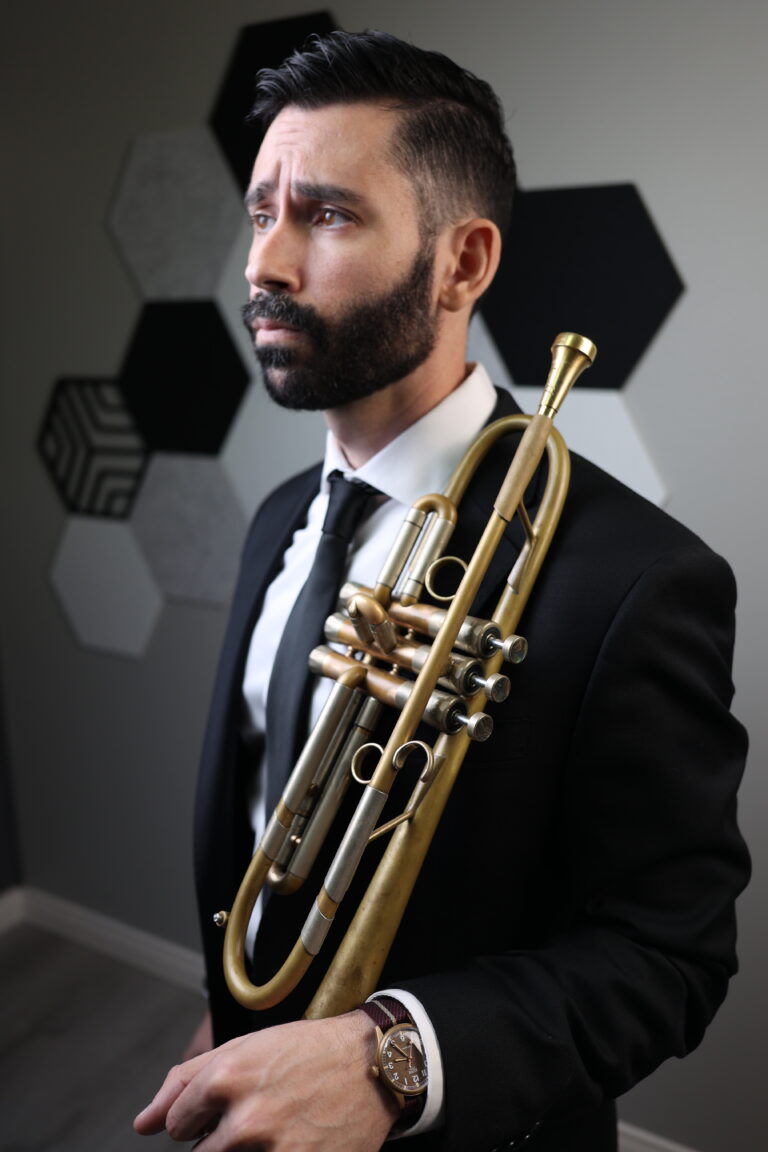
About the Author
Jesse Garcia
Founder, 1% Trumpet Program
Jesse is a working trumpeter and teacher. He’s performed with the Glenn Miller Orchestra, freelanced on the Las Vegas commercial scene, played extended cruise ship contracts around the world, and served as a trumpeter in the United States Army. He’s worked hands-on with over 100 trumpet players — from beginners to comeback players to seasoned pros — and reaches an audience of 75,000+ across his social platforms. He founded the 1% Trumpet Program to teach what actually works for adult players, drawing on the same systems he uses to keep his own chops sharp on the road.
Want the full system in 30 minutes? Watch the free training — the same diagnosis-first framework I use with every player in the 1% Trumpet Program.
RELATED READING
- Embouchure Stopped Working? Diagnose It — the five-branch tree for diagnosing what changed.
- How to Read Your Own Embouchure — the dashboard you should have been watching.
- Even Farkas Updated — the 1970 recant on prescriptive embouchure templates.