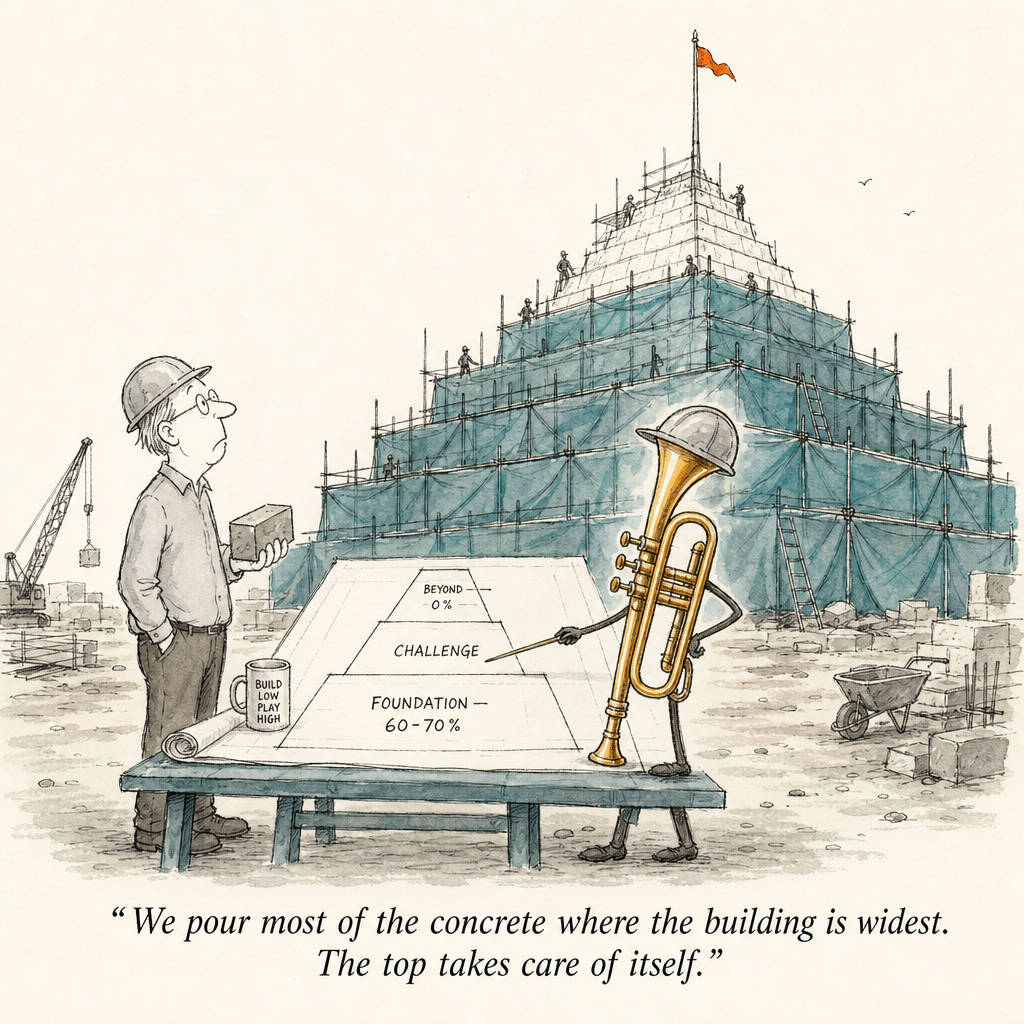
Ask a room full of trumpet players how to increase trumpet range and you will get a room full of secrets. A magic mouthpiece. A magic exercise. A magic word somebody’s college professor whispered once. Everybody has a trick, and almost nobody has range.
Here is the uncomfortable truth underneath all of it. Range is not a trick. Range is not a secret. Range is not even a note. Range is the output of a system, and if you want more of it, you have to build the system. When the system is right, high notes are easy. When the system is wrong, no amount of effort will save you, because the effort itself is usually what’s breaking it.
I have said this on camera a hundred different ways: getting better at high notes is not a weightlifting competition. It is not about brute strength. There is a systematic element that has to be in place for you to play higher notes, and you want to develop it over time so you don’t blow yourself up along the way.
This guide is that system, start to finish. Why range fails. What actually creates a high note. The three levers that do the real work. How to figure out where your range honestly is right now. How to distribute your practice so you get stronger instead of injured. And how long all of it actually takes, with real numbers instead of fantasy.
Every section here goes deeper in its own dedicated article. This is the map. The territory is one click away, whenever you’re ready for it.
Why Trumpet Range Fails (It’s Not What You Think)
Before we build anything, you need to understand why your range keeps failing. Because it is almost never the reason players think it is. Players think they’re weak. Players think they need a stronger face, a better horn, a smaller mouthpiece. And so they push harder, and the pushing is exactly what kills the note.
There are three failure modes, and they feed each other.
The point of failure is vibration
To produce a sound out of the trumpet, and to keep producing it, your lips have to be vibrating. That’s it. That’s the whole game. The second the lips stop vibrating, the sound is gone. Not quieter. Gone.
Down low, you have margin. The frequencies are slower, and you can mash in a little extra pressure and still get the lips to speak. There’s room for error. But as you go up, the vibration gets faster and faster, and that margin disappears. Up in the stratosphere, any little bit of extra interference is enough to mess up the sound entirely. High notes don’t fail because you ran out of strength. They fail because something stopped the vibrating surface.
Which brings us to the thing that stops it most often.
The pressure trap
Picture it. Your solo’s coming up. You’re about to scream this high note, it’s going to be so sick. And nothing comes out.
Has that ever happened to you? It’s happened to me. And here’s what actually happened in that moment: you jammed the mouthpiece so hard into your face that your lips touched the inside of the cup and the vibration stopped. Game over. Not because the note was too high. Because you physically shut down the only thing making sound.
Mouthpiece pressure is the silent killer of trumpet range. It works just well enough to fool you. A little pressure pins the lips, adds tension, and buys you a note or two, so your nervous system learns that pressing works. Then you press more. Then your range tops out, your endurance evaporates, and your chops hurt. Jamming the horn into your face means the sound stops, or you hurt your chops, or both. It is not a winning strategy. I’ve written a full breakdown of this trap and how to climb out of it in the mouthpiece pressure trap, and the range-specific escape plan lives in how to extend your range without pressure.
The protective reflex
The third failure mode is the sneakiest, because it doesn’t feel like a mistake. It feels like trying hard.
Your body has a built-in resistance to having air compressed and pushed through it. It’s a survival mechanism. When the pressure builds, the throat closes, the face braces, the whole system tightens up against the very air you’re trying to use. I call it the protective reflex, and for trumpet players it is public enemy number one, because playing high requires exactly the thing your body instinctively fights: compressed air moving freely.
And here’s the part that should worry you. We make it worse. We overdo it as a species of instrumentalists. We are hotheaded. We are terrible at pacing ourselves. So we jam the horn into our face, we overblow, and we do it consistently enough that it burns into the nervous system. Eventually you get nervous just picking up the horn, and the reflex fires before you’ve played a note. Now every high note is a fight between your air and your own body, and your body is winning.
Put the three together and you get the picture: the note dies when the lips stop vibrating, pressure and the protective reflex are what stop them, and both of those are things you are doing, not things happening to you. That is genuinely good news. You can’t fix weak, but you can absolutely fix wrong. The full diagnosis, with everything that’s actually going on when the note won’t speak, is here: why you can’t play high notes on trumpet.
What Actually Creates a High Note
So if it’s not strength and it’s not pressure, what is it?
Two pillars. You need speed of air, and you need an embouchure efficient enough to sustain that air. If your embouchure is too weak, nothing comes out. If you’re using too much pressure, you’re stopping the vibrating surface, so the note’s not coming out either. Everything in range development is a version of those two pillars: make the air faster, and keep the lips free to vibrate while you do it.
The word for how you make air faster is compression. And here’s a way to feel it right now, no horn required. Pretend you don’t have an aperture. Put your finger over your mouth so no air can escape, and blow. Squeeze all the air inside your mouth. Compact it. Squish it into a smaller and smaller space, as tight as you can. That’s compression. All of that air is now energized, and when you let it go by opening the aperture, it speeds up as it comes out. Faster air, faster lip vibration, higher note. That’s the whole physics lesson.
Good compression vs. bad compression
But compression is where players go wrong, because there are good sources of compression and bad ones, and under pressure your body will always reach for the bad ones first.
The good sources are the ones that train and get stronger. Your tongue position, which shapes the oral cavity and channels the air. Your abdominal support, the athletic engine of the whole operation. Your aperture, the final gate the air passes through. And the inside of your mouth itself, squeezing the air the way you just did with your finger over your lips. There’s a lot of ways to skin a cat, and every one of those levers creates real, sustainable compression.
The bad sources are the compensations. Closing the throat. Cranking mouthpiece pressure. Pinching the lips into a tight little knot. Clenching the jaw. Every one of these will produce something that resembles a high note today and costs you your range tomorrow, because every one of them either chokes the air or stops the vibration.
I once made a video where a quack trumpet doctor prescribes the complete bad-compression program: use as much pressure as possible, play as loud as you can, close your throat, take the biggest breath possible, and pull your embouchure way back. The joke is that the patient nearly dies on the high C. The reason the joke lands is that this is exactly what most players are already doing. If your high note routine reads like that doctor’s advice, you’re playing yourself.
The test I give my students for every source of effort is the North Star: does it feel good, sound good, and respond easily? All three. Not one, not two. Good compression passes that test. Bad compression always fails at least one part of it, usually “feels good” first. The full comparison of pressurized air versus pressed-on lips is worth your time: air compression vs. pressure.
The Three Levers: Tongue, Air, and Aperture
Good compression comes from three main levers you can actually practice. Here’s each one, what it does, and where to go deeper.
The tongue: if you can whistle, you can play high notes
If you can whistle from low to high, you can play high notes on the trumpet. I mean that literally. Whistle a low note, then slide up high, and pay attention to what happens inside your mouth. Your tongue elevates. That rising tongue channels the air and speeds it up, and the higher tone shows up because of it. The trumpet works the same way. The mechanism for high notes is already installed in your body. You’ve just never been asked to run it with a mouthpiece on your face.
Give your tongue clear instructions and it will speed up that air for you. Do some lip slurs and notice what your tongue is doing on the way up. If the answer is “nothing,” congratulations, you just found the missing piece of your range. The complete breakdown of syllables, arch, and how to train it is here: tongue position for high notes.
The air: speed, not volume
Let me tell you about the night I learned what air support actually means. In college I played a big band concert with the great Bobby Shew, and at the end of a tune I got to play a high F sharp. Nailed it. Bobby even turned around and gave me a little nod, and for one glorious second I was living in the closing credits of an 80s sitcom. Then he turned back to the audience and played a double C so destructive, so monstrous, that I wanted to crawl under my chair.
Afterward I found out where all that power came from. His abdominal muscles. When you brace and support with your abs, you can do so much more with so much less face, because you’re spreading the kinetic energy across your whole body instead of concentrating it on two small lips. Think of a water bottle with no air in it: twist it hard so everything inside gets compressed, then pop the cap. That’s abdominal support.
Notice what this is not: taking the biggest breath of your life. More air is not faster air. Players who inhale a swimming pool for the big note and then can’t get it through the horn end up with the back pressure feeding into their heads. That’s the headache, the dizziness, the light show. The breath you take in and the breath you let out need to be roughly equivalent. Air in, air out, no traffic jam. The difference between moving more air and moving faster air is the single most misunderstood thing in range building, and it gets its own full article: air speed vs. air volume.
The aperture: the last gate
The aperture is the opening between your lips that the air passes through, and it’s the final lever. A bigger aperture lets more air through. A smaller aperture makes the same air come through faster. It’s not the only way to create compression, but it matters, especially when you’re playing quietly.
Two warnings, though. First, don’t beat up your aperture. Pinching it shut with lip tension is bad compression wearing a good compression costume. The aperture should be focused by the system around it, not strangled by the lips themselves.
Second, and this one fixes more missed high notes than almost anything else I teach: set up for the top note. If you’ve ever started an exercise down low, climbed toward a high note, and had it fizzle out, here’s what happened. You set your aperture, tongue, and air for the bottom note and then tried to adjust your way up, giving yourself a dozen opportunities to mess it up in transit. Flip it. If you can go from high to low, you can go from low to high. If you’re starting on a low C and heading for a high C, you’d better be set for that high C right from the beginning. Pre-set, then play.
Your Real Range: The Honesty Test
Now we get to the part nobody wants to hear.
Quick, trumpet player: what’s the highest note you can play?
You’re a liar. Stop it.
I know you’re lying because almost every trumpet player lies about this, and not on purpose. You thought of your personal best. The highest note you ever played, once, on a good day, warmed up, fresh, with the wind at your back. That is not your highest note. Your highest note is the one you can play at the end of a gig, at the end of the rehearsal, at the end of the day. The one that, gun to your head, you can still play in front of other people, reliably, all the time.
Your personal best is great. It means you peaked, and peaking means you’re making progress. But when you take a peak and turn it into your average, you set yourself up for constant disappointment and constant overreach. It’s the weightlifter who benched 315 once and now thinks that’s his working weight. If he loads 315 every day, he doesn’t get stronger. He gets hurt.
This is why I tell players to stop asking “how do I get a double C?” It’s the wrong question, and the wrong question sends you down the road of terrible overplaying and overcompensation. The right question is: how do I get the next half step from where I’m comfortable, wherever that is? If the double C conversation still fascinates you, and I get it, it fascinated me too, I wrote about who actually gets there and how in Double High C: is it realistic?. But the honest answer starts with the honest note.
So find yours. Your true base note has to pass a brutal set of criteria. You can hit it from anywhere in your range, including from a low F sharp. You can bend it, slur it, articulate it every way you know. You can play it soft and loud without your technique falling apart. You can hold it for a full breath. And you land it nine times out of ten, even when you’re not perfectly warmed up. If you wouldn’t bet a paycheck on that note in front of an audience, it is not your base.
Most players discover their honest base is a third or a fourth below what they’ve been telling people. Good. That sting you’re feeling is the sound of your range finally standing on something real.
The Range Pyramid: How to Increase Trumpet Range Without Wrecking Your Chops
Here is the organizing spine of the entire system. If you remember one thing from this guide, remember this.
Trumpet playing is the CrossFit of the music world. It demands power like a lifter, endurance like a distance runner, precision like a gymnast, and speed like a sprinter, all at once. And that’s exactly why the way most players train range fails: they train it like a one-dimensional strength contest. They leap for the highest note they can possibly squeak, grind on it until they’re gassed, and call the wreckage a practice session. I call that reckless leaping, and it builds exactly two things: bad habits and injuries.
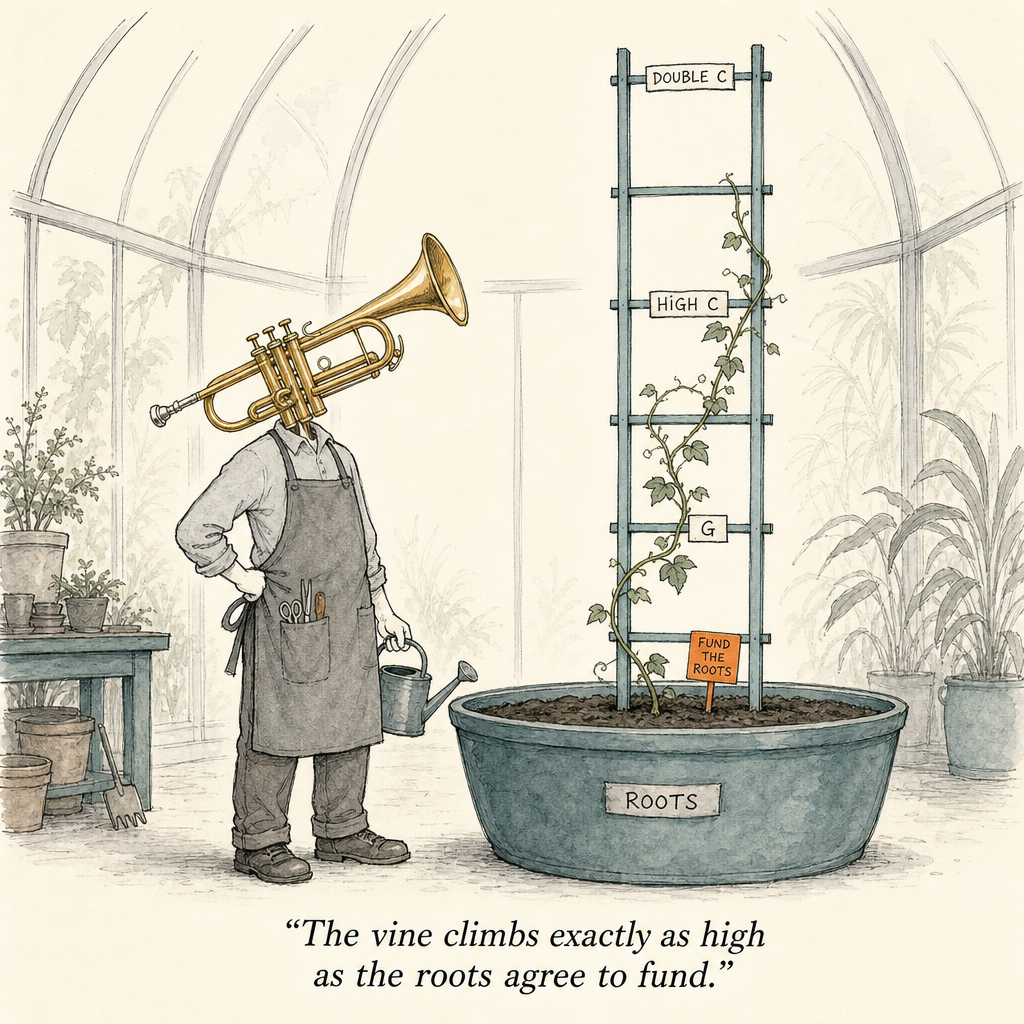
The alternative is strategic overload, and the tool is the range pyramid. You take your honest base note from the last section, and you distribute your range practice time like this:
- Foundation, 60 to 70 percent of your range time. Everything up to your base note. Completely comfortable territory. This is where you refine tone, dynamics, articulation, and endurance.
- Development, 20 to 25 percent. The next half step or two above your base. Very good notes that take slight effort. This is where consistency gets built.
- Challenge, 10 to 15 percent. A half step or two above that. Noticeably harder, achievable with good form when you’re fresh. Quality over quantity, short focused visits.
- Limit, 2 to 5 percent. Your current ceiling. Very taxing, maximum precision required, touched only when you’re completely fresh.
- Beyond, 0 percent. The notes above your ceiling. Zero. Do not practice them. They will wreck your form, drain your tank, and derail the entire session.
In a 60-minute range session, that’s 35 to 40 minutes in the foundation, 12 to 15 in development, 6 to 9 in challenge, and one to three minutes, total, at your limit. If you don’t have 60 minutes, shrink the session and keep the ratio.
Look at those numbers again, because they offend everything the high-note-hungry part of your brain believes. Two-thirds of your range practice happens on notes you already own. This is not me being conservative. This is how every endurance athlete on earth trains. Elite marathoners run the overwhelming majority of their miles at an easy pace and only a sliver at race pace, and they are the fastest distance runners in human history. The foundation work is not what you do instead of building range. The foundation work is what builds the range. You cannot pour a 50th floor onto a building whose lower floors are cracked.
And the small percentages at the top matter just as much as the big one at the bottom, because too many high notes is poison. Too few and there’s no stimulus to adapt to. Too many and you get fatigue, form breakdown, reinforced bad habits, and injury risk. The pyramid is the Goldilocks dose: enough exposure to your ceiling to force adaptation, never so much that the adaptation turns destructive.
You know that little voice that says “just a couple of high notes, what could it hurt?” You sure about that? If you have to ask, you already know.
Here’s the payoff, and it’s the part that makes the discipline worth it. The pyramid moves. When your development notes pass the base criteria for two solid weeks, the whole structure shifts up a half step. The note that used to be your challenge becomes development. The note that used to be your limit becomes your challenge. The B flat that used to be your ceiling quietly becomes part of your warm-up. That’s what building range actually looks like: not one heroic leap, but the entire pyramid ratcheting upward, half step by half step, on a foundation that never cracks.
The Exercises That Build the Pyramid
Notice everything we’ve covered so far and everything we haven’t. No secret exercise. That’s on purpose, because the exercise matters less than how you use it. But the pyramid does need building materials, and four families of exercises do most of the work.
Lip slurs are the range builder’s bread and butter, because they force the tongue, air, and aperture to coordinate through the partials without the tongue-stroke hiding sloppy transitions. They’re also your tongue-position diagnostic: slur upward and notice whether your tongue rises the way it does when you whistle. The complete progression, from beginner patterns to burners, is here: lip slurs for trumpet.
Long tones are where your foundation gets poured. Sixty-plus percent of your range time lives in comfortable territory, and long tones are how that territory becomes bulletproof: tone, response, air control, and the quiet embouchure stability that everything higher stands on. They’re deceptively simple and almost universally done wrong. Here’s how to do them right: long tones for trumpet.
Overtone exercises live in the development and challenge zones. Riding the harmonic series teaches your chops where the notes slot without you muscling between them, and they build the resonance that makes upper register notes ring instead of squeak. Full guide: trumpet overtone exercises.
Pedal tones are the secret weapon, and they should be your best friend. Why? Because of everything we established at the start: we overdo it, we jam the horn into our faces, and it burns into the nervous system. Pedal tones counteract that. Down in the basement you physically cannot muscle the note. You’re forced to relax, balance the embouchure, and let air do the work, which is precisely the pattern that dissolves the protective reflex. The old James Stamp approach, starting on middle C and working down chromatically to pedal C, is one of the best recovery and rebalancing tools in existence. And you still have to keep a real embouchure while you do it. You can’t just collapse into fuzz and junk. Nobody wants that. The full case is here: pedal tones on trumpet.
Whatever exercise you’re on, one rule governs all of them: practice your high notes soft.
If you can’t bench 135 pounds, would you load up 205? Of course not. Yet trumpet players do exactly that every day, barely able to get a high C out and trying to play it as loud as possible. Volume is not where you work. Think of a high note like a golf swing. You can swing as hard as you want, but if you miss the ball, you’ve missed the objective. So you groove the swing slowly first, every step completed, and add power only after contact is automatic.
Playing softly does the same thing, and it comes with a bonus: reps. Play your high notes as loud as you can and you get maybe five attempts before you’re cooked. Play them softly and you can rack up rep after rep after rep. Finding a high note is like cracking a safe. There’s a combination in there, some exact arrangement of tongue, abs, and aperture, and you need as many chances as possible to find it. Soft playing buys you those chances. And somewhere along the way you’ll discover the thing every player discovers: the notes were never as hard as you were making them. Then, and only then, you open up the sound.
Light, Medium, Heavy: Periodizing Your Range Work
The pyramid tells you how to distribute practice within a session. But range is built across weeks, not sessions, and this is where most self-taught range programs quietly fall apart. Players find an approach that works and then run it at maximum intensity every single day, which is the training equivalent of beating a dead horse. Worse, when the horse starts coming back to life, they beat it again. You will not win against Mother Nature. Your chops adapt during recovery, not during playing. Skip the recovery and you’ve skipped the improvement.
So we borrow periodization straight from athletics, and we rate every practice day Light, Medium, or Heavy.
A Light day sits around a 3 or 4 out of 10 in effort. Foundation-zone playing, easy fundamentals, pedal tones, soft long tones. A Medium day, 5 or 6, is your default: normal skill work with visits to the challenge zone. A Heavy day, 7 or 8, is where you carefully venture into limit-zone territory. The full system, and how to plan a week with it, is here: light, medium, heavy trumpet training.
The rule that ties periodization to the pyramid is simple: limit work happens only on Heavy days, and only when you’re absolutely fresh. This is a trumpet public service announcement. Instead of getting all tired and trying to squeak high notes past the finish line, stop doing that. Play near the max of your range only when you’re fresh, three to five reps, with two to three minutes of rest in between. You’re trying to reach a new level of energy and power, and you cannot get there with nothing in the tank. Would you work on your sprint speed on exhausted legs? What sense does that make? Sprinters recover fully between efforts because the entire point is quality at maximum output. Your top notes are sprints. Treat them like it.
For everything below the limit, think of your endurance like a stamina bar in a video game. Let it hit the red and you lose: staggered, done for the day, maybe done for two or three days. So don’t let it go red. The moment you feel yourself getting near the edge, take the horn off your face or back way off. Better yet, spend most of your time in the middle of the bar, playing at 60 or 70 percent, where the meter barely moves. Do that consistently and the meter itself grows. Your old 80 percent becomes your new 70. That’s the entire stamina game, and I’ve built it out fully in how to build trumpet stamina.
One more thing, because it confuses everyone at first: your range shrinking when you’re tired is not your range failing. A tired high C and a fresh high C are two different notes played by two different bodies, and judging your ceiling at the end of a long day tells you nothing except that you’re human. Why that happens, and what tired range is actually telling you, is here: why your range disappears when you’re tired.
How Long Does This Actually Take?
Let’s talk timelines, because this is where the fantasy dies and the progress starts.
The unit of range progress is the half step, and the pyramid tells you exactly what earning one looks like: the next note above your base has to pass the full base criteria, nine out of ten, from anywhere, at any dynamic, even when you’re not fresh, for two solid weeks. For most dedicated adult players practicing consistently, that’s a matter of weeks to a couple of months per half step. Not days. Also not years, unless your practice is chaos.
I know that sounds slow if you’re used to YouTube titles promising an octave by Friday. But run the math the other direction. A half step every six to eight weeks is most of an octave in a year, on a foundation that holds up under pressure, at the end of gigs, in front of people. Meanwhile the reckless leaper spends that same year in a loop of overreach, blown chops, forced rest, and starting over. Small improvements, stacked consistently, explode in a surprisingly short amount of time. Slow is smooth, smooth is fast.
There are signs you’re ready to shift the pyramid up: the notes above your base feel easier than they used to, the new note shows up reliably in actual music, and using it regularly doesn’t cost you extra fatigue. And there are signs you jumped early: forcing a timeline, trading quality for altitude, rising fatigue, and previously solid notes going wobbly. When in doubt, wait the extra week. The pyramid punishes impatience and pays compound interest on discipline.
You can even feel the progression in your warm-up. If you normally start on second-line C, start a half step higher this week, and a half step above that in a few days. Done methodically, you’ll find you don’t need to spend all day in the gutter before you can move upstairs, and your access to the upper register stops depending on hour-long warm-up rituals. The complete honest-numbers breakdown, including what to expect at different practice volumes, is here: how long does it take to add a half step to your range?
The System, Not the Secret
Here’s everything in one breath.
Your range fails because pressure and the protective reflex stop your lips from vibrating, not because you’re weak. A high note is fast air meeting an efficient embouchure, and the fast air comes from good compression: tongue, abs, aperture, and the inside of your mouth, never the throat, never the mouthpiece jammed into your face. You find your honest base note, the one you’d bet on gun-to-your-head, and you build a pyramid on it: 60 to 70 percent foundation, 20 to 25 development, 10 to 15 challenge, 2 to 5 limit, and zero, always zero, beyond. You build it with lip slurs, long tones, overtones, and pedal tones, played soft before loud. You spread the work across Light, Medium, and Heavy days, touch your ceiling only when you’re fresh, and you move the whole structure up a half step at a time.
That’s how to increase trumpet range. Not a secret. A system. And systems don’t care about talent or luck. They care whether you show up and run them.
The Fastest Way Through This
You could piece this system together yourself from the articles above, and if that’s your path, take it. Everything you need is there. But if you’d rather see the whole thing assembled in one sitting, I put together a free 30-minute training that walks through exactly how I teach this system inside the 1% Trumpet Program: the pyramid, the compression sources, the periodization, and how they fit together into a daily practice you can actually run. It’s the map plus the route, in half an hour instead of half a year of trial and error.
Watch the free 30-minute training here and start building range that’s still there at the end of the gig.