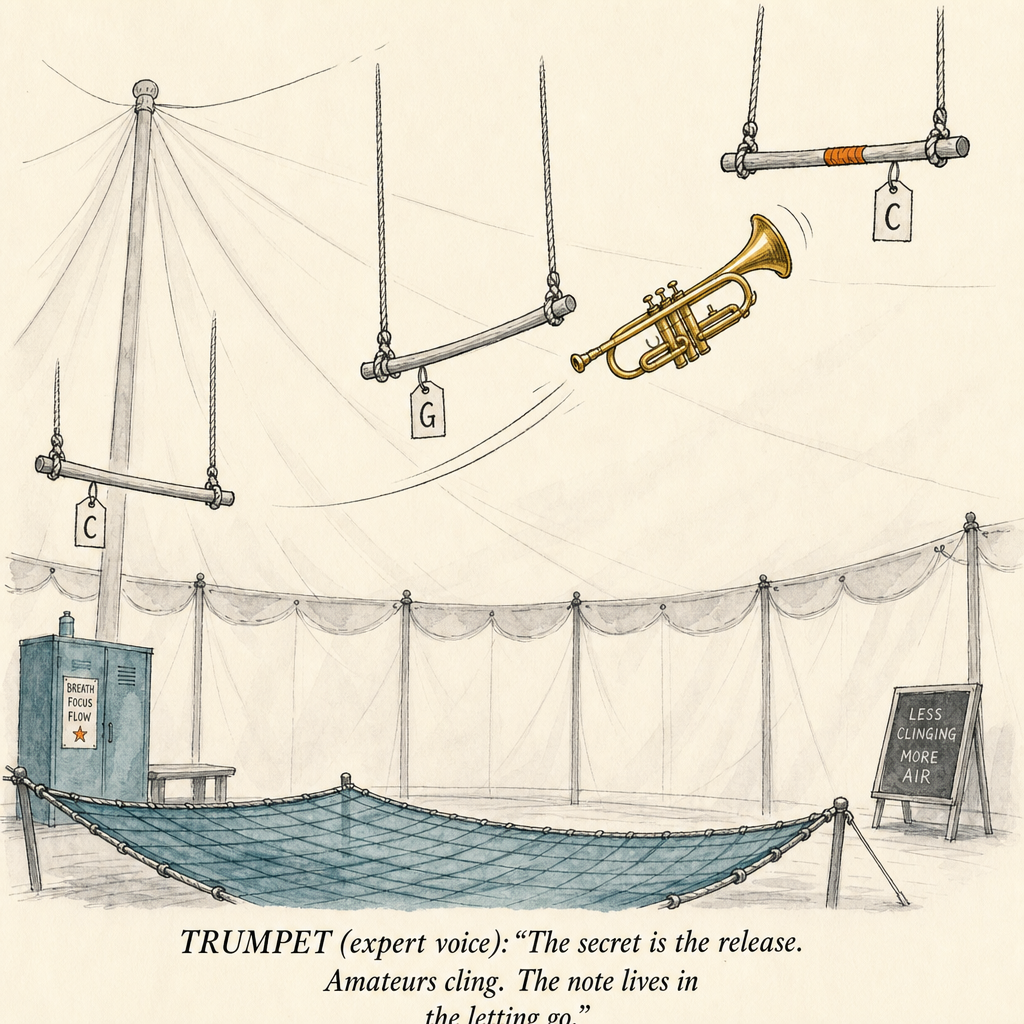
A trumpet lip slur connects notes on the same valve combination without tonguing between them. Start with an easy two-note pattern, listen for one connected sound, and stop before you need extra pressure to make the change.
Start the progression | Technique | Daily routine | Troubleshooting | Questions
Lip slur exercises for trumpet: the complete progression
Here’s the progression, four levels deep. For Levels 1 through 3, start on open valves, then repeat the pattern down through the valve combinations (2, 1, 1-2, 2-3, 1-3, 1-2-3), which walks the whole exercise down chromatically. Metronome on. Soft. Set for the top note every time.
Level 1: Two-note slurs. Start on second-line G, slur down to low C, and slur back up. Four slow beats per note. That’s it. This looks insultingly easy, and that’s the point. You’re not training strength here, you’re drawing the map: feeling exactly what the tongue and air do to move between two partials with zero valve help. If you can’t make this shift smooth, clean, and identical ten times in a row, you have no business at Level 3.
Level 2: Three-note slurs. Low C up to G, up to third-space C, and back down. Two beats per note. The added partial forces your setup rule to earn its keep: you must be set for the top C before the low C ever sounds. Listen for the telltale bump or bulge as you cross each partial. A clean slur sounds like one connected sound that happens to change pitch, not three notes stapled together.
Level 3: Expanding range. Extend the same open-valve sequence only as the notes become comfortable: low C (C4), second-line G (G4), third-space C (C5), top-space E (E5), G above the staff (G5), and back down. One beat per note, still soft. This is where the pyramid rules below become non-negotiable, because the top of this pattern is real range work now. If the top note only speaks when you mash, it’s not ready to be in the pattern. Cap the exercise at the highest note you can slur to cleanly and softly, and be patient about promoting new notes into it.
Level 4: Speed and lip trills. Use two adjacent comfortable partials on one fixed valve combination and gradually accelerate the alternation until it becomes a trill. Do not assume any two neighboring written notes form a same-fingering lip trill; confirm the fingering and partials first. Speed tests your flexibility: when the alternation locks up, slow down and recover clean coordination before accelerating again. If the trill locks up, you’ve found the exact tempo where your coordination breaks. Train just below it.
Progress through these levels the same way you’d load a barbell: earn the next plate. That’s progressive overload, and it applies to flexibility exactly the way it applies to strength.
These are written pitches for B-flat trumpet. In the first pattern, second-line G is G4 and low C is C4. Tongue the first note once, then connect the remaining notes without a new tongue attack. Put the horn down between repetitions; this is not a continuous-playing challenge. Start with Level 1 if you are rebuilding after a break.
What a lip slur actually trains
A lip slur is deceptively simple: you move between notes on the same valve combination without tonguing. No valves changing, no articulation to hide behind. You are practising the coordination of air, tongue position and the vibrating lip opening, rather than using a valve change or new tongue attack to move between notes.
That’s the whole secret. A lip slur is a range rep with the training wheels removed.
When you slur from a G up to a C, I coach tongue position, supported air and aperture together. Use those as coordination cues, then check whether the transition actually sounds connected and feels easier. That’s the exact coordination a high note demands, rehearsed in a register where you can afford to pay attention.
And here’s the diagnostic power: do some slow lip slurs right now and notice what your tongue is doing. Really sit there and feel it. If the transition feels forced, explore tongue position as one possible lever. Not feeling a movement is not, by itself, a diagnosis of your range problem. The tongue is one of the primary ways to speed up the air, and slurs are the test that reveals whether yours is participating. I’ve broken down the full mechanics of that lever in the tongue position article, and its high-register application in tongue position for high notes.
If your slurs feel like a fight, it’s usually because one of those three good compression sources is asleep and something bad has volunteered to cover the shift: mouthpiece pressure, throat squeeze, or lip pinch. The slur doesn’t create that problem. It exposes it. That’s a gift.
Rule one: set up for the top note
Use these two rules with the progression above: clear setup first, then clean repetitions.
Have you ever done a slur that climbs from low to high, and the top note just fizzles out? Here’s why. You were set up for the bottom note, and you tried to adjust your way up. Every partial along the way was a mid-air renovation, and by the time you reached the top, something had drifted.
Now notice that the same slur descending feels easy. Same notes, just flipped. That’s because starting high means you were already set for the top.
So flip the logic on your ascending slurs. Set up for the top note of the pattern before you play the bottom one. If the slur runs from low C up to third-space C, be set for that top C from the very first note: tongue, air, and aperture already living where the high note lives. The bottom notes will still speak. Low notes are forgiving like that. But now the climb is a release instead of a scramble.
This one adjustment transforms slurs from note-roulette into actual training.
Rule two: technique first, power second
Think of a slur like a golf swing. You can swing the club as hard as you want, but if you miss the ball, you’ve missed the objective. Slurs are the same. All the air in the world means nothing if the coordination isn’t there.
So you build it the way you’d build a golf swing: slowly and softly, making sure every step is completed, and only then adding power. Play your slurs at an easy volume. Find the top note soft and make it comfortable. Know where the tongue is, where the embouchure is, what the abs are doing. Once those positions are conscious and repeatable, then you add speed and volume.
Most players run this in reverse. They blast their slurs at forte, miss half the top notes, and call it flexibility training. That’s not training. That’s rehearsing your misses at high volume.
Where slurs live in your range pyramid
Now, dosage. Because even a perfect exercise becomes poison at the wrong dose.
I teach range through a pyramid: most of your work stays in the foundation, where notes are completely comfortable. Smaller amounts go to development and challenge territory, with only brief visits to your true limit and no work beyond it. See the complete range guide for the wider system.
Your slur practice should mirror that distribution. The overwhelming majority of your slur reps happen in patterns you find easy, refining smoothness, evenness, and tone. A modest slice pushes into patterns that take real focus. A sliver touches your ceiling, and only when you’re fresh.
Most players invert the pyramid. They treat the flexibility book like a video game, racing to the highest page they can survive, spending all their time on the two exercises they can barely play. Then they wonder why their slurs never get smoother and their chops are always trashed. The exercises they can already do are where the quality gets built. The monster pages are a progress test you visit occasionally, not a residence.
The mistakes that turn slurs into damage
Three ways players take the best exercise on the horn and turn it into a liability.
Mashing through the shifts. When the upper note won’t speak, the hand wants to help by pulling the horn into the face. Now you’re not training flexibility, you’re training the mouthpiece pressure trap with a metronome. The moment pressure becomes the thing moving the pitch, stop, drop a level, and get the tongue and air doing the work again.
Squeezing instead of arching. As the pattern climbs, the throat wants to close and the lips want to pinch. Both kill the vibration you’re trying to speed up. If your sound thins out and your neck tightens on the way up, you’ve swapped good compression for bad. Softer, lower, slower until the shift happens without the squeeze.
Slurring on a dead tank. Flexibility work demands fine motor control, and fine motor control is the first thing fatigue steals. Slurs belong early in your session, while the coordination is sharp. Ten focused minutes fresh beats thirty sloppy minutes tired, every single time.
A simple daily slur routine
Here is an optional ten-minute elapsed-time template, including horn-down recovery between repetitions. It is not ten uninterrupted minutes of blowing. Shorten it to match your current capacity, and use the daily-practice guide to fit it into your session.
Minutes one through six: Level 1 and Level 2 patterns through all seven valve combinations, soft, slow, tongue awake, set for the top note on every rep. This is your foundation work, and it should feel almost boring. Boring is the sound of quality accumulating.
Minutes seven through nine: one Level 3 pattern, capped at your highest clean-and-soft note. Two or three quality reps per valve combination. The instant quality drops, you’re done with this block.
Minute ten: if you’re fresh and it’s a heavier practice day, one or two touches of a Level 4 trill or a pattern one notch above your cap. If you’re tired, skip it entirely and end on something easy. Nothing is lost by skipping the top. Plenty is lost by forcing it.
Track the same comfortable pattern under the same conditions: are transitions more connected, response more reliable and pressure no higher? Those are better progress checks than a promised result after a fixed number of days. And if you want to understand why the top notes fizzle in the first place, read why you can’t play high notes on trumpet next. The two articles are halves of one answer.
Lip slur questions
How is a lip slur different from a valve slur?
A lip slur changes between notes available on the same fingering. A valve slur connects notes while the fingering changes. Both can be legato, but they ask different things of your coordination.
What should I do when a note cracks?
Slow down, use an easier interval and an easy volume, then retest. Listen for a connected sound instead of forcing the top note. If you cannot recover a comfortable response, end the block rather than collecting more misses.
When should I move to the next level?
When the current pattern is repeatably connected, soft and comfortable without extra pressure. Speed and range are options you earn, not boxes you must tick today.
Should lip slurs hurt?
No. Stop for pain or persistent physical symptoms. Get qualified advice rather than trying to practise through them. Returning players should build workload gradually; BAPAM has return-to-playing guidance for musicians recovering from time away or injury.
Get the whole system, not just the exercise
Lip slurs are one tool in a complete range-building system, and the sequencing matters as much as the exercises. In 1% Trumpet coaching, I teach exactly how to fit slurs, long tones, and range reps into a week that builds instead of burns. I walk through the core of that system in the free training.
Watch the free training and stop guessing at the dosage. The exercise was never the problem. The system around it was.
– Jesse