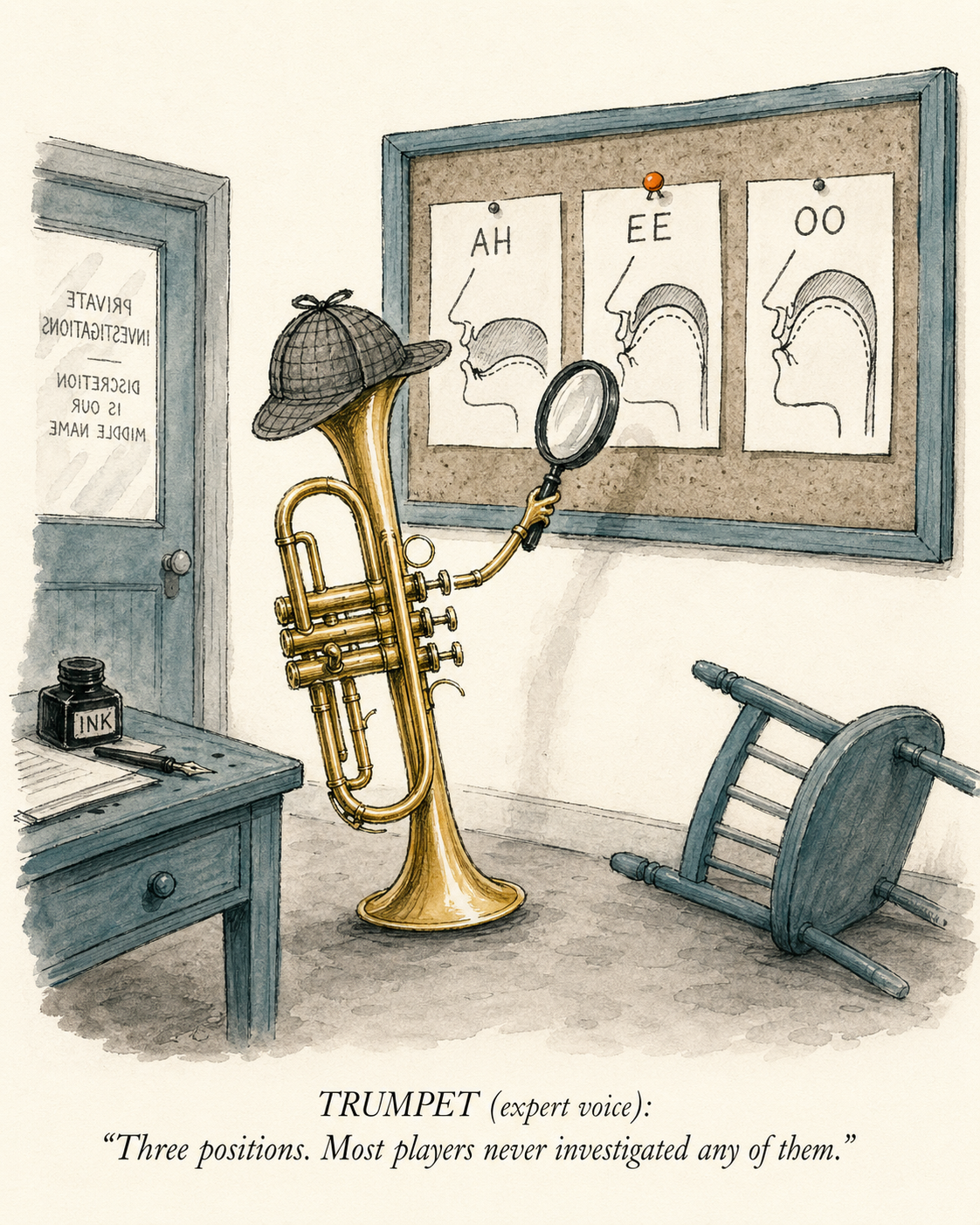
If you only learn one thing about tongue position trumpet endurance I’ve ever written, learn this: your tongue is the single most powerful efficiency lever you’re probably not using.
Most trumpet players think the tongue is something you only think about for articulation. You “tah” or “dah” or “doo” to start a note, and after that the tongue just sits there. That’s the picture almost every player carries around in their head, and it’s costing them years of their playing life.
Because while your tongue is sitting there doing nothing, it could be doing the work that your lips and the mouthpiece are currently grinding themselves into the dirt to do. It could be producing compression for free. It could be unlocking your upper register without a single extra ounce of effort. It could be doubling your endurance.
This is the cheat code. Once you see it, you can’t unsee it.
The Whistling Test for Tongue Position Trumpet Endurance (Find Out Right Now if You Have a Tongue Problem)
Before we go anywhere else, do this. Whistle a low note. Now slide that whistle as high as you can go. Then slide it back down. A whistle glissando, low to high to low.
Pay attention to what your tongue did. It moved. It arched up to climb the pitch and dropped back down to descend. Your lips barely changed. The tongue did almost all the work.
That motion is the same motion you need on trumpet. Tongue arch, cavity shape, airstream control. The mechanism is identical. The only difference is that on the horn there’s a buzzing seal in front of your face, but the engine driving the pitch upward is the same engine that drives a whistle upward.
Now the diagnostic part. If you can’t whistle at all, or if you can whistle but you have no idea what your tongue just did, that tells you something important. You don’t know how to use your tongue when you play. That’s why you have a range problem. That’s why you have an efficiency problem. That’s why you have an endurance problem. The tool was never online.
This is also why whistling is one of the best in-between exercises in trumpet practice. When you’re stuck on the horn and can’t feel what’s happening, the cognitive load is too high. There’s too much going on. Take the trumpet out of the picture. Whistle the same shape, the same slide, the same motion. Feel the tongue move. Then go back to the horn and try to do the same thing with the buzz on top.
Whistling is the off-horn diagnostic. It’s free. You can do it anywhere. And if you can’t do it, you’ve found your bottleneck.
What “Tongue Position” Actually Means
When trumpet teachers say “use your tongue,” players nod and have no idea what to do. So let’s get concrete.
Tongue position on trumpet is described in vowel shapes. The vowel you make in your mouth determines where your tongue sits and how much space is in your oral cavity. Four vowels do almost all the work.
AH. Tongue is low and flat. Mouth is open. Big oral cavity. This is the position for your low register and pedal tones.
EH or AY. Tongue starts to rise toward the middle of the mouth. Cavity gets smaller. This is your middle register, the meat of where most trumpet music lives.
EE. Tongue is arched up high, close to the roof of your mouth. Cavity is small and narrow. This is your upper register, the top of the staff and above.
HISS or SSS. Tongue is so close to the roof of the mouth that you could almost hear air whistling through. Cavity is tiny. This is your screamer range, the stuff above high C.
Notice the pattern. As you go higher, the tongue rises and the cavity shrinks. This is not a coincidence and it is not optional. It’s physics.
Why a Smaller Cavity Equals a Faster Air Stream
Think about a recorder. Or a tin whistle. Or any wind instrument where the player’s mouth is part of the resonating chamber. On those instruments, the shape of the air column inside the body of the instrument determines the pitch. Change the column length, change the pitch. The instrument is built around that physics.
On trumpet, the air column is partly the horn and partly you. Your oral cavity is acoustic real estate. Your tongue is what reshapes it. When you arch the tongue up, you shorten and narrow the column on your side, the air has to move through a smaller space, and it accelerates. Faster air vibrates the lips at a higher frequency. Higher frequency equals higher pitch.
This is the same reason whistling works. When you whistled that slide a minute ago, your tongue raised and lowered the air column inside your mouth, and the whistle followed. The trumpet is the same physics with a buzzing source bolted to the front. The lips are the buzzing source, but the tongue is what shapes the buzz into a usable pitch. Every great high note player you’ve ever heard is using this. They might not be able to explain it. But it’s happening.
The Tongue Is “Free Compression”
Here’s the part that should change how you think about every practice session for the rest of your life.
In the Compression Sources framework I teach in my program, there are good sources of compression and bad sources. Bad sources are the ones that wreck you over time. Mouthpiece pressure, throat closure, lip pinching. They produce compression in the short term and they grind your tissue in the long term.
Good sources don’t have that cost. The big three are tongue, abdominal engagement, and aperture control.
Tongue is the headliner. Here’s why.
Your lips are tissue. They fatigue. Every minute you play, you’re spending lip endurance, and at some point that bank account hits zero. That’s when chops go from tired to done, and when they’re done, you’re done.
The tongue is different. It’s a different kind of muscle, and the way you use it on trumpet is more like holding a position than working a rep. The tongue does not fatigue from playing trumpet the way the lips do. You can hold an arched tongue position for hours. You can hold it during a two-hour gig. You can hold it through a marathon big band rehearsal. It just sits there and does its job.
So when you build a note from tongue compression instead of lip pressure, you’re paying for that note with currency you have unlimited supply of, instead of currency that runs out at minute thirty. That’s why I call the tongue free compression. The bill never comes due.
Now stack that against what most trumpet players actually do. They don’t use the tongue. They blow harder, press the mouthpiece harder, close the throat tighter, pinch the lips smaller. Every one of those is a withdrawal from the lip-tissue bank account. Every one is a payment they’ll regret tomorrow.
Same high note. Wildly different cost.
Why Tongue Position Helps With Pitch Slotting
There’s a second benefit to tongue position that almost nobody talks about, and it’s huge for endurance. The right tongue position makes notes slot.
Slotting is what trumpet players call it when a note locks in cleanly to the harmonic series. Bad slotting feels like the note is fighting you, drifting flat or sharp, splitting between two partials. Good slotting feels like the note is sitting in a groove that was carved for it.
Think about a speaker enclosure. The cabinet around the speaker shapes the sound more than the cone itself. A perfectly good driver in the wrong-shaped box sounds bad. The same driver in the right-shaped box sounds incredible. The cabinet is doing acoustic work that the cone alone can’t do.
Your oral cavity is the cabinet. Your lips are the driver. When the cabinet is shaped correctly for the pitch you’re playing, the note resonates and slots. When the cabinet is the wrong shape, the lips have to fight to make the pitch happen, and you eat lip endurance trying to muscle a note into a slot that the cavity is working against.
This is why two players can both have “good chops” and one of them can play for two hours while the other dies at thirty minutes. Same lips. Different cabinet management. The efficient player is letting the oral cavity do most of the slotting work. The grinder is forcing the lips to do work that should have been free.
Why Comfort Is the Real Solution (Not the Range Pyramid)
Here’s where most players get this wrong. They read an article like this and immediately try to feel their tongue while screaming top-of-the-staff Gs. That’s the worst possible place to learn this.
You can’t notice form when you’re at peak limits. If you’re working really hard, you don’t have time to think about form. Every ounce of available attention is going into not falling apart. The tongue is one variable in a system that’s already overwhelmed, and the brain’s response to overwhelm is to revert to the worst habits, the ones that are most automatic.
So the real solution isn’t “go to the top of your range and force the tongue to do something different.” The real solution is comfort. You have to be playing in a place where you have spare cognitive capacity. Where the lips aren’t on fire. Where you’re not white-knuckling the next note. That’s the only place tongue awareness can take root.
This is why I teach the Range Pyramid the way I do. Not because the pyramid is the solution, but because the pyramid keeps you in zones where you have enough comfort to notice what’s happening. Tongue work belongs in your easy register first. Build the awareness there. Make the motion automatic. Then carry it upward when the foundation is honest.
Players who try to learn tongue arch by ripping double Cs are skipping every step that actually teaches the body what to do. Efficiency lives in the comfortable zone. Build it there first.
The Practical Drill: Lip Slurs, Lip Trills, and Whistling
Reading about tongue position is useless. Feeling it is everything. There are two drills that actually teach the body what to do, one on the horn and one off it.
On the horn: lip slurs and lip trills. Slurs and trills are the in-horn way to feel the tongue move fast, because the only way to make them work is to let the tongue do the lifting. Pick a slur inside your comfortable range. Low C to G to C and back. Or G to C and back. Something easy.
Round one. Play the slur with no conscious tongue movement. Keep your tongue parked in one position. AH the entire slur. Notice what your lips have to do. Notice what your air has to do. Notice the effort.
Round two. Play the same slur, same tempo, same dynamic. But this time, deliberately change the vowel as you ascend. AH on the bottom note, EH in the middle, EE on the top. As you come back down, reverse the vowels. Let the tongue do the lifting.
Then push it into a lip trill. A trill is a slur fast enough that the lip alone can’t keep up. The tongue has to flicker. If you’ve ever wondered why some players have effortless trills and others can’t trill to save their life, this is why. The trillable players are using the tongue. The grinders are trying to flap their lips.
Off the horn: whistling slides. When the trumpet is too hard or you’re too tired or you can’t feel anything because everything is overloaded, take the horn out. Whistle the same shape you were just trying to play. Slide low to high. Feel the tongue. Then put the horn back in and try to recreate the feeling with the buzz on top.
Whistling is the cheat behind the cheat code. It strips out the cognitive load of playing and leaves you alone with the one variable that matters: what’s the tongue doing? If you can’t make the whistle work, you can’t make the trumpet work. The whistle is honest in a way the trumpet isn’t, because the trumpet has too many other moving parts to hide behind.
Use both. Lip slurs and lip trills on the horn. Whistling slides off the horn. Together, they give you a feedback loop most trumpet players never set up.
Common Mistakes When Players First Try Tongue Arch
Two warnings, because every player I’ve taught this to has tried to break it the same way.
Mistake one: tensing the jaw. When you arch the tongue, the jaw stays relaxed. You are not biting down. You are not clenching. The tongue lifts independently of the jaw. If you’re locking your jaw to get the tongue up, you’re trading good compression for tension, and tension is one of the bad sources we’re trying to leave behind.
Mistake two: closing the throat. The tongue arches, but the back of the throat stays open. If you feel like you’re swallowing or choking the airflow, you’ve gone too far and you’re now using throat closure (a bad source) instead of tongue position (a good source). The air should still move freely through the back of the mouth. Compression should always come from arrangement, not constriction.
If both of those are right and the tongue is doing real work, you’ll feel like the horn is suddenly giving things to you for free. That’s the right feeling. Trust it.
How to Build This Into Your Practice
You don’t need a separate “tongue routine.” That’s not how this works. Tongue awareness gets built in by adding one question to every exercise you already do. What is my tongue doing right now?
Lip slurs: am I changing vowels as I ascend? Lip trills: is the tongue actually flickering, or am I trying to lip-flap my way through? Long tones: is my tongue staying in the right position for the pitch I’m holding? Range work: when I push toward the top of the pyramid, is the cavity shrinking to support it, or am I trying to muscle the lips into doing the cavity’s job? Articulation studies: after I tongue the note, where does my tongue land?
Apply the 2:1 ratio here too. When you catch yourself blowing a note with the wrong tongue position, fix it twice. Play that note again with the right vowel. Then once more, clean. Move on. That’s how you build the muscle memory until tongue arch happens on its own.
And keep whistling. In the car. Walking the dog. Doing dishes. Whistle slides. Whistle the line you’re working on. Whistle the high note you couldn’t get this morning. The motion is free reps for the muscle that matters most.
Give it two to four weeks of conscious focus and the awareness becomes automatic. Six months in and you’ll wonder how you ever played without it.
Why This Is the Single Highest-Leverage Lever You Have
Most of the things we work on in the 1% Trumpet Program take real time to build. Building chops as a trained athlete is a months-long process. Progressive overload is slow by design. Recovery and periodization unfold over weeks. None of it is a quick fix.
Tongue position is the closest thing to a quick fix that exists on trumpet. Not because the work is easy. The awareness still has to be built, and the muscle memory still has to be earned. But the lever is so massive that even partial implementation gives you a noticeable lift inside one practice session. You feel it the first day. You feel it more the second day. By the end of a week you can already play things you couldn’t play a week ago.
That doesn’t happen with most trumpet work. Range usually takes months. Endurance usually takes months. But tongue arch, applied honestly, gives you something you can feel in an afternoon. That’s why I call it the cheat code. It’s the lever the instrument was designed around, and most players are leaving it on the table their entire careers.
Pick it up. Use it. The chops you save are your own.
Tested Patterns vs Scattered Opinions
Here’s the part that’s worth saying out loud, because it’s the reason most players are stuck on this in the first place.
You’ve probably been told contradictory things about your tongue by different teachers. One teacher tells you to keep the tongue low and let the air do the work. The next teacher tells you to arch the tongue aggressively. A third teacher says don’t think about the tongue at all. A fourth tells you to think about hot soup, or a high “EE,” or arching toward an imaginary point above the soft palate. By year three you’ve collected six contradictory opinions and you don’t know which one to trust.
Most of the time that contradiction isn’t because anyone is lying. It’s because each of those teachers has only worked with their own narrow set of bodies. Their advice worked on the few dozen students they’ve taught, and so they generalized it into a rule. But your body isn’t the body their rule was built on. So the rule fails on you, and you blame yourself.
The difference between an opinion and a system is bodies. How many bodies has the method been tested on? How many ages? How many starting points? How many failure modes? A single teacher’s lifetime of students is one data set. A coaching system that’s been pressure-tested across hundreds of trumpet players, across every age and ability, across every imaginable starting condition, is a different kind of artifact. It’s not a louder opinion. It’s a tested pattern.
That’s the gap I’m trying to close for the players in my program. Not “here’s my opinion about tongue arch.” But “here’s the pattern we’ve seen work across this many bodies, and here’s how we adjust it for your specific one.” Tested patterns brought to your situation, not generic theory shouted from a podium.
If you’ve spent years jumping between contradictory advice and getting nowhere, that’s not a you problem. That’s an information environment problem. The fix isn’t more opinions. The fix is a system that’s already absorbed the contradictions and built around what survives.
I run a free 30-minute training that walks through the framework I use with every player in the program. It’s the version that’s been refined across hundreds of bodies, not the version that worked on the four students one teacher happened to have. If you want the tested-pattern version of trumpet endurance instead of one more scattered opinion, you can grab the training here: toot-your-own-horn.com/landing-page.
If you already know the program is what you’ve been looking for, book a strategy call. We’ll look at where your tongue (and your endurance, and your range) actually is right now, what’s broken, and whether the program is a fit. No script, no pressure, just a real conversation about the chops you want and how to get there.
Where to Go Next
Tongue position is one of the four good compression sources, and it’s the one I lead with because it’s the highest-leverage. To see how it fits into the bigger endurance system, start with the full trumpet endurance guide. To see what to stop doing while you’re learning to use the tongue, read the mouthpiece pressure trap. To go deeper into how compression actually works, see air compression vs pressure.
The tongue is right there. Free compression, every note, every gig, for the rest of your playing life. Use it.
— Jesse
The tongue is free compression hiding in plain sight. Watch the free 30-minute training to see the diagnostic layer that catches tongue position trumpet endurance leaks the second they show up — instead of years later, after the damage is done.