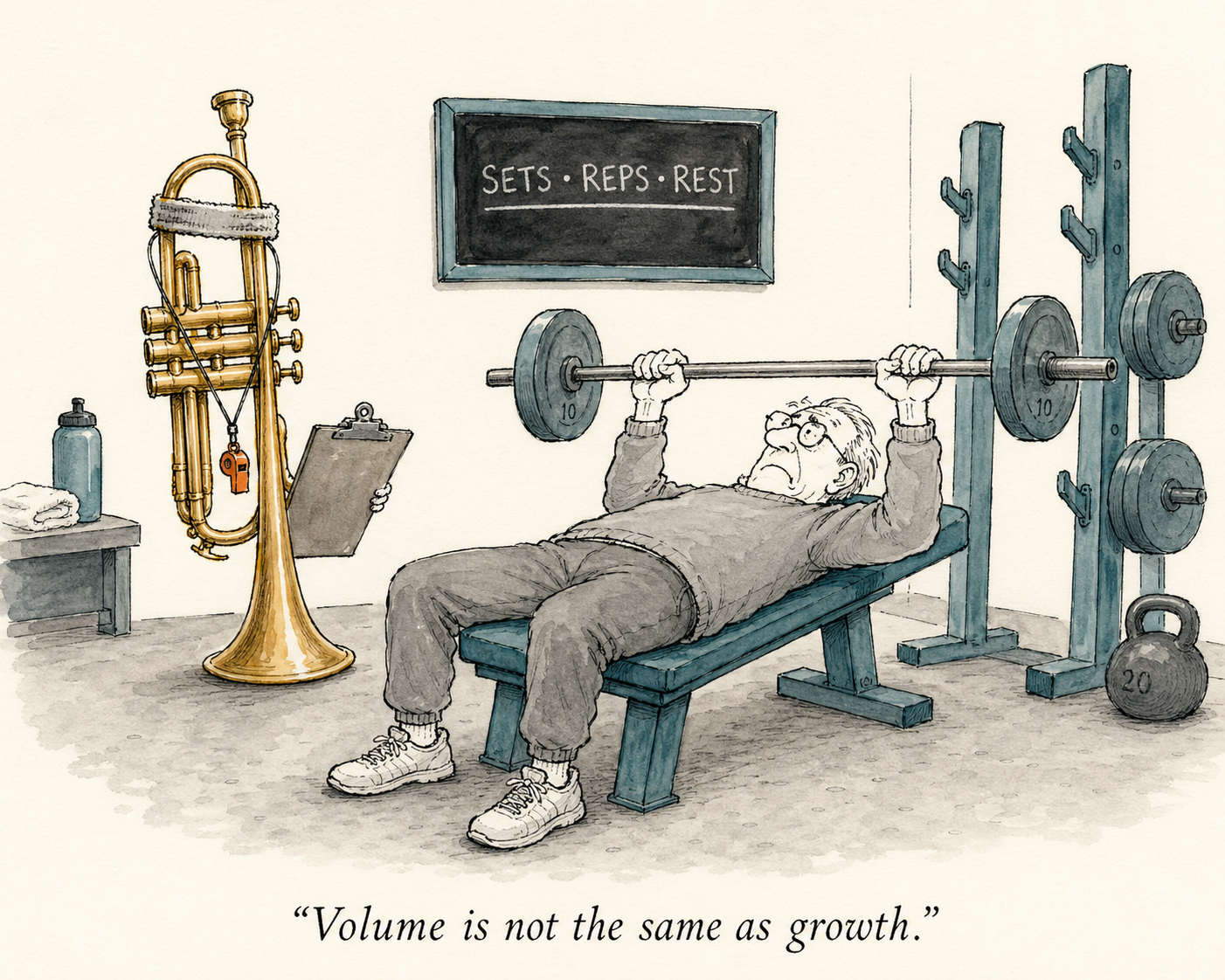
If a serious powerlifter announced their trumpet endurance gym training plan for the week was to grind the same lift for six straight hours with no rest, no progression, no plan, just keep moving the bar until their arms gave out, you’d assume they’d never set foot in a real gym.
That’s exactly how most trumpet players train endurance.
“Long tones until you can’t hold them anymore.” “Scales until your face falls off.” “Push through the wall and the wall moves.” That’s the standard advice. And it has produced exactly the kind of trumpet players you’d expect: tough, willing to grind, and stuck at the same ceiling for a decade.
Here’s the part that nobody in the trumpet world wants to admit. Your chops are muscle. They contract under load. They fatigue. They recover. They adapt. They follow every single rule that strength training has been refining for the last sixty years. The trumpet world is just two generations behind on actually applying any of it.
This article is the bridge. We’re going to translate the gym vocabulary into trumpet vocabulary, show you why volume by itself is a dead end, and set up the mental model you’ll need for the rest of the Training arc in this series. By the end, you’ll know why “more practice” hasn’t been working, and you’ll have a framework that actually does.
Trumpet Endurance Gym Training Starts Here: Chops Are Muscle. Treat Them Like Muscle.
The whole argument hinges on this. If chops aren’t muscle, the gym analogy is just a cute metaphor and you can ignore everything else I’m about to say. So let’s settle it first.
Trumpet playing is repeated, controlled muscular contraction against resistance. The orbicularis oris and the surrounding facial muscles fire to hold an aperture. The corners engage to seal the embouchure. The tongue arches to direct compression. The diaphragm and abs drive the air. Every single one of those is a muscle doing real work, and the resistance comes from the air column, the mouthpiece, and the horn itself.
That’s the textbook definition of strength training. It looks different from a bicep curl because the muscles are smaller and the load is invisible, but the underlying biology is identical. The face fatigues. The face recovers. The face adapts. And if you load it correctly, with the right ratio of stress to recovery, it gets stronger.
Once you accept that, every gym principle is on the table.
Sets, reps, volume, intensity, frequency, recovery, periodization, progressive overload. Every word that a strength coach uses is now a word you should be using about your practice. The stress principles that build any other muscle in your body apply here too. The reason this isn’t already common knowledge in the trumpet world is honestly just lag. The pedagogy was written before sports science caught up, and most teachers still teach the way they were taught.
You don’t have to.
Sets and Reps for Trumpet Players
Let’s translate the vocabulary.
In the gym, a rep is one complete execution of a movement. One squat. One row. One press. A set is a cluster of reps performed back to back, followed by rest before the next cluster.
On the horn, a rep is one phrase. One scale. One lip slur. One excerpt. One run through a single line of music. Anything that’s a discrete bit of playing followed by a moment where you could stop. A set is a cluster of those phrases performed back to back, followed by rest before the next cluster.
That’s it. That’s the whole translation. The minute you start thinking in those units, your practice changes.
Most players don’t think this way at all. They open the method book, set a 30-minute timer, and just play. There’s no concept of a set. There’s no concept of a rep. There’s no concept of rest between phrases. It’s one long, undifferentiated grind, and the chops have no idea where the work ends and the recovery begins.
Compare that to a smart lifter’s session. Three sets of eight reps. Two minutes of rest between sets. Each rep performed with intention. The lifter knows exactly what they did, exactly how their body responded, and exactly when to stop.
You can run a practice session the same way. Five reps of a phrase, played cleanly. Drop the horn. Let the face come back for ten seconds. Five more reps. Drop again. That’s two sets, and you’ll feel the difference in your face by the third one. The chops are getting trained the way a muscle wants to be trained, in clean bursts with recovery built in, not in a continuous wash of effort.
That density structure also gives you something the long-grind approach can never give you. Feedback. When every rep is a discrete unit, you can hear which one was clean and which one was off. You can fix things in real time. You can tell when set three is degrading and pull the plug before you start training bad form. That’s the kind of practice that actually moves the needle.
Volume vs Intensity (And Why You’re Probably Confusing Them)
Here’s where most trumpet players get the wheels off the rails. They have one knob in their head, and that knob is called “more.” More time, more notes, more sessions, more days. They turn the knob up and wait for endurance to show up.
It doesn’t.
The strength world solved this problem decades ago by separating the knob into two distinct variables.
Volume is how much total work you do. In the gym, that’s sets times reps times weight. On the horn, that’s roughly minutes of playing times the load on your face during those minutes. A 30-minute session at light intensity is low volume. A 30-minute session at heavy intensity is high volume. Time alone doesn’t tell you volume. Load matters.
Hard truth: a 60-minute session of mindless playing at medium intensity is dramatically more volume than most amateur faces can absorb, and the second half of that session is just damage you’re going to pay for tomorrow. Marathon practice sessions are a top-five endurance killer for this reason.
Intensity is how hard a single rep is relative to your maximum capacity. In the gym, that’s a percentage of your one-rep max. On the horn, that’s where you are on the range pyramid, how loud you’re playing, and how technically demanding the passage is. A high-G long tone at fortissimo is high intensity. A low-C lip slur at piano is low intensity. Same instrument, completely different load.
Volume and intensity are not the same knob. They have to be balanced against each other, and the balance shifts depending on what you’re training.
Here’s the rule strength coaches have been hammering for decades: you can’t max out both at once. If you’re training high intensity, you have to drop the volume. If you’re training high volume, you have to drop the intensity. Anyone who tries to do high volume at high intensity for more than a couple sessions in a row breaks. Powerlifters know this. Marathoners know this. The only group that consistently doesn’t know this is amateur trumpet players, who routinely try to play long, loud, and high all in the same session and then wonder why their face is wrecked on Wednesday.
The first job of a smart practice plan is deciding which knob you’re turning today and leaving the other one alone.
Why “Long Tones Forever” Is Bad Strength Programming
Let me say something that’s going to upset some traditionalists.
Long tones, by themselves, are a terrible endurance program.
I’m not saying long tones are useless. They have a real purpose for sound calibration, ear training, and listening to your own buzz. They have a place. But the standard advice of “play long tones forever and your endurance will build” is a misunderstanding of how muscles actually grow.
Think about what a long tone is in strength terms. It’s an isometric hold. You’re producing a single, sustained contraction at one intensity level for an extended period. That’s the equivalent of holding a plank, or holding a wall sit, or locking out a heavy lift and refusing to put it down.
Isometrics build a specific kind of capacity. They’re great for teaching control at a fixed position. They’re great for stabilizing tissue. They have a role in any well-designed program. But you would never build a marathoner’s stamina by having them hold a wall sit for an hour. You would never build a powerlifter’s strength by having them hold a barbell still for an hour. The body adapts to what you ask it to do, and if all you ask it to do is hold one position, that’s the only thing it gets good at.
Real endurance is dynamic. It’s the ability to play a phrase, recover for a beat, play another phrase, recover again, and do that for two hours without your chops collapsing. That’s not what a long tone trains. That’s what sets and reps with smart rest density trains.
The other problem is that long-tone-forever programs lock players into one intensity. There’s no progression. There’s no overload. There’s no light day, medium day, or heavy day. There’s just the same flat input every session, which produces the same flat output. Without progressive overload, the body has no reason to adapt, and it won’t.
If you’ve been doing long tones forever and your endurance hasn’t moved, this is why. The program isn’t broken because you aren’t tough enough. The program is broken because it isn’t a program.
Why Doing More Isn’t More
This is the lesson that takes the longest to land for most players, especially the ones with strong work ethics. The instinct is iron: if I want bigger results, I should do more.
In the gym, that instinct is the single biggest reason beginner lifters plateau or get hurt. They start a program, see results, and immediately try to add weight, add reps, add days, and shorten rest all at once. The body, which was happily adapting to a smart progression, suddenly hits a wall of input it can’t recover from. Performance drops. The lifter doubles down. Performance drops more. Eventually they tear something or quit.
Trumpet players do the same thing. They start practicing more consistently, they feel the chops responding, and they think: “If 30 minutes a day is working, an hour must work twice as well.” So they double the time. The chops feel okay for a few days. Then they start to drag. Then the high notes get harder, not easier. Then the player concludes that they “need to push through” and adds another half hour. By the end of the month, they’re worse than they started, and they have no idea why.
The why is simple. They were turning the volume knob without touching the intensity knob, and they were turning it past the recovery threshold of their face.
Here’s the thing nobody tells you: the chops grow during recovery, not during practice. Practice is the stimulus. Recovery is the adaptation. If you stack stimulus on top of stimulus with no recovery, you don’t get more growth. You get less, because the system never gets to consolidate what you already gave it. The stress and recovery cycle is the engine of every physical adaptation your body is capable of, and that includes your face.
More isn’t more. Smarter is more. The player who runs a clean 25-minute session with built-in rest density and a calibrated intensity will out-train the player doing 90-minute marathons every time, over any meaningful timeline.
The Athlete Model: Periodize or Plateau
One more concept from the strength world before we close, because it’s the one that ties this whole article to the next two in the series.
No serious athlete trains at the same intensity every day. Not powerlifters. Not marathoners. Not cyclists. Not boxers. Every well-trained athlete in the world periodizes. They mix hard days with deliberately easy days, and they cycle through phases of higher volume, higher intensity, and recovery.
This isn’t optional in any other physical discipline. It’s the baseline. The reason every coach periodizes is that the human body simply does not adapt to flat input. It needs variation. It needs the contrast between a heavy day and a light day to actually build capacity.
Trumpet players are the one group that mostly doesn’t periodize. They open the method book, run the same routine, and call it consistency. That’s not consistency. That’s repetition. And repetition without periodization produces what you’d expect from any other muscle in the same situation, which is a long, slow plateau.
In the next article in this arc I break down the Light, Medium, and Heavy day system using RPE scoring, which is the simplest way to install periodization into a trumpet routine. For now, just internalize the principle. Every day cannot be a heavy day. And depending on your level, recovery either looks like a full day off the horn or a deliberately light day acting as recovery. Both work. The mix is what builds the chops.
And before you can periodize intelligently, you have to understand the third strength principle that runs underneath everything: progressive overload. Small, calibrated increases over time, with recovery built in. That’s the next article. The two go together.
What This Means for Your Practice This Week
You don’t need to overhaul your routine to start getting the benefit of this thinking. Three small shifts will move the needle right away.
First, start counting reps and sets. Not obsessively. Just notice. Pick a phrase. Decide you’re going to play it five times. Drop the horn between each one. Take ten seconds. Play five more. That’s two sets of five. You just trained your face the way a muscle wants to be trained, and the next time you sit down with that phrase, you’ll feel it more dialed in.
Second, pick which knob you’re turning today. Either the session is a volume session, where you’re playing for time at moderate load, or it’s an intensity session, where the load is up and the time is short. Don’t try to do both. The body can’t bank both gains at once, and trying produces the worst of both.
Third, build in real rest. Not the fake rest where you keep the horn in your hands and noodle between exercises. Real rest. Horn down. Face relaxed. Ten to thirty seconds between phrases, longer between sets. If your physics on the horn aren’t already clean, fixing efficiency is non-negotiable before you stack training volume on top, and the rest is where your face has the chance to consolidate everything else you’re working on.
That’s it. Three shifts. Counting, choosing, and resting. Run that for a week and tell me your face doesn’t feel different.
The Bigger Frame
The trumpet has a culture problem more than a pedagogy problem. The culture says that more is more, that grinding is virtue, that you build endurance by suffering. None of that is true in any other physical discipline, and it isn’t true on the horn either.
Once you stop training like it’s 1962 and start training like an athlete, the chops respond. Not slowly. Fast. Most of the players in my program who switch from long-tone-forever programming to a real periodized system see a meaningful endurance shift inside of three to four weeks. Not because they’re tougher than they were before. Because the system is finally letting their face do what muscle is built to do.
Read this article alongside the rest of the Training arc and the picture gets clear. Progressive overload is how you load the system. Light, Medium, and Heavy days are how you periodize it. Clean efficiency is what keeps the load productive instead of destructive. All of it sits inside the bigger four-pillar frame of the full endurance system, and all of it pulls from the same playbook the rest of the athletic world has been running for half a century.
Your face is just a small muscle group with a complicated job. Train it like one.
“I Don’t Have Time” Is The Whole Reason You Need a System
I want to close on the objection most players never say out loud, because it’s the one that’s actually killing their progress.
“I don’t have time.”
I hear it from working musicians, from band directors juggling fifty kids, from comeback players squeezing the horn in between a job and a family. And every time I hear it, I want to ask the same question back: do you know what unstructured practice is actually costing you in time?
Because here’s what nobody tells you. The wandering is the time sink. Not the practice. The wandering. The fifteen minutes at the start of every session where you don’t really know what you’re working on. The week you spent re-doing the same week of practice because you forgot what you fixed last Tuesday. The month you burned chasing a range fix that was actually a compression problem. The same plateau, restarted three different ways, none of them stuck. Add that up over a year and you don’t have a time problem. You have a system problem that looks like a time problem.
“I don’t have time” almost always means “I don’t have time to waste.” Fair. Neither do I. And that’s the exact reason a real system saves you time instead of costing you more of it. With a plan, you stop guessing. You stop re-doing. You stop circling the same week of practice for a month and calling it consistency. The minutes you do put in finally compound, instead of leaking out the bottom of the bucket every time you sit down with no plan.
Time is the one variable in this whole equation you can’t get back. You can buy a better mouthpiece. You can buy a better horn. You can buy more sleep. You cannot buy back the year you spent practicing the wrong thing. Compounding gains over months out-runs scattered hours over years, every single time, and it isn’t close.
The free 30-minute training is the time-leverage move. It’s how you stop bleeding hours into unstructured practice and start putting them into a system that actually pays them back. That’s it. That’s the pitch.
— Jesse
Related Reading
- The Ultimate Trumpet Endurance Guide (the full four-pillar system)
- Progressive Overload for Trumpet Players (next in the Training arc)
- Light, Medium, and Heavy Days (periodization specifics)
- Building Endurance Through Efficiency (the foundation underneath all training)
- Stress Principles for Trumpet Practice (the science framing)
- The Complete Trumpet Comeback Guide (Start Here)
Stop bleeding hours into unstructured practice. The free 30-minute training lays out the diagnosis-first system I use with every player in the 1% Trumpet Program — so the time you do have actually compounds. Watch it here.