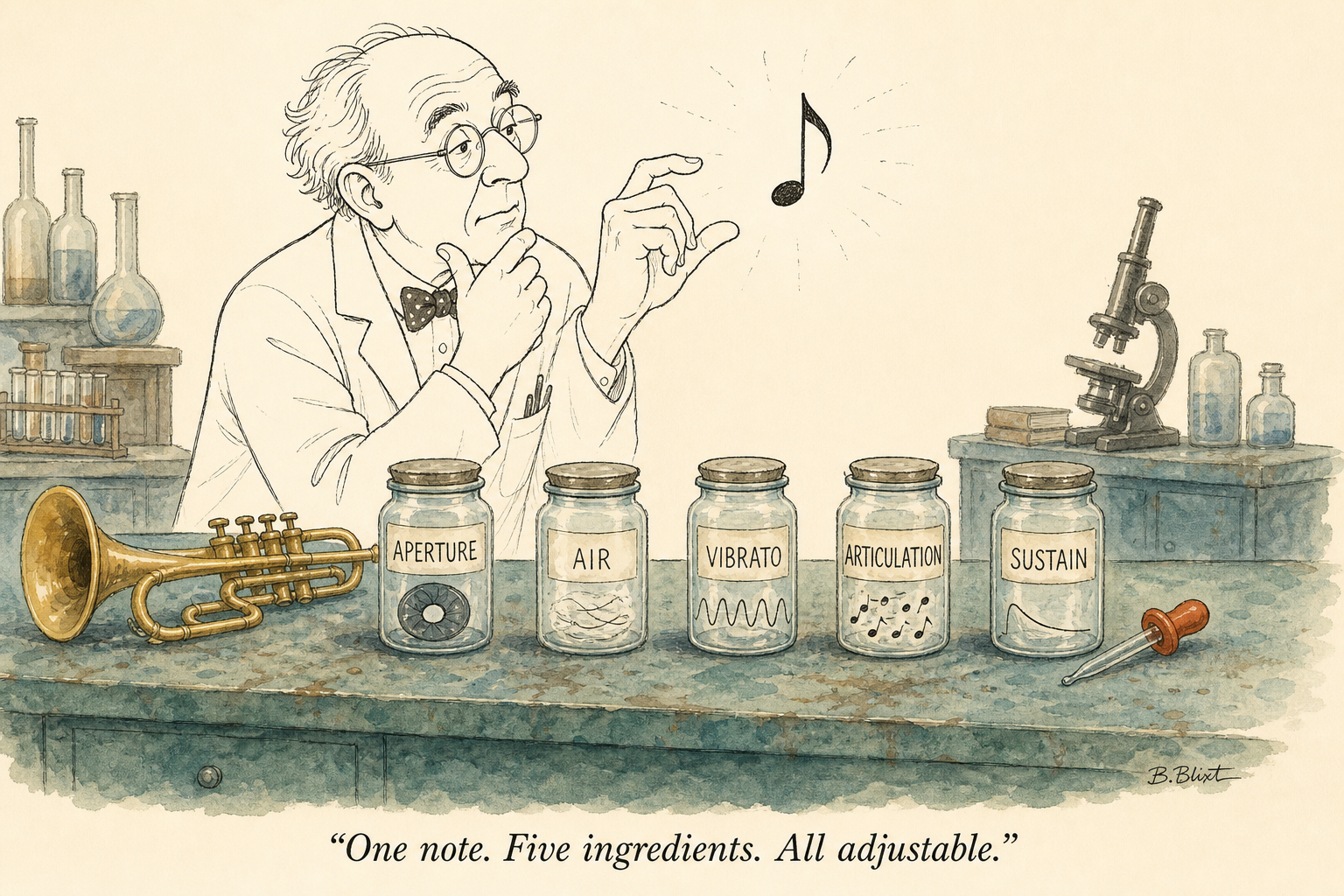
There is an old story about a young cook who only knew one variable in the kitchen, and that variable was salt.
The dish would come back from a table, the chef would taste it, and the cook would add more salt. Watery and bland, he salted it. Overcooked and tough, he salted it. Missing acid, missing fat, missing heat, missing time, he salted it.
Eventually the chef pulled him aside and said, “There are at least eight things on this plate you can change. Salt is one. You have been hammering the only knob you can find for two years and the food is not getting better. Look at the rest of the kitchen.”
That cook is most trumpet players.
You have a sound. You do not love your sound. So you do the one thing you know how to do. You blow more air. You play long tones. You buy a different mouthpiece. You add salt.
A trumpet sound is not one thing you adjust. It is five ingredients you can change independently on every individual note. Most players have never named those five, so they cannot adjust four of them, so they keep reaching for the salt.
This article gives you the names. Once you have them, you can start cooking. The broader frame is laid out in the trumpet sound guide. This article zooms in on one specific layer of that guide: what a single note actually is.
Why Trumpet Players Think Sound Is One Thing
Walk up to a player who is unhappy with their sound and ask what specifically they are unhappy with. Most of the time you get “it does not sound good” or “I want a fuller sound.” All real complaints. None of them diagnostic.
It is the kitchen problem. The dish does not taste right. Okay. Is it under-salted? Missing acid? Missing fat? Missing time on the heat? Until you can name the variable, you cannot fix the dish. You can only add more salt and hope.
Most players think sound is one thing because that is how their ear was trained. Nobody decomposed the order. Nobody handed them a cutting board and said, “This is aperture. This is air. This is vibrato. This is articulation. This is sustain. They all change the dish. Today we are working on the vibrato.”
So the player walks to the long-tone exercise carrying one fuzzy bucket called “my sound.” The sound comes out roughly the same as yesterday. They cannot taste the five ingredients separately, so they taste the dish as a whole, decide it is bad, and reach for the salt.
That is how five years of practice produces a sound that sounds like one year. The wiring on each note is doing five things at once and the player only ever adjusts one of them.
You can stop this week. The first move is naming the five.
The Five Components, One at a Time
Here are the five ingredients in every single note you play. Read these slowly. The point is not to memorize them. The point is to start hearing them as separate things on a recording, the way a chef tastes salt and acid and fat as separate things on a plate.
Aperture
The aperture is the size and shape of the opening between your lips when air goes through.
Smaller aperture, more focused. The sound centers up, gets narrower, more pointed. Larger aperture, more open. The sound spreads and gets wider.
Harry James played with a relatively open aperture, which is part of why his tone fills the room the way it does. Wynton Marsalis plays with a tighter, more controlled aperture, especially in classical, which is part of why his clarity at speed is so unbelievable. Same horn. Same fingers. Different aperture. Different sound.
The dial range. Too small, the sound gets pinched and thin, sometimes unstable. Too large, the sound gets airy and diffuse. The work is to find where on that dial your reference player is sitting on each note in your range.
Air
Air has three sub-variables most players blur into one. Volume, speed, and support quality.
Volume is how much air you are moving. More volume, more body. Less volume, smaller, more intimate.
Speed is how fast that air is moving through the aperture. Faster air, more brilliance and shimmer on the top end. Slower air, more warmth and wood.
Support quality is whether the air is coming from a settled core or being pushed by your throat and shoulders. A well-supported note feels delivered, not shoved.
Air is the ingredient most teachers emphasize first, and the one most adult players have rehearsed the longest. The mistake is treating air as the only knob. Air is the one you reach for when you do not know what else is wrong, the way the cook reaches for salt. It can solve some problems. It cannot solve four out of the five.
The dial range. Too little air, the sound goes pale and lifeless. Too much air, it overblows and gets edgy. Faster air than the line wants and you get hard-edged brilliance where you wanted warmth. Slower than the line wants and you get muddy where you wanted clarity.
Vibrato
Vibrato is the wave you put on a sustained pitch. Its sub-variables are width, speed, and onset.
Width is how far the pitch wobbles above and below center. Speed is how fast that wave cycles. Onset is when in the note the vibrato kicks in. Some players hit the note already wobbling. Some start straight and add vibrato halfway through. Some never wobble at all.
Harry James played a wide, slow, prominent vibrato that announced itself immediately. That vibrato is most of what you recognize when you hear him on a record. Miles Davis essentially trained vibrato out of his playing because his teacher rapped his knuckles whenever he wobbled. Wynton Marsalis switches it off entirely for classical and opens it up on a ballad. Vibrato is one of the most powerful identity-shaping levers you have, and most players never touch it consciously.
The dial range. Too little, the sound feels stiff and scared. Too much, it sounds dated or showy or out of style for the music. Wrong onset and you sound like you are decorating instead of singing.
Vibrato deserves its own deep dive, because it is a whole identity question by itself. We get into that in the article on vibrato as identity. For now, the key point is that vibrato is its own ingredient. It is not part of “sound.” It is one of the five things you can adjust separately.
Articulation
Articulation is the front edge and the back edge of the note. The attack and the release.
The attack is how the note starts. Sharp tongue, hard front edge. Soft tongue, gentle front edge. No tongue at all, breath attack, completely round entry. The release is how the note ends. Stopped clean by the tongue, ringing release, fade, lift, pop. The back of the note is just as expressive as the front, and most players ignore it entirely.
Marsalis articulates with a rhythmically pocketed crispness. The front of his notes lands so consistently in time you can hear the metronome through them. Miles articulates conversationally, almost spoken, sometimes barely a tongue at all. Same notes. Different feel. The articulation is doing the work.
The dial range. Too sharp, the front of the note clicks or pops or sounds aggressive. Too soft, the note has no point of arrival. Wrong release and the phrase ends without breathing.
Cooking equivalent. Articulation is the texture of the bite. Crunchy, soft, melting, snap. The ingredients can be identical and the texture decides whether the dish is exciting.
Sustain
Sustain is what the note does between the attack and the release. The middle of the bite.
Most players think a sustained note is static. You hit it, you hold it, you release it. A shelf of sound.
Listen to a great player do a long held note. It is not a shelf. It is shaped. The note opens. It sometimes intensifies in the middle. It tapers or doesn’t. The pitch is alive across its length, the air is alive across its length, the body of the sound is alive across its length. There is a story in the duration.
Long-tone discipline is sustain training, whether the player knows it or not. If your long tones are flat and identical from front to back, you are training a flat sustain. If your long tones have shape and life across the duration, you are training a sustain that can carry a phrase.
The dial range. Too flat, the note is dead in the middle. The dish gets boring before you finish chewing. Too active, the sustain becomes manneristic and the listener stops hearing the note and starts hearing the gymnastics.
That is the five. Aperture. Air. Vibrato. Articulation. Sustain.
Why These Five Are Independent
Here is the part that, once it lands, changes how you practice forever.
Every one of these five components is independently adjustable on every individual note in your range.
You can change aperture without changing air. You can change air without changing vibrato. You can change articulation without changing sustain. The five CAN move together, the way a chef adjusts salt and acid at the same time because the dish needs both. They do not HAVE to. The adjustment on each is a separate decision.
This is hard to feel at first because most players have only ever experienced their five components moving as a clump. When they go to play “louder,” everything changes at once. More air, bigger aperture, more vibrato, harder attack, fatter sustain. Five dials rotated together. So they think a “louder sound” is one thing, when it is actually a coordinated movement of five.
Real sound work is the discipline of learning to move them separately. Adjust the aperture and hold the rest constant. Adjust the air and hold the rest constant. The first time you try this, it will feel impossible. It is not. It is a skill. Like a cook learning to taste salt and acid as separate ingredients in a vinaigrette, when at the start they only tasted “the dressing.”
Most players never learn it. So their five-dial control panel stays welded into one knob, that knob is air, and they salt every dish.
Component-Level Matching to Your Reference Player
If you have read the guide or the earlier articles in this series, you already know about picking one trumpet player as your singular reference. The recordings you listen to every day. The sound you are trying to install.
Here is where the components actually do their work.
Without the components, “sound like Marsalis” is a fuzzy command. You play a note. It does not sound like Marsalis. You do not know why. You try harder. It still does not. You give up because the gap is too vague to close.
With the components, “sound like Marsalis” decomposes into five separate questions you ask about each note.
Is my aperture sized like his?
Is my air doing what his is doing?
Is my vibrato matching his?
Is my articulation landing where his does?
Is my sustain shaped like his?
Each is a yes or a no. Each is closeable separately. You can be 80% there on aperture and 30% there on vibrato, and now you know exactly what to work on tomorrow.
This is the same self-evaluation loop every great player ran, except now you are evaluating five things instead of one fuzzy variable. Without the decomposition, you are the cook adding salt. With it, you are a chef tasting the dish and saying, “needs acid.”
There is a separate article in this series, the rewiring framework that uses these components, that goes deeper into how rewiring actually works on a per-note basis. This article is the ingredient list. That one is the recipe.
“I Cannot Think About Five Things at Once When I Play”
This is the objection that comes up the moment a player understands the five components. They look at the list, look at the trumpet, think about a phrase at quarter equals 120, and go: there is no way I can think about all five while I am playing.
They are right. You cannot. The trick is, you do not.
A great cook is not standing at the stove thinking about salt and acid and fat and heat and time and texture and plating all simultaneously, on every plate, all night. That is not how cooking works.
What a great cook does is isolate one variable in deliberate practice, drill it until it goes underneath conscious attention, then move to the next one. Salt one week. Acid the next. Heat control the week after. By the time the cook is on the line during real service, none of those individual variables are conscious anymore. The cook is operating at the level above ingredients. They are thinking about the dish.
You do the same thing with the five components. You isolate one. You drill it. You let it go underground. Then you isolate the next.
Week one, the only thing you pay attention to is aperture. You hold the others as best you can and keep asking the aperture question. A hundred reps. Some closer, some farther. Aperture only.
Week two, you switch to air. The aperture work does not vanish, it sits in the background and starts to set. Conscious attention this week is on air. Week three, vibrato. Week four, articulation. Week five, sustain.
After five weeks you have done one full pass through the dish. You have not mastered any of the five. You have started rewiring each one. You have given each one a real, isolated, undivided attention week, and begun to feel them as separate ingredients instead of one welded clump.
Then you start the cycle again. The second pass is faster than the first because you have built initial vocabulary. The third is faster than the second.
After about a year, the components are no longer something you “think about.” They are something you adjust. The conscious attention has moved up one level. You are no longer thinking “is my aperture sized correctly,” you are thinking about the phrase, and the aperture is auto-correcting underneath. That is exactly what a chef means when they say a young cook has gotten their hands.
The fear that you cannot think about five things at once is a fear about today. It is not a fear about a year from now. A year from now the five things will be operating below conscious thought, and you will be thinking about the music. But you only get there if you start naming and isolating them now.
The 30-Day Component Drill Cycle
Here is one concrete way to start. Not the only structure. A structure that works.
For the next 30 days, run a weekly rotation through the five components. Six days of work per week. One component per day, with a wildcard day on the seventh.
Day one. Aperture day. Long tones. Slow simple lines. Match your reference player’s aperture as closely as you can on every note. Notice when it drifts smaller or larger. Reset. Rep again. The only question you ask today is the aperture question.
Day two. Air day. Same material, different question. Volume, speed, support. Where is the air doing more than his? Where is it doing less? Where is the support collapsing?
Day three. Vibrato day. Width, speed, onset. Most players need a real wake-up here because they have never controlled vibrato consciously. Today you do.
Day four. Articulation day. Front edges and back edges of every note. Are you tonguing where he tongues? Releasing where he releases?
Day five. Sustain day. The middle of the bite. Long tones with active attention to what happens in the duration. Not flat, not manneristic, alive.
Day six. Integration day. Take a short phrase from a recording. Try to match all five components on every note. You will fail. The point is not to succeed. The point is to feel where the failures cluster. That tells you what to weight more next week.
Day seven. Recovery. Listen, do not blow. Or take a light day with simple material and no diagnosis. Rest is part of the program. You cannot cook well when you are exhausted, and you cannot rewire well when your chops are fried.
After 30 days, two things have happened. You have done the first full pass through the components. And you have started to taste them as separate ingredients on recordings. You will hear a sustained note and notice the vibrato width before you notice “that is a beautiful sound.” That is the chef’s palate developing. That is the entire game.
The slow players never start. The fast players start this week.
What This Looks Like Over Time
Every trumpet player whose sound you admire went through this decomposition process, even if they never named it. Their teacher named it for them. Their ear named it for them. Their thousands of hours of listening named it for them. Somebody helped them taste salt and acid and heat as separate things.
The reason adult comeback players get stuck is that nobody named the components for them, so the chef’s palate never developed, so they stand at the stove for years adding salt and asking why the food is not improving.
Once the names are in your head, you cannot un-know them. You will hear a great player from now on and you will not just hear “good sound.” You will hear “wide vibrato, slow speed, late onset.” You will hear “tight aperture, fast air, soft articulation, intensifying sustain.” Your ear has been upgraded. Permanently. From a customer’s ear into a chef’s ear.
The 1% Trumpet Program runs this work as structured curriculum because doing it alone is brutally hard. You cannot taste your own dish accurately when you are also the cook. You need someone in the room who has already developed the chef’s palate, who can tell you, with calibrated honesty, that today the aperture is fine and the problem is the sustain. Players who try to do this alone end up adding salt for years and convincing themselves the dish is improving. It is not. They just got used to the taste.
The Cost of Staying a One-Knob Cook
You have been told for most of your trumpet life that “more practice” is the answer. It is not, by itself. More practice with one welded knob gives you a deeper groove of the sound you already have. More practice without the five components is more salt on a dish that needs acid.
The cost of staying a one-knob cook is not that you stop improving. The cost is that you improve along the wrong axis. Your range goes up. Your endurance goes up. Your accuracy goes up. And your sound, the thing that actually makes a listener stop and lean in, stays exactly where it was when you were seventeen. Because the sound work was never the work you were doing.
If you want a different outcome, you have to do the component work. Learn the five ingredients. Drill them one at a time until they go underground. Develop the chef’s palate by listening to your reference player with the five questions in your head. And keep doing it long enough that the new wiring sets.
Most players will not do this. They will read this article, nod, feel briefly inspired, and tomorrow go back to long tones with no isolated variable, no decomposition, and adding salt.
The 1%ers are the ones who pick up the cutting board.
If you want help running this work in a structured way, with a coach who has already developed the palate and can taste your dish honestly, that is what we do in the program. We run a free 30-minute training that walks through how this fits with the other layers most players need to develop. Range, endurance, the protective reflex that quietly kills most adult comeback work, and the practice ratio that makes the whole thing compound. You can grab it at toot-your-own-horn.com/landing-page.
If you do nothing else this week, do this. Pull up a recording of your reference player. Listen to one held note. Ask yourself the five questions in order. What is the aperture doing? What is the air doing? What is the vibrato doing? What is the articulation doing? What is the sustain doing?
Five answers. One note. That is the chef’s palate beginning. Cook from there.
Want to go deeper? Continue with the next articles in this series:
- How to Build a Great Trumpet Sound: The Inner Game of Tone and Musicality — The complete guide.
- The Algorithm of Trumpet Playing — The rewiring framework that uses these components.
- Vibrato as Identity — Vibrato deserves its own deep dive.