You’ve been practicing. You’ve been putting in the hours. You’ve been doing everything right, or at least, everything you think is right. And yet, you’re still stuck. You’re not getting better. Or you’re getting better so slowly that it feels like you’re not getting better at all.
You’re frustrated. You’re confused. You might even be thinking about giving up.
If this describes you, I want to tell you something: I know why you’re stuck. And it might not be what you think.
Most people think they’re stuck because of a lack of talent, or a lack of technique, or a lack of equipment. They think if they just had the right mouthpiece, or the right teacher, or the right practice routine, everything would click.

But that’s not why you’re stuck. You’re stuck because of a lack of focus.
Let me explain what I mean.
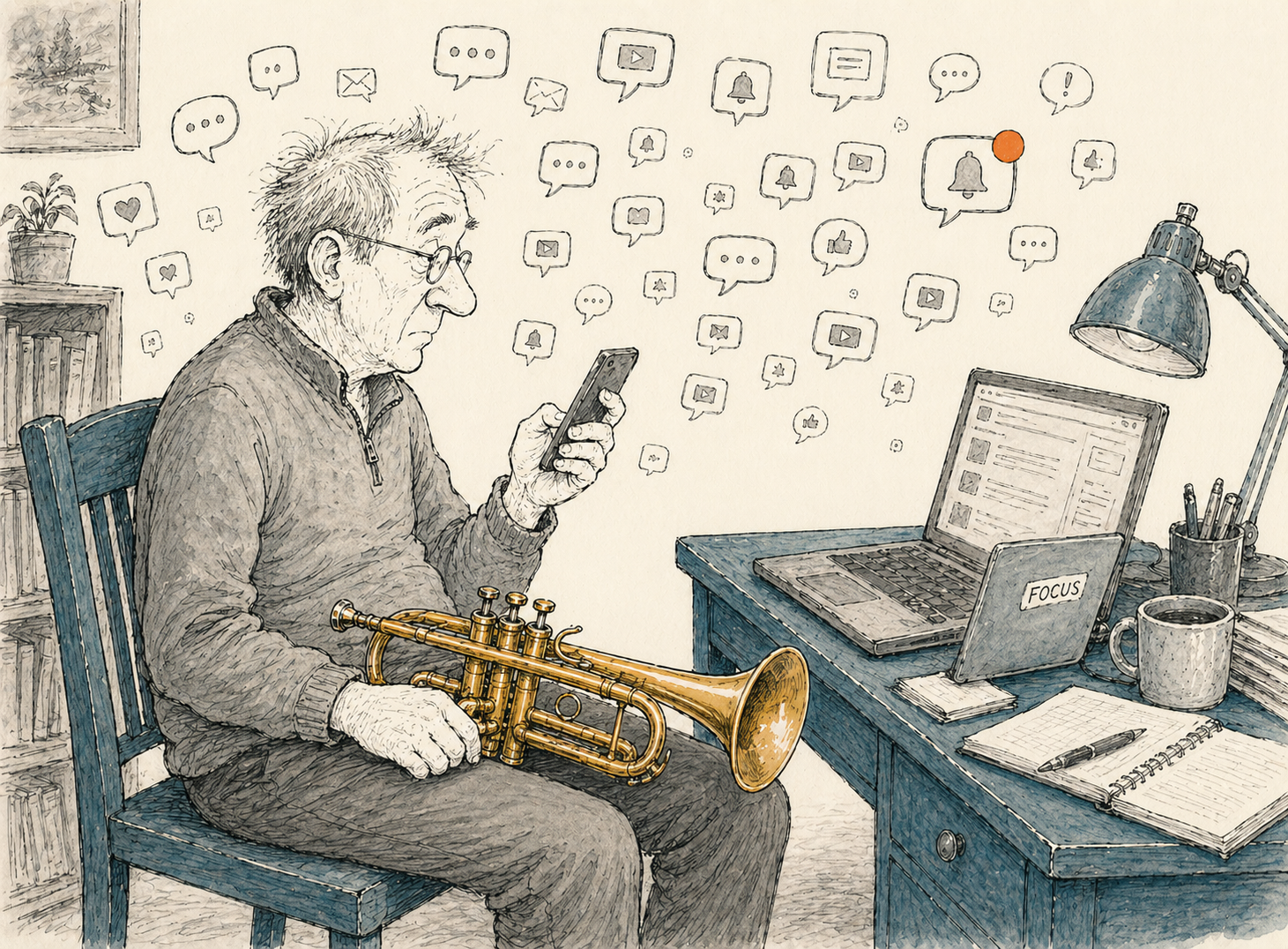
In today’s world, we live in a constant state of distraction. Our phones are buzzing. Social media is demanding our attention. There are notifications coming from everywhere. And our brains are wired to respond to these distractions. Evolution has made us pay attention to novelty, because in the past, novelty often meant danger or opportunity.
But in the modern world, novelty is everywhere, and most of it is not important. Most of it is noise. And if you’re constantly paying attention to this noise, you don’t have the mental capacity to focus on what actually matters.
Which brings me to trumpet playing. Trumpet playing requires focus. It requires deep work. It requires the ability to tune out everything else and concentrate on the task at hand.
But if you’re in a constant state of distraction, if your attention is fragmented, if you’re jumping from one thing to another, then you’re not going to be able to do the deep work that’s necessary to improve your trumpet playing.
Let me give you a concrete example. Let’s say you sit down to practice, and your phone is nearby. You tell yourself you’re going to focus, but then your phone buzzes. Someone has texted you. Your brain immediately wants to check that text. Will you check it? Maybe not immediately. But part of your attention is now on your phone instead of on your practice.
So instead of being 100% focused on your trumpet practice, you’re maybe 80% focused. And that 20% that’s missing is going to affect your practice quality.
Now, this might not seem like a big deal. After all, you’re still practicing. But here’s the thing: when you’re doing deep work, when you’re really trying to make progress, that 20% matters a lot.
There’s a concept called “flow state” or “the zone.” It’s when you’re so focused on what you’re doing that everything else falls away. Time disappears. You’re just playing. And in this state, you improve quickly. You learn quickly. You make progress.
But you can’t get into flow state if you’re distracted. You can’t get into flow state if your phone is nearby. You can’t get into flow state if you’re thinking about everything else you need to do.
So here’s what I’m going to recommend: create a practice environment with zero distractions.
Put your phone in another room. Close your email. Close your web browser. Close any apps that might distract you. Lock the door if you have to. Create an environment where the only thing available to you is your trumpet.
This is not easy. Your brain is going to rebel against this. Your brain is going to crave stimulation. You’re going to think of reasons why you need to check your phone. You’re going to think about things you need to do. You’re going to feel anxious about being “disconnected.”
But stick with it. Give yourself 30 minutes of completely distraction-free practice. See what happens.
I’m willing to bet you’ll be shocked at what you can accomplish in 30 minutes of truly focused practice. You’ll probably accomplish more than you would in 2 hours of distracted practice.
But there’s more to this than just removing external distractions. You also need to remove internal distractions.
What are internal distractions? They’re the things going on in your head. Worry about your job. Stress about a relationship. Anxiety about a performance. Obsessive thoughts about something that happened yesterday.
All of these things are pulling your attention away from your practice.
So how do you handle internal distractions?
The first step is to acknowledge them. Don’t try to suppress them. Just notice them. “Oh, I’m thinking about that awkward conversation I had at lunch today. I’m noticing that thought.”
The second step is to redirect your attention back to your practice. Gently, without judgment. Just redirect.
The third step is to repeat. Because your mind is going to wander again. That’s normal. That’s not a sign that you’re doing something wrong. That’s just how minds work. The practice is in noticing when your mind has wandered, and gently redirecting it.
This is a skill, and like any skill, it improves with practice.
Here’s something else that I think is important. You need to understand the difference between productive work and busy work.
Productive work is work that moves you closer to your goal. It’s the deep work. It’s the difficult stuff. It’s the practice that challenges you.
Busy work is work that feels productive but doesn’t actually move you closer to your goal. It’s the easy stuff. It’s playing songs you already know. It’s running through the same scales you always run through. It’s doing the comfortable things that don’t push you.
Now, some busy work is necessary. You need warm-ups. You need to reinforce fundamentals. But if you spend most of your practice time on busy work, on comfortable things that don’t challenge you, then you’re not going to improve.
So you need to identify what’s productive work for you, and you need to dedicate the bulk of your practice time to that.
Here’s a framework you can use. Divide your practice time into three sections.
First section: warm-up and fundamentals. This is necessary, but it’s not the deep work. 20% of your practice time.
Second section: productive work. This is the stuff that challenges you. This is where you’re working on things that are just beyond your current ability. This is where the growth happens. 60% of your practice time.
Third section: cool-down. This is where you play things you enjoy, reinforcing what you’ve learned. 20% of your practice time.
Notice that 60% of your practice time is dedicated to productive work. That’s where the focus needs to be.
But here’s the thing: in order to actually do productive work, you need to be focused. You need to be in a state of flow. You need to be free from distractions.
And that’s why you’re stuck. You’re not stuck because you’re not talented. You’re not stuck because you don’t have the right equipment. You’re stuck because you’re not focused. Your attention is fragmented. Your practice is not as deep as it needs to be.
So here’s my challenge to you: create a distraction-free practice environment. Commit to 30 minutes of completely focused practice. Spend that time on productive work. Not on busy work. Not on comfortable things. On things that challenge you.
Do this for a week. Track the results. I think you’re going to be surprised at what you can accomplish when you’re truly focused.
Because the truth is, you’re probably not stuck at all. You probably have all the talent, all the ability, all the potential you need. You’re just not using it to its fullest because you’re distracted.
So remove the distractions. Find your focus. And watch what happens to your trumpet playing.
You might not be stuck after all.
Want this kind of thinking applied to your own playing?
The free 30-minute training reveals the same framework I use with my 1% Trumpet Program students — the one most comeback players never figure out on their own.
Watch the free training →Want the full system in 30 minutes? Watch the free training — the same diagnosis-first framework I use with every player in the 1% Trumpet Program.