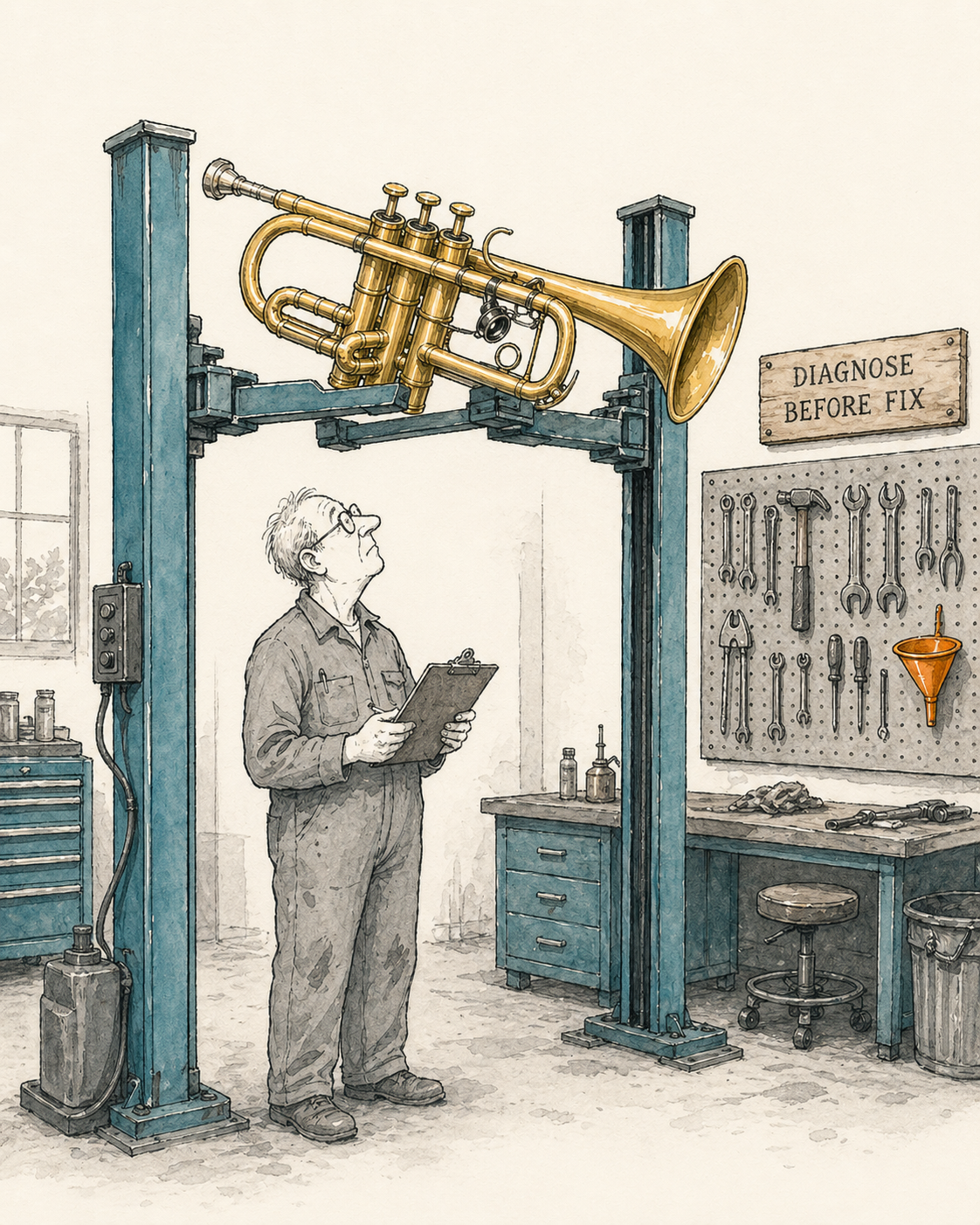
Every trumpet player on earth has had this trumpet chops tired vs done moment. You’re forty minutes into a session. The chops are getting heavy. There’s a voice in the back of your head saying “one more pass” and another voice saying “stop now.”
One of those voices is right. The other one is going to cost you the next three days.
The hardest skill in this instrument isn’t a high C. It isn’t double tongue. It isn’t sight reading. It’s the ability to tell, in real time, whether your chops are tired or done. Because tired chops can keep going carefully and still benefit from the work. Done chops can’t, and pushing through done chops is damage, not training.
Most players never learn the difference. They use one word, “tired,” for two completely different states. So they push when they should stop, or they stop when they could have gotten one more good rep in. Either way they leave gains on the table.
This article is the diagnostic. By the end of it you’ll have a 30-second self-check you can run at the start of every session, a list of the most reliable signals your chops are sending you, the ego story that lies, and an exact protocol for what to do when you’ve tipped over the line.
Trumpet Chops Tired vs Done: The Low Fuel Light Analogy
Picture the low fuel light in your car. The first time it comes on, you’ve probably got 30 to 50 miles left before you actually run out. The car is fine. The engine is fine. The light is just a heads-up. You can keep driving. You should plan a stop, but you don’t need to pull over right this second.
That’s tired chops. The warning light is on. You’ve still got something in the tank. If you drive carefully, you can keep going for a while and even make it home.
Now picture the moment the engine starts coughing. The car shudders, the RPMs drop, the engine cuts in and out. That’s not “low fuel” anymore. That’s “out of fuel,” and every additional mile you try to squeeze out of it is doing damage to the fuel pump.
That’s done chops. The engine is coughing. The buzz is failing. Pressing the gas pedal harder doesn’t add fuel to the tank. It just kills the pump.
The difference between tired and done is the difference between “running low” and “out.” Tired is the warning. Done is the breakdown. They feel similar from the driver’s seat for about thirty seconds, and then they don’t. Your job is to learn the moment they diverge.
What Tired Chops Actually Feel Like
Here’s the honest list of what tired feels like. Not poetic. Not abstract. The actual sensations.
The buzz still works, but it feels heavier. You can produce a clean note. The aperture still cooperates. It just takes a little more focus and a little more air than it did at minute ten of the session.
Range is still there with a touch more effort. If your normal comfortable top is a high G, the high G still pops. It might take a second to settle. It might feel slightly less easy than it did during your warm-up. But it’s there.
Articulation is slightly slow. Double tongue feels a hair behind. Single tongue at fast tempos starts to drag. The crisp edge has dulled by maybe ten percent. Not collapsed. Dulled.
Sound is still focused but a touch dull. The core of the note is still there. The center is still in tune. But the bloom on the front of the note, the little bit of brilliance that was there at minute five, has softened.
Recovery is fast. Tired chops come back overnight. Sometimes they come back in a few hours. You wake up the next morning and the face feels normal again.
Tired is a green light to keep going carefully. You can still play. You can still benefit from the work. The right move is to drop the intensity, take more rest between phrases, lean on lighter material, and finish the session with deliberate calibration. This is actually where some of the best endurance gains live because you’re training the chops to recover under load.
What Done Chops Actually Feel Like
Done is a different animal. The signals aren’t subtle dimming. They’re system failures.
The buzz is unstable or feathery, and the pitch slips. You go to start a note and the front edge wobbles. The pitch wanders even though your aperture and air feel locked in. You’re not making a sound. You’re making a leak.
High notes won’t pop at all. Not “they’re harder.” They simply will not come out. The note that you played cleanly at minute fifteen is now a splat or nothing. Your face is no longer producing the necessary frequency, full stop.
Articulation is foggy and mushy. The front of the note is gone. You can hear yourself trying to tongue cleanly and the result is a smear. Even simple articulation that you can do in your sleep starts to fall apart.
Sound is airy and unfocused regardless of effort. No matter how much air you push, no matter how hard you try, the sound has lost its core. You can hear the air around the pitch instead of the pitch riding the air.
Recovery takes 2 to 3 days, not overnight. You wake up the next morning and the face still feels swollen, numb, or raw. By day two it’s better but still not right. By day three you might be back, if you actually rested.
Done is a red light. Not yellow. Red. Pushing through done is not training. It is repeated micro-trauma to soft tissue that has lost the capacity to respond, and your body files that experience away in the protective reflex bank for the next time you pick up the horn.
The 30-Second Self-Check
Run this at the start of every session and at the halfway point. Thirty seconds. That’s it.
Step 1. Free buzz, low to mid. Buzz a clean low C up to a G with no horn, no mouthpiece. Listen for that focused mosquito-like sound. If the buzz is clean and centered, that’s a green flag. If it’s airy, double-buzzing, or you can’t get it to start, that’s a hard signal.
Step 2. Mouthpiece buzz, the same C to G. Add the mouthpiece. Same pitches. Is the response immediate? Is the pitch landing where you intend it? If you have to chase the note, that’s a yellow flag.
Step 3. One easy note on the horn. Pick a note in the middle of your comfortable range. A G on the staff is fine. Play it for four beats at a comfortable mezzo-forte. Listen. Does it feel good, sound good, and respond easily? That’s the Trumpet North Star, and all three have to be true. Not two of three. All three.
If all three layers pass, you’re fresh enough to do real work. If layer 1 or 2 is wobbly but layer 3 still passes, you’re tired but functional. If layer 3 fails, if a comfortable middle-of-the-range note doesn’t feel good, sound good, and respond easily, your chops are done. Stop the session. Today is a light day or a day off.
This isn’t optional. This is the diagnosis that decides everything else.
The Most Reliable Indicators (Forget the Rest)
If you only watch three signals, watch these. They are the indicators that lie the least.
Indicator 1: The top of your range pyramid changes character. Not the absolute top. The part of the pyramid where you usually live with confidence. If the notes at the upper-comfortable edge of your pyramid suddenly feel different, your chops are telling you something. A small change here is the earliest reliable sign of fatigue. By the time the absolute top notes are gone, you’re already deep into tired and possibly into done.
Indicator 2: Your free buzz quality. The free buzz strips away every variable except the lips themselves. If your free buzz at low-to-mid range is clean, your chops have something left. If your free buzz feels feathery, leaky, or won’t start, the soft tissue is asking for rest. The free buzz is the most honest test you have because it can’t be cheated by mouthpiece pressure or air manipulation.
Indicator 3: Recovery from the previous session. If you woke up this morning and your face still feels off from yesterday, that is the signal. Not “I usually feel like this.” That is fatigue accumulating. Two days of incomplete recovery is the doorway to done.
Everything else, including how loud you can play, how high you can scream, how long you can hold a note, is downstream of these three. Watch these and you’ll catch fatigue early enough to act on it.
The Ego Story That Lies
Every trumpet player has heard this voice. “I just need to push through. One more rep. Just get to the end of the etude. The chops will figure it out.”
This voice is not your friend. It is a coping pattern, and it has been carved into your nervous system by years of training that confused suffering with growth.
Here’s the truth that voice doesn’t want to hear. Your body has already given you the answer. The signals are the answer. The buzz, the articulation, the sound, the response. Your body is a measurement instrument and it is telling you, with no agenda and no ego, what state you’re actually in. The story that “I should be able to do this” is the lie. The buzz that just splatted is the truth.
Think of it like the difference between hungry and starving. Hungry is uncomfortable but functional. You can keep working through it for a while. Starving is a body in shutdown, and at that point eating one more handful of food doesn’t fix anything. You need to actually stop and refuel.
Or think about an athletic injury. Sore muscle and torn muscle both hurt. The first one wants you to keep moving carefully so it doesn’t stiffen up. The second one wants you to stop immediately because every additional rep is widening the tear. The right response depends entirely on which one you have. Confusing them is how recreational athletes turn six-week sore muscles into six-month tears.
The ego story collapses the difference. It tells you all fatigue is the same and the answer is always “push through.” It is wrong, and the cost of believing it is your career on this instrument.
What To Do When You’ve Tipped Into Done
You played past the line. It happens. Here’s the protocol.
Stop now. Not after this etude. Not after this last phrase. Now. Every additional minute of done-chop playing extends your recovery time and reinforces the protective reflex. The cost compounds, and the cost is paid in the next 72 hours, not in the next 5 minutes.
Light playing only for the next 1 to 3 days. This is the classic recovery situation, and the answer isn’t necessarily “no horn.” The answer is light. Soft, low, short. Calibration only. Stay well below your normal range pyramid. Twenty minutes maximum. The point isn’t to “maintain” anything. The point is to keep blood flowing to the tissue while it rebuilds.
If a full day or two off feels right, take it. If you’re a player who gets anxious without daily horn time, run a true light day instead. Both are valid recovery options. Light, medium, and heavy is a real periodization framework, not a vibe. A real light day functions almost identically to a day off. The face still rebuilds. The muscle memory still consolidates. You just keep your routine intact.
Sleep harder than usual. Tissue repair is not a metaphor. It happens during deep sleep, and if you’re under-slept your chops literally cannot rebuild on schedule. An extra hour of sleep on a recovery night is worth more than any exercise you could have done in the same hour.
Don’t catastrophize. Done is recoverable. It is not an injury in the orthopedic sense. It is acute fatigue plus minor soft-tissue inflammation, and human tissue is built to come back from exactly this kind of stress when you stop adding to it. The catastrophe is not done chops. The catastrophe is panicking, ignoring the signal, and grinding through the next session because you’re afraid of falling behind. That turns done chops into a chronic problem.
Stop. Light. Sleep. Wait. The face will be back, and it will often come back stronger than it was before the session that cooked you. That’s the entire point of stress and recovery. The system adapts upward, but only when the recovery actually happens.
Where the Frameworks Fit
If you’re an existing reader of this blog, you’ve seen the pieces of this diagnostic before. Here’s how they connect into one decision.
The Trumpet North Star is your real-time test. Feels good, sounds good, responds easily. All three. If any one of those drops, the chops are tired. If two or three drop, the chops are done.
The Protective Reflex is what you build when you ignore the signals. Every time you push through done, your nervous system learns that trumpet equals threat, and it bakes a defensive response into the next session. Tired chops give you a clean opportunity to teach your nervous system that you respect its signals. Done chops, ignored, teach it the opposite.
The Range Pyramid is your early warning system. The character of the notes near the top of your comfortable range changes before your absolute top notes disappear. Watch the upper-comfortable edge, not the ceiling. The ceiling is a lagging indicator.
The 2:1 Practice Ratio tells you when material is too hard. If you’re missing more than you’re hitting, the load is wrong, and continuing under that load is how tired tips into done. Drop the difficulty, restore the ratio, and the chops survive the session.
Light, Medium, and Heavy is the structural answer. You don’t go heavy two days in a row. You don’t go heavy on a day where the morning self-check failed. You stress the system on purpose, then you let it rebuild on purpose. Done chops are almost always the result of a heavy day stacked on top of unfinished recovery.
The One Question That Decides Every Session
Here’s the whole article in one question. Ask it before every session and at the halfway mark.
Is the buzz still working?
If the answer is yes, even with a little extra effort, you’re tired. You can keep going carefully. Drop intensity, take more rest, stay in calibration mode, finish well, log the session, and recover tonight.
If the answer is no, if the buzz is feathery, the pitch is slipping, the sound has lost its core, and the response has gone foggy, you’re done. The session is over. Light playing for the next 1 to 3 days. Sleep. Wait. Trust the biology.
The greatest trumpet players in the world are not the ones with the most stamina. They’re the ones who learned to read the signals early, respond accurately, and stop on time. Over a hundred trumpet players have come through my program at this point, and almost without exception, the breakthrough moment for each of them was the same. It wasn’t a new exercise. It wasn’t a new piece of equipment. It was the day they stopped lying to themselves about what their chops were telling them.
Listen to the signal. Ignore the story. The chops you build in the next year are decided right there.
“I Push Through, I’m Fine.”
I want to talk to the player who just read all of that and is already drafting the rebuttal in his head. The player whose internal voice goes, “Yeah, sure, but I push through and I’m fine. I’ve always pushed through. It’s worked so far.”
No. You’re not fine. You’re in damage debt and you don’t know it yet.
Every push past done is damage. Damage that doesn’t get its recovery becomes the next plateau. Not next year’s plateau. The one you’re already on. The one you can’t explain. The one where your range stopped moving, your endurance stopped scaling, your sound stopped opening up, and you keep telling yourself it’s a phase.
It isn’t a phase. It’s the bill arriving for years of pushing through done.
“I push through” is the most expensive belief in trumpet playing. It works in the short term. It absolutely ruins the long term. It’s the belief that drained more careers off this instrument than any other single mistake, and the cruel part is that the players who held it the most stubbornly were usually the ones who cared the most.
Here’s the part nobody wants to hear. The body’s signal is honest. The ego’s story is the lie. And the protective reflex makes self-honesty harder, not easier. The more you push, the more the reflex covers the real signal. Your face starts protecting itself. Your aperture starts cheating. Your air re-routes around the damage. By the time it gets loud enough that you can’t ignore it, the damage debt is already years deep, and you’re standing on a plateau wondering why nothing you try is working.
That’s not a coincidence. That’s the cost finally landing.
And here’s the harder thing. You cannot read your own signal honestly when the ego is voting for “more.” The reflex is built precisely to fool the player wearing it. It doesn’t show up in a mirror. It doesn’t show up on a recording. It shows up in a coach who’s seen the pattern in over a hundred faces before yours and can name it before you finish the first phrase.
That’s what an outside set of eyes actually buys you. Not opinions. Not technique tweaks. An honest read of what your body is doing while your story is busy lying to you.
The careers that ended quietly off this instrument did not end because the chops were bad. They ended because the chops were never read for the player. Nobody told them. Nobody saw it. They pushed through, kept pushing through, hit the unexplained plateau, lost faith, set the horn down. That’s the actual horror story. Not blown-out lips. Not catastrophic injury. Just a slow fade nobody named in time.
Don’t be that. Get the outside read your protective reflex hides from you.
— Jesse
The free 30-minute training is where I show you the read your reflex won’t let you see. It’s the diagnostic the 1% Trumpet Program runs on every player who walks in the door, and the reason their plateaus finally start moving.
If you want to see how all of this fits together (diagnosis, training, recovery, and the long arc of building chops that actually last), start at the trumpet endurance guide. And if you’re rebuilding after time away, the same diagnostic principles apply on day one of your trumpet comeback.