I had a guy in his late forties come into a coaching call once and play through about ninety seconds of warm-up. Long tones, a scale, a fragment of something he liked. Clean enough. Reasonably in tune. Decent air.
I asked him who he was trying to sound like.
He said, oh, all of them. He listed nine players. He had spent the last three years cycling through them. A month on Maurice André, a month on Doc Severinsen, a month on Arturo Sandoval, two weeks on Lee Morgan, back to Marsalis, then Hubbard. He was proud of how broad his listening was. He said he wanted to be well-rounded.
I told him he was sailing without a compass.
He sounded like exactly what he was. A trumpet player who admired everyone and was indistinguishable from no one. His tone was technically passable and emotionally anonymous. His sound had no fingerprint because his ear had no fixed point. He had been navigating his entire practice by trying to look at every star at once.
That is the trap this article is going to pull you out of.
The Thesis: One Star, Six Months, You Will Not Become a Copycat
Here is the claim, stated as plainly as I know how to state it.
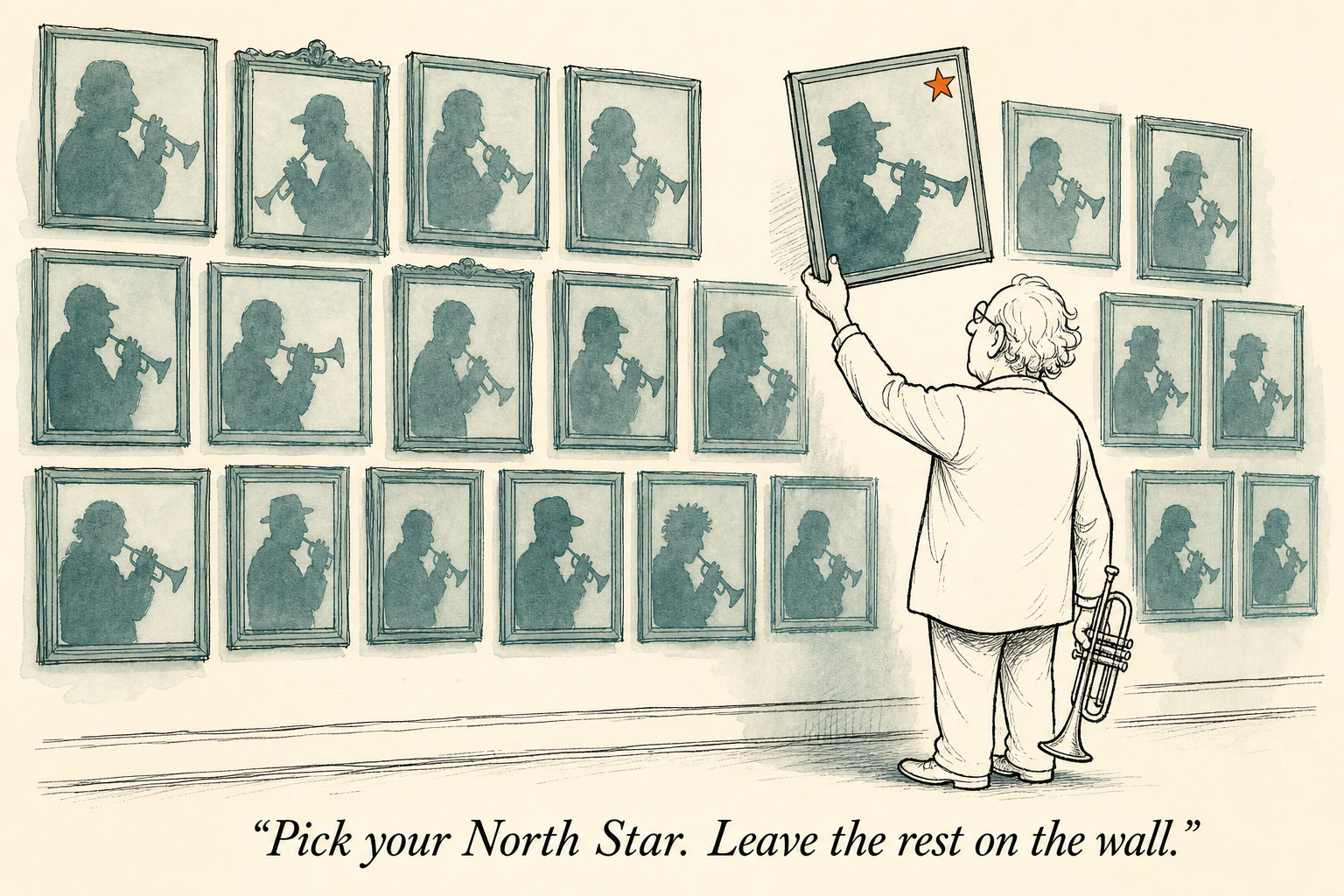
If you want a sound with identity, you have to pick one trumpet player to model and commit to that player for at least six months. One player. Daily listening. Match-and-evaluate practice. No second player added until the first one is in your ears so deeply that you can hear them when you close your eyes.
Most adult players will not do this. They are afraid that if they pick one and chase the sound, they will become a copycat. They are afraid of disappearing into someone else’s identity. They tell themselves they are being open-minded by listening broadly. They are not being open-minded. They are being indecisive, and the cost is that they sound like no one in particular.
Here is what they are missing. You will not become a copycat. You do not have a self yet, not a musical one. Your current sound is a low-resolution average of every player you have ever absorbed, run through whatever your chops can currently produce. That is not an identity. That is noise. You cannot lose an identity you have not yet built.
What actually happens when you pick one player and chase that sound for real is that you absorb the components of a great sound (aperture, air, vibrato, articulation, sustain) deeply enough that they become available to you. Once those components are in your body, your own personality starts shaping how you deploy them. The synthesis happens after the absorption. Not before.
Every player you would name as having a singular sound did this. Marsalis spent years on Cootie Williams and Clifford Brown. Miles spent years inside the bebop vocabulary before peeling away. Payton transcribed Clifford Brown for phrasing precision. Harry James grew up imitating circus and big-band lead players until imitation hardened into identity. They modeled, and the erasure never came. The modeling is what built the version of themselves that the world recognizes.
You can read more about why this works in the trumpet sound guide, where I lay out the imagination-first thesis. The North Star idea sits at the center of it.
This article is the deep-dive on the four canonical North Star choices. We are going to walk through each one. You are going to feel a pull toward one of them. The pull is the point. That pull is the same instinct I write about in aestheticism as a magnet. Your aestheticism is what tells you which player you are already drawn to, before you have words for it. We are going to listen to the pull and we are going to commit.
The Four Axes
The four players I am about to walk you through are not a ranking. They are four different axes of trumpet identity. Each one represents a different answer to the question, “what do you want your sound to do for the listener?”
- Wynton Marsalis is the versatility axis. Classical and jazz at the highest level, both, in the same chops.
- Miles Davis is the identity axis. Personality and tone color over fireworks. Restraint as content.
- Nicholas Payton is the tradition meeting modernity axis. Armstrong’s lineage carried forward, warm and harmonically deep, without sounding like a museum piece.
- Harry James is the power and projection axis. Big, bright, ringing, vibrato-forward, made to be heard from across a room.
Your gut is going to lean one direction reading the next four sections. Let it.
Wynton Marsalis: The Versatility North Star
If you have a trumpet player friend who plays a Haydn concerto on Sunday morning and a Monk tune on Sunday night and sounds at home in both, that friend is chasing the Marsalis axis whether they know it or not.
The sound. Warm, focused, what some writers call “unbrassy.” The core is rich and full in the middle of the horn rather than spread or metallic. He plays with no edge even at volume. The pianissimo control is clean. The vibrato is controlled and tasteful, switched off entirely for classical, opened up for ballads. The articulation is rhythmically pocketed, every note placed deliberately, and the upper register stays as clear as the middle.
The technique. Range that is genuinely staggering, with scarily precise upper-register control. Multiple tonguing (single, double, triple) practiced as a daily fundamental, not a party trick. Lightning-fast lines that stay crystal clear. Phrasing built around what he calls “laugh, cry, shout, sigh,” vocal-like inflections borrowed from singers and from horn players he has studied his whole life. His articulation vocabulary is encyclopedic and pulls openly from Armstrong, Cootie Williams, Clifford Brown, and Miles.
The stylistic range. This is why Marsalis is the universal pick if you cannot decide. In 1984 he won Grammy Awards in classical and jazz the same year. He is still the only artist in any genre to do that. The reason is that he switches concept, not just style. Classical means pure tone, no vibrato, baroque clarity. Jazz means swing-pocket articulation, blues inflection, New Orleans rhythmic feel. Same chops. Different concept. Different sound coming out the bell.
Two recordings to start with.
- Black Codes (From the Underground) (1985). Listen to “Cherokee” or “Delfeayo’s Dilemma.” This is the swing axis. Articulation, fast-line clarity, jazz vocabulary at full operating temperature.
- Haydn, Hummel, L. Mozart: Trumpet Concertos (1983, with Leppard and the National Philharmonic). The Haydn third movement is the canonical classical-tone benchmark. If you want to know what trumpet sound is supposed to sound like in a recital hall, this is it.
Pick Marsalis if: you refuse to specialize. You want legitimate classical tone and swinging jazz vocabulary in the same chops. You value clarity, tradition, and tonal beauty over raw range or modern lead-trumpet brightness. You are the kind of person who thinks of “well-rounded” as an honest goal rather than an excuse for never getting deep.
He is also the safest universal pick if you cannot decide. His clarity translates to every other player you might want to study later. If you spend a year on Marsalis and then move to Miles, the work transfers.
Miles Davis: The Identity North Star
If you ever played a Miles recording in a room with people who do not know much about jazz and watched them stop talking, you know what this axis is.
The sound. Dark, smooth, round. Miles described his own sound as having “no attitude in it.” Mid-range focused. Never brassy. Never shrill. The vibrato is essentially absent, trained out of him as a teenager by his teacher Elwood Buchanan, who rapped his knuckles every time he wobbled. That straight tone became his signature against the vibrato-heavy fashion of the era. The articulation is conversational, vocal, almost spoken. Notes feel placed rather than attacked.
The technique. This is where Miles confuses people. He did not play with the kind of horn-on-fire athleticism that Marsalis or Harry James did. His technique was different. The Harmon mute with the stem out, played close to a microphone. He pioneered that setup. The result is velvety, almost-whispered, vocal in a way no other trumpet player had recorded before. Space and silence as content. He said more with fewer notes. Mid-register focus and the deliberate refusal of high-register fireworks. He stayed in the singing range of the horn and worked the color of every note inside that range.
What critics in his early career sometimes called “thin” was not weakness. It was exposed tone, with no cosmetic vibrato to hide behind. He let you hear the air going through the horn. That vulnerability is the asset.
The stylistic range. Miles is the strongest argument in trumpet history for the claim that identity is portable across context. Bebop sideman with Charlie Parker. Cool jazz on Birth of the Cool. Hard bop quintets. Modal jazz on Kind of Blue. The second great quintet through the mid-sixties. Electric on In a Silent Way and Bitches Brew. The harmonic context changed completely across those records. The voice did not. Same dark mid-range tone, same use of space, same phrasing identity, plugged into radically different musical environments.
Two recordings to start with.
- “So What” from Kind of Blue (1959). Open horn, modal, the canonical Miles statement of phrasing-as-identity. Listen to how much he is not playing. The space is the content.
- “‘Round Midnight” from ‘Round About Midnight (1957). The definitive Harmon-mute-on-microphone intimacy. If you want to know what a single note can carry when it is delivered with absolute honesty, this is the track.
Pick Miles if: you want identity over flash. If you are a returning adult player who is never going to out-technique a nineteen-year-old conservatory animal, and most adult comeback players are not, then Miles is the proof that personality, restraint, and tone color beat fireworks every time. Pick him if your goal is to sound like yourself rather than like a clinic. Pick him if you have ever heard a player who was technically immaculate and felt completely unmoved.
There is a particular kind of adult player who needs Miles like medicine. The player who has been chasing range and high notes for years, never getting where he wants, secretly afraid he picked the wrong instrument. That player needs to spend a year on Miles and remember that the trumpet is also a singing instrument, and that one perfectly placed mid-register note can do more in a recording than a dozen high screams ever will.
Nicholas Payton: The Tradition Meeting Modernity North Star
This is the player I send a lot of comeback adults toward, particularly the ones who want a full warm sound but also want to sound like they are alive in the current decade.
The sound. Big, ripe, “burnished.” Reviewers have used “capacious” and “enveloping” to describe him, and those words actually mean something. The sound fills space. Warm and round through the full range, never brash or edgy. There is a brassy ring on top of body underneath. The vibrato is gentle and controlled, used as color rather than as a constant, and he is fully capable of pure no-vibrato singing tone when the line calls for it. The articulation is clean and crystal clear, built on Bowman, Arban, and on transcribing Clifford Brown obsessively for phrasing precision.
The technique. He has talked about his embouchure as something that “begins at the back of his neck,” which sounds esoteric until you understand what he means. The sound is body-driven. It is connected. It is not a chops-first attack. His daily practice routine reflects that. Breathing, Cichowicz flow studies, Clarke 1 and 2, whisper tones. Sound-first. He talks about staying close to the middle of the horn to find the core, milking elemental melody, never rushing, singing the line.
He is also a multi-instrumentalist (piano, Rhodes, Clavinet, vocals on his own records). That informs the harmonic depth on his trumpet playing.
The stylistic range. Payton’s roots are deep in the Armstrong / Treme / Congo Square lineage. Doc Cheatham called him the greatest New Orleans-style player since Armstrong. Post-2003, with Sonic Trance, he opened the work into electric, fusion, hip-hop, and Afro-Caribbean idioms without losing the core. He coined “Black American Music” (#BAM) and argues that “jazz” is a marketing label rather than a musical category. He sees the music as a continuum of Black improvised music from Armstrong forward. Tradition meeting modernity is not an aesthetic for him. It is the whole point.
Two recordings to start with.
- Doc Cheatham & Nicholas Payton (1997), “Stardust.” Grammy-winning duet. Pure tone. Buttery phrasing. Armstrong DNA in a player who was twenty-three years old at the time. If you want to hear what the lineage actually sounds like in someone who can carry it, this is the track.
- Dear Louis (2001), “Tight Like This.” Searing solos. Modern bop spin on tradition. The same player from the Doc Cheatham record, but now showing you the other side of his vocabulary.
Pick Payton if: you want tradition fluency without sounding like a museum piece. If your goal is a full, warm, harmonically deep modern sound rooted in Armstrong but capable of speaking in 2026 idioms, Payton is the model. Not the right pick for screech-lead chasers. The right pick for comeback players chasing tonal richness and soul.
Harry James: The Power and Projection North Star
Harry James is the answer when “powerful big sound and technique” is the goal, and he is the most unfashionable choice on this list, which is exactly why some of you should pick him.
The sound. Big, bright, full-bodied. Stays brassy and centered even at extreme volume and altitude. Brilliant high register. Warm cornet-like low end that is often under-recorded but is there if you listen. The vibrato is heavy, prominent, vocal in conception, sometimes called “saccharine” by critics, intentionally placed front-and-center as part of his identity. He lived loudest in projected ringing fortissimo, but he had real dynamic range underneath that. The articulation is declarative. Clean attacks. Theatrical. There is a carryover in his playing from the circus and the “hot” jazz era that you can still hear, even on the ballad recordings.
The technique. Critics in his time used the word “unlimited” about his technique, accuracy, and endurance, and that is not exaggeration when you go back to the recordings. The high register is full-bodied, not a thin scream. Multiple tonguing, fast and precise, built into his own Harry James Trumpet Method. Strong lip flexibility and trills. Valve and lip glissandi, half-valves, valve tremolos used as expressive tools. He had what arrangers called a “rolling style,” long phrases of many notes in two- or four-bar groups that demand exceptional control. He famously played a Parduba double-cup mouthpiece, which contributed to the brightness, the power, and the stamina.
The stylistic range. This is where most modern trumpet players underestimate him. He was the lead trumpet in Goodman’s “powerhouse trio” on “Sing, Sing, Sing” and “One O’Clock Jump.” He recorded the million-selling instrumental ballad “You Made Me Love You” in 1941, which still defines the singing-trumpet ballad sound for that whole era. He played concert showpieces: “Carnival of Venice,” “Flight of the Bumblebee,” “Trumpet Rhapsody,” a Chopin waltz. He recorded a Concerto for Trumpet in 1941. Hot jazz and blues feature work. Ballad crooning on horn. Concert-hall serious. All of that in one career, in roughly the same decade.
Two recordings to start with.
- “You Made Me Love You” from Harry James and His Orchestra (1941, Columbia). The definitive ballad / vibrato / lyric statement. If you want to hear what an old-school singing trumpet sounds like with no apology, this is the track.
- “The Carnival of Venice” from Harry James and His Orchestra (1941, Columbia). Concert technique. Multiple tonguing. Range. Showmanship that is also musicianship.
Pick Harry James if: you are chasing raw projection, big bright lead-trumpet identity, old-school singing vibrato, and legitimate concert-level technique. Pick him if you are an adult player who wants your tone heard from across the room and you do not mind being unfashionable in modern jazz circles. Pick him if you grew up loving the big-band sound and never let it go. Pick him if you have ever felt like the modern aesthetic of restraint and “tasteful” playing is leaving something on the table that you actually want.
He is the right answer for more players than admit it. Some of you want to play a singing fortissimo ballad and have grown adults cry. Harry James is your man.
How to Actually Choose
You have read four profiles. You probably already feel a pull. Listen to it. Then test it against three questions.
Question one. When you imagine yourself playing in front of a small group of people who matter to you, what kind of moment do you want to create? A moment of stylistic mastery where they are impressed by how broadly competent you are? Marsalis. A moment of intimacy where one perfectly placed note rearranges the room? Miles. A moment of warmth and lineage that feels like an old friend just walked in? Payton. A moment of ringing power that lifts everyone in the building? Harry James.
Question two. What kind of trumpet player annoys you when you hear them? This is a real diagnostic. The player who frustrates you is telling you about your aesthetic. If technically immaculate but emotionally empty playing makes you cringe, you are a Miles person. If precious, restrained, “tasteful” playing makes you roll your eyes, you are probably a Harry James person. If clinical jazz with no roots makes you tune out, you are a Payton person. If players who only ever play one style and treat that like a virtue irritate you, you are a Marsalis person.
Question three. If you had to spend an hour every morning for the next year listening to one of these four players’ recordings, which one would not feel like a chore? That is your answer. The one your nervous system already wants is the one that will absorb fastest.
“I love all four” is not on the list of acceptable answers. That is on purpose.
What Six Months With One Player Looks Like
I want you to know what you are signing up for, in concrete terms, before you commit.
Twenty minutes of focused listening every day, minimum. Not background. Eyes closed, no phone, no driving, no dishes. Just sound going into ears with attention. Two recordings on rotation for the first month. After the first month, expand to four or five.
Daily binary self-evaluation in your practice. Every long tone, every exercise, every phrase, you ask the question: does this sound like Marsalis, yes or no? The first month the honest answer is almost always no, and that is fine. The probability of a match creeps up over reps. There is a full piece on this in the guide where I describe it as the Probability Game. Treat every rep as one data point in a long convergence.
No second player added for at least six months. I know you will want to. The discipline of singularity is most of the work. Your ear is going to absorb that one player at depth, and that depth is what eventually gives you the ability to absorb others quickly later. If you cycle, nothing absorbs.
A weekly check-in with a recording of yourself. Once a week, record a few minutes of yourself playing. Compare it to your North Star. Just look at the gap. The gap is data. The gap closes slowly over months. By month four or five, you will hear something in a recording of yourself that wasn’t there at the start.
Patience structured into the practice. Some players can run this kind of work seven days a week. Others need a structure of harder days alternated with light days, or even days off entirely. Both work. Light days are not failure days. They are recovery days for the chops and for the imagination. Burnout is the only failure mode that actually sets you back.
That is the commitment. Six months. One player. Listening, matching, evaluating, recording. If you can do that, your sound will be a different sound by next year. If you can’t, you are going to keep sounding like a low-resolution average of everyone.
“What If I Pick the Wrong Player?”
This is the question that holds most people up. Let me handle it directly.
You cannot pick the wrong player. You can only pick a player.
The skill you are training during these six months is not “becoming Marsalis” or “becoming Miles.” The skill you are training is the ability to absorb a sound at depth and produce it on the horn. That underlying skill is portable. Once you have done it once, you can do it again with any other player in roughly half the time, because the listening framework, the binary self-evaluation, and the components-of-sound vocabulary are all in place.
So even if you spend six months on Harry James and decide at month seven, “actually, I think I’m a Miles person,” you have not lost the time. You built the underlying machinery. The Miles work goes faster because of it.
The only way to actually waste the six months is to not commit. If you spend six months sort-of-on Harry James while also sort-of-listening to four other players, you trained nothing. That is the actual mistake, and I write about it in the 5-player mistake. Trying to absorb five players at once dilutes all of them, and you end up with a sound that is everyone’s average and no one’s identity.
The wrong move isn’t picking Marsalis when you should have picked Miles. The wrong move is picking none of them. Pick one. Mean it.
The CTA: “I Still Can’t Decide”
If you have read this far and you genuinely cannot pick, here is what I tell my students.
Default to Marsalis. Not because he is the best. There is no “best” on a list of four different axes. Default to him because his clarity translates. The work you do absorbing Marsalis transfers to every other player on this list and to dozens beyond it. He is the cleanest entry point to the discipline of modeling. If you put six months into Marsalis and then decide your real pull is Miles or Payton or Harry James, the underlying skill you built will let you absorb your real pick faster than it would have if you had started cold.
If even that feels too much like a commitment, the deeper problem is not the player. It is that you are still inside the story that picking is dangerous. That story is what is keeping your sound generic. The story has to go before any of this works.
This is the layer where I stop writing and start working with people one-on-one in the 1% Trumpet Program, because the indecision is rarely a thinking problem. It is usually a confidence problem. The player has had the same fuzzy sound for so long that committing to a specific reference feels like exposing how far they are from it. The commitment makes the gap visible, and visible gaps are uncomfortable.
The program is built around making that gap visible on purpose, in the presence of someone who can run the binary evaluation with you, so that the discomfort becomes data instead of shame. You stop hiding from the reference. You start chasing it. The sound starts to move within months instead of decades.
If you want to see exactly how that works, the deepest entry point is the free 30-minute training at toot-your-own-horn.com/landing-page. I walk through the full system in there. North Star modeling, the Probability Game, the components of sound, and the practice structure that actually moves the needle on adult tone.
Watch it. Or do not watch it. Either way, by the time you finish this article, do me one favor.
Pick a player. Marsalis, Miles, Payton, James, or any other legitimate North Star you have a real pull toward. Open one of their canonical recordings. Listen for twenty minutes with your eyes closed. Then pick up your horn, play one long tone, and ask yourself the question. Does this sound like them? Yes or no?
The player you pick is the fixed point that lets every other piece of your sound work make sense. Without that point, you are sailing without a compass. With it, every rep has a direction.
Pick one. Mean it. Six months. Then we talk.
Continue with the rest of the series:
- How to Build a Great Trumpet Sound. The complete guide. Imagination, aestheticism, and the inner game of tone.
- Aestheticism as a Magnet. The trained taste that pulls great sound out of generic noise.
- The 5-Player Mistake. Why trying to absorb five players at once dilutes all of them.