A guy walked into a coaching call last year and told me he had been practicing seriously for five years.
Adult comeback player. Picked the horn back up in his early forties, set a real schedule, bought good books, watched the YouTube channels, clocked his hours. Six days a week, sometimes seven. He had put in the time.
He played for me. Long tones, a flow study, the head of a tune. It was clean. It was acceptable. And it sounded almost exactly the way I would have expected him to sound after one year, not five.
He told me, “I keep practicing and my sound is the same. I sound like myself, and I do not want to sound like myself anymore.”
The reason this happens, and the reason it happens to almost every adult player I work with, is that he had been practicing without a rewiring framework. He was running the same algorithm every day, harder, and getting the same algorithm back, harder. The sound at year five was the sound he had installed by year three. He had been polishing it, not rebuilding it.
That is the trap this article is going to pull you out of.
The Thesis: Your Trumpet Sound Is a Circuit Board, and Every Note Is Wired Separately
Here is the claim, stated cleanly.
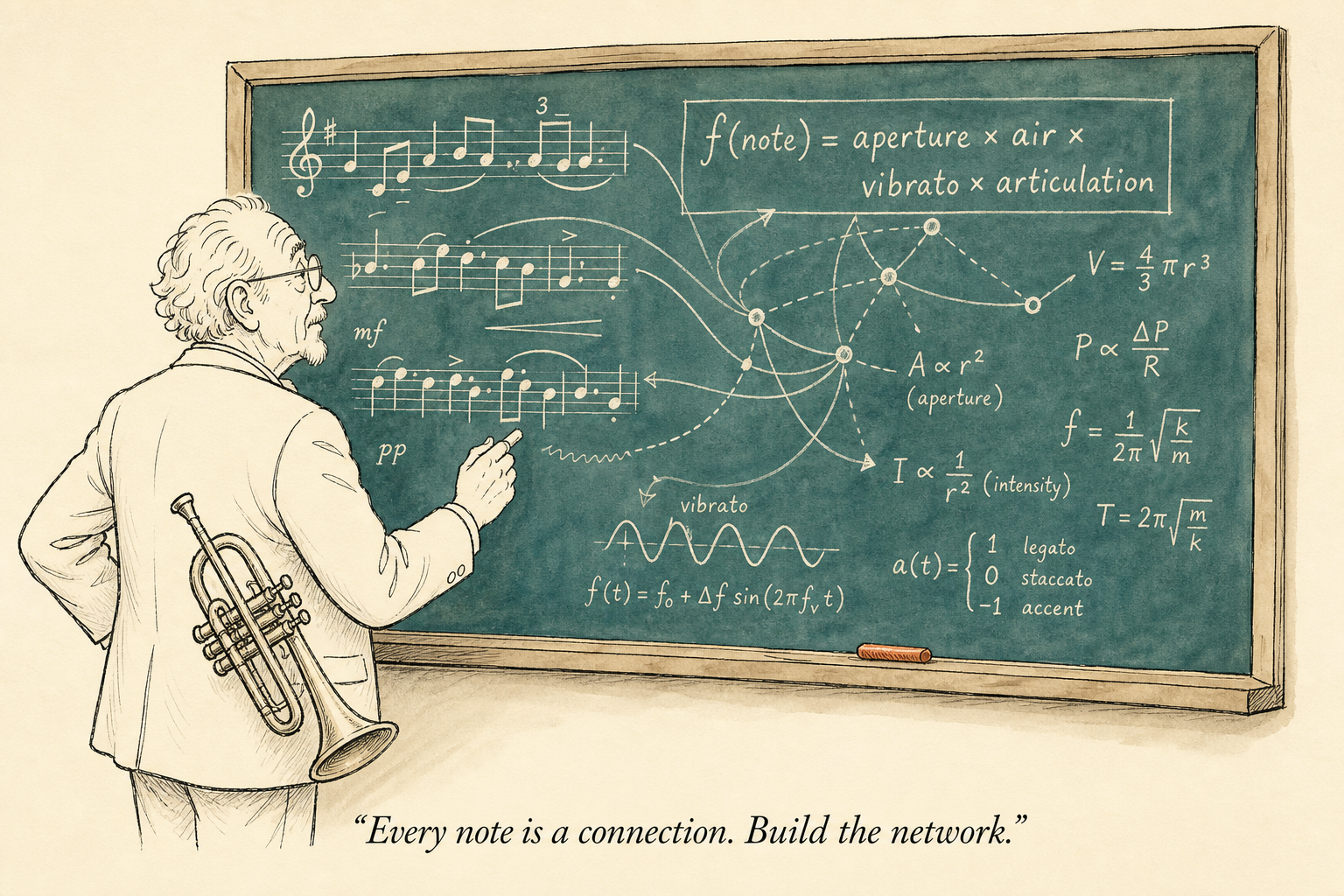
Your trumpet sound is the output of a system in your nervous system. That system has separate wiring for every note in your range. Aperture, air, vibrato, articulation, sustain. Each one is set independently for low F-sharp, low G, G-sharp, A, B-flat, and on up to wherever your range ends. None of it is global. There is no master tone knob, no single thing you adjust that changes the whole horn at once.
When you want a different sound, you have to go in and rewire those circuits one note at a time.
This is what most adult players do not understand. They think practicing more is going to magically transform the wiring they already have. It will not. Reps are how the wiring sets, not how it changes. A thousand more reps with your current algorithm gives you a deeper groove of the algorithm you started with. You do not get a new one.
If you want a new sound, you have to do the rewiring work consciously. You have to know which note you are working on, what you are trying to install on that note, and what the current wiring is doing wrong. Then you swap the wire and run the new circuit until it holds.
That is the algorithm of trumpet playing. It is not a metaphor. It is what is actually happening every time you produce a note.
This article sits inside the bigger frame I lay out in the trumpet sound guide. This one will still make sense if you have not read that yet, but you will get more out of both with the guide’s context.
Why Five Years of Practice Can Sound Like One
Here is what is actually happening to most adult players who feel stuck.
You learn the trumpet as a kid or a teenager. You install a set of physical defaults. Your aperture settles at a particular size. Your air settles at a particular speed. Your vibrato settles into whatever shape you absorbed from whoever you were imitating. Your articulation lands wherever your tongue happened to land the first few hundred times you played a note.
By the time you are twenty, those defaults are locked in. Every note in your range has its own wiring, set automatically by the patterns you ran most often as a young player.
Now, twenty or thirty years later, you come back to the horn. You start practicing again. You work hard. You log hours.
What are those hours doing? They are running your existing circuit. Same aperture firing on the same notes. Same air pattern. Same articulation. You are not rewiring anything. You are flexing the same algorithm harder.
The result is the result you already had, with more endurance behind it. Your range goes up because the circuit is better fueled. Your accuracy improves because the timing is more reliable. But the sound, the actual identity of what comes out of the bell, does not move. Why would it? You did not change the wiring.
This is why a player can practice for five years and sound the same as they did at year one. The reps are setting the existing circuit deeper. Without intervention, that circuit will sound the same in another five years.
The intervention is rewiring.
The Trumpet as a Circuit Board
Picture an old vintage radio, the kind with vacuum tubes and exposed wiring on the back. If you have ever opened one up, you know the inside is not a single piece. It is dozens of components, each connected by its own wire, each tuned to do its own job. A wire for low frequencies. A wire for high frequencies. A wire for volume, tone, static suppression.
When the radio sounds wrong, a good repair tech does not “fix the radio” in some general way. They open it up, isolate which component is misbehaving, identify which wire feeds that component, and swap the wire or change the resistor on it. They do not touch the parts that are working. They go in surgically, one wire at a time, and they trust that fixing the right wires in the right order will produce a radio that sounds correct.
Your trumpet sound system is built the same way.
Picture your range as a vertical board. At the bottom is your low F-sharp. At the top is whatever your highest reliable note is. Between those two points are roughly twenty notes. Each one is its own component on the board. Each one has wires running into it from five different sources. Aperture wire. Air wire. Vibrato wire. Articulation wire. Sustain wire.
That is one hundred wires for a basic range. If your range is bigger, more wires.
When you produce a note, the system fires every wire that feeds that note simultaneously, and the output you hear is the sum of all of them. If your low G has a slightly leaky aperture wire and a slow air wire and a wobbly vibrato wire, your low G is going to sound like a slightly leaky, slow, wobbly low G. Forever. Until you go in and replace one of those wires.
This is what “rewiring” means physically. It is not poetic. It is what is happening in your body when you change a sound. And here is the thing nobody tells you. You can only change one wire at a time. If you try to swap five wires simultaneously, you create chaos. Your body cannot integrate that much change at once. One note. One component. One wire. Run it. Lock it. Move to the next.
Mapping Every Note in Your Range
Before you can rewire anything, you have to know what is currently installed.
Most players have never done this audit. They know what their high register feels like, vaguely. They know they have a “bad note” somewhere in the middle, vaguely. None of that is precise enough to rewire anything.
Here is the audit. Pick a quiet morning. Play every chromatic note in your range, slowly, one at a time, with a tuner and a recorder running. Sustain each one for at least four seconds. Do not stop to fix anything. Just play and record.
Then sit down with the recording and go note by note. For each note, ask the five questions.
What is the aperture doing? Tight, open, leaky, focused? Different from the note above and below?
What is the air doing? Flowing freely or being constricted at the throat? Fast or slow? Is the support behind it the same as the next note or different?
What is the vibrato doing, if anything? An unintentional wobble? A vibrato you are not putting there on purpose? Or dead-flat?
What is the articulation doing? How does the front edge of the note sound? Is the tongue placement consistent with the notes around it?
What is the sustain doing? Does the note hold its shape for four seconds, or does it open up halfway through, pinch closed, or drift in pitch?
You are going to discover something uncomfortable. Almost every player does. You will find notes in your range that are wired completely differently from the notes right next to them. Your low A sounds great. Your low B-flat sounds terrible. Why? Because the wires that feed those two notes were installed by different practice sessions, in different states of mind, years apart. Your nervous system did not coordinate them.
This is the map. Once you have it, you can rewire it.
What Rewiring Actually Feels Like
I want to walk you through what it physically feels like to rewire one note. Because if you have never done this work consciously, you will not know what to expect, and you will quit too early.
Take low B-flat. Say you want it to ring more. Right now it sounds pinched and dull. The aperture is wrong. The air is being held back at the throat. You have decided to start with the air wire.
The first rep, you blow more air. You try to open the throat. You produce the note.
It feels weird. It does not feel like your B-flat. It feels like someone else’s. Your body wants to snap back to the old pattern. Your ears tell you something is off.
That is the rewiring sensation. The new wire is not yet integrated. The old wire is still hot.
Reps two through ten feel similar. Some of them sound better than your old B-flat. Some sound worse. Some crack. You start to wonder if you are making it worse.
Reps ten through thirty are the worst part. This is where most players quit. The new pattern is not yet automatic, and the old pattern is not yet replaced. You are stuck between two algorithms. You play one B-flat that sounds like a revelation, and the next one sounds like a beginner. You feel like you are getting worse.
You are not. You are in the middle of the rewire.
Around rep thirty to fifty, something starts to settle. The new pattern feels less weird. Your body starts to predict it. The old default is still there but does not show up automatically anymore. You can choose between them.
Around rep one hundred to two hundred, the new pattern is the default. Your body produces the new B-flat without you having to think about it. The old wire is dim. The new wire is hot. The rewire is done.
That is one wire. Air on low B-flat. One.
You have ninety-nine more wires to consider, and that is just for the basic range. Now you understand why this work takes time, and why most players never finish even the first lap.
Component-Level Rewiring (And Where to Go Deeper)
I am keeping this short because the deep dive on the five components is its own article. If you want the full anatomy of a single note, read the components of sound on a single note. It walks through aperture, air, vibrato, articulation, and sustain in detail.
For now, here is the high-level rule. When you rewire a note, you are not changing it in some general way. You are changing one of the five component wires that feed it. One at a time.
If you try to change all five at once, you will fail. Your nervous system cannot integrate five new wires on one note simultaneously. You pick the wire that is most off, swap it, run the reps until it holds, and then move to the next wire on the same note or the same wire on the next note.
The audit you ran in the previous section tells you which wire to start with. Some notes need air work. Some need aperture work. Some need vibrato work. The rewiring proceeds in that order.
Order of Operations: Rewire Low First, Work Up
Here is the strategic move most players miss. When you start the rewiring, do not start in the middle of your range. Do not start at the top. Start at the bottom.
The low register is where the foundational wiring lives. If your low B-flat has a bad air wire, that bad air wire is feeding upward into the rest of the range. The rewires you do at the top will not stick if the bottom is still feeding the old pattern up. The body will revert. You will rewire the same upper notes three or four times and they will keep slipping back, because the foundation is wrong.
Start at low F-sharp. Work up chromatically. Fix the most egregious wire on each note before you move to the next. Do not chase perfection on every wire. Pick the worst one, fix it, lock it, move on.
A full lap, working chromatically from low F-sharp up to high C, fixing the worst wire on each note, can take weeks or months depending on how much you practice. That is the work.
After one lap, you do a second. The second lap is faster because the foundation from the first lap is supporting it. The third is faster still. Most players I work with feel a real shift in their overall sound after the second or third lap, not the first. Be patient.
The players who try to skip the low register and only work on their flashy upper notes never get a real sound. They are rewiring on top of broken foundation. The wires never lock.
“But This Sounds Too Technical for Me”
Here is the objection I get every time I lay this out for a player.
“This sounds way too complicated. I am not a technical person. I just want to play music.”
I want to push back on it directly.
First, complicated does not mean impossible. The wiring of a vintage radio is complicated too. That is why a tech has a manual and works in order. The complexity of the system is not a problem. It is the reason the system exists. A trumpet that produced sound through one undifferentiated knob would also produce one undifferentiated sound. The fact that there are a hundred wires is what makes a trumpet capable of producing the range of expression it can produce. You want the complexity. You just do not want to face it.
Second, “I am not technical” is almost always cope. The same player who tells me they are “not technical” can describe in extreme detail the differences between a 3C and a 1.5C mouthpiece, the lacquer on a vintage Bach, and which valve oil they prefer. They are technical when the topic is gear. They are mysteriously “not technical” when the topic is their own playing.
Third, and this is the one I want you to sit with. The technical players are the ones who do not have to be talented.
Read that again. The technical players are the ones who do not have to be talented.
The reason a great player can sound great is one of two things. Either they got lucky and absorbed beautiful sound through their ears as a kid, with so many imitation reps that the wiring set itself up correctly without conscious effort. Or they got the wiring there through deliberate work, mapped the components, and rewired what was wrong on purpose.
The first path requires being born into the right environment. A musical family. A great early teacher. A community of players whose sound you absorbed before you knew you were absorbing it. If you did not get that, you are not going to get it now. That train left.
The second path is the engineer’s path. It is the path available to every adult player who is willing to do the audit, do the rewiring, and put in the reps. It is not glamorous. But it works. And the players who walk it end up sounding better than most of the so-called talented players, because they have a level of conscious control over their sound that the talented players never had to develop.
Complicated is not your enemy. Complicated is the price of admission.
What Comes Next
Once you accept that the wiring is real and the rewiring is the work, the next two articles in this series become the actual mechanics.
The components of sound on a single note gives you the full anatomy of the five wires. How to feel each one independently and how to isolate each one in practice.
The probability game gives you the binary self-evaluation that drives the rewiring. After every rep, you ask yes or no, did this match my reference. The probability creeps up over time. That is the mechanism that locks the new wire into place.
Read those two and you have the full operating system. Audit the board. Pick the worst wire. Run new reps with binary self-evaluation. Lock the wire. Move to the next.
That is the algorithm. There is no shortcut to it.
What This Has to Do With Why You Sound Like Yourself
You sound like yourself right now because the wiring you have is the wiring that got installed early and ran most often. Every minute you played as a kid, every recording you copied without realizing it, every habit you picked up from your first teacher, was a rep that strengthened the wires that are now your default sound.
If you do not like what those wires produce, the fix is not more reps of the same wires. The fix is the rewire.
Most adult players never start. They are afraid it will make them worse before it makes them better, and the truth is, it will. The first thirty reps of a new wire feel awful. Most players cannot tolerate it. They abandon the rewire after a week and go back to flexing the wires they already have. They tell themselves they are “playing music” instead of “doing technical work,” and they stay exactly where they are forever.
The 1%er does not abandon the rewire. The 1%er expects the discomfort, runs through it, locks the wire, and moves to the next. Over a year, dozens of components rewired. Over five years, the entire board rebuilt.
This is the work I do every day with the trumpet players in the 1% Trumpet Program. The reason the program exists is that the rewiring work is structurally hard to do alone. You need someone who can hear which wire is wrong on which note before you waste two months working on the wrong component. You need someone who will tell you, with calibrated honesty, when a rewire has actually locked. You need someone who can hold the order of operations for you when you get impatient.
I run a free 30-minute training that walks through the system the program is built on. It covers the rewiring framework I just described, alongside everything else trumpet players need to develop, range, endurance, articulation, and the protective reflex that quietly kills most adult comeback players’ progress.
You can grab it at toot-your-own-horn.com/landing-page.
If the rewire is the path you want, that training will show you the next step. If it is not, then close this article, pick one note in your range that you do not love, and run the audit on it. Aperture, air, vibrato, articulation, sustain. Pick the worst one. Run thirty reps with a different setting on that one wire. See what happens.
The rewire begins the moment you start asking which wire is wrong.
Continue with the next articles in this series:
- The Components of Sound on a Single Note — The full anatomy of the five wires and how to isolate each one in practice.
- The Probability Game — The binary self-evaluation that drives the rewiring rep by rep.
- Pick One Trumpet Player and Mean It — The reference sound your rewire is trying to match.
- How to Build a Great Trumpet Sound (Start Here) — The full inner-game frame this article sits inside.