Ask ten trumpet players what an embouchure is and you will get ten answers. Some will point at their lips. Some will say it is the “setup.” Some will get a faraway look and start talking about feel. None of them are wrong, exactly. But none of them are giving you something you can actually use.
Here is the version that is useful. Your trumpet embouchure is the way you arrange your face, lips, jaw, and the inside of your mouth so the horn will speak. It is not a single muscle. It is not a position you find once and lock in forever. It is a small system of moving parts working in conversation with the instrument, and every part of that system is doing a job.
When the system works, you barely notice it. When it stops working, it is all you can think about.
This guide is the map of that system. We are going to walk through every part of it, what each part does, how the trumpet itself participates, and how the whole thing fits together. By the end you will understand your own chops well enough to build them on purpose instead of by accident. And if you ever lose them, you will know how to find your way back.
That last sentence is the whole reason this article exists.
Two Ways to Approach Your Trumpet Embouchure
There are two ways to approach a trumpet embouchure, and the best players I know use both.
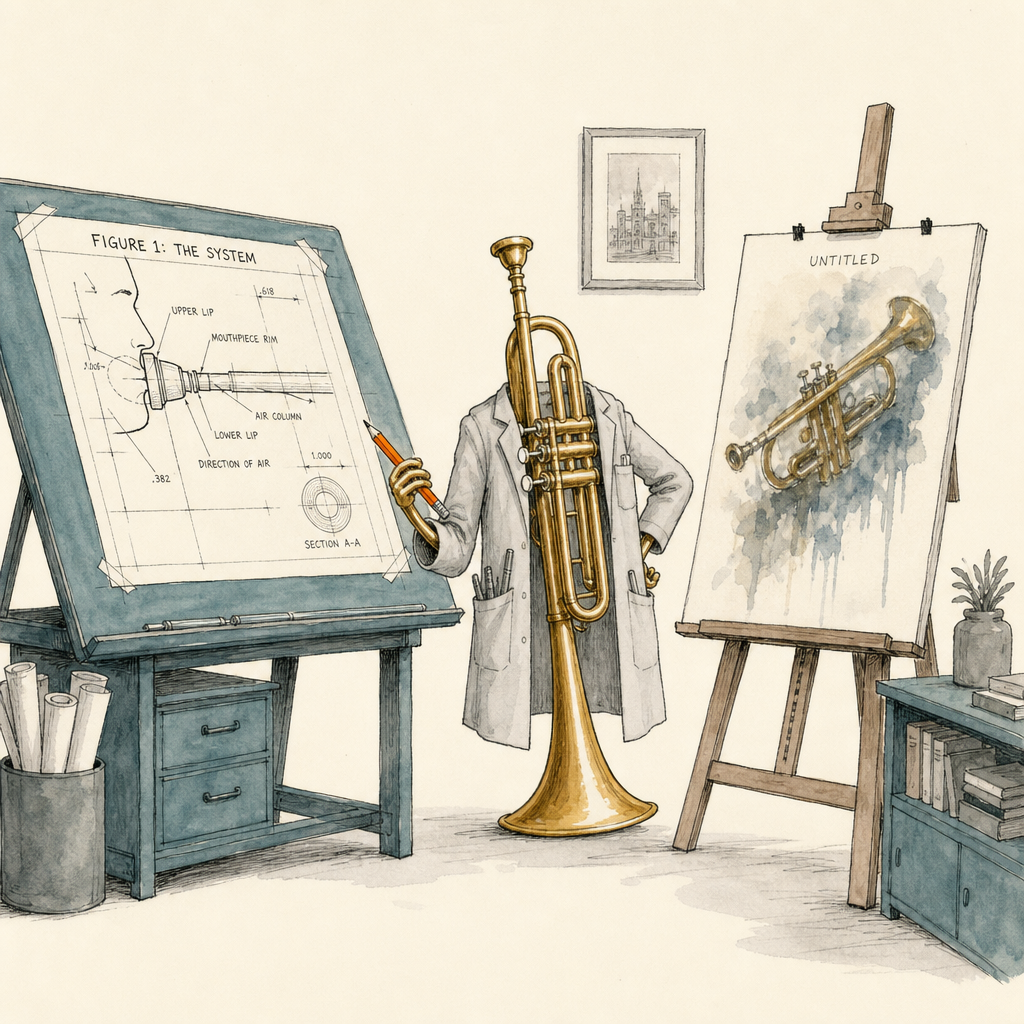
The first way is the engineer. The engineer breaks the embouchure into components. The engineer wants to know what the aperture is, what the corners are doing, where the air is pointed, how the tongue shapes the airstream. The engineer treats the embouchure like a machine with parts, because that is exactly what it is. When something goes wrong, the engineer does not panic. The engineer asks which part failed.
The second way is the artist. The artist does not think about parts at all. The artist hears the sound first, clear and ringing, in their mind, and then lets that imagined sound pull the body into the shape it needs. The artist trusts that if the ear leads, the face will follow. And here is the thing. The artist is right. When you truly hear the note you want, your body has an astonishing ability to organize itself around producing it. I have written more about this in the articles on sound and aestheticism, because the artist side runs deep and it deserves its own room.
So which one are you supposed to be?
Both. You are supposed to be both. The motor learning research is unusually clean on this point. Players who learn skill only as feel, with no explicit understanding underneath, perform brilliantly until something shifts in their world. Then the feel deserts them and they have nothing to fall back on. Players who only analyze freeze up under performance pressure. The expert state, in study after study, is conceptual knowledge of what causes what paired with implicit execution of the rest. Know the system. Then play.
The engineer builds the system. The artist plays it. You need both, and this guide is going to make you a better engineer so that your artist has something solid to stand on. Full breakdown of the two halves is here: /engineer-vs-artist-embouchure/.
The Cautionary Tale: Why Feel Alone Will Fail You
Let me tell you about a player I have seen over a hundred times. Maybe you have been this player. Maybe you are right now.
This player is good. Genuinely good. They built their chops young, on pure feel and repetition, and somewhere along the way they could rip a double C and never thought twice about how. They never studied it. They never broke it down. They just played, and it worked, and that was that.
Then something changes. A layoff. Six months away from the horn for a busy season at work. Or dental work, a crown, a shifted tooth, a small change to the hard surfaces their lips have always pressed against. They come back to the trumpet expecting to pick up where they left off.
And it is gone.
Not just rusty. Gone. The notes that used to be automatic now fight back. And here is the cruel part. They cannot get it back, because they never knew how they got there in the first place. They have nothing to reverse-engineer. They are chasing a feeling that no longer exists, hunting for something that is not there anymore, and they have no map to anywhere else.
Here is the analogy I want you to hold onto, because it is the one that explains everything.
Imagine a friend invites you to a restaurant clear across town. You do not know the way, so you just follow their taillights. Turn when they turn. Merge when they merge. You are not navigating. You are following. And you arrive perfectly fine, park the car, have a great meal.
Then dinner ends and your friend has already left. Now you have to drive home alone. You have no idea where you are. You were not reading street signs. You were not building a mental map. You were watching a pair of taillights, and the taillights are gone.
That is the player who built their chops on feel alone. They arrived. They played great. But they followed their way there instead of navigating, so they cannot retrace the route. And it gets worse. If the roads themselves change, if a street gets closed for construction, then even following will not save you next time. Dental work is the roads changing. The old route does not exist anymore, and you never learned to navigate, so you are truly stuck.
This is not a story I am making up to scare you. A 2025 meta-analysis on procedural skill retention found that roughly half of an accuracy-dependent motor skill is lost in about six to seven months without practice. A three-month layoff is real biology, not laziness. And the worst version of this story is a clinical one. Embouchure dystonia, the focal task-specific dystonia that ends careers, shows up most often in players with long histories of repetitive playing and no conscious model of what they are doing. Pure feel without understanding is not just fragile. In its worst form it is dangerous.
The engineer can always find the way home, because the engineer was reading the map the whole time. Understanding your trumpet embouchure is not just better playing today. It is insurance against the day something changes. And on a long trumpet career, something always changes. I go deeper on what to do when this happens to you here: /embouchure-stopped-working/.
How a Trumpet Actually Makes Sound
Before we tour the system, you need this one fact locked in, because everything else hangs off it. And I have to be careful here, because the standard story most players have been told is wrong.
Here is the standard story. Your lips buzz. The trumpet amplifies the buzz. End of story.
That is not what is happening. It sounds right, and it is what almost every band director will tell you, but it falls apart the moment you look at the actual physics. The trumpet is not a passive amplifier. The horn is an active partner. The note that comes out is something the two of you negotiate, every single time.
Lips and horn are dance partners
Physicists call this a coupled oscillator. Your lips and the air column inside the horn are two oscillating systems locked into each other, and the note is what they agree on. Neither one is leading. They negotiate.
Here is why that matters. If your lips were the only thing making the sound, free-buzzing a tune without a mouthpiece would feel the same as playing the horn. It does not. If you free-buzz a melody and then try to play it on the trumpet, the pitches almost never match. That is not a bug in your chops. That is the physics telling you free-buzzing and playing are two different things.
Free-buzzing is your lips running solo. No horn, no mouthpiece, no acoustic load. Your lips are mushy and broadly tuned on purpose, so on their own they can hum at almost any pitch they want, but with a fuzzy, indistinct sound. Free-buzzing is you talking to yourself.
Playing is a conversation. The moment you put the mouthpiece into a horn, an entirely new partner shows up. The air column inside the horn has its own list of notes it wants to vibrate at. The acousticians call them impedance peaks. Translated into English, the horn has favorite pitches built into its bore. Roughly a dozen of them, sitting in approximately the harmonic series. Those favorites are what generations of brass makers have been engineering into the tubing for five hundred years.
Your lips are soft and broadly tuned. The horn’s favorites are narrow and strong. When you put your lips in the neighborhood of one of those favorites, the horn pulls your lips into the slot and holds them there. Once you find the slot, the slot finds you. You do not have to grip the note. You just have to stop fighting the regime you are already in.
The horn is opinionated
This is the line worth tattooing on the inside of your eyelids. The horn is more opinionated than your lips are. The acousticians measured this. A bore’s resonance peaks are roughly thirty to a hundred times sharper than your lip’s natural resonance. The bore wins the negotiation. Your lips offer a vibration; the bore decides which of its slots to capture it into.
That is a feature, not a bug. It is the entire reason you can be slightly off and still get a note out. The horn pulls you toward correctness. Without that pull, every trumpeter would sound like a kazoo player.
It also explains why high notes are not just a strength problem. Up high, the horn helps you less. The targets get smaller. The wind underneath them gets thinner. Each high note is supported by fewer resonance peaks, and the peaks themselves are weaker because the horn radiates more of the high-frequency energy out the bell instead of reflecting it back to your lips. You are doing more of the work yourself up there. It is not that you are weak. The acoustics are abandoning you.
I have written a dedicated article on this whole conversation, with the experiments you can do right now to feel it. Start here: /how-a-trumpet-makes-sound/.
What your job is, in one sentence
So what is the embouchure for, really? Now that we know the horn is an active partner, the job description gets clean.
Your embouchure exists to put your lips at the right tension, with the right vibrating mass, in the right place, so the horn can pull you into a slot and keep you there. Faster vibration for higher notes. Easier vibration for endurance. That is the whole target.
Everything we are about to walk through serves that goal. Every lever, every adjustment, every habit. If a technique helps your lips vibrate more freely at the speed the horn wants, keep it. If a technique produces a note but kills the vibration to do it, you have not solved anything. You have papered over the problem and it will come back.
The Embouchure Is One Corner of a Bigger System
Here is where I have to be honest about scope.
Your trumpet embouchure does not work alone. It is one corner of a larger system, and the other corners are air and compression.
Air is the fuel. Compression is how you manage that air across several body systems so the lips can vibrate fast enough for the note you want. The embouchure is the part of the system the air actually passes through and acts on. Air is what you supply. Compression is how you pressurize and direct it. The embouchure is the precision nozzle at the end. All three have to work together, and a problem in any one of them shows up as a problem in the others.
That overlap is real, and it is why this can get confusing. A player with weak abdominal support will start clamping the lips to compensate, and now it looks like an embouchure problem when the root cause is air management. This is one reason diagnosing your own playing is hard, and why a second set of trained eyes is worth so much.
A note on the word “compression,” because the field has muddled it. Compression is not one thing. There are at least seven distinct compression sources in trumpet playing. Six of them train and get stronger with practice. One of them, mouthpiece pressure into the lips, injures and gets worse with practice. Saying “use more compression” without specifying which kind is how players end up reinforcing the source that hurts them. That whole conversation needs its own cluster, and it is getting one. For this guide, when we talk about lip compression below, that is the embouchure’s slice of a much larger compression story that lives elsewhere.
For now we are focused on the embouchure corner. The lips, the face, the jaw, the inside of the mouth, and how they shape and direct the air. That is plenty. Let us tour the levers.
A Guided Tour of the Chops Levers
Here is the map. Each part below is a lever you can actually move. None of them works in isolation, and the goal is never to max one out. The goal is to find the combination that gets your lips vibrating freely at the speed the horn wants. Each lever has its own full article. This is the overview. The detail is one click away.
Embouchure Types: How Players Are Built Differently
Not every embouchure looks the same, and that is not a flaw. Mouthpiece placement, the ratio of upper lip to lower lip in the cup, the angle of the horn against the face. Players are built differently.
The pedagogy world spent decades arguing over the one correct setup. Philip Farkas published the most influential book in the field in 1962, prescribing a standard embouchure with corners firm and lips lined up evenly. What almost nobody mentions is that Farkas himself recanted in 1970. He published a photographic study of forty virtuoso horn players and documented enormous variation in setup, placement, and airstream direction. The 1962 prescription lives on in band rooms. The 1970 correction is barely read. I wrote a full article on this because the story matters and the implication matters more: /even-farkas-updated/.
Before you change anything, you need to know what kind of embouchure you actually have and which traits are worth keeping. Start here: /trumpet-embouchure-types/.
The Aperture: An Output, Not a Setting
The aperture is the small opening between your lips that the air passes through. It is, in a real sense, the business end of the whole operation.
Here is the most important thing I can tell you about it. The aperture is an output, not a setting. You do not set the aperture in advance and then play through it. You set lip tension and you deliver air, and the aperture is the result. High-speed video of working players shows the aperture is not even a fixed shape. It opens and closes once per cycle of vibration, which means hundreds to thousands of times per second. It changes duty cycle with register. It changes geometry with dynamic. It is not a hole. It is a resonant geometry.
Most players never think about the aperture directly, which is a mistake, because it is one of the most powerful and most abused levers you have. Set tension and air. Let the aperture be the result. Full breakdown here: /trumpet-aperture-guide/.
Lip Compression: A Direction, Not an Amount
This is where most of the confusion in trumpet teaching lives.
When somebody tells you to “compress the lips,” they have not actually told you anything yet. Lip compression is a direction, not an amount. There are at least four distinct ways to compress the lips, each one recruiting different muscles, each one producing a different sound, and each one with its own price tag.
Pucker. The lips contract toward their own center, narrowing the aperture in a ring. The orbicularis oris muscle does this on its own. This is the Maggio tradition’s signature setup, exaggerated into a forward “monkey lip” position to preserve vibrating mass.
Pull-in toward the teeth. The lips draw flat back against the front teeth. This recruits deeper layers of orbicularis oris plus mentalis (the chin muscle that flattens the lower lip) plus depressor labii inferioris. The effect is to brace the lips, reduce the free-vibrating mass, and create a stiffer reed.
Smile, lateral pull. Risorius and zygomaticus pull the corners of the mouth toward the ears. This stretches the lip longitudinally and thins it. Lateral tension does raise pitch. It also burns endurance and thins the tone, which is why the smile system has fallen out of favor at the elite level. Smile is the most expensive way to go up.
Corners firm, center soft. The dominant elite-level paradigm today. The corners get held isometrically, opposing muscles firing against each other at the modioli, the fibrous knots at the mouth corners. The corners do work even when they do not move. Meanwhile the central segment of the lip, the part inside the mouthpiece cup, stays relatively free to vibrate. It is a brace, not a clamp.
Most working players combine vectors. Corners firm with a slight pucker and a controlled pull-in is a pretty common modern setup. The point is to know what you are actually doing.
There is one more dimension to mention here, which is how rolled-in or rolled-out your lips are. Rolled-in presents the firmer, drier vermilion border of the lip to the mouthpiece. Rolled-out presents the wetter, fleshier inner mucosa. Different feel, different sound, different range of useful application. Rolled-in tends toward range and articulation crispness. Rolled-out tends toward warmth and tonal heft. Neither is morally superior. Each represents a different choice about which tissue is in the cup doing the vibrating.
The full lever-by-lever breakdown lives here: /lip-compression-trumpet/.
Jaw Position and Air Direction
Your jaw is not just along for the ride. Where you set it changes the angle your teeth present to your lips, which changes where the air gets pointed inside the cup. Some players naturally blow the air downstream, some upstream, some closer to straight across, and the right answer depends on your build, mostly your bite alignment.
Roughly three quarters of trumpet players play a “downstream” embouchure, where the air angles slightly downward inside the cup. The rest play upstream. These are anatomical defaults driven mostly by tooth and jaw structure, not chosen styles. Trying to force the wrong direction for your face is one of the most reliable ways to fight yourself on every note.
Get this wrong and you are fighting your own anatomy. Get it right and the horn feels like it is helping you. Full article: /jaw-position-air-direction-trumpet/.
Tongue Position: The Hidden Throttle
You cannot see your tongue, so most players forget it is even part of the embouchure. It absolutely is.
The tongue decides how much room the air has on its way out. Arch it up and you reduce the cross-section of the oral cavity, which means the same volume of air has to move faster through the narrower channel. Real-time MRI of healthy trumpet players ascending into the upper register shows the tongue progressively narrowing the cavity as the pitch climbs. Sick players, dystonic players, fail to do this. The tongue is part of the trained motor program.
If you cannot feel what your tongue is doing, try whistling. Whistle a low note, then whistle an octave up, slowly. Pay attention to what your tongue does between the two. That arching motion is the tool, and it is free. If you can whistle a clean octave, you have the motor program already. Now you just have to learn to recruit it at the horn.
Full article: /tongue-position-trumpet/.
Reading What Your Face Is Telling You
Your face is constantly giving you feedback. Most players do not know how to read it. The white ring left on your lips after a chop session is information. The way the corners feel an hour into a heavy set is information. The shape of your aperture in a mirror, the symmetry of the lip motion, the color of the tissue after you take the horn off. All of it is the system telling you what is happening. Learning to read those signals turns your embouchure from a mystery into an instrument panel.
I walk through every signal here: /reading-your-embouchure/.
When You Decide Something Needs to Change
Sometimes you look at the levers above and realize a setup change is in order. This is the one to be careful with. Changing an embouchure is real work, it takes time, and done carelessly it can set you back months. Done correctly, it can transform a player. Done by guessing on YouTube, it can put you in a hole you do not climb out of for a year.
Read this before you change anything: /practicing-embouchure-changes/.
That is the system. Eight levers, eight doors, all opening off the same hallway. You do not have to walk through all of them today. But now you know they are there, and you know they connect.
The Trumpet Death Spiral
There is a specific failure mode I want you to know by name, because once you see it you can never un-see it, and most struggling trumpet players are somewhere on this loop. I call it the Death Spiral.
Here is how it goes. The lips do not respond the way you want. Maybe you are reaching for a high note that used to be there. Maybe your chops are tired. Maybe you are a comeback player and the buzz is rusty. Whatever the reason, the note does not come out clean.
So you push more air. That is your nervous system’s first move when something does not work. Push harder. Try harder. Force more of whatever you were already doing.
Extra air without a corresponding aperture adjustment does not produce a louder, freer tone. It produces turbulence. The lip muscle (orbicularis oris) ramps up activation to seal against the higher pressure. That extra muscle activation stiffens the tissue and choke-points the blood flow to it. Your lips become less responsive, not more.
So the next move is mouthpiece pressure. You shove the horn into your face. And here is where the physics gets brutal.
Direct measurement of capillary blood pressure in the human lip puts it at about 33 mmHg. That is the pressure at which blood can still get into and out of the tissue. Mouthpiece contact pressure during a fortissimo high note has been measured at roughly 560 mmHg. That is an order of magnitude past the point where circulation shuts down. The white ring that appears on your lips after a hard set is not a badge. It is clinical blanching. It is your tissue running out of blood supply in real time.
A blanched lip cannot vibrate well. The sensory nerves in the tissue, the ones that tell your brain what your lip is doing, get noisier. You are now playing on a stiffer lip with worse feedback. The note is even thinner than it was a second ago.
So the brain runs the same correction, harder. More air. More pressure. The Death Spiral has you.
This is the part most players do not realize. Studies that put force gauges on the mouthpiece consistently show players underestimate how hard they are pressing, sometimes by an order of magnitude. The player thinks they are barely touching the rim while the gauge reads thirty Newtons. You cannot feel your way out of this. You have to know what is happening.
A single session deep in the spiral can cost three or four days of recovery. Not because of skill loss. Because of tissue repair. The orbicularis oris injury literature documents real microtearing and microvascular damage from sustained high-pressure playing. Your face needs time to fix itself. Comeback players who push through it are usually wondering why they are not getting better. They are not getting better because they have not let the tissue heal.
The way out of the spiral is mechanical, not motivational. You back off the force. You soften the contact. You let the air drive the lip instead of bullying it. You rest the tissue, or you do light low-register playing that restores circulation without re-triggering the load. Both work. A total rest day rebuilds perfusion. A light day rebuilds perfusion and pattern. Pick whichever fits the rest of your week. Just stop adding force.
The Death Spiral is not weakness. It is your nervous system’s default correction (push harder) when no diagnostic vocabulary is available. Give the player a vocabulary, and the default changes. The whole point of this article is to give you that vocabulary, so when your chops misbehave you have something to say to yourself besides “try harder.”
“This Is Too Much to Think About”
If you have read this far and part of you is thinking, that is a lot, how am I supposed to hold all of that in my head while I am trying to play music, I want to address that directly. Because it is the most honest reaction in the world, and the answer matters.
You are not supposed to think about all of it at once. Ever.
The motor learning research I mentioned earlier has a name for the failure mode where you try to consciously manage every muscle while you play. It is called constrained action. It is the choke. Wulf and colleagues have shown across two decades of studies that focusing your attention on internal body parts during performance is the fastest way to interfere with the very motor skill you are trying to execute. The fluent state is external focus. You attend to the sound, the airstream, the target. The body, which has been trained to know what to do, does it.
So when do you think about the engineer’s content?
Slowly, one piece at a time, away from the pressure of performing. You take one lever, the aperture, say, and you play around with it for a couple of weeks. You get curious. You experiment. You notice what changes. Then you move to the next one. The understanding builds in layers, and it builds during practice, not on the gig. By the time you are performing, the thinking is done and the artist is driving.
The carpenter does not measure with calipers during the performance of building a chair. They measured at the bench, long before. On the job, they pick up the wood and put it where it needs to be, because they already know.
And here is the part that should take the pressure off completely. Your trumpet embouchure is yours. It is literally part of your body. Nobody can hand you the right one, because the right one depends on your lips, your teeth, your jaw, your build. The components are universal. The combination is personal. The whole job is to understand the parts well enough that you can find your own version of the system, the one that feels good, sounds good, and responds easily for you.
You are not memorizing somebody else’s answer. You are learning to navigate so you can find your own way home. That is not a burden. That is ownership. And it is the only thing that is ever going to make your playing truly, durably yours.
You Could Figure This Out Alone. Here Is What It Costs.
I know the player reading this. You are capable. You have taught yourself most of what you know, and there is a voice in your head saying you should be able to figure your embouchure out on your own too. You are smart. The information is out there. Why pay anyone?
Let me tell you what that road actually looks like, because I have watched a lot of people walk it.
You will spend years following taillights. You will find a YouTube video that says blow down, and another that says blow across, and a forum thread that says the first two guys are idiots. You will try one thing for a week, feel a flicker of progress, lose it, and try the opposite. You will plateau, get frustrated, take a break, come back, and plateau in the same spot. Not because you are not working hard. Because you are working hard without a map. The roads keep changing on you and you never learned to navigate.
The honest cost of reverse-engineering your own chops alone is years of dead reps. And the worst part is not even the lost time. It is the Death Spiral playing out unattended while you have no idea what is happening to your face. Tissue does not heal on a schedule that respects your patience. Push the wrong levers long enough and you do not just lose months. You can lose range you never get back. The clinical literature on embouchure dystonia is the worst-case version of what happens when a player practices an injury pattern into themselves for years. Prognosis is poor. There is no easy reversal. The treatments that work for hand dystonia in other musicians often do not work for the lips.
I am not telling you that to scare you. I am telling you because the cost of going it alone is not just the time. It is that you never build the conceptual layer. You never get the engineer’s map. You get a feel that might work today and might not work tomorrow, and no way to tell why.
The free training I put together exists to hand you the map. It is thirty minutes. In it, I walk through how the system actually fits together, the same engineer’s view this article opened with, so you can stop guessing and start navigating. Thirty minutes against years of trial and error is not a hard trade.
You can absolutely figure this out yourself. The question is whether you want to spend two years doing it, or thirty minutes learning the route from somebody who has already driven it. Over a hundred trumpet players have gone through my coaching, and the thing that changes for almost all of them is not talent. It is that they finally got to see the map.
Watch the free 30-minute training here: https://toot-your-own-horn.com/landing-page
Your trumpet embouchure is yours to build. I just want to make sure you can find your way home.