15 min read
The first 30 days of practice — what to play, how much, and how hard.
In this guide:
- The Mental Reset Before the First Note
- The 30-Minute Cap (Yes, a Cap)
- What an Actual First-Week Session Looks Like
- The Intensity Rule: Light/Medium/Heavy
- Rest Is Practice (Read That Again)
- Stay Within Your Current Ability (Not Your Old Ability)
- Track Everything (Even When It Feels Pointless)
- The First Mistake to Avoid: “Just Adding 10 Minutes”
- The Second Mistake: Comparing Today to Your Peak
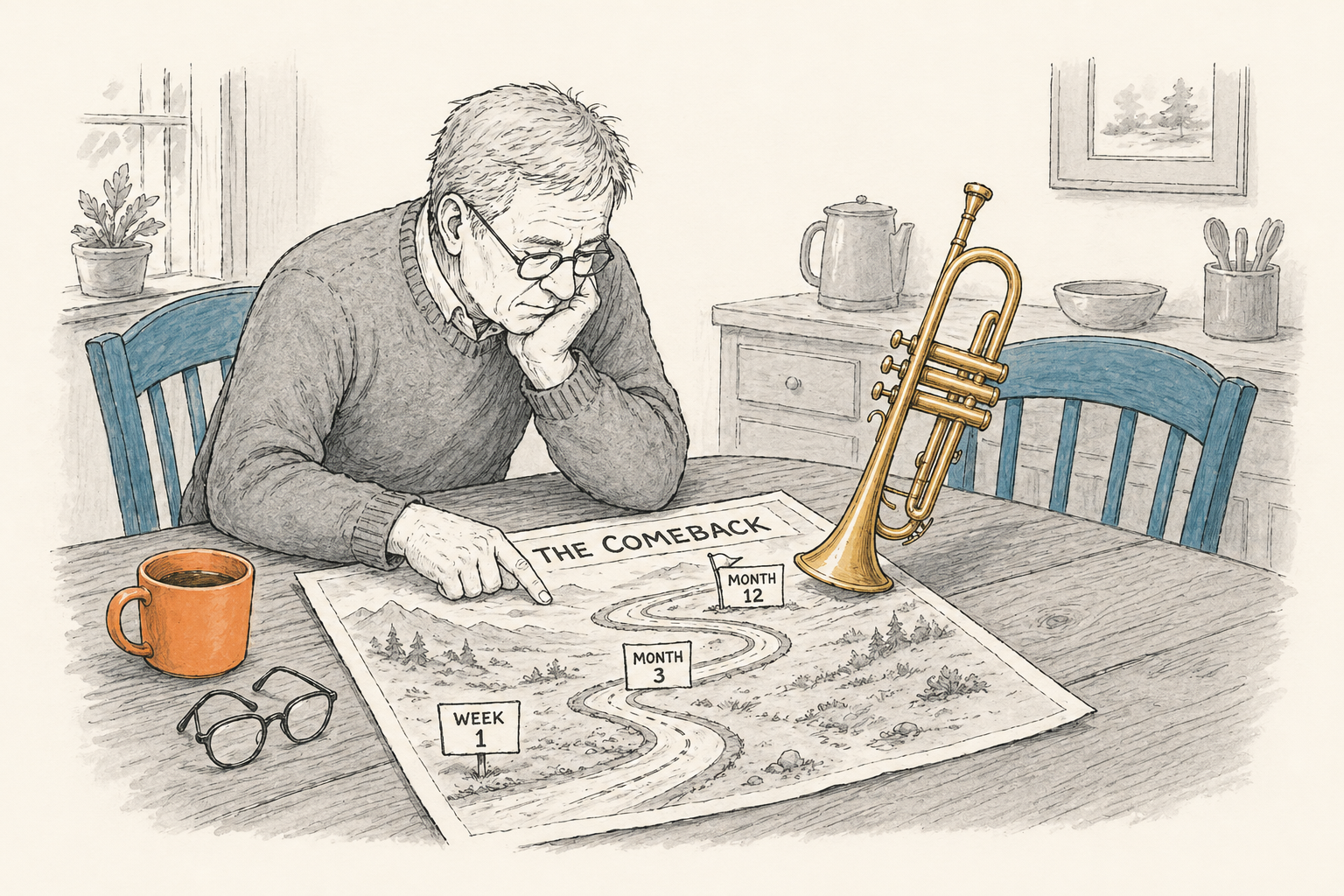
- What “Going Forward” Looks Like After Month One
- Frequently Asked Questions
- The Real Answer
Most trumpet players who come back from a long break sabotage themselves in the first week.
Not because they’re lazy. Because they try to practice the way they used to.
They sit down, pull out their old warm-up routine, and start working through it like nothing happened. Long tones. Lip slurs. Tonguing studies. Maybe a little something out of Arban or Clarke. And then they reach for a high note that used to be easy, hit a wall, push harder, hit the wall harder, and walk away from that session feeling like the comeback is going to be much rougher than they expected.
Here’s the thing. That session didn’t fail because their chops are gone. It failed because they tried to run the playbook of a player who doesn’t exist anymore.
The trumpet player you were is still in there somewhere, but you can’t get back to him by practicing like him from day one. You have to build a different kind of session for the first stretch of the comeback, and once that foundation is set, you graduate back into the kind of practice that actually pushes you forward.
This article is the exact session structure I give comeback players for the first 90 days. The intensity rules. The recovery rhythm. The non-negotiables. What goes in. What stays out. And what you have to track or you’ll quit before the work pays off.
Prefer to watch? Here is the short version.
The Mental Reset Before the First Note
Before your lips touch the mouthpiece, you have to get clear on one thing.
The goal of your first 30 days is not to “play well.” The goal is to show up consistently and not hurt yourself. That’s it. If you can do that, the chops come back faster than you think. If you skip that step and try to play well from day one, you set the comeback back by weeks every time you push too hard.
This isn’t a low-bar consolation prize. It’s the real goal. Because what you’re actually doing in the first 30 days isn’t building chops — it’s building the relationship with the instrument again. You’re teaching your body that picking up the horn doesn’t mean a fight. You’re teaching your nervous system that the trumpet is safe. You’re rebuilding the habit of daily practice. And you’re laying down the muscle memory tracks that everything else will run on for the next year of comeback.
If you go in trying to “play like you used to,” you trigger your body’s protective reflex on day one and reinforce it for the next month. You don’t want that. You want the opposite. You want every session to teach your body that this is fine, this is easy, this is what we do now.
The 30-Minute Cap (Yes, a Cap)
For the first four weeks, your maximum daily practice is 30 minutes. Not your minimum. Your maximum.
I know that sounds wrong. You’re motivated. You want to make up for lost time. You want to pour an hour into every session because you feel like you have so much ground to cover. Don’t.
Here’s what happens when you push past 30 minutes in week one. Your chops are not conditioned. The muscles that haven’t fired in years fatigue fast. Past the 30-minute mark, you stop building and start grinding. Every minute beyond fatigue reinforces compensation patterns — extra mouthpiece pressure, throat tension, lip jamming. The “extra” practice doesn’t add anything. It actively trains the wrong things.
And then tomorrow comes, and your chops are too wrecked to practice cleanly, so you either skip the day or you push through with a worse session than yesterday. Either way, the streak you needed for muscle memory to compound is broken.
30 minutes a day, every day, for four weeks. That’s the floor and the ceiling. After the first month, you can start working up — 45 minutes by month two, an hour by month three or four. But the 30-minute cap in week one is non-negotiable, and the 30-minute floor never goes away. Even on your busiest day, even on a heavy travel day, even when you don’t feel like it. Thirty minutes, every day.
What an Actual First-Week Session Looks Like
Here’s the structure I give comeback players for week one. Adjust the times based on how your chops feel — if any phase is making you fatigue or strain, cut it shorter and end early.
Minutes 0-5: Soft long tones in the middle of the horn
Start on a comfortable note. For most comeback players that’s somewhere between low C and second-line G. Play soft. As soft as you can while still producing a real tone. Hold each note for 4-8 counts at a slow tempo, breathe, repeat.
This is not “warm-up.” This is reintroduction. You’re letting your body remember the feeling of vibration without any demand. No range. No volume. No tempo pressure. Just soft, sustained sound.
If your tone is airy or unfocused, that’s fine. Don’t fight it. Don’t blow harder. Don’t reposition to “fix” it. Let it be airy. Your sound will resolve over the next two weeks as your aperture coordinates again. Trying to force focus on day one is exactly how you reinforce the protective reflex.
Minutes 5-15: Easy lip slurs in a small range
Slur up and down a fifth. Low C to G, low D to A, that kind of range. Slow. Soft. Half volume of what feels “normal.” If a slur breaks or splits, don’t dig in — back off, breathe, and try again gently. Let the air do the moving.
Don’t go higher than what feels easy. If you can comfortably slur up to G but A starts to require effort, G is your ceiling for week one. Build the foundation under the ceiling before you raise it.
Minutes 15-22: Single tonguing in the middle register
Slow, even quarter notes on a single pitch. Around 60 BPM. Crisp but soft attacks. The point isn’t speed. The point is reconnecting tongue and air without your face fighting either of them.
Then a simple ascending pattern — five-note scale up and down, repeated cleanly at the same tempo. Don’t push the tempo. Don’t extend the range. Repetition is the work.
Minutes 22-28: One short song or melody
Pick something simple you know by ear — a hymn, a folk tune, a slow standard. Play it once through, soft and relaxed, in a comfortable key. The point of this section is to remind you why you play. The first three sections are mechanical. This one is musical. Don’t skip it.
Minutes 28-30: Cool down
Two minutes of soft, descending lip slurs into the lower register. Pedal tones if you can find them comfortably. The goal is for the last note your face feels to be relaxed and easy, not strained. What your chops feel at the end of the session is what your nervous system files away as “this is what trumpet feels like.” Make that ending count.
That’s it. Thirty minutes. Done.
The Intensity Rule: Light/Medium/Heavy
Once you’re past week one and your face is responding, you need to start managing intensity across the week. Not every session should be the same. Athletes have known this forever. Trumpet players treat it like a foreign concept.
The Light/Medium/Heavy framework is simple:
Light day: Easy material. Low volume. Stay in your comfort zone. Most of the session feels like you could hold a conversation while playing. RPE 3-4 out of 10.
Medium day: Solid work, some challenge. You’re putting in real effort but you’re not going to your limit. RPE 5-6.
Heavy day: Testing day. Pushing range or endurance or speed. The kind of session where you find your edge and work near it. RPE 7-8. Never 9 or 10. Never to failure.
For the first month back, your week looks like this: 5 Light days, 1 Medium day, 1 rest or very-light day. That’s it. Zero Heavy days in month one. You’re not ready, and the cost of a Heavy day in week three (a four-day setback while you recover) is worse than the upside of “testing where you’re at.”
Month two: 4 Light, 2 Medium, 1 light or rest. Still no Heavy days. The Medium days will start telling you whether you’re ready for more.
Month three is when Heavy days might enter the rotation. One per week, maximum, scheduled deliberately, with two Light days on either side of it for recovery. Anyone who tells you to push hard every day for fast results is selling you a setback disguised as ambition.
Rest Is Practice (Read That Again)
Here’s the principle most comeback players miss for the first three months: rest is practice. It’s not the opposite of practice. It’s part of practice. The growth happens during recovery, not during the playing.
Lifting weights makes muscles temporarily smaller and weaker. They grow back stronger during the days off. Trumpet works the same way. The chops you build are built between sessions, not during them. Skip the recovery and you’re not building anything — you’re just accumulating fatigue.
Three concrete rest principles for the comeback:
Take the horn off your face between phrases. Don’t rest the rim against your lips while you read or count or wait for the next entrance. Cumulative pressure cuts off blood flow to the lips like a tourniquet. Pull the horn away every chance you get. Two seconds of blood flow restored is worth ten seconds of “saved” repositioning time.
Build rest INTO every session. Even in a 30-minute session, you should have moments where the horn is off your face. After every long phrase, after every lip slur exercise, after every rep — pull it away, breathe, then come back.
Build rest INTO every week. One full rest day per week minimum in the first two months. Some weeks two. The day off isn’t a gap in your practice — it’s the day your face actually does the rebuilding.
If you’re skipping these, you’re skipping the part of training where progress actually happens.
Stay Within Your Current Ability (Not Your Old Ability)
The single fastest way to wreck a comeback is to test your old high notes.
You will be tempted. You’ll be in the middle of a clean session, things will feel good, and you’ll think “let me just see if it’s still there.” Don’t. The cost of that one rep when you’re not ready is days of recovery and a reinforced protective reflex that will take weeks to undo.
Your working range right now is whatever you can play cleanly, repeatedly, without strain. That’s where you build. If your comfortable range tops out at G on top of the staff, then G is your ceiling for the foreseeable future. Don’t decorate it with flirts up to A. Don’t reach for the high C “just to check.” Build under your ceiling until the ceiling lifts on its own — and it will, faster than you’d think, if you stay disciplined.
Same logic on volume. Don’t blast just because you used to. Half volume, focused tone. Loud playing while your chops are recovering is just compensation in disguise.
Track Everything (Even When It Feels Pointless)
Tracking is the thing that keeps you from quitting around month two when your feelings start lying to you.
Around the 6-8 week mark of every comeback, there’s a stretch where the player feels like they’re not making progress. They’re not seeing dramatic gains. The “thrill” of the early returns has faded. The grind has set in. And without tracking, this is when most people quit. They tell themselves “this isn’t working” and walk away — exactly when the actual progress is starting to compound.
You don’t track because tracking is fun. You track because your memory will gaslight you, and the data won’t.
The minimum viable track:
- Date
- Duration — how long you played (and rested)
- Intensity — Light, Medium, or Heavy
- One sentence — how it felt, anything notable
That’s it. 30 seconds at the end of the session. A notebook works. A note on your phone works. A spreadsheet works. The platform doesn’t matter. What matters is that you have data when you start questioning whether the work is paying off.
At week 8, you’ll look back at your week 1 entries — “everything felt foreign,” “lips fatigued at minute 12” — and compare them to “30 minutes at light intensity, finished feeling fresh, sound is starting to come together.” That contrast is what gets you through the trough. Without it, your brain only sees today’s session and it doesn’t feel like enough.
The First Mistake to Avoid: “Just Adding 10 Minutes”
Once your chops start feeling good in week three or four, the temptation will hit hard. “I feel great today. Let me just go a little longer.”
That’s exactly how every comeback setback I’ve seen has started. The “just 10 more minutes” turns into 15. The chops are conditioned for 30. They get hammered for 45. The next day’s session is rough. The day after that gets cut short. And now the daily streak that was building muscle memory is sputtering.
The discipline of stopping at 30 minutes when you feel good is more important than the discipline of practicing for 30 when you don’t feel like it. Both matter. But the first one is what most comeback players fail at.
If you have extra capacity in week three, the answer isn’t “more minutes today.” The answer is “I’ll be ready for my Medium day next week.” Save the energy. Stack the rest. Let the foundation cement.
The Second Mistake: Comparing Today to Your Peak
The comparison that destroys comeback players is the wrong one. They compare today’s session to their best session ever. They wonder why they can’t play what they used to play. They feel diminished and frustrated and ready to quit.
Stop. The right comparison is today versus week 1. Today versus where you were when you started this comeback. By that comparison, almost every session is a win. You’re moving forward. That’s the only direction that matters.
Comparing to your peak is comparing yourself to a different person. He had different time, different recovery, different age, different responsibilities. That player is gone. The comparison is meaningless. And the only thing it produces is the urge to push harder, which is the exact thing that will set you back.
What “Going Forward” Looks Like After Month One
Once you’ve stacked four weeks of clean 30-minute sessions, the path opens up:
Month 2: Sessions can extend to 45 minutes. Intensity can include occasional Medium days. Range can creep upward as it presents itself naturally — never forced. Light days still dominate the week.
Month 3: Sessions can reach 30 minutes if your chops respond well. One Heavy day per week becomes possible. You’re starting to test where the edge is, carefully. The base is solid enough that one harder day doesn’t wreck the next.
Month 4 onward: You’re a trumpet player again. Your sessions look more like a typical practicing player’s sessions. Variety, intentional intensity management, real challenges, real recovery. The comeback frame fades. You’re just practicing now.
The whole point of the disciplined first 30-90 days is to earn your way to that “regular trumpet player” status without setbacks, without injury, and without retraining the bad habits that probably contributed to whatever break you took in the first place.
Frequently Asked Questions
What if 30 minutes feels too easy by week two?
It probably does. That’s the point. The 30-minute cap isn’t about what your face can handle in any given session — it’s about what your face can handle every day for 30 days in a row. You’re building a streak that gets your nervous system rewired. Save the extra capacity for tomorrow’s session. Compounding daily 30s beats heroic weekly 90s every time.
Should I do my old warm-up routine?
Not yet. Your old warm-up was built for a player whose chops were already conditioned. Doing it now means you’re practicing exercises that assume a baseline you haven’t rebuilt. Use the simple structure in this article for the first month. By month two or three, you can start reintroducing pieces of your old routine — but only the parts that match your current ability.
What if I miss a day?
You miss a day. The next day, you do your 30 minutes. You don’t double up. You don’t try to “make up” the missed session. Doubling up is exactly the kind of intensity spike that triggers a setback. One missed day is fine. Trying to compensate is what creates problems.
How do I know if I’m ready to add intensity?
Look at your data. If three consecutive sessions felt easy at your current level, your face is telling you it’s ready. Add five minutes, or move one Light day to a Medium. One change at a time. Then run that for a week. If the next three sessions hold up, you can add the next change. Don’t compound new intensity changes — change one variable, observe, then change the next.
Should I practice with a metronome from day one?
Yes. Not because you need to be tight in week one, but because the metronome trains your patience. You can’t rush a metronome. It forces you to play at the tempo you set, not the tempo your nerves want. For comeback players who tend to push, the metronome is the most underrated tool in the practice room.
What if my lips swell up after a session?
Some swelling is normal in the first two weeks — your lips haven’t been doing this work in a while. The test is how it feels the next day. If you wake up the next morning and your face feels normal, you’re inside the recovery window. If you wake up still puffy or sore, you went too hard yesterday. Cut tomorrow’s session shorter and use lighter material.
Do I need a teacher for the comeback, or can I do this alone?
You can do it alone — players have for centuries. But a teacher who has guided comeback players will save you weeks. They catch the compensations you can’t see. They keep you from reinforcing bad habits. They tell you when to push and when to back off. Whether to hire one or go solo is one of the highest-leverage decisions in your comeback.
The Real Answer
How do you practice trumpet after a long break?
Soft. Short. Daily. Within your current ability, not your old one. With rest built into every session and every week. Tracked. Patient. Disciplined enough to stop at 30 minutes when you feel great, and disciplined enough to show up for 30 minutes when you don’t.
Whether you stopped for a week or 10 years, the process is the same. Start slow and steady. Listen to your chops. Listen to your embouchure. Don’t do more than you can. The second you start to force things, you’re going to get in trouble — and the people who try to skip these steps and outrun mother nature get punished. The trumpet starts to feel like a chore. Strains and setbacks compound. And the comeback that should have taken three months ends up taking a year.
Be patient. Be prudent. Be conservative. And you’ll get there infinitely faster than the player trying to muscle their way back. I promise you that.
The complete framework — the warm-up structure, the range pyramid, the L/M/H schedule, the recovery protocol — is in the Complete Trumpet Comeback Guide.
Watch the Free Training: “Why Your Trumpet Playing Got Worse (And the 3-Step System to Fix It)”
If this article got you fired up, the free training goes deeper. The same diagnostic-first system used inside the 1% Trumpet Program — the protective reflex framework, the 2:1 ratio in action, and the systematic rebuild that actually works for adult players.
Today. Thirty minutes. Soft. Track it. Repeat tomorrow.

About the Author
Jesse Garcia
Founder, 1% Trumpet Program
Jesse is a working trumpeter and teacher. He’s performed with the Glenn Miller Orchestra, freelanced on the Las Vegas commercial scene, played extended cruise ship contracts around the world, and served as a trumpeter in the United States Army. He’s worked hands-on with over 100 trumpet players — from beginners to comeback players to seasoned pros — and reaches an audience of 75,000+ across his social platforms. He founded the 1% Trumpet Program to teach what actually works for adult players, drawing on the same systems he uses to keep his own chops sharp on the road.
Want the full system in 30 minutes? Watch the free training — the same diagnosis-first framework I use with every player in the 1% Trumpet Program.