11 min read
Adult brains, adult bodies, and what’s actually different about coming back later.
In this guide:
Yes. You can.
I could end the article right there and it would be the most honest answer you’ll find on the internet. But you didn’t come here for a one-word answer. You came here because something in you is stirring — a pull toward an instrument you used to play, a life you used to live, a version of yourself that you miss — and you need someone to tell you it’s not too late.
It’s not too late.
But I want to do more than just give you permission. I want to tell you what’s actually waiting for you on the other side of picking that horn back up, because it’s better than you think. And I want to talk about the thing nobody talks about — why you put it down in the first place, and why that reason, whatever it was, doesn’t disqualify you from picking it back up.
Prefer to watch? Here is the short version.
Why You Put It Down
Nobody puts a trumpet in a case and closes it for the last time on a good day. There’s always a reason. And the reason matters — not because it changes whether you can come back, but because it’s probably still sitting in the back of your mind, whispering that maybe you shouldn’t.
Let me see if one of these sounds familiar.
You put it down because life happened. Career took off. Kids came along. Marriage needed attention. Bills needed paying. The trumpet didn’t disappear in one dramatic moment — it just got edged out, one skipped practice at a time, until the case hadn’t been opened in a year and then five and then twenty. You didn’t quit. You just got busy being an adult.
You put it down out of frustration. You hit a wall you couldn’t get past. Maybe it was range. Maybe it was consistency. Maybe you just couldn’t close the gap between what you heard in your head and what came out of the bell, and eventually the frustration outweighed the joy. So you stopped. Not with a decision — with a slow surrender. The love was still there. It just hurt too much to keep reaching for something that felt like it was pulling away.
You put it down because of a loss. I know a veteran — I won’t use his name — who was a hell of a trumpet player. Played in the military. Loved it. And then he played Taps for a fallen comrade, and he couldn’t touch the horn after that. The instrument became fused with the grief. Every time he thought about picking it up, he wasn’t thinking about music. He was thinking about that day, that field, that flag. The trumpet didn’t represent joy anymore. It represented pain.
You put it down because someone told you to. Maybe not in those words. Maybe it was a teacher who crushed your confidence. Maybe it was a parent who said music wasn’t a real career. Maybe it was a spouse who didn’t understand why a grown adult needed to “play an instrument.” Maybe it was your own voice, telling you that you weren’t good enough, that you’d missed your window, that serious people don’t do this.
You put it down because you aged out of the infrastructure. High school ended. Or college ended. Or the military band ended. And suddenly there was no section, no ensemble, no reason to play every day. The trumpet wasn’t part of the structure of your life anymore, and without that structure, it drifted away.
Whatever your reason — it was real. It was valid. And it has nothing to do with whether you can come back.
The Question Behind the Question
When someone Googles “can you relearn trumpet as an adult,” they’re not really asking about the trumpet. They’re asking about themselves.
Am I too old? Have I waited too long? Is this a waste of time? Will I embarrass myself? Do I still have what it takes? Does this make sense for a person my age with my responsibilities?
Those are identity questions. And identity questions don’t get answered by trumpet exercises. They get answered by looking at what’s actually true.
So here’s what’s actually true:
Your brain still learns. Neuroplasticity doesn’t stop at 25. That’s a myth that got popular and never got corrected. Adults learn differently than kids — you need more repetition, more intentional practice, more recovery time — but the machinery works. You can build new neural pathways at 45, 55, 65, 75. The research is unambiguous on this.
Your musical brain is intact. The ear you developed, the phrasing instincts, the harmonic awareness, the ability to hear a melody and understand its shape — that didn’t degrade when you stopped playing. It’s stored differently than motor skills. Your fingers and lips forgot. Your ears didn’t. And that musical intelligence gives you a massive advantage over a true beginner — you know what good sounds like, which means you can steer toward it even when your chops are rebuilding.
Your body can do this. Unless you have a specific medical condition that affects your embouchure or breathing (and if you’re unsure, ask a doctor, not a forum), there is no physical reason an adult can’t play trumpet. You’ll need to rebuild the small muscles around your mouth. You’ll need to recondition your air support. You’ll need patience with the process. But the equipment works. It just needs rebooting.
You have advantages you didn’t have the first time. You’re more disciplined than you were at 14. You understand delayed gratification. You can commit to a routine without a band director threatening you. You can actually appreciate the music you’re playing instead of treating it like homework. You have money to invest in good instruction. And — this is the big one — you have the maturity to enjoy the process instead of just chasing the result.
What Nobody Tells You: It’s Better the Second Time
Here’s what surprises most comeback players, and it’s the thing that keeps them going through the tough early weeks:
Playing trumpet as an adult is more meaningful than playing trumpet as a kid.
When you were 14, trumpet was something you did. Part of the schedule. Maybe you loved it, maybe it was just your thing, but you didn’t fully appreciate it because you didn’t have the life experience to understand what it was giving you.
Now you do. Now, when you nail a phrase that’s been giving you trouble, it hits different. When you hear your sound fill a room, it means something it couldn’t have meant at 16. When you sit down after a long day and play something beautiful just for yourself — not for a grade, not for a chair placement, not to prove anything to anyone — that’s a different kind of fulfillment.
Trumpet as an adult isn’t band class. It’s therapy. It’s meditation with feedback. It’s a part of your identity that you’re reclaiming on your own terms, for your own reasons. And there’s something powerful about choosing this — not because someone signed you up or because it was on the schedule, but because you want it.
I’ve watched grown men get emotional the first time their sound comes back. Not because of the notes. Because of what the notes represent — a piece of themselves they thought was gone.
That piece isn’t gone. It’s waiting.
“But I’m Too Old”
Let me address this directly, because it’s the most common objection and it’s the most wrong.
Too old for what, exactly?
Too old to play in the NFL? Sure. Human performance has hard physical ceilings in some domains. Too old to play trumpet? No. Not even close.
Trumpet isn’t a young person’s game. It’s a coordination and efficiency game. The players who play the longest and the best aren’t the strongest or the youngest — they’re the most efficient. They’ve learned how to produce maximum sound with minimum effort. And that kind of efficiency can be built at any age, because it’s a skill, not an athletic gift.
I’ve worked with players in their 70s who are making better music than they made in their 30s. Not louder, not higher — better. More musical, more expressive, more present. Because they finally have something to say.
Age changes the timeline. It changes how much recovery you need between sessions. It changes the pace of the rebuild. It does not change the destination. You can play trumpet. You can sound good. You can make music that moves you and the people around you. And no number on a birthday card changes that.
“But I Don’t Have Time”
You have 30 minutes.
I know you think you don’t. I know your schedule is packed and your responsibilities are real. But you have 30 minutes. You spent 30 minutes on your phone today doing something you won’t remember tomorrow. You could spend those same 30 minutes doing something that reconnects you with a part of yourself that you’ve been missing for years.
Thirty minutes a day is the minimum for a real comeback. Not two hours. Not the marathon sessions you did in college. Thirty minutes, focused, consistent, every day. That’s enough to rebuild. That’s enough to grow. That’s enough to have this be a real, lasting part of your life again.
If trumpet matters to you — and if you’re reading this article, it does — then you can find 30 minutes. It’s not a time problem. It’s a permission problem. You’re waiting for someone to tell you it’s okay to make this a priority.
I’m telling you: it’s okay.
What the Comeback Actually Looks Like
I won’t sugarcoat this — the first few weeks aren’t pretty. Your lips will feel like they belong to someone else. Your range will be a fraction of what it was. Your endurance will be measured in minutes. And the gap between memory and reality will be disorienting.
But here’s what happens if you stick with it:
Within a few weeks, response starts returning. Notes that felt impossible start speaking. Your sound begins to warm up. You have moments — just flashes at first — where you hear yourself and think, “There it is.”
Within a few months, those flashes become your baseline. Your consistency improves. Your endurance builds. You start playing music, not just exercises. And the psychological shift is even bigger than the physical one — you stop feeling like a “comeback player” and start feeling like a trumpet player again.
Within six months to a year, if you’re following a real system and avoiding the common mistakes, you’ll be somewhere you didn’t think was possible when you opened that case for the first time. Maybe not exactly where you were before. Maybe somewhere different. Often somewhere better — because this time you’re building on understanding instead of brute force.
That’s not a sales pitch. That’s the pattern I’ve watched play out across hundreds of adult comeback players.
What You’re Really Deciding
Here’s what I want you to understand. This isn’t a trumpet decision. It’s a life decision.
When you ask “can I relearn trumpet as an adult,” you’re really asking whether it’s okay to reclaim something that matters to you. Whether you’re allowed to invest time in something that isn’t “productive” by the world’s standards. Whether you deserve to do something just because it brings you joy.
The answer to all of those is yes.
You put the trumpet down for a reason. The reason was real. But the reason is in the past, and you’re here, now, reading this article, which means something in you already knows you want to do this.
So let me take the last excuse off the table: you don’t need to know how to do this alone. You don’t need to figure out the system by yourself. You don’t need to spend months in the circles — the information avalanche, the equipment rabbit hole, the isolation spiral. There’s a faster path, and it starts with deciding that you’re worth 30 minutes a day.
Frequently Asked Questions
I haven’t played in 30+ years. Is it really possible?
Yes. I’ve worked with players who hadn’t touched a horn since high school in the 1970s. Within six months of consistent, structured practice, they were making real music. The timeline is longer than someone who’s been away for 10 years, but the destination is the same. What matters most isn’t how long you’ve been away — it’s what you do starting now.
I was never that good to begin with. Can I still come back?
This is actually an advantage in disguise. If you were never at a high level, you have fewer bad habits to undo and less of an ego gap to manage. You’re not comparing yourself to a peak that took years to build. You get to start with a clean slate and build properly from the ground up. Some of the most successful adult players I’ve worked with describe themselves as “average high school band kids.” They’re not average anymore.
Will my family think I’m crazy?
Some might. Here’s the thing — most people who question it will change their mind the first time they hear you play something beautiful in the living room. And the ones who don’t? They don’t get to decide what brings meaning to your life. You’re not asking permission. You’re making a choice.
Do I need my old trumpet or should I buy a new one?
Start with whatever you have. If your old horn is in playable condition, it’s fine for the first three to six months. Don’t let equipment be the barrier to starting. You can evaluate upgrades later, from a position of experience instead of guessing.
What’s the first thing I should do?
Open the case. Buzz the mouthpiece. Play a few notes. Don’t judge what comes out — just make contact. Then read the Complete Trumpet Comeback Guide for the full system. And if you want someone in your corner from day one, book a strategy call. That’s what it’s there for.
The Permission You’ve Been Waiting For
If you’ve read this far, you don’t need more information. You need a decision.
You can relearn trumpet as an adult. People older than you, busier than you, and further removed from the instrument than you have done it — and they’ll tell you it was one of the best decisions they ever made.
Not because they became professional musicians. Because they got a piece of themselves back. A piece that had been sitting in a case in the closet, waiting.
The trumpet doesn’t care how old you are. It doesn’t care how long it’s been. It doesn’t care about the reason you put it down.
It only cares whether you pick it back up.
Watch the Free Training: “Why Your Trumpet Playing Got Worse (And the 3-Step System to Fix It)”
If this article got you fired up, the free training goes deeper. The same diagnostic-first system used inside the 1% Trumpet Program — the protective reflex framework, the 2:1 ratio in action, and the systematic rebuild that actually works for adult players.
I’ll see you on the other side.
About the Author
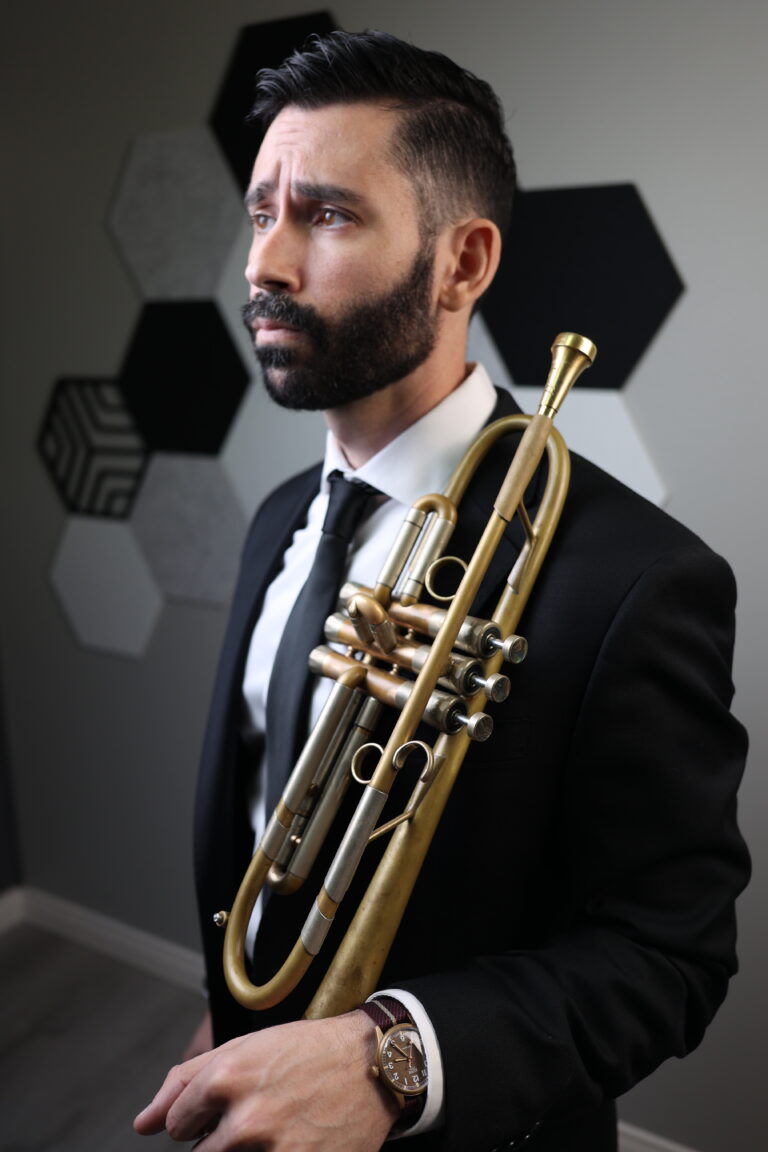
Jesse Garcia
Founder, 1% Trumpet Program
Jesse is a working trumpeter and teacher. He’s performed with the Glenn Miller Orchestra, freelanced on the Las Vegas commercial scene, played extended cruise ship contracts around the world, and served as a trumpeter in the United States Army. He’s worked hands-on with over 100 trumpet players — from beginners to comeback players to seasoned pros — and reaches an audience of 75,000+ across his social platforms. He founded the 1% Trumpet Program to teach what actually works for adult players, drawing on the same systems he uses to keep his own chops sharp on the road.
Want the full system in 30 minutes? Watch the free training — the same diagnosis-first framework I use with every player in the 1% Trumpet Program.