I once knew a trumpet player who was convinced his mouthpiece was wrong. He thought a bigger cup would help him play higher. He thought a smaller diameter would give him better control. He was constantly switching mouthpieces, always looking for the magic piece that would fix his playing.
One day, I told him something simple: your lips don’t lie. If you’re not playing well, the problem isn’t the mouthpiece. The problem is your lips. Or more accurately, the problem is what your lips are doing.
This is one of the most important concepts I’ve learned in my trumpet journey. Your lips don’t lie. They will tell you exactly what’s going on if you’re willing to listen.
Here’s what I mean. When you’re having trouble with a note, when you’re struggling to play something that should be easy, when your tone sounds off, the mouthpiece didn’t suddenly become bad. Your mouthpiece is the same as it was yesterday. The difference is in your lips.
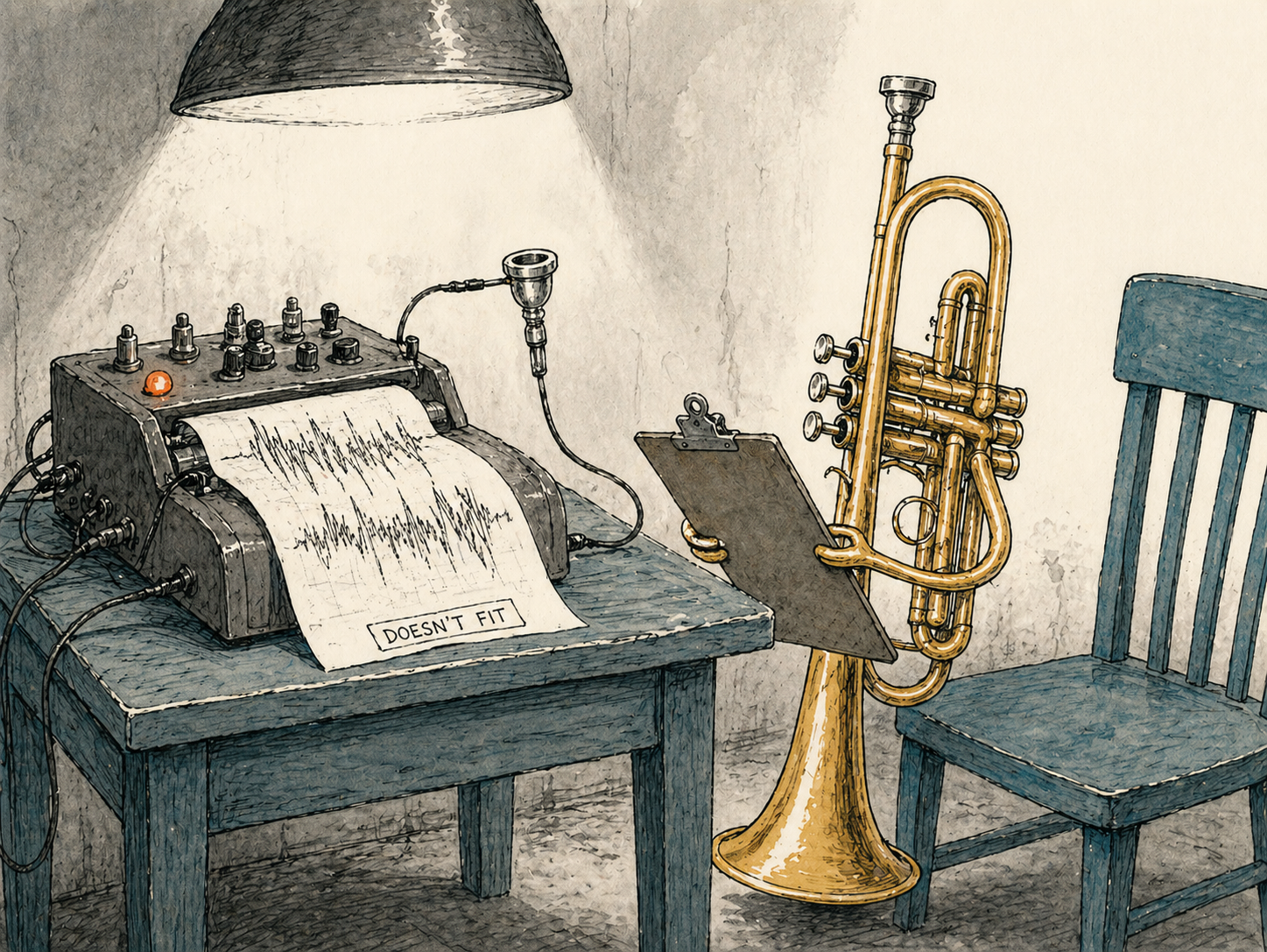
Your lips are the vibrating element of the trumpet. They’re what creates the sound. The mouthpiece, the leadpipe, the valves, the bell—these are all just amplifiers and directors of the sound that your lips create. If your lips aren’t vibrating correctly, all the fancy mouthpieces in the world won’t fix it.
So when you’re struggling, instead of blaming the mouthpiece, ask yourself: what are my lips doing? Am I creating tension? Am I using my throat to help me play? Am I buzzing correctly?
Here’s a practical exercise to understand this. Without the trumpet, without the mouthpiece, just your lips, try to create a buzz at a specific pitch. Try to buzz a middle C. Try to buzz an A above middle C. Try to buzz a high C.
If you can buzz these pitches, then the problem isn’t with your ability to vibrate at these frequencies. The problem is something else. Maybe it’s your air support. Maybe it’s the position of the mouthpiece. Maybe it’s your breath support. But it’s not your basic ability to vibrate.
On the other hand, if you can’t buzz these pitches, if you can only buzz in a certain range, then you’ve found the real limitation. Your lips simply can’t vibrate at those frequencies yet. And the solution isn’t a new mouthpiece. The solution is to build the strength and control in your lips to vibrate at those frequencies.
This is why buzzing is such a useful diagnostic tool. Your lips don’t lie. They’ll tell you exactly what they’re capable of.
Here’s another way to think about it. Imagine you’re a drummer, and someone’s handing you different types of drumsticks. “Try these bamboo sticks,” they say. “Try these plastic sticks. Try these heavier sticks. One of these is the right stick for you, and once you find it, your playing will improve dramatically.”
Would you believe them? Probably not. You’d know that the drumstick matters, but it doesn’t matter as much as your hands do. A good drummer with a bad stick will still sound better than a bad drummer with a good stick.
Same with trumpet. The mouthpiece matters, but it matters way less than your lips do. You could give Wynton Marsalis a mediocre mouthpiece and he’d still sound pretty good, because his lips know what to do. You could give a beginner a professional mouthpiece and they’d probably still sound like a beginner, because their lips haven’t learned what to do yet.
This is why I’m always a bit skeptical of the mouthpiece safari that we talked about in a previous article. Yes, different mouthpieces have different characteristics. Yes, the right mouthpiece might give you a slight advantage. But if your lips aren’t doing the right thing, no mouthpiece is going to save you.
So here’s my advice: stop blaming the mouthpiece. Start listening to your lips. What are they telling you? Are you able to buzz the notes you want to play? Are you able to control the buzz? Are you able to sustain a steady pitch?
If the answer is no, then you’ve found your problem. And the solution isn’t a new mouthpiece. The solution is to train your lips to do what you want them to do.
And here’s the beautiful thing: once your lips know what to do, once you’ve trained them to buzz the right frequencies, once you’ve developed the strength and control you need, then you can work on mouthpiece optimization if you want to. But even then, the mouthpiece is a minor consideration compared to what your lips are doing.
Your lips don’t lie. They’re the most honest feedback you can get about your playing. If you’re struggling, listen to them. Find out what they’re trying to tell you. And address that issue directly.
That’s the real path to improvement.
Want this kind of thinking applied to your own playing?
The free 30-minute training reveals the same framework I use with my 1% Trumpet Program students — the one most comeback players never figure out on their own.
Watch the free training →Want the full system in 30 minutes? Watch the free training — the same diagnosis-first framework I use with every player in the 1% Trumpet Program.
RELATED READING
- The Trumpet Embouchure Pillar Guide — the complete map of the system your lips are part of.
- How to Read Your Own Embouchure — the five-gauge scan that turns intuition into a diagnostic.
- Embouchure Stopped Working? — when the signals turn into a crisis.