13 min read
How fast can you really expect your chops to come back.
In this guide:
If you typed that question into Google or asked an AI, I already know something about you.
You’re measuring backward.
The fact that you’re asking “how long does it take to get my chops back” tells me exactly where your identity is right now. You’re standing in the present, staring at the rearview mirror, trying to calculate the distance between where you are and where you used to be.
That framing is going to hurt you. Not because the question doesn’t deserve an answer — it does, and I’ll give you honest timelines in a minute. But because the question itself reveals an assumption that will slow your comeback down if you don’t catch it early.
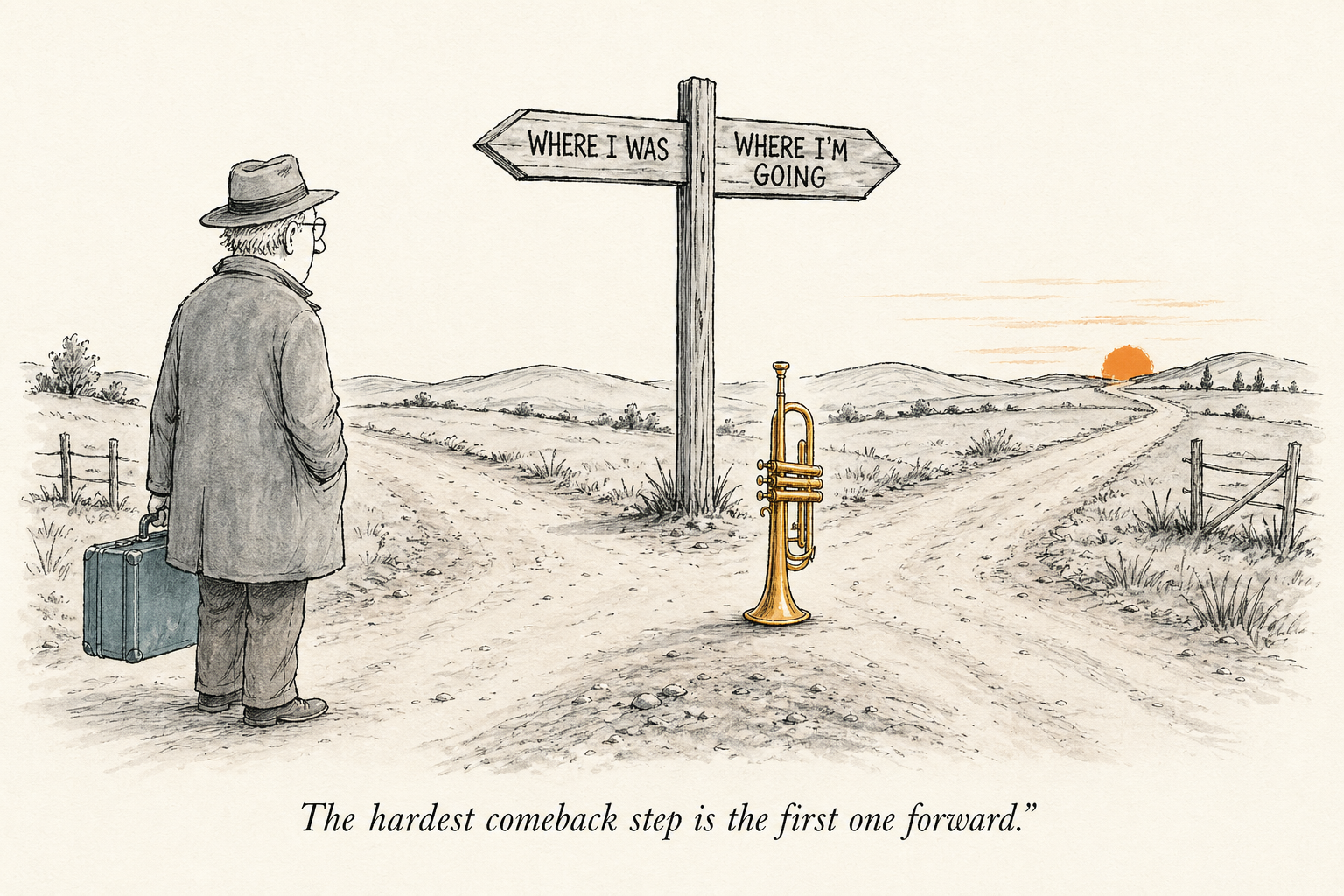
The assumption is: the goal is to return to where you were.
And I’m going to be honest with you — that might not be the right goal. For some of you, depending on your age, how much time you have to practice, and what your life looks like now, getting back to your exact peak may not be realistic. Not because you’re broken or too old, but because your peak might have happened when you were 22, practicing four hours a day, with zero responsibilities and a nervous system that hadn’t learned to brace against the instrument yet.
I’m not saying that to discourage you. In fact, most comeback players I work with end up surprising themselves — they get further than they expected, and some of them surpass their old peak entirely, because they’re playing smarter and more efficiently than they ever did before. But I tell you this now because I want to redirect you toward the question that actually gets you where you want to go.
The better question isn’t “how long will it take to get back?” It’s “what do I need to do to build a version of my playing that feels good, sounds good, and keeps improving?”
That’s a forward-facing question. That’s a question that drives action instead of anxiety. And it’s the question this article is really going to answer.
Because here’s what I can promise you. I can’t guarantee you’ll reach your exact peak again. I can’t guarantee a timeline. What I can guarantee is this: you can play without pain, you can sound good, and you can make real improvements from wherever you’re at right now. That’s not a consolation prize — that’s the whole game. That’s all any of us can ever ask from this instrument. The guys playing at the highest level in the world are chasing the same thing: does it feel good, does it sound good, am I still getting better? If you can get those three, you’ve won. Everything else is just a number on a page.
But first — since you came here for timelines, let me give you timelines.
The Honest Timeline (With a Giant Asterisk)
Here’s the uncomfortable truth: there’s no single answer. I’ve seen comeback players start sounding like themselves within two weeks, and I’ve seen others grind for six months before things really clicked. The variance is enormous because the variables are enormous.
But here’s the general pattern I see across hundreds of comeback players:
Weeks 1-2: The Recalibration Phase
Everything feels foreign. Your lips don’t respond the way you remember. Your sound is thin. Your endurance is measured in minutes, not hours. Your brain remembers what you used to do, and your body can’t deliver it. This is the most psychologically brutal phase because the gap between memory and reality is at its widest.
This is also the phase where most people make the biggest mistakes — pushing too hard, chasing old notes, doubling down after a bad day. If you survive this phase without destroying yourself, you’re ahead of 80% of comeback players.
Weeks 3-6: Signs of Life
Response starts improving. You’re not sounding great, but you’re sounding less terrible. The horn starts to feel like something you recognize again. Endurance creeps up — maybe you went from 15 minutes to 25 minutes before things fall apart. You have occasional moments — a phrase, a tone, a note — that remind you of the player you used to be.
This phase is dangerous in a different way. Those little glimpses of your old self can trigger the urgency to push harder. “It’s coming back — I just need to accelerate it.” No. You need to stay patient. The progress is fragile, and the fastest way to lose it is to mistake a good day for a new baseline and try to build on it before it’s solid.
Months 2-4: Real Traction
If you’ve been consistent — truly consistent, not “I practiced five days last week and then skipped four” — this is where things start compounding. Your sound fills out. Your range starts creeping upward in a way that feels sustainable, not forced. You can play longer without the death spiral. You start having more good days than bad days.
This is also where most people quit. Not because it’s going badly — because they can’t see how far they’ve come. Without tracking, you forget where you started. You compare yourself to where you want to be instead of where you were eight weeks ago. You feel like you’re “still not there” even though you’ve made massive progress. Your memory gaslights you. Don’t let it.
Months 4-8: The Identity Shift
Somewhere in this window, if you’ve been doing the work, something changes that’s deeper than chops. You stop thinking of yourself as a “comeback player” and start thinking of yourself as a trumpet player. The instrument stops feeling like a project and starts feeling like a part of your life again. Your practicing becomes maintenance and growth instead of damage repair.
Months 8-12+: Exceeding Expectations
This is where the players who stuck with it start surprising themselves. “I don’t think I ever played this consistently before.” “My sound is actually better than it was in college.” “I’m doing things I couldn’t do at my peak.” This happens more often than you’d think, and the reason is simple: most people played their entire career with a protective reflex they didn’t know they had. When you come back and actually address that reflex, you unlock efficiency you never had before.
The Variables That Actually Matter
Those timelines are general patterns. Where you fall within them depends on a handful of specific variables, and some of them matter way more than you’d think.
How long you were away. This is the obvious one, but it’s less important than most people assume. The difference between 5 years away and 15 years away is smaller than the difference between someone who practices consistently and someone who doesn’t. I’ve seen players come back after 30 years and outpace players who were only away for 5 — because the 30-year player followed the system and the 5-year player tried to wing it.
How you played before you stopped. This one matters more than the time away. If you played with good fundamentals before — efficient air, minimal pressure, relaxed setup — your body has a better blueprint to return to. If you played with a lot of compensations — jamming the mouthpiece, overblowing, throat tension — then your comeback isn’t just rebuilding, it’s rebuilding better than what you had. That takes longer, but it’s actually the better scenario long-term, because you’re fixing problems you carried for years.
Your age. I’m not going to pretend this doesn’t matter, because it does. But it doesn’t matter the way you think. Age doesn’t limit your potential — it changes your recovery. A 25-year-old can push harder on a given day and bounce back faster. A 55-year-old needs more light days, more recovery, more patience with the process. But the destination? The 55-year-old can get to the same place. The road just has more rest stops.
The older players who struggle aren’t struggling because of age. They’re struggling because they’re trying to train like they’re 25. They go Heavy-Heavy-Heavy and wonder why they’re wrecked. The moment they accept that recovery IS the training — that the light days are where the growth happens — everything changes.
How consistently you practice. This is the variable that dwarfs everything else. I’d rather you practice 30 minutes a day, seven days a week, than 90 minutes three times a week. The math says you get more total time with the three longer sessions. The math is wrong. Muscle memory is built through daily repetition. Every day you skip, your nervous system loses some of the calibration it built the day before. Consistency isn’t just important — it’s the single biggest predictor of comeback success I’ve seen across hundreds of players.
Whether you have guidance. A player with a coach who can identify their specific bottleneck and keep them from reinforcing bad habits will move two to three times faster than a player figuring it out alone. That’s not a sales pitch — it’s what I’ve watched happen over and over. The self-taught player spends three months building compensations that then take another three months to undo. The coached player skips that entire detour. Whether you get a teacher or go it alone is one of the highest-leverage decisions you’ll make.
The Non-Negotiables
Timelines don’t mean anything without the right actions underneath them. If you want the best shot at a fast, sustainable comeback, here’s what has to happen. These aren’t suggestions. These are the non-negotiables.
Practice every single day. Not five days a week. Not “most days.” Every day. Thirty minutes minimum. In the first four weeks, I’d actually cap your maximum at 30 minutes too, because it’s very easy to overdo 30 minutes when your chops aren’t conditioned for it yet. After the first month, you can start working up toward 45 minutes, and eventually an hour — but 30 minutes daily is the floor from day one and it never moves.
“I don’t have 30 minutes” is a lie you’re telling yourself. You have 30 minutes. You watched something on your phone for 30 minutes today. It’s not a time problem, it’s a priority problem. And if trumpet isn’t worth 30 minutes of your day, you need to have an honest conversation with yourself about whether you actually want this comeback or just like the idea of it.
Stay within your current ability. Not your old ability. Your current ability. Today. If you can comfortably play up to a G on top of the staff and everything above that requires strain, then G is your ceiling for now. I don’t care that you used to live above high C. That player is gone. Build from where you are, not from where you were. The range pyramid in the comeback guide explains exactly how this works.
Track what you’re doing. Duration, intensity (light/medium/heavy), one sentence about how it felt. That’s the minimum. It takes 30 seconds at the end of each session. Without tracking, you will quit during the trough — that stretch around months 2-3 where you feel like nothing is happening even though everything is happening. The data is what keeps you honest and keeps you going when your feelings are lying to you.
Manage your intensity. Not every day is a push day. You need light days — easy playing, fundamentals, low demand. You need medium days — solid work, some challenge. And you need the occasional heavy day — testing your limits when you’re fresh and rested. If you go hard every day, you’ll reinforce the protective reflex and your comeback will stall. If you go light every day, you won’t adapt. The balance is what drives progress.
Get honest with yourself. About where you are right now. About what’s realistic. About whether you’re actually following the plan or just telling yourself you are. About whether that “discipline” of pushing through dead chops is actually ego in disguise. Honesty is the foundation everything else is built on, and your comeback will move exactly as fast as you’re willing to be honest.
What “Getting Your Chops Back” Actually Means
Let me redefine this for you, because the phrase itself is misleading.
“Getting your chops back” implies a destination — a fixed point you’re returning to. Like you left your chops at a bus stop ten years ago and now you need to go pick them up.
That’s not how it works.
What you’re actually doing is building a new version of yourself as a trumpet player. A version that has the advantage of experience, maturity, and — if you do this right — a smarter approach than you ever had before. A version that doesn’t play from panic, doesn’t measure itself against a 22-year-old’s peak, and doesn’t need to prove anything to anyone.
Some things will come back faster than you expect. Your musical ear, your phrasing instincts, your knowledge of the instrument — that stuff is stored differently than motor skills, and it’s still in there. The first time you play a phrase and it sounds musical, even though your chops are barely functional, you’ll feel it. That’s the part that never left.
Some things will take longer than you want. Range usually takes the longest because it requires the most coordinated, efficient playing — and coordination is the thing that degrades most during time away. Endurance comes back faster than range for most people. Sound quality lands somewhere in between.
And some things will end up better than they ever were. I mean that. Players who come back and address their protective reflex, who learn to manage load, who build secure attachment with the instrument — they often end up playing more consistently and more musically than they did during their “peak.” Because their peak was built on compensations and white-knuckling. This time, they’re building on a real foundation.
So stop asking how long it takes to get your chops back. Start asking how good you can make them going forward.
Frequently Asked Questions
I was away for 20+ years. Is my timeline going to be significantly longer?
Not as much as you’d think. The length of time away matters less than the quality and consistency of your comeback approach. I’ve worked with players who were away for 25-30 years who made faster progress than players away for 5, because they followed the system and didn’t try to shortcut the process. Your timeline is more about what you do starting now than how long you’ve been gone.
I’m in my 50s/60s. Should I expect a slower comeback?
Expect a different comeback, not necessarily a slower one. Your recovery between sessions takes longer, which means you need more light days and better load management. But your capacity for improvement isn’t diminished by age — it’s diminished by ignoring recovery. Work smarter, rest better, and the destination is the same.
What if I never get back to where I was?
Then you’ll be somewhere else — and that somewhere else might be better in ways you can’t predict yet. Trumpet playing isn’t just about range and endurance. It’s about musicality, expression, consistency, and joy. Many comeback players find that even if their absolute ceiling is a step lower than their peak, their average day is better, their consistency is better, and their relationship with the instrument is healthier than it ever was.
How do I know if I’m on track?
Track your practice. Compare month 1 to month 2, not today to yesterday. Progress on trumpet is noisy day-to-day but clear month-to-month. If your good days are getting more frequent and your bad days are getting less severe, you’re on track — even if it doesn’t feel like it.
Should I set a specific timeline goal?
I’d set process goals, not outcome goals. “I will practice 30 minutes every day for the next 30 days” is a process goal. “I will have my high C back in 90 days” is an outcome goal. You control the process. You don’t control the outcome. Stack the process, and the outcomes take care of themselves.
The Real Answer
How long does it take to get your trumpet chops back?
It depends. On your consistency, your patience, your willingness to build from where you are instead of where you were, and whether you have the right system and the right support.
But here’s what I can tell you with certainty: if you practice 30 minutes every day, manage your intensity, track your progress, and resist the urge to force timelines — you will get there. Not “back.” There. Wherever “there” turns out to be for you. And it will almost certainly be further than you think is possible right now.
The complete system for making that happen — the range pyramid, the L/M/H framework, the warm-up structure, all of it — is in the Complete Trumpet Comeback Guide.
Watch the Free Training: “Why Your Trumpet Playing Got Worse (And the 3-Step System to Fix It)”
If this article got you fired up, the free training goes deeper. The same diagnostic-first system used inside the 1% Trumpet Program — the protective reflex framework, the 2:1 ratio in action, and the systematic rebuild that actually works for adult players.
Start today. Thirty minutes. Track it. And stop looking in the rearview mirror.
About the Author
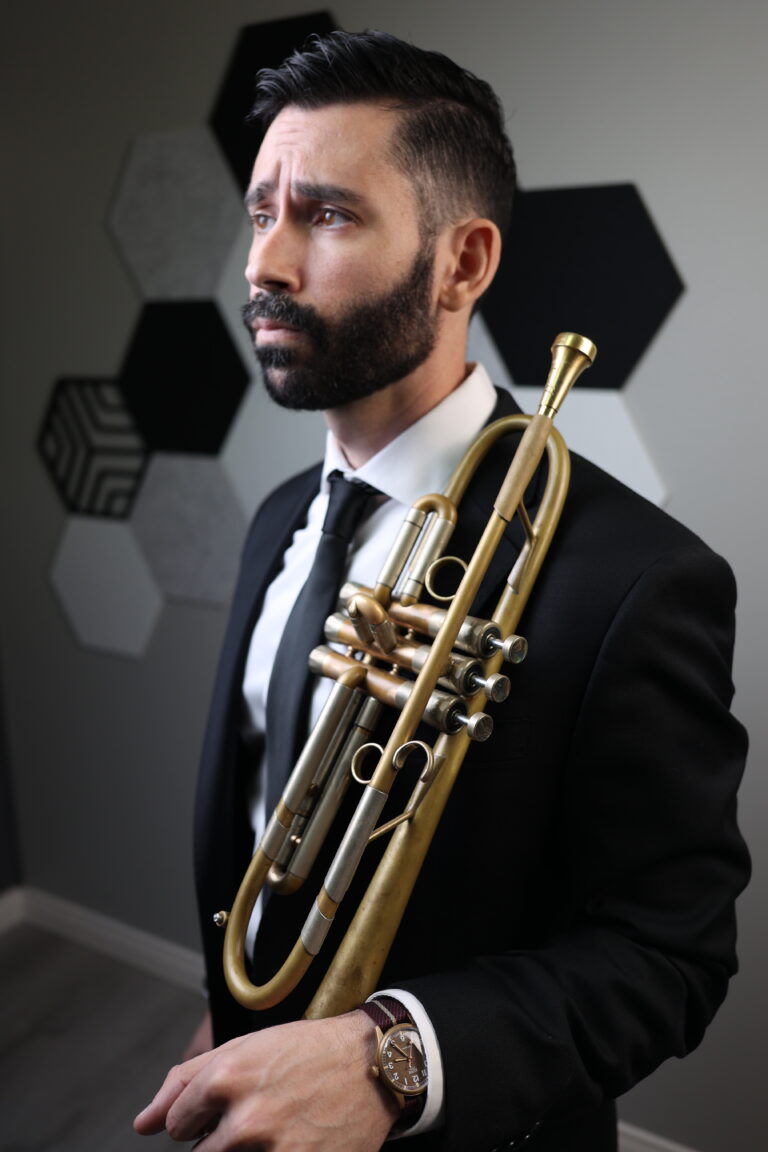
Jesse Garcia
Founder, 1% Trumpet Program
Jesse is a working trumpeter and teacher. He’s performed with the Glenn Miller Orchestra, freelanced on the Las Vegas commercial scene, played extended cruise ship contracts around the world, and served as a trumpeter in the United States Army. He’s worked hands-on with over 100 trumpet players — from beginners to comeback players to seasoned pros — and reaches an audience of 75,000+ across his social platforms. He founded the 1% Trumpet Program to teach what actually works for adult players, drawing on the same systems he uses to keep his own chops sharp on the road.
Want the full system in 30 minutes? Watch the free training — the same diagnosis-first framework I use with every player in the 1% Trumpet Program.